
Solid-State Batteries Make the Leap from Lab to Real-World Vehicles
After years of development, solid-state batteries are finally entering real-world testing and early production in 2026. The breakthrough technology promises to double electric vehicle ranges, slash charging times, and eliminate fire risks.
By Factlen Editorial Team
- Legacy Automakers
- Established car manufacturers are taking a measured approach, focusing on rigorous real-world testing before committing to mass production.
- Chinese Manufacturers
- Chinese automotive giants are aggressively pushing to bring solid-state batteries to the mass market as early as 2026.
- Battery Startups
- Agile startups are pushing the absolute limits of energy density and charging speeds, though they often face skepticism from industry veterans.
What's not represented
- · Lithium-ion battery manufacturers defending the continued viability and cost-effectiveness of current technology.
- · Raw material suppliers discussing the supply chain implications of shifting to solid-state chemistries.
Why this matters
For consumers, solid-state batteries represent the tipping point for electric vehicle adoption. By eliminating range anxiety, making charging as fast as pumping gas, and removing the fire risks associated with current lithium-ion packs, this technology removes the final hurdles to mass EV ownership.
Key points
- Stellantis and Factorial have begun road-testing a Dodge Charger Daytona equipped with solid-state batteries in North America.
- Factorial's FEST cells boast an energy density of 375 Wh/kg and can charge from 15% to 90% in 18 minutes.
- China's Dongfeng Motor targets mass production of its 350 Wh/kg solid-state battery in the second half of 2026.
- Dongfeng claims its battery will enable a 1,000-kilometer range and retains 74% capacity at -30°C.
- Verge Motorcycles and Donut Lab have demonstrated pack-level fast charging, reaching 80% in 12 minutes.
- Despite rapid progress, industry experts caution that scaling manufacturing and ensuring long-term reliability remain significant hurdles.
For years, solid-state batteries have been the automotive industry's holy grail—a technology perpetually described as being "just a few years away." But in the summer of 2026, the narrative has fundamentally shifted. Major automakers and ambitious startups are moving solid-state cells out of the laboratory and onto public roads, marking a critical turning point in the race to commercialize the next generation of electric vehicle power.
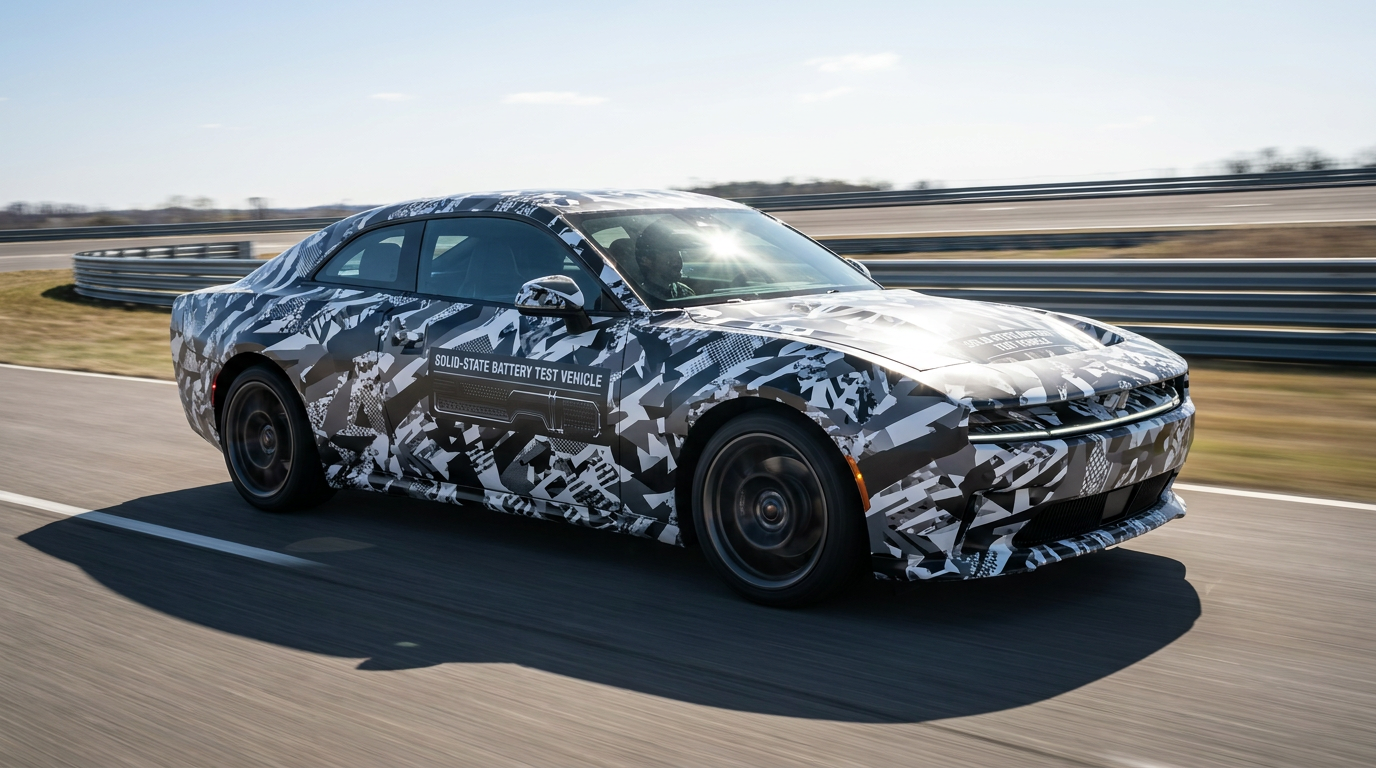
In North America, the transition became tangible when Stellantis and Massachusetts-based battery developer Factorial Energy announced they had integrated solid-state cells into a Dodge Charger Daytona development vehicle. The prototype is currently undergoing rigorous real-world road testing to validate its performance, safety, and reliability under everyday driving conditions. This marks the first time solid-state batteries have been integrated into a Stellantis vehicle, and the first automotive application of the technology in North America.[1][2][5]
The specifications driving the Stellantis project highlight why the industry is investing billions into the technology. Factorial's FEST (Factorial Electrolyte System Technology) cells boast an energy density of 375 watt-hours per kilogram (Wh/kg)—significantly higher than the 200–300 Wh/kg typical of today's best lithium-ion batteries. In testing, the cells demonstrated the ability to recharge from 15 percent to 90 percent in just 18 minutes, while operating reliably in extreme temperatures ranging from -22°F to 113°F (-30°C to 45°C).[1][2][8]

Transitioning from laboratory cell testing to a functional vehicle required substantial engineering. Stellantis had to develop a patented mechanical architecture for the battery pack to accommodate the solid-state cells, while engineers reworked the vehicle's control systems and pack design to optimize performance without sacrificing safety or durability. While mass production remains a few years away, the road-testing program is a crucial step toward bringing the technology to consumers.[1][2][8]
Meanwhile, the timeline for commercialization is accelerating even faster in China. Dongfeng Motor recently announced plans to begin mass production and vehicle integration of its own solid-state batteries in the second half of 2026. The automaker's new battery cells achieve an energy density of 350 Wh/kg, which Dongfeng claims will enable electric vehicles to exceed a driving range of 1,000 kilometers (620 miles) on a single charge.[3][4]
Meanwhile, the timeline for commercialization is accelerating even faster in China.
Dongfeng's technology utilizes an oxide-polymer composite solid electrolyte, replacing the flammable liquid electrolytes found in conventional lithium-ion batteries. This design change drastically reduces the risk of combustion and explosions during collisions or thermal events. In rigorous safety tests, the batteries remained operational even after being compressed and deformed by 50 percent, and showed no signs of smoke or fire when exposed to temperatures of 170°C (338°F).[3][4]
The Chinese automaker has also addressed one of the most significant pain points for EV owners: cold-weather performance. During winter calibration testing in Mohe, China's northernmost city, Dongfeng's solid-state battery retained more than 74 percent of its electrical charge at temperatures as low as -30°C (-22°F). Furthermore, the new battery pack is roughly 30 percent lighter than traditional liquid-electrolyte counterparts, allowing engineers to increase driving range without adding heavy, bulky components to the vehicle.[3][4]

Beyond passenger cars, solid-state technology is also making waves in the two-wheeled market. Verge Motorcycles, an Estonian-Finnish manufacturer, has partnered with battery spin-off Donut Lab to produce the Verge TS Pro, which the companies claim is the world's first production vehicle powered by an all-solid-state battery. Donut Lab advertises an astonishing energy density of 400 Wh/kg for its cells, promising a range of up to 600 kilometers (372 miles) for the motorcycle's long-range variant.[5][6]
Donut Lab recently published the results of a pack-level fast-charging test conducted with the Verge TS Pro. Using an 18 kWh air-cooled battery pack, the motorcycle sustained over 100 kW of charging power—a 5C rate—for five minutes straight. The pack charged from 10 percent to 50 percent in five minutes, and reached 80 percent in just 12 minutes. The company stated that this marks the first public demonstration of its battery technology at the pack level in a real vehicle environment.[7]
However, the aggressive timelines promised by startups have been met with skepticism from industry veterans. When Donut Lab first unveiled its battery at the Consumer Electronics Show, executives from major battery manufacturers questioned the validity of the specifications, noting that no independent testing was initially provided. Additionally, while Verge Motorcycles initially promised customer deliveries in the first quarter of 2026, the company's website later shifted the delivery window for new orders to the fourth quarter, prompting speculation about production delays.[6]

Despite the hurdles and the skepticism surrounding early claims, the broader trajectory of the industry is clear. The fundamental shift from liquid to solid electrolytes represents a paradigm change in battery physics. By suppressing the growth of dendrites—metallic whiskers that can cause short circuits in liquid systems—solid electrolytes safely enable the use of lithium metal anodes, which is the key to unlocking massive gains in energy density.[3][8]
With Stellantis gathering real-world data on American roads, Dongfeng preparing its manufacturing lines in China, and startups pushing the boundaries of charging speeds, the solid-state era is no longer a distant concept. The competition has shifted from materials discovery in the lab to manufacturing integration on the factory floor, setting the stage for a dramatic transformation of the electric vehicle market before the end of the decade.[1][3][8]
How we got here
2024–2025
Battery startups and automakers announce major breakthroughs in solid-state cell energy density and cycle life in laboratory settings.
January 2026
Donut Lab unveils its solid-state battery at CES, claiming it is ready for immediate production in Verge Motorcycles.
March 2026
Donut Lab publishes the first pack-level fast-charging test results for its solid-state motorcycle battery.
June 2026
Stellantis and Factorial announce the start of real-world road testing for a solid-state Dodge Charger Daytona.
Late 2026
Dongfeng Motor plans to begin mass production and vehicle integration of its 350 Wh/kg solid-state batteries.
Viewpoints in depth
Legacy Automakers
Established car manufacturers are taking a measured approach, focusing on rigorous real-world testing before committing to mass production.
Companies like Stellantis, Toyota, and Nissan are investing heavily in solid-state technology but are cautious about promising immediate mass-market availability. By integrating prototype cells into development vehicles like the Dodge Charger Daytona, they aim to validate performance, safety, and durability under everyday driving conditions. Their primary focus is ensuring that the new mechanical architectures and control systems can handle the unique thermal and physical properties of solid-state cells before scaling up manufacturing, with most targeting broad commercialization between 2028 and 2030.
Chinese Manufacturers
Chinese automotive giants are aggressively pushing to bring solid-state batteries to the mass market as early as 2026.
Automakers like Dongfeng and battery giants like CATL and BYD are accelerating their timelines to maintain dominance in the global EV market. Dongfeng's commitment to mass-producing a 350 Wh/kg solid-state battery in the second half of 2026 reflects a strategy of rapid iteration and deployment. By utilizing oxide-polymer composite electrolytes that are compatible with existing manufacturing infrastructure, these companies aim to be the first to offer vehicles with 1,000-kilometer ranges, leveraging their established supply chains to outpace Western competitors.
Battery Startups
Agile startups are pushing the absolute limits of energy density and charging speeds, though they often face skepticism from industry veterans.
Companies like Factorial Energy and Donut Lab are driving the narrative around solid-state capabilities, claiming energy densities of 375 to 400 Wh/kg and charging times under 20 minutes. While their lab results and early pack-level tests are highly promising, these startups frequently encounter pushback from established battery scientists who demand independent verification. The challenge for these disruptors is proving that their breakthrough chemistries can be manufactured reliably at scale without prohibitive costs or unforeseen degradation issues.
What we don't know
- How quickly solid-state battery manufacturing can be scaled up to meet the volume demands of the global automotive industry.
- The final consumer cost of the first generation of solid-state-equipped electric vehicles.
- Whether the aggressive production timelines promised by startups and Chinese manufacturers will face unforeseen delays.
Key terms
- Solid Electrolyte
- A solid material (often a ceramic, glass, or polymer) that conducts ions between the battery's anode and cathode, replacing the flammable liquid used in traditional batteries.
- Energy Density (Wh/kg)
- A measure of how much electrical energy a battery can store relative to its weight. Higher energy density means a vehicle can travel further without increasing the battery's physical weight.
- Lithium Metal Anode
- An advanced battery component that uses pure lithium metal instead of graphite, allowing the battery to store significantly more energy. Solid electrolytes are required to use lithium metal safely.
- Dendrites
- Microscopic, needle-like metallic structures that can grow inside a battery during charging, potentially piercing the separator and causing a short circuit or fire.
- C-Rate
- A measure of the rate at which a battery is discharged or charged relative to its maximum capacity. A 5C rate means the battery is being charged at a power level five times its total capacity.
Frequently asked
What is a solid-state battery?
A solid-state battery replaces the flammable liquid or gel electrolyte found in conventional lithium-ion batteries with a solid material, such as a polymer, oxide, or sulfide. This change allows for higher energy density and significantly improves safety.
How fast can solid-state batteries charge?
In recent tests, Factorial's solid-state cells charged from 15% to 90% in just 18 minutes. Donut Lab demonstrated a motorcycle battery pack charging from 10% to 80% in 12 minutes.
When will cars with solid-state batteries be available to buy?
While Chinese automaker Dongfeng plans to begin mass production in late 2026, most major global automakers, including Stellantis and Toyota, are currently in the road-testing phase and target broad commercial availability between 2028 and 2030.
Do solid-state batteries perform better in cold weather?
Yes. Because they do not rely on liquid electrolytes that can freeze or become sluggish, solid-state batteries maintain their charge much better in extreme cold. Dongfeng's battery retained 74% of its capacity at -30°C (-22°F).
Sources
Source coverage
8 outlets
3 viewpoints surfaced








[1]Car and DriverLegacy Automakers
Stellantis Starts Testing Solid-State Batteries in a Dodge Charger Daytona
Read on Car and Driver →[2]ElectrekBattery Startups
Factorial, Stellantis test solid-state EV batteries in real life
Read on Electrek →[3]CarNewsChinaChinese Manufacturers
Dongfeng to mass-produce solid-state batteries in H2 2026, enabling 1,000 km+ range
Read on CarNewsChina →[4]ArenaEVChinese Manufacturers
Dongfeng targets late 2026 for mass production of long-range solid-state batteries
Read on ArenaEV →[5]New AtlasBattery Startups
Revolutionary solid-state batteries finally hit US roads
Read on New Atlas →[6]The PackBattery Startups
Donut Lab - CES - Solid State battery
Read on The Pack →[7]ElectriveBattery Startups
Donut Lab publishes another fast-charging test – with a Verge motorcycle
Read on Electrive →[8]Battery Tech OnlineLegacy Automakers
Stellantis Tests Factorial Solid-State Batteries in Dodge Charger Daytona on Public Roads
Read on Battery Tech Online →


Every angle. Every day.
Get business stories with full source coverage and perspective breakdowns delivered to your inbox.