
The Initial SpaceX Frenzy Is Cooling, But a Massive Wave of Index Cash Is About to Strike
Following its historic $1.77 trillion IPO, SpaceX is triggering a second market earthquake as major index funds are forced to buy the stock despite its tiny public float.
By Factlen Editorial Team
- Growth & Retail Investors
- Viewing SpaceX as a generational infrastructure play across space and AI, justifying premium valuations.
- Passive Index Providers
- Focused on rules-based, measured incorporation of new equities without succumbing to market hype.
- Strict Index Traditionalists
- Prioritizing proven profitability and market seasoning over immediate access to mega-IPOs.
What's not represented
- · Retail investors who missed the initial IPO allocation
- · Competitors in the aerospace and AI sectors facing a newly capitalized giant
Why this matters
If you have a 401(k) or a broad market index fund, you are about to become a SpaceX shareholder. Unprecedented rule changes by major index providers mean passive retirement money is flowing into the space and AI giant much faster than in previous tech booms.
Key points
- SpaceX's $1.77 trillion IPO has prompted major index providers to rewrite rules to allow faster inclusion.
- The Nasdaq-100 will add SpaceX after just 15 trading days, forcing passive funds to buy the stock.
- Only about 4.2% of SpaceX shares are publicly traded, creating a severe supply constraint against massive index demand.
- S&P Dow Jones Indices refused to alter its rules, meaning the S&P 500 will not include SpaceX until at least June 2027.
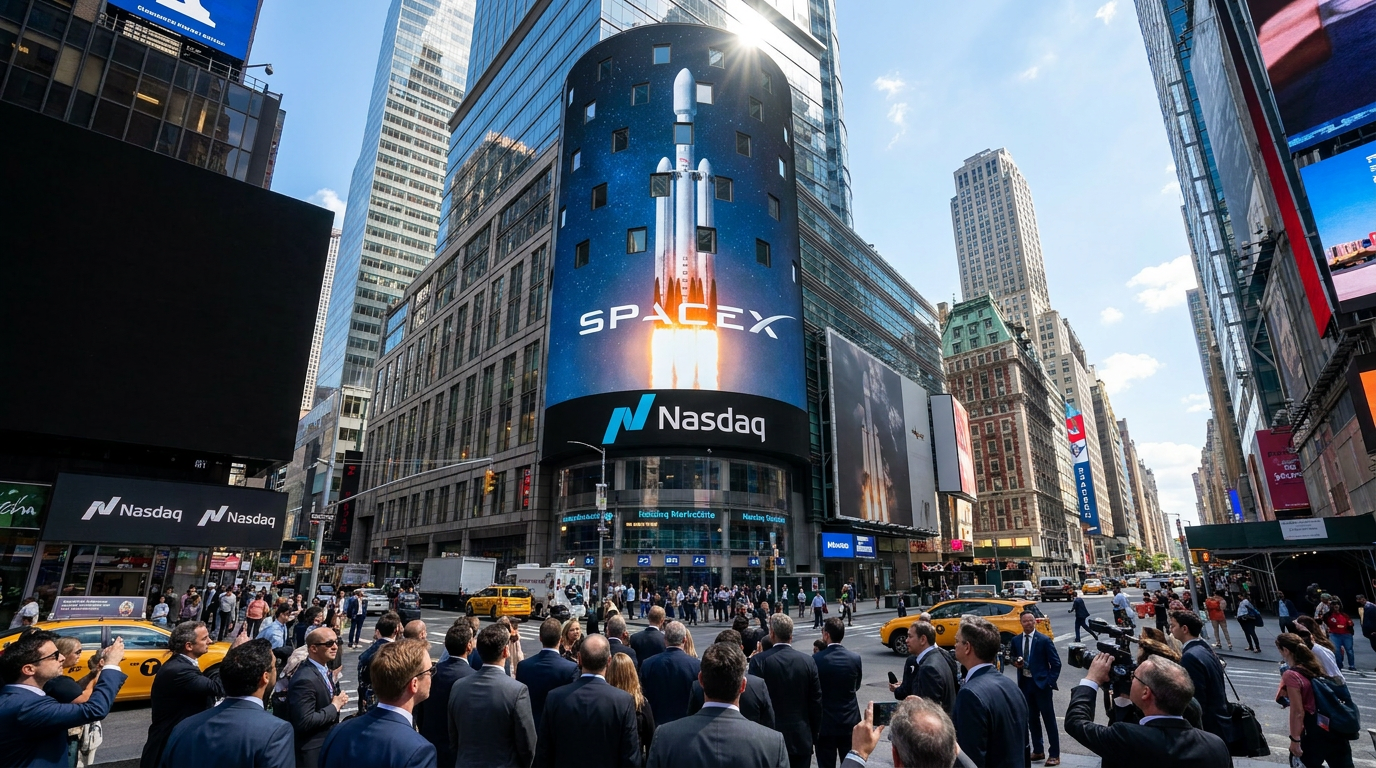
SpaceX’s historic June 12 initial public offering shattered financial records, debuting at a staggering $1.77 trillion valuation. While the initial retail frenzy that drove the stock up 33% in its first week is beginning to stabilize, Wall Street is bracing for a second, potentially more powerful wave of capital.[1][4]
The new catalyst is index inclusion. Trillions of dollars are parked in passive index funds and exchange-traded funds (ETFs) that automatically track market benchmarks. When a company is added to an index, these funds are forced to buy the stock mechanically, regardless of price or valuation.[1][6]
Historically, mega-cap IPOs had to wait months or even years to join major indices. But the sheer scale of SpaceX—which immediately became one of the ten most valuable public companies in the world—prompted index providers to rewrite their rulebooks to ensure their benchmarks accurately reflect the modern market.[6]
Nasdaq finalized a "Fast Entry" methodology specifically to accommodate companies of this magnitude. Under the new rules, SpaceX will be added to the tech-heavy Nasdaq-100 index after just 15 trading days, meaning funds like the massive Invesco QQQ Trust will begin accumulating shares in early July.[2][3][6]

Other providers moved even faster. The Centre for Research in Security Prices (CRSP) and FTSE Russell allowed entry after just five trading days. As a result, broad-market vehicles like the Vanguard Total Stock Market ETF have already begun their mandatory purchasing.[2][3][6]
The Centre for Research in Security Prices (CRSP) and FTSE Russell allowed entry after just five trading days.
This synchronized buying wave is colliding with a severe supply constraint. SpaceX only made roughly 4.2% of its shares available to the public during the IPO, raising $75 billion while insiders and CEO Elon Musk retained the vast majority of the equity.[4][6]
Forcing billions of dollars of index-fund demand into such a tiny public float has the potential to create significant upward price pressure. The dynamic has sparked debate over whether the mechanical buying will artificially inflate the stock before the company's core businesses fully mature.[1][6]

However, index managers are taking steps to mitigate the shock. Vanguard, which manages trillions in passive assets, noted that because index weightings are adjusted for the available float, SpaceX will initially make up less than 1% of broad portfolios. The firm emphasized a "measured incorporation" to prevent hype from overwhelming the funds.[5]
Not every index provider bent the rules. S&P Dow Jones Indices announced it would maintain its strict inclusion criteria for the S&P 500, which requires a 12-month seasoning period and four consecutive quarters of GAAP profitability.[2][3]
Despite generating over $18 billion in revenue in 2025, SpaceX reported a GAAP net loss of $4.94 billion as it aggressively reinvested in its Starship program and its newly acquired xAI subsidiary. Consequently, the company will not be eligible for the S&P 500 until at least June 2027.[2][4]

This creates a stark divide for everyday investors. Those holding Nasdaq-100 or total-market funds are gaining immediate exposure to the space and artificial intelligence sectors, while traditional S&P 500 investors are protected from early volatility but risk missing out on potential upside.[2][3]
Ultimately, the SpaceX listing has permanently altered the landscape for private mega-unicorns. By forcing index providers to adapt, SpaceX has paved a faster route to public capital for future AI and tech behemoths, ensuring that retail investors and retirement accounts get a seat on the rocket sooner than ever before.[6]
How we got here
Feb 2026
SpaceX acquires Elon Musk's artificial intelligence company xAI, setting the stage for a massive combined public offering.
Mar 30, 2026
Nasdaq finalizes a "Fast Entry" rule change to allow mega-cap IPOs into the Nasdaq-100 after 15 trading days.
Jun 4, 2026
S&P Dow Jones Indices announces it will not waive its 12-month seasoning or profitability requirements for the S&P 500.
Jun 12, 2026
SpaceX officially debuts on the Nasdaq, raising $75 billion at a $1.77 trillion valuation.
Early Jul 2026
SpaceX is scheduled to be formally added to the Nasdaq-100, triggering mandatory buying from tracking funds.
Viewpoints in depth
Passive Index Providers
Focused on rules-based, measured incorporation of new equities without succumbing to market hype.
Firms like Vanguard emphasize that while SpaceX is a massive company, its tiny public float means it will initially represent a fraction of a percent in broad market funds. They rely on float-adjusted weightings to ensure that mechanical buying doesn't destabilize their portfolios, allowing exposure to grow gradually as insider lock-up periods expire and more shares enter the market.
Growth & Retail Investors
Viewing SpaceX as a generational infrastructure play across space and AI, justifying premium valuations.
Retail investors and growth-focused analysts see SpaceX's $1.77 trillion valuation as a reflection of its monopoly in rocket launches, its Starlink communications network, and its integration with xAI. They argue that gaining early access through Nasdaq and total-market funds is crucial, as the company's aggressive reinvestment strategy prioritizes long-term market dominance over short-term GAAP profitability.
Strict Index Traditionalists
Prioritizing proven profitability and market seasoning over immediate access to mega-IPOs.
S&P Dow Jones Indices and traditionalist investors maintain that the S&P 500's stringent rules protect retirement accounts from the volatility of newly public companies. By demanding four quarters of GAAP profitability and a 12-month waiting period, this camp argues that investors are shielded from the "FOMO" mentality, even if it means missing out on the initial post-IPO stock surges.
What we don't know
- How severely the mechanical buying from index funds will inflate SpaceX's stock price given the constrained public float.
- When SpaceX will achieve the four consecutive quarters of GAAP profitability required to finally enter the S&P 500.
Key terms
- Initial Public Offering (IPO)
- The process by which a private company offers its shares to the public for the first time, allowing everyday investors to buy ownership.
- Index Fund
- A passive investment vehicle designed to track the performance of a specific market benchmark, automatically buying the stocks included in that index.
- Public Float
- The number of a company's shares that are actually available to be traded by the general public, excluding restricted shares held by company insiders.
- GAAP Profitability
- Earnings calculated according to Generally Accepted Accounting Principles, a standard set of accounting rules required for inclusion in certain strict indices like the S&P 500.
- Float-Adjusted Weighting
- A method used by index funds to determine how much of a stock to buy based only on the shares available to the public, rather than the company's total overall value.
Frequently asked
When did SpaceX go public?
SpaceX held its initial public offering on June 12, 2026, debuting on the Nasdaq under the ticker symbol SPCX.
Will SpaceX be in my 401(k)?
Yes, if your retirement account holds broad-market or Nasdaq-100 index funds, you will likely own SpaceX shares by July 2026. However, S&P 500 funds will not include the stock until at least 2027.
Why isn't SpaceX in the S&P 500 yet?
The S&P 500 requires companies to be publicly traded for 12 months and report four consecutive quarters of GAAP profitability, criteria SpaceX does not yet meet due to heavy reinvestment.
What is a public float?
The public float refers to the portion of a company's shares that are freely available for everyday investors to trade, excluding shares held tightly by insiders or executives.
Sources
Source coverage
6 outlets
3 viewpoints surfaced






[1]MarketWatchGrowth & Retail Investors
The initial SpaceX frenzy is cooling off — but a new wave of cash is waiting to strike
Read on MarketWatch →[2]ForbesStrict Index Traditionalists
SpaceX Could Join The Nasdaq-100 Within Weeks
Read on Forbes →[3]The Motley FoolGrowth & Retail Investors
The Fast-Track to Index Inclusion for SpaceX
Read on The Motley Fool →[4]MorningstarGrowth & Retail Investors
SpaceX Launches History's Largest IPO
Read on Morningstar →[5]VanguardPassive Index Providers
Investors worried about the impact of the SpaceX IPO launch on index funds can rely on a more grounded approach
Read on Vanguard →[6]Pengana CapitalPassive Index Providers
The largest IPO in history lists Friday. Mechanical, price-insensitive buying will follow.
Read on Pengana Capital →

More in finance
See all 6 stories →Retirement Planning
The 2026 Playbook for Tax-Efficient Retirement Withdrawals
11 sources

Index Mechanics
How SpaceX's $1.75 Trillion IPO Is About to Trigger a Massive Wave of Automated Buying
7 sources
Assumable Mortgages
How Assumable Mortgages Work: The Strategy Buyers Are Using to Secure 3% Rates
5 sources

Retirement Strategy
The 'Income-Only' Retirement: How to Live Off Dividends and Shield Your Wealth from 2026 RMD Taxes
8 sources

Every angle. Every day.
Get finance stories with full source coverage and perspective breakdowns delivered to your inbox.