
Right-Wing Outsider Abelardo de la Espriella Wins Colombia's Presidential Runoff
Criminal defense lawyer Abelardo de la Espriella narrowly defeated leftist Senator Iván Cepeda, marking a sharp rightward pivot for Colombia driven by security fears.
By Factlen Editorial Team
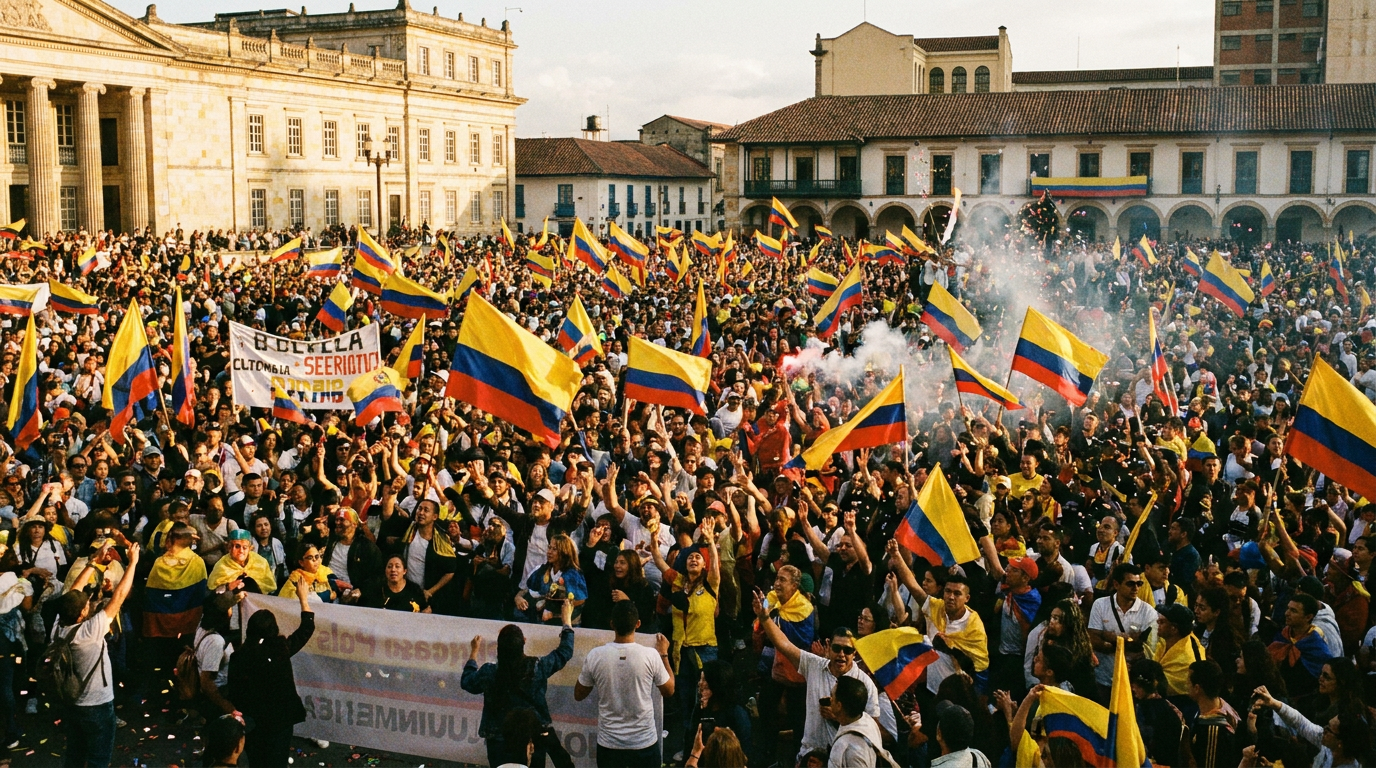
- Security Hardliners
- Argue that previous peace dialogues failed and only overwhelming state force and mass incarceration can dismantle the cartels.
- Progressive Coalition
- Value social reform and negotiated peace, warning that militarized policing will return Colombia to an era of state-sponsored human rights abuses.
- Geopolitical Allies
- View the election as a strategic victory that realigns Colombia with U.S. anti-narcotics efforts and counters leftist influence in Latin America.
- Institutional Observers
- Focus on the integrity of the democratic process, expressing concern over the fragmented congress and unsubstantiated claims of electoral fraud.
What's not represented
- · Indigenous and Afro-Colombian communities disproportionately affected by rural violence
- · Armed groups and cartels whose operations will be targeted by the incoming administration
Why this matters
Colombia is the United States' closest strategic ally in South America and the world's largest producer of cocaine. This election abruptly ends the country's brief experiment with left-wing governance, signaling a return to hardline, militarized anti-narcotics policies that will reshape regional diplomacy and the global drug trade.
Key points
- Right-wing lawyer Abelardo de la Espriella won Colombia's presidential runoff with 49.65% of the vote.
- He defeated leftist Senator Iván Cepeda, who captured 48.7% as the candidate for the ruling Historic Pact.
- De la Espriella campaigned on a hardline security platform, promising to build 10 Bukele-style mega-prisons.
- The election serves as a sharp rejection of outgoing President Gustavo Petro's 'Total Peace' dialogues.
- The result realigns Colombia closely with U.S. anti-narcotics efforts and accelerates a rightward shift in Latin America.
- Outgoing President Petro and Cepeda's supporters have alleged vote-count irregularities without providing evidence.
Abelardo de la Espriella, a flamboyant criminal defense lawyer who campaigned on a promise of Bukele-style mega-prisons, has narrowly won Colombia's presidential runoff. The victory marks a sharp rightward pivot for South America's second-most populous nation, effectively ending its brief four-year experiment with a left-wing government.[1][2]
With nearly all ballots counted on Sunday evening, De la Espriella secured 49.65% of the vote, edging out leftist Senator Iván Cepeda, who captured 48.7%. The razor-thin margin of roughly 248,000 votes out of more than 25 million cast underscores the deep polarization gripping the country as it navigates overlapping security and economic crises.[1][6]
Cepeda, a philosopher and prominent human rights defender, ran as the standard-bearer for the ruling Historic Pact coalition. He promised to continue outgoing President Gustavo Petro's social reforms and his signature "Total Peace" initiative—a controversial effort to negotiate demobilization pacts with the country's remaining armed groups.[3][4][5]

De la Espriella, representing the Defensores de la Patria party, offered a radically different vision. Nicknamed "The Tiger," the millionaire attorney built his public profile defending high-profile clients, including figures tied to right-wing paramilitary groups. He campaigned as an anti-establishment outsider, modeling his rhetoric on El Salvador's Nayib Bukele and former U.S. President Donald Trump.[1][2][4]
The election ultimately functioned as a referendum on Colombia's deteriorating security landscape. While violence remains below the catastrophic peaks of the late 20th century, the past year has been the deadliest since the landmark 2016 peace agreement with the FARC guerrillas. Petro's "Total Peace" dialogues largely stalled, leaving rural communities vulnerable to turf wars between rival cartels and rebel factions.[1][4]
De la Espriella capitalized on this widespread anxiety. He abandoned the traditional conservative playbook in favor of a heavy-handed, militarized approach to public safety. His central campaign pledge involves constructing ten maximum-security "mega-prisons" and authorizing security forces to aggressively neutralize cartel members, a platform that resonated deeply with voters exhausted by extortion and kidnappings.[1][3][4]

Cepeda's campaign struggled to outrun the baggage of the incumbent administration. Petro, Colombia's first-ever leftist president, saw his tenure crippled by sluggish execution, a fragmented congress, and a relentless succession of corruption scandals involving his inner circle. Analysts noted that Cepeda's strategy of positioning himself as Petro's natural successor alienated crucial centrist voters in the runoff.[6]
Cepeda's campaign struggled to outrun the baggage of the incumbent administration.
Despite the loss, the Historic Pact demonstrated enduring strength, mobilizing nearly 12.7 million voters. Cepeda's base, heavily concentrated in marginalized regions and urban centers, rallied behind his promises of agrarian reform, wealth redistribution, and the protection of judicial independence. For these voters, a return to hardline security policies evokes the state-sponsored human rights abuses of the early 2000s.[1][5]
The immediate aftermath of the election remains tense. Even before the polls opened, President Petro sowed doubts about the integrity of the process, alleging without evidence that unidentified actors were attempting to manipulate the vote with foreign funds. Following the results, Cepeda's supporters have alleged vote-count irregularities, raising fears of unrest in the capital, Bogotá.[1][4]
De la Espriella's victory is poised to dramatically reshape Colombia's foreign policy, particularly its relationship with Washington. Petro had frequently clashed with U.S. officials, accusing the United States of ideological interference and criticizing its anti-drug strategies. De la Espriella, by contrast, has explicitly promised to realign Bogotá with U.S. interests.[3]

The president-elect received a highly publicized endorsement from Donald Trump following his first-round victory in May. In a live address broadcast on social media Sunday night, De la Espriella announced that he had already spoken by phone with the former U.S. president, describing the United States as Colombia's "most important strategic ally in the fight against organized crime."[1][3]
The outcome in Colombia accelerates a broader right-wing resurgence across Latin America. De la Espriella joins a growing bloc of conservative populist leaders—including Argentina's Javier Milei and El Salvador's Bukele—who have successfully weaponized economic anxiety and security fears to dismantle leftist coalitions.[1][2]
Governing, however, will present immediate challenges for the political novice. De la Espriella lacks a traditional party apparatus and will face a highly fragmented legislature. Funding and constructing ten mega-prisons in a country grappling with ballooning public debt will require significant political maneuvering and likely face fierce opposition from human rights organizations.[1][6]

The transition period leading up to the August 7 inauguration will be a critical test of Colombia's democratic institutions. The incoming administration must prepare to inherit a complex web of active military operations and fragile ceasefires, while the outgoing government faces pressure to ensure a peaceful transfer of power despite its vocal skepticism of the results.[4][6]
For now, Colombia stands at a stark crossroads. Voters have decisively rejected the left's vision of negotiated peace, opting instead for an untested outsider promising order through overwhelming force. Whether De la Espriella can deliver on his sweeping security mandates without unraveling the country's fragile democratic norms remains the defining question of his incoming presidency.[2][3]
How we got here
August 2022
Gustavo Petro is inaugurated as Colombia's first left-wing president, launching his 'Total Peace' initiative.
May 31, 2026
Abelardo de la Espriella unexpectedly wins the first round of the presidential election with 43.7% of the vote.
June 21, 2026
De la Espriella defeats Iván Cepeda in the runoff election by a margin of less than one percentage point.
August 7, 2026
Scheduled inauguration day for the new president of Colombia.
Viewpoints in depth
The Security Hardliners' view
Focus on De la Espriella's mandate to dismantle cartels through overwhelming state force.
Supporters of the incoming president argue that the failure of 'Total Peace' left a dangerous vacuum that was quickly filled by cartels and rebel factions. They contend that El Salvador's model proves extreme measures are necessary to reclaim the state from organized crime, dismissing human rights concerns as secondary to the basic public safety of everyday citizens.
The Progressive Coalition's view
Warn that militarized policing will criminalize poverty and reignite state-sponsored violence.
Cepeda's base maintains that the root causes of Colombia's violence are systemic inequality and a lack of state presence in rural areas, not just a shortage of prison cells. They fear De la Espriella's heavy-handed policies will disproportionately target marginalized communities and return the country to the bloody era of paramilitary violence seen in the early 2000s.
Washington's Strategic view
Celebrate the election as a vital realignment of a key regional partner.
U.S. conservatives and anti-narcotics officials see De la Espriella as a crucial ally in a region that had been drifting away from American influence. They anticipate renewed cooperation on extradition, military aid, and drug interdiction, effectively abandoning Petro's ideological resistance to the traditional war on drugs.
What we don't know
- Whether De la Espriella can secure the funding and legislative support required to build ten mega-prisons.
- How the country's active armed groups will respond to the incoming administration's militarized crackdown.
- If the left-wing Historic Pact coalition will fully accept the election results or organize mass protests.
Key terms
- Historic Pact
- The left-wing political coalition founded by outgoing President Gustavo Petro, which backed Iván Cepeda in the 2026 election.
- Total Peace
- A controversial policy of the Petro administration aimed at negotiating simultaneous peace treaties with various guerrilla and paramilitary groups.
- Paramilitaries
- Private, right-wing armed groups originally formed to fight leftist guerrillas, which became deeply involved in drug trafficking and human rights abuses.
- Mega-prisons
- Massive, maximum-security incarceration facilities, popularized by El Salvador's Nayib Bukele, designed to hold thousands of gang members under severe conditions.
Frequently asked
Why was Gustavo Petro not on the ballot?
Colombian presidents are constitutionally limited to a single four-year term, barring Petro from seeking re-election.
What is the 'Total Peace' policy?
It was President Petro's initiative to negotiate simultaneous demobilization pacts with all remaining armed groups, which critics say allowed cartels to expand.
How close was the final vote?
Abelardo de la Espriella won by roughly 248,000 votes, securing 49.65% of the vote to Iván Cepeda's 48.7%.
What has De la Espriella promised to do about crime?
He pledged to build 10 maximum-security 'mega-prisons' and authorize security forces to aggressively target criminal organizations.
Sources
Source coverage
7 outlets
4 viewpoints surfaced







[1]The GuardianProgressive Coalition
Far-right millionaire Abelardo de la Espriella wins Colombia’s presidential runoff
Read on The Guardian →[2]NYTSecurity Hardliners
Abelardo De La Espriella, Trump-Backed Rightist, Headed for Win in Colombia
Read on NYT →[3]CBS NewsSecurity Hardliners
A deeply divided electorate will choose Colombia's next president in a runoff
Read on CBS News →[4]PBSGeopolitical Allies
Deeply divided Colombians vote for their next president in a runoff
Read on PBS →[5]Al JazeeraProgressive Coalition
Colombia election: Ivan Cepeda faces Abelardo de la Espriella
Read on Al Jazeera →[6]Anadolu AgencyInstitutional Observers
Voting stations close in Colombia's polarized presidential runoff
Read on Anadolu Agency →[7]AS/COAInstitutional Observers
Poll Tracker: Colombia's 2026 Presidential Election
Read on AS/COA →


Every angle. Every day.
Get news politics stories with full source coverage and perspective breakdowns delivered to your inbox.