
The Evidence Pack: Why VO2 Max Is the Strongest Predictor of Longevity
Cardiorespiratory fitness, measured by VO2 max, outperforms traditional risk factors like smoking, diabetes, and hypertension in predicting lifespan. A review of the clinical evidence shows that even modest improvements in aerobic capacity dramatically reduce all-cause mortality.
By Factlen Editorial Team
- Preventive Cardiologists
- Advocate for aggressive, early intervention through exercise to build aerobic capacity before age-related decline begins.
- Public Health Officials
- Focus on moving the most sedentary populations out of the lowest fitness quartile to achieve the greatest population-level mortality reduction.
- Longevity & Geroscience Researchers
- View VO2 max not just as a cardiovascular metric, but as a proxy for systemic cellular health and mitochondrial function.
What's not represented
- · Health Insurance Providers
- · Socioeconomically Disadvantaged Populations
Why this matters
Most medical checkups focus on blood pressure, cholesterol, and weight, but ignore the single most powerful metric for predicting how long and how well you will live. Understanding and improving your VO2 max offers a highly actionable, dose-dependent way to significantly extend your healthspan.
Key points
- VO2 max is a stronger predictor of all-cause mortality than smoking, diabetes, or hypertension.
- A 2018 study of 122,007 patients found a 500% higher mortality risk for the least fit compared to the most fit.
- The American Heart Association advocates treating cardiorespiratory fitness as a clinical vital sign.
- Every 1-MET increase in aerobic capacity reduces mortality risk by roughly 13 to 15 percent.
- There is no upper limit to the survival benefits of extreme cardiorespiratory fitness.
- VO2 max is highly trainable at any age through a mix of steady-state cardio and high-intensity intervals.
When patients visit a primary care physician for an annual physical, the standard panel of tests is highly predictable. Doctors measure blood pressure, calculate body mass index, draw blood to check cholesterol and fasting glucose, and ask about smoking habits. Yet, according to a growing consensus in longevity medicine and cardiology, this routine screening systematically ignores the single most powerful predictor of human lifespan: cardiorespiratory fitness.[2][6]
Cardiorespiratory fitness, or CRF, reflects the integrated ability of the heart, lungs, blood vessels, and skeletal muscles to deliver and utilize oxygen during sustained physical effort. The gold-standard metric for quantifying this capacity is VO2 max—the maximum volume of oxygen a person can consume per kilogram of body weight per minute. While traditionally viewed as a metric reserved for elite endurance athletes and sports scientists, a mountain of clinical evidence now positions VO2 max as the ultimate biomarker for longevity.[2][3]
The most definitive evidence comes from a landmark 2018 study published in JAMA Network Open by researchers at the Cleveland Clinic. The retrospective cohort study analyzed 122,007 patients who underwent exercise treadmill testing over a 24-year period, tracking all-cause mortality. The sheer scale of the data allowed researchers to isolate the effects of aerobic capacity from other lifestyle factors with unprecedented precision.[1]
The findings fundamentally shifted how preventive cardiologists view exercise. The researchers discovered that cardiorespiratory fitness is inversely associated with long-term mortality, and crucially, they observed no upper limit to the benefit. Individuals in the lowest fitness percentile—the bottom 25 percent—faced a staggering 500 percent increase in the risk of all-cause mortality compared to those in the "elite" fitness group, defined as the top 2.5 percent for their age and sex.[1]

To put the magnitude of this risk into perspective, the Cleveland Clinic researchers compared low aerobic capacity to traditional clinical red flags. The data revealed that being in the lowest fitness category carried a higher risk of death than being a current smoker, having coronary artery disease, or being diagnosed with type 2 diabetes. In the hierarchy of mortality risks, poor cardiorespiratory fitness stood alone at the top.[1][6]
This paradigm shift prompted the American Heart Association to issue a formal scientific statement advocating that cardiorespiratory fitness be categorized as a clinical vital sign. Authored by a panel of leading exercise physiologists and cardiologists, the statement argued that CRF should be routinely assessed alongside temperature, pulse, and blood pressure, noting that its addition to traditional risk models significantly improves the prediction of adverse cardiovascular outcomes.[2]
The protective effect of aerobic capacity operates on a continuous, dose-dependent curve. A comprehensive meta-analysis of over 100,000 participants demonstrated that every 1-MET (metabolic equivalent of task) increase in exercise capacity is associated with a 13 to 15 percent reduction in all-cause mortality and cardiovascular events. One MET represents the amount of oxygen consumed while sitting at rest; increasing maximum capacity by just one MET is roughly equivalent to improving one's running pace by a mere 0.6 miles per hour.[4]
The protective effect of aerobic capacity operates on a continuous, dose-dependent curve.
What makes this dose-response relationship particularly encouraging is where the steepest benefits occur. The most dramatic reductions in mortality risk are realized when individuals move from the "low" fitness category to the "below average" or "average" categories. Simply getting off the couch and establishing a baseline level of cardiovascular conditioning yields massive dividends for lifespan, proving that one does not need to become an elite marathoner to harvest the majority of the longevity benefits.[2][5][6]
However, for those who do pursue extreme fitness, the data challenges a long-held medical concern. For years, some observational studies suggested a "J-shaped curve" to exercise, hypothesizing that extreme endurance training might eventually damage the heart and accelerate mortality. The Cleveland Clinic data directly refuted this, showing that extreme cardiorespiratory fitness—two standard deviations above the mean—was associated with the lowest risk-adjusted all-cause mortality across all age groups, with the survival benefit becoming especially pronounced in patients over the age of 70.[1]

The physiological mechanisms behind this protection are profound. A high VO2 max indicates a robust cardiovascular system capable of high cardiac output, elastic and responsive blood vessels, and a dense capillary network. At the cellular level, it reflects a high concentration of efficient mitochondria in the skeletal muscle, which translates to better metabolic flexibility, improved insulin sensitivity, and a heightened ability to clear metabolic waste products.[2][3]
While VO2 max dominates the longevity conversation, researchers emphasize that it works in tandem with a secondary pillar: muscular strength. Sarcopenia, the age-related loss of muscle mass and function, is a major driver of frailty and mortality in older adults. Studies tracking grip strength and appendicular lean mass show that maintaining muscular strength provides an independent survival benefit, acting as a metabolic sink for glucose and a physical buffer against catastrophic falls.[6]
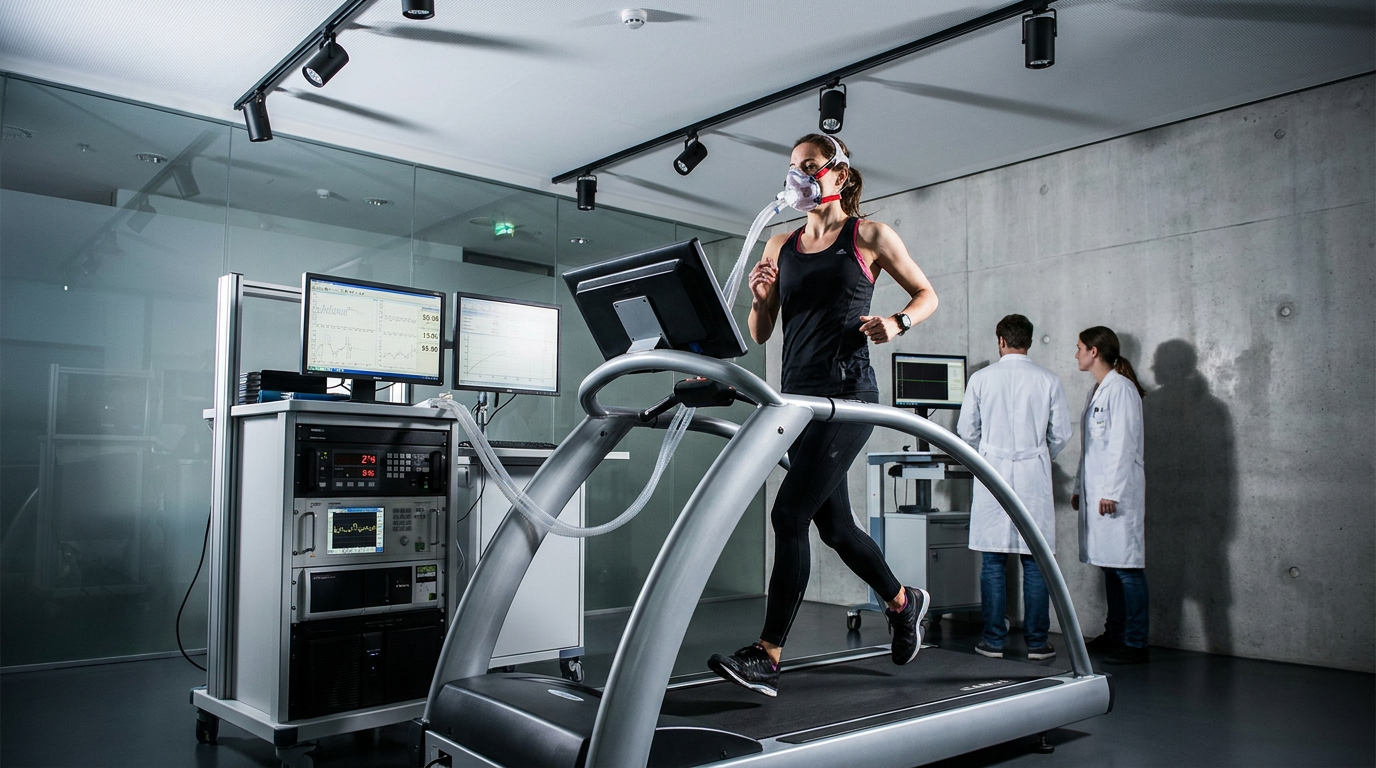
Despite the overwhelming evidence, measuring VO2 max remains a bottleneck in primary care. The gold standard requires a Cardiopulmonary Exercise Test (CPET), where a patient runs on a treadmill or pedals a stationary bike to exhaustion while wearing a mask that analyzes the exact ratio of inhaled oxygen to exhaled carbon dioxide. Because this requires specialized equipment, trained physiologists, and significant time, it is rarely covered by standard insurance for asymptomatic patients.[2][6]
In the absence of clinical testing, consumer technology is attempting to fill the void. High-end smartwatches and fitness trackers now use proprietary algorithms to estimate VO2 max based on heart rate response to sub-maximal running or walking. While these estimates have a margin of error compared to a laboratory CPET, sports cardiologists generally agree they are accurate enough to track individual trends over time and provide a useful baseline for the average person.[6]

For those looking to improve their metric, exercise physiologists recommend a polarized approach to training. The foundation is built on "Zone 2" cardio—steady-state, moderate-intensity exercise like brisk walking, light jogging, or cycling performed for 45 to 60 minutes several times a week. This intensity, where one can still hold a conversation, specifically targets mitochondrial efficiency and builds the aerobic base.[3][6]
To push the absolute ceiling of VO2 max, the base must be complemented by high-intensity interval training (HIIT). Protocols such as the "4x4" method—four minutes of near-maximal effort followed by three minutes of active recovery, repeated four times—are highly effective at stressing the cardiovascular system and forcing the heart to increase its stroke volume.[5][6]

The ultimate takeaway from the accumulated evidence is one of profound agency. Unlike genetic predispositions or chronological age, cardiorespiratory fitness is a highly modifiable risk factor. At any stage of life, engaging in structured aerobic exercise can reliably increase VO2 max, offering a scientifically validated pathway to not just a longer life, but a life characterized by enduring physical resilience.[1][2][6]
How we got here
1920s
British physiologist Archibald Hill first proposes the concept of maximal oxygen uptake (VO2 max) as a measure of cardiovascular capacity.
1989
The Cooper Institute publishes early landmark data linking physical fitness to lower all-cause mortality in healthy men and women.
2009
A major meta-analysis in JAMA confirms that every 1-MET increase in fitness reduces mortality risk by 13 to 15 percent.
2016
The American Heart Association publishes a scientific statement advocating that cardiorespiratory fitness be treated as a clinical vital sign.
2018
JAMA Network Open publishes a massive 122,000-patient study proving that low fitness carries a higher mortality risk than smoking or diabetes.
Viewpoints in depth
Preventive Cardiologists
Advocate for aggressive, early intervention through exercise to build aerobic capacity before age-related decline begins.
This camp argues that the medical system's reliance on pharmaceutical interventions for cholesterol and blood pressure misses the forest for the trees. They point to the JAMA data showing that low fitness is more dangerous than diabetes or smoking. Their primary goal is to have VO2 max recognized as a vital sign and to prescribe structured exercise with the same precision as medication.
Public Health Officials
Focus on moving the most sedentary populations out of the lowest fitness quartile to achieve the greatest population-level mortality reduction.
While acknowledging the benefits of elite fitness, public health experts emphasize the steepness of the mortality curve at the bottom. They argue that public resources shouldn't be spent optimizing the VO2 max of recreational athletes, but rather on urban design, active transport, and community programs that help completely sedentary individuals achieve just a 1- or 2-MET improvement, which yields the highest relative reduction in all-cause mortality.
Longevity & Geroscience Researchers
View VO2 max not just as a cardiovascular metric, but as a proxy for systemic cellular health and mitochondrial function.
This camp looks beyond the heart and lungs, focusing on what a high VO2 max represents at the cellular level. They argue that the ability to process oxygen efficiently is a direct reflection of mitochondrial density and metabolic flexibility. To them, VO2 max is the ultimate biomarker of biological age, indicating a body that can effectively manage oxidative stress, clear cellular waste, and resist the systemic inflammation that drives the aging process.
What we don't know
- Exactly how much of an individual's baseline VO2 max is dictated by genetics versus early childhood activity levels.
- The precise threshold at which the longevity benefits of high-intensity interval training plateau or yield diminishing returns.
- How to effectively scale clinical Cardiopulmonary Exercise Testing (CPET) to make it accessible and affordable for the general public.
Key terms
- VO2 max
- The maximum volume of oxygen a person can consume per kilogram of body weight per minute during intense exercise.
- Cardiorespiratory Fitness (CRF)
- The overall ability of the circulatory and respiratory systems to supply oxygen to skeletal muscles during sustained physical activity.
- MET (Metabolic Equivalent of Task)
- A unit used to estimate the metabolic cost of physical activity, where one MET equals the energy expended while sitting quietly at rest.
- All-cause mortality
- The death rate from all causes of death for a population in a given time period; used in studies to measure overall survival risk.
- Mitochondria
- The powerhouses of the cell, responsible for generating most of the chemical energy needed to power biochemical reactions, heavily utilized during aerobic exercise.
- Zone 2 Cardio
- A moderate intensity of aerobic exercise where the body relies primarily on fat oxidation and mitochondrial function, typically performed at a pace where one can still hold a conversation.
Frequently asked
What is considered a good VO2 max score?
A 'good' score is highly dependent on age and sex. For a 40-year-old man, a score around 45 mL/kg/min is considered good, while for a 40-year-old woman, a score around 35 mL/kg/min is comparable. Elite endurance athletes often score in the 60s, 70s, or even 80s.
Can I improve my VO2 max if I am already in my 60s or 70s?
Yes. Research consistently shows that cardiorespiratory fitness is highly trainable at any age. While absolute peak capacity naturally declines with age, older adults who engage in structured aerobic training can significantly improve their VO2 max and drastically reduce their mortality risk.
Do I need to run to improve my VO2 max?
No. Any exercise that sustains an elevated heart rate and challenges the cardiovascular system will work. Cycling, swimming, rowing, and brisk incline walking are all highly effective, low-impact alternatives to running.
Are the VO2 max estimates on smartwatches accurate?
They are generally accurate enough for tracking personal progress, though they are not as precise as a clinical Cardiopulmonary Exercise Test (CPET). They work best when calibrated with outdoor running or walking data using GPS and heart rate sensors.
Sources
Source coverage
6 outlets
3 viewpoints surfaced




[1]JAMA Network OpenPreventive Cardiologists
Association of Cardiorespiratory Fitness With Long-term Mortality Among Adults Undergoing Exercise Treadmill Testing
Read on JAMA Network Open →[2]American Heart AssociationPreventive Cardiologists
Importance of Assessing Cardiorespiratory Fitness in Clinical Practice: A Case for Fitness as a Clinical Vital Sign
Read on American Heart Association →[3]Frontiers in BioscienceLongevity & Geroscience Researchers
Survival of the fittest: VO2max, a key predictor of longevity?
Read on Frontiers in Bioscience →Cardiorespiratory Fitness as a Quantitative Predictor of All-Cause Mortality and Cardiovascular Events in Healthy Men and Women
Read on JAMA →[5]Mayo Clinic ProceedingsPublic Health Officials
Long-term Change in Cardiorespiratory Fitness and All-Cause Mortality
Read on Mayo Clinic Proceedings →[6]Factlen Editorial TeamLongevity & Geroscience Researchers
Synthesis by Factlen editorial team
Read on Factlen Editorial Team →

More in health
See all 7 stories →Muscle & Aging
The Longevity Biomarker Hiding in Plain Sight: The Evidence for Muscle Mass and Strength
7 sources

Paternal Neuroplasticity
How Fatherhood Rewires the Male Brain: The Neuroscience of Paternal Neuroplasticity
6 sources

Paternal Health
The 'Dad Brain' Is Real: How Fatherhood Rapidly Rewires Men's Brains
6 sources

Women's Health
Why Millions of Women Are Using the Wrong Painkiller for Period Cramps
8 sources

Every angle. Every day.
Get health stories with full source coverage and perspective breakdowns delivered to your inbox.