
The 1620 Era: How Women's Snowboarding Shattered the Spin Barrier
Driven by shorter 'volume-shifted' boards and safe airbag training facilities, female snowboarders have successfully landed the 1620-degree spin, fundamentally rewriting the sport's physical limits.

Share this story
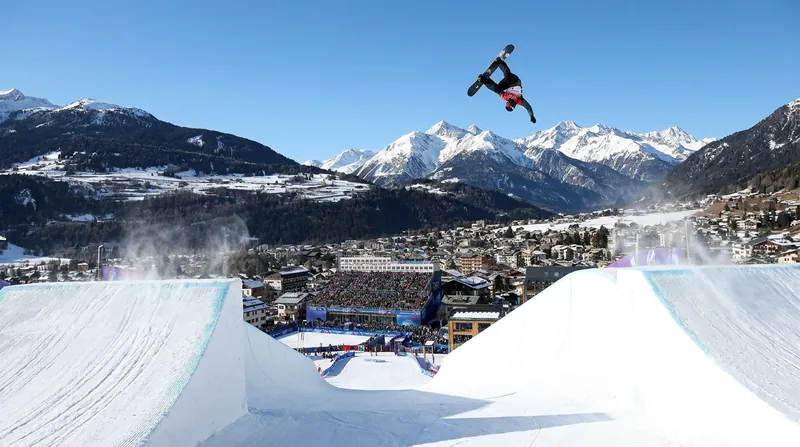
In the high-altitude chill of the 2025–2026 winter season, the physics of women's snowboarding were fundamentally rewritten. When Japanese snowboarder Kokomo Murase launched off a massive kicker and landed a backside triple cork 1620—first in training, then to claim gold at the 2026 X Games, and ultimately carrying that momentum to the Milano Cortina Olympics—she didn't just win a competition. She shattered a ceiling that many thought would hold for another decade.[2]
To understand the magnitude of a 1620, one must break down the math of the rotation. The trick requires the rider to spin 1620 degrees—exactly four and a half full rotations—while simultaneously flipping off-axis three separate times, a maneuver known as a "triple cork." The rider takes off riding forward and lands riding backward, or "switch." Executing this requires a violent generation of torque at the lip of the jump, followed by a perfectly timed aerodynamic tuck to accelerate the spin, and blind spatial awareness to spot the landing.
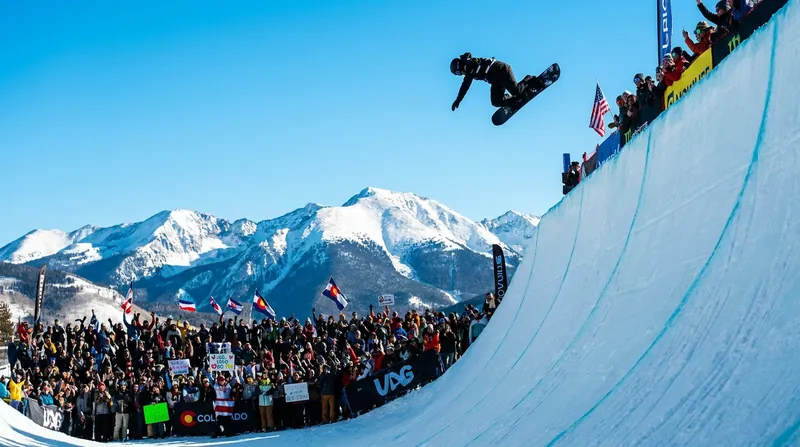
Murase was not the only rider pushing the sport into the 1620 era this season. On the men's side, South Korean snowboarder Chaeun Lee brought the trick into the restrictive, vertical walls of the halfpipe. At the 2026 Winter Olympics, Lee became the first athlete to successfully land a frontside triple cork 1620 in a halfpipe competition. While big air jumps offer massive hangtime and distance, the halfpipe demands near-instantaneous rotation before gravity pulls the rider back down the 22-foot icy transition.[2]
This sudden explosion of progression is not merely the result of braver athletes; it is the culmination of a multi-year revolution in snowboard technology. For decades, the formula for a stable, big-jump snowboard was simple: make it longer and stiffer. But longer boards carry a heavy "swing weight"—the rotational inertia that fights against the rider when they try to spin fast in the air.[1]
Enter the "volume-shifted" board revolution, which became the dominant design standard by 2026. Board engineers realized that by making snowboards significantly wider, they could drastically reduce the length without sacrificing the surface area needed to float in powder or land heavy jumps. A rider who traditionally rode a 152-centimeter board could now ride a 146-centimeter volume-shifted deck.[1]
This reduction in length pulls the mass of the board closer to the rider's center of gravity. In physics terms, it reduces the moment of inertia. When Murase initiates her 1620, the shorter board snaps around with far less resistance, allowing her to squeeze in that final half-rotation before the ground rushes up to meet her.[1]
Camber profiles—the curve of the board when viewed from the side—have also evolved to support these massive tricks. Modern freestyle boards utilize a "hybrid camber" design. Traditional camber sits under the rider's feet, acting like a loaded spring to provide the explosive pop needed to clear 80-foot jumps. Meanwhile, rocker, or reverse camber, at the nose and tail lifts the contact points slightly off the snow, making the board more forgiving and reducing the catastrophic risk of catching an edge on a slightly under-rotated landing.[1]
But technology alone cannot overcome the human instinct of self-preservation. The true catalyst for the 1620 era is the proliferation of year-round airbag training facilities. A decade ago, learning a new triple cork meant launching onto hard-packed snow; a single mistake could end a season or a career.[3]
Today, facilities like SNÖBAHN in Colorado and Maximise in Quebec utilize massive, sloped inflatable airbags that perfectly mimic the pitch of a real mountain landing. These "no-bounce" systems allow riders to safely absorb the impact of a botched landing. Instead of attempting a dangerous new trick once or twice a week, athletes can now launch into an airbag fifty times a day.[3]
This high-repetition environment builds the crucial muscle memory required for complex multi-axis flips. By the time a rider like Murase or Lee takes their trick to the snow at the X Games or the Olympics, they have already landed it hundreds of times in a controlled, consequence-free environment. The airbag has transformed snowboarding progression from a game of reckless courage into a science of calculated repetition.[3]
However, this rapid progression has sparked a fierce philosophical debate within the snowboarding community. Style purists argue that the sport is losing its creative soul, morphing into a "spin-to-win" gymnastics contest. Critics point out that when riders are hyper-focused on squeezing in four and a half rotations, they sacrifice the slow, tweaked grabs and individual flair that originally separated snowboarding from rigid Olympic disciplines like aerial skiing.[4]
Progression advocates counter that this cycle is as old as the sport itself. When the 1080, consisting of three rotations, was first introduced, it was criticized as robotic and rushed. Today, the 1080 is considered a standard trick, and riders execute it with massive, stylish grabs. The argument goes that once the 1620 barrier is normalized, the next generation will figure out how to make it look effortless.[4]
Progression advocates counter that this cycle is as old as the sport itself.
As the 2026 season closes, the question is no longer whether women can land a 1620, but where the physical limit truly lies. With airbag technology mitigating risk and volume-shifted boards optimizing physics, the 1800—five full rotations—is already being discussed in training camps. But for now, the 1620 stands as the ultimate testament to what happens when human athleticism perfectly aligns with engineering and infrastructure.[3][4]
Key points
- Japanese snowboarder Kokomo Murase became the first woman to land a backside triple cork 1620 in competition during the 2026 season.
- The trick requires four and a half full rotations combined with three off-axis flips.
- South Korea's Chaeun Lee also made history by landing a frontside triple cork 1620 in the Olympic halfpipe.
- The progression is heavily driven by 'volume-shifted' snowboards, which are shorter and wider to reduce rotational swing weight.
- Sloped airbag training facilities now allow athletes to safely practice high-consequence tricks dozens of times a day.
- A debate continues between progression advocates and style purists over whether extreme spins detract from the sport's aesthetic roots.
How we got here
2015
The first men's triple cork 1440s and 1620s are landed, pushing the boundaries of big air.
2017
Airbag landing facilities begin appearing in North America, allowing safe year-round training.
2024
Volume-shifted snowboards become a dominant market trend, reducing swing weight for riders.
Nov 2025
Kokomo Murase lands the first women's backside triple cork 1620 in training in Austria.
Jan 2026
Murase successfully lands the 1620 in competition at the X Games.
Feb 2026
Chaeun Lee lands the first frontside triple cork 1620 in an Olympic halfpipe at Milano Cortina.
- Progression Advocates
- Athletes and fans who believe pushing the physical limits of rotation is the core of the sport.
- Safety & Infrastructure Developers
- Engineers and facility operators focused on mitigating the extreme risks of modern tricks.
- Style Purists
- Critics who argue that hyper-rotational tricks detract from the aesthetic roots of snowboarding.
Perspectives this story doesn't cover
- Casual recreational snowboarders
- Medical professionals treating extreme sports injuries
Sources
Source coverage
4 outlets
3 viewpoints surfaced




- [1]OutsideSafety & Infrastructure Developers
The Best Snowboards of 2026
Read on Outside → - [2]Olympics.comProgression Advocates
2025/2026 Snowboard World Cup halfpipe, slopestyle & big air schedule
Read on Olympics.com → - [3]Progression AirbagsSafety & Infrastructure Developers
Airbag Training Facilities and Progression Parks
- [4]Factlen Editorial TeamSafety & Infrastructure Developers
Synthesis by Factlen editorial team
Read on Factlen Editorial Team →
More in Sports
See all →Winter Sports
U.S. Ski & Snowboard Unveils Record 13 Domestic World Cup Events for 2026-27 Season
3 sources
Operation Giant Slalom
How 'Operation Giant Slalom' Dismantled a Transnational Cartel Network
4 sources

Injury
Snowboard Injury Report: Brearley, McMorris, and Hirano Target 2026–27 Returns Following Grueling Olympic-Year Setbacks
6 sources
Standings
Josie Baff and Adam Lambert Headline the 2026 Australia New Zealand Cup Snowboard Cross Standings Chase
5 sources
Comments
Every angle. Every day.
Get Sports stories with full source coverage and perspective breakdowns, free every day.