
How Electric Hydrofoil Boats Are Rewriting the Rules of Marine Transport
By combining underwater wings with aerospace flight software, a new generation of electric boats is eliminating drag, maximizing battery range, and offering a silent, zero-emission ride.
By Factlen Editorial Team
- Marine Technologists
- Focus on the software, efficiency gains, and the engineering breakthrough of fly-by-wire stabilization.
- Environmental Advocates
- Highlight the ecological benefits of zero emissions, noise reduction, and the elimination of destructive wakes.
- Maritime Market Analysts
- Track the commercial viability, market growth projections, and the economic shift from high upfront costs to long-term operational savings.
What's not represented
- · Marina operators managing charging infrastructure upgrades
- · Local regulators managing speed limits for wake-free vessels
Why this matters
Marine transport has long been a heavy polluter due to the massive energy required to push hulls through water. Hydrofoiling solves the physics problem of drag, making zero-emission, silent, and wake-free electric boating commercially viable for the first time.
Key points
- Electric hydrofoil boats use underwater wings to lift the hull above the surface, reducing drag by up to 80 percent.
- This massive reduction in friction allows battery-electric boats to achieve ranges of 50 to 75 nautical miles at high speeds.
- Onboard aerospace software adjusts the wings up to 100 times per second to keep the inherently unstable boats perfectly balanced.
- Because the hull doesn't push through the water, hydrofoils produce zero wake, protecting shorelines and marine infrastructure.
- The global electric boat market is projected to grow from $7.8 billion in 2025 to over $24 billion by 2034.
Water is incredibly dense. Pushing a traditional boat hull through it requires massive amounts of energy, a reality that has dictated marine engineering for centuries. For decades, this fundamental physics problem made electric boats largely impractical for anything beyond slow, short-distance cruising. Batteries simply could not store enough energy to push a heavy hull very far before running out of power.[7]
But a quiet revolution is currently taking place on lakes, coastal waterways, and urban harbors. A new generation of electric boats is no longer pushing through the water at all; instead, they are flying above it.[7]
By combining 160-year-old hydrofoil concepts with modern aerospace software and high-density lithium-ion batteries, marine engineers have unlocked the code to sustainable boating. The result is a rapidly growing market for electric hydrofoil vessels that promise zero emissions, zero wake, and near-silent operation.[1][7]
To understand why hydrofoiling is the missing link for electric marine transport, one must look at the physics of drag. When a traditional boat accelerates, it creates a bow wave and must constantly expend energy to climb over the water it displaces.[4]
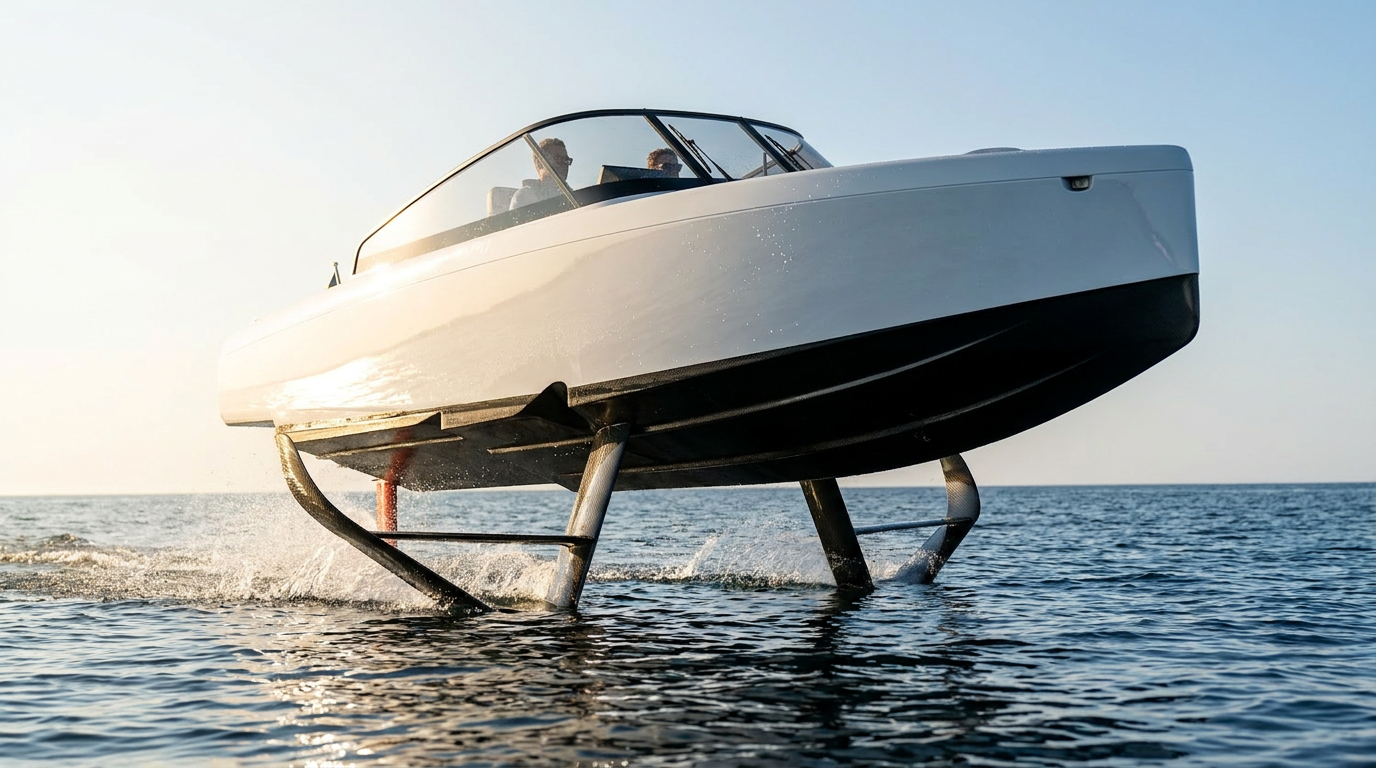
A hydrofoil solves this by acting like an underwater airplane wing. As the boat gains speed, water flows over the submerged carbon-fiber wings. Because of the foil's specific shape, water travels faster over the top surface than the bottom, creating a distinct pressure difference.[4]

According to Bernoulli's principle, this pressure difference generates upward lift. Once the vessel reaches a critical speed—often around 10 to 15 knots—the hull rises completely out of the water, leaving only the thin struts and the propulsion unit submerged.[4][7]
The efficiency gains achieved by this maneuver are staggering. Lifting the hull into the air reduces hydrodynamic drag by up to 80 percent compared to a traditional planing boat.[2]
This drastic reduction in friction is exactly what makes battery-electric propulsion viable on the water. Instead of draining a massive battery bank in 30 minutes just to plow through the waves, an electric hydrofoil uses a fraction of the energy to maintain its flight, unlocking ranges of 50 to 75 nautical miles on a single charge.[2][3]
However, a fully submerged hydrofoil is inherently unstable. If left to its own devices, the boat would crash or capsize almost immediately, much like trying to balance a pen on the palm of your hand.[7]
However, a fully submerged hydrofoil is inherently unstable.
This is where modern fly-by-wire software enters the equation. The latest electric hydrofoils rely on advanced flight controllers—similar to those used in modern fighter jets—that continuously process data from onboard gyroscopes, accelerometers, and ultrasonic height sensors.[2][7]
These computers adjust the angle of attack of the underwater wings up to 100 times per second. The software makes micro-corrections to account for oncoming waves, crosswinds, and even passenger movement, resulting in an artificially stabilized, glass-smooth ride even in choppy conditions.[2]

Two companies are currently leading this commercial charge. In Sweden, Candela has pioneered the consumer market with its C-8 leisure boat, which utilizes a 69-kilowatt-hour battery and a highly efficient 55-kilowatt pod motor to cruise comfortably at 27 knots.[2]
Meanwhile, in the United States, Navier has developed the N30, a 30-foot aerospace-inspired vessel. The N30 is slated to become the backbone of a major clean mobility network in the Maldives, where a fleet of 100 electric foiling boats will provide emission-free inter-island transport starting in 2026.[3]
The environmental benefits of these vessels extend far beyond the elimination of greenhouse gases and exhaust fumes. Because the hull flies above the surface, hydrofoil boats produce virtually no wake.[2]

Traditional boat wakes cause severe shoreline erosion and damage to marine infrastructure, forcing regulators to impose strict speed limits in coastal zones. A hydrofoil, however, can travel at 30 knots through a harbor without disturbing a docked canoe or eroding a fragile riverbank.[2][7]
Furthermore, the absence of a roaring combustion engine eliminates underwater noise pollution. Traditional marine engines generate significant acoustic disturbances that have been shown to disrupt the communication, navigation, and mating habits of marine wildlife.[6]
The economics of boating are also shifting as a result of this technology. While the upfront purchase price of a carbon-fiber electric hydrofoil remains steep—often exceeding $390,000 for a luxury consumer model—the operational costs are a fraction of their fossil-fuel counterparts.[6][7]
Owners of electric boats save an estimated $5,000 to $7,200 annually on fuel and routine maintenance. There are no oil changes, no spark plugs to replace, and no complex winterization procedures required for the electric drivetrain.[6]

The broader electric boat market is responding aggressively to these breakthroughs. Valued at roughly $7.8 billion in 2025, the sector is projected to surge past $24 billion by the mid-2030s, driven by stricter maritime emission regulations and continuous advancements in battery density.[1][5]
Challenges certainly remain, particularly regarding the build-out of high-speed marine charging networks and the sheer manufacturing scale required to lower upfront costs. But as the technology matures and production increases, the sight of boats silently flying above the waves is poised to become the new normal on the world's waterways.[5][7]
How we got here
1869
Emmanuel Denis Farcot patents the first hydrofoil concept, though the technology remains niche for over a century.
1974
Boeing launches the Jetfoil, a gas-turbine powered passenger hydrofoil that proves the concept works at scale.
2019
Swedish manufacturer Candela launches the C-7, the first mass-produced electric hydrofoil leisure boat.
2024
US-based Navier introduces the N30, an aerospace-inspired electric foiling vessel designed for both leisure and commercial use.
2026
A fleet of 100 electric hydrofoil water taxis begins deployment in the Maldives to create an emission-free transit network.
Viewpoints in depth
Marine Innovators
Engineers and technologists view hydrofoiling as the ultimate solution to the physics problem of marine drag.
For marine engineers, the transition to electric propulsion was historically blocked by the density of water. Pushing a heavy hull requires exponentially more energy as speed increases, making heavy battery banks impractical. By lifting the hull out of the water, innovators argue they haven't just built a better boat—they've fundamentally changed the physics equation of maritime transport. The focus for this camp is entirely on software refinement, as the fly-by-wire systems that keep these vessels stable are the true intellectual property driving the industry forward.
Environmental Advocates
Conservationists champion the technology for its ability to eliminate emissions, noise, and destructive wakes.
Environmental groups emphasize the secondary benefits of hydrofoiling that go beyond simply replacing fossil fuels. Traditional boat wakes are a major cause of shoreline erosion and damage to fragile coastal ecosystems. Because hydrofoils fly above the surface, they leave virtually no wake, allowing them to travel at high speeds through protected zones without disturbing the environment. Furthermore, the silent operation of electric pod motors eliminates the underwater acoustic pollution that severely disrupts marine life communication and navigation.
Traditional Boating Industry
Legacy manufacturers and market analysts acknowledge the tech but point to high costs and infrastructure hurdles.
While impressed by the technology, traditional maritime analysts caution that electric hydrofoils remain a luxury product. With consumer models frequently pricing above $390,000, the technology is currently out of reach for the average recreational boater. Additionally, this camp points out that the widespread adoption of electric boats is bottlenecked by a lack of high-speed marine charging infrastructure at local docks and marinas. Until manufacturing scales up and charging networks expand, they view hydrofoils as a premium niche rather than an immediate replacement for gas outboards.
What we don't know
- How quickly high-speed marine charging infrastructure can be deployed to support widespread commercial fleets.
- Whether manufacturing scale can bring the price of carbon-fiber electric hydrofoils down to match traditional gas-powered boats.
- How long-term maintenance of complex underwater flight-control actuators will compare to traditional marine maintenance over a 10-to-20-year lifespan.
Key terms
- Hydrofoil
- An underwater wing attached to a boat's hull that generates lift, raising the vessel out of the water to reduce drag.
- Bernoulli's Principle
- A principle of fluid dynamics stating that an increase in the speed of a fluid occurs simultaneously with a decrease in pressure, which is how foils generate lift.
- Fly-by-wire
- A system that replaces conventional manual controls with an electronic interface, using computers to automatically stabilize the vessel.
- Pod Motor
- An electric propulsion unit housed in a submerged pod outside the boat's main hull, often integrated directly into the hydrofoil structure.
Frequently asked
How fast do electric hydrofoil boats go?
Most consumer and commercial electric hydrofoils cruise comfortably between 20 and 30 knots, matching the speed of traditional gas-powered boats.
What happens if the boat hits debris underwater?
Modern hydrofoils are designed with sheer pins or breakaway mechanisms that allow the foil to swing back upon impact, protecting the hull from severe structural damage.
Do you need special training to drive one?
No. The onboard flight-control software automatically manages the complex balancing and foiling mechanics, allowing the driver to steer it just like a conventional boat.
Are electric boats cheaper to own?
While the initial purchase price is significantly higher, owners save an estimated $5,000 to $7,200 annually on fuel and maintenance, as electric motors require no oil changes or winterization.
Sources
Source coverage
7 outlets
3 viewpoints surfaced







[1]Fortune Business InsightsMaritime Market Analysts
Electric Boat Market Size, Share & Industry Analysis, 2026-2034
Read on Fortune Business Insights →[2]CandelaMarine Technologists
Electric vs. combustion engine boats; all you need to know
Read on Candela →[3]AutoEvolutionMarine Technologists
100 Electric Flying Boats Will Create a Massive Clean Mobility Network in the Maldives
Read on AutoEvolution →[4]E-SurferMaritime Market Analysts
Hydrofoil technology: How it works and its applications
Read on E-Surfer →[5]Research and MarketsMaritime Market Analysts
Electric Boat Global Market Report 2026
Read on Research and Markets →[6]HalevaiEnvironmental Advocates
Compare electric vs gas boats: Performance, cost, and maintenance
Read on Halevai →[7]Factlen Editorial TeamEnvironmental Advocates
Synthesis by Factlen editorial team
Read on Factlen Editorial Team →
Every angle. Every day.
Get automotive stories with full source coverage and perspective breakdowns delivered to your inbox.