
The Rise of the 'Green-Collar' Apprenticeship: How Vocational Training is Powering the Clean Energy Boom
As the transition to renewable energy accelerates, vocational programs and paid apprenticeships are emerging as the debt-free fast track to some of the fastest-growing jobs in the U.S. economy.
By Factlen Editorial Team
- Vocational & Equity Advocates
- Emphasize the debt-free nature of apprenticeships and the opportunity to build generational wealth in marginalized communities.
- Labor Market Analysts
- Focus on the unprecedented growth rates and the severe skills shortage threatening deployment timelines.
- Federal & State Policymakers
- View vocational training as the critical mechanism to achieve statutory climate targets and ensure grid reliability.
- Factlen Editorial Team
- Synthesizes the data to highlight the cultural shift away from four-year degrees toward high-paying trades.
What's not represented
- · Traditional four-year university administrators
- · Fossil fuel industry workers transitioning to new roles
Why this matters
For decades, students were told a four-year degree was the only path to a stable career. The explosion of green-collar trades proves that paid apprenticeships offer a debt-free, highly lucrative alternative that is essential to modernizing the global energy grid.
Key points
- Wind turbine service technicians and solar PV installers are projected to be the two fastest-growing occupations in the U.S. economy through 2034.
- Registered apprenticeships offer an 'earn while you learn' model, allowing workers to avoid tuition debt while securing high-paying roles.
- The U.S. Department of Energy estimates that completing a registered apprenticeship yields a $300,000 lifetime earnings premium.
- State governments and grassroots organizations are funding pre-apprenticeship programs with wrap-around services to ensure marginalized communities can access the green boom.
- Despite rapid growth, 86% of solar employers report difficulty finding trained workers, making human capital the primary bottleneck in the energy transition.
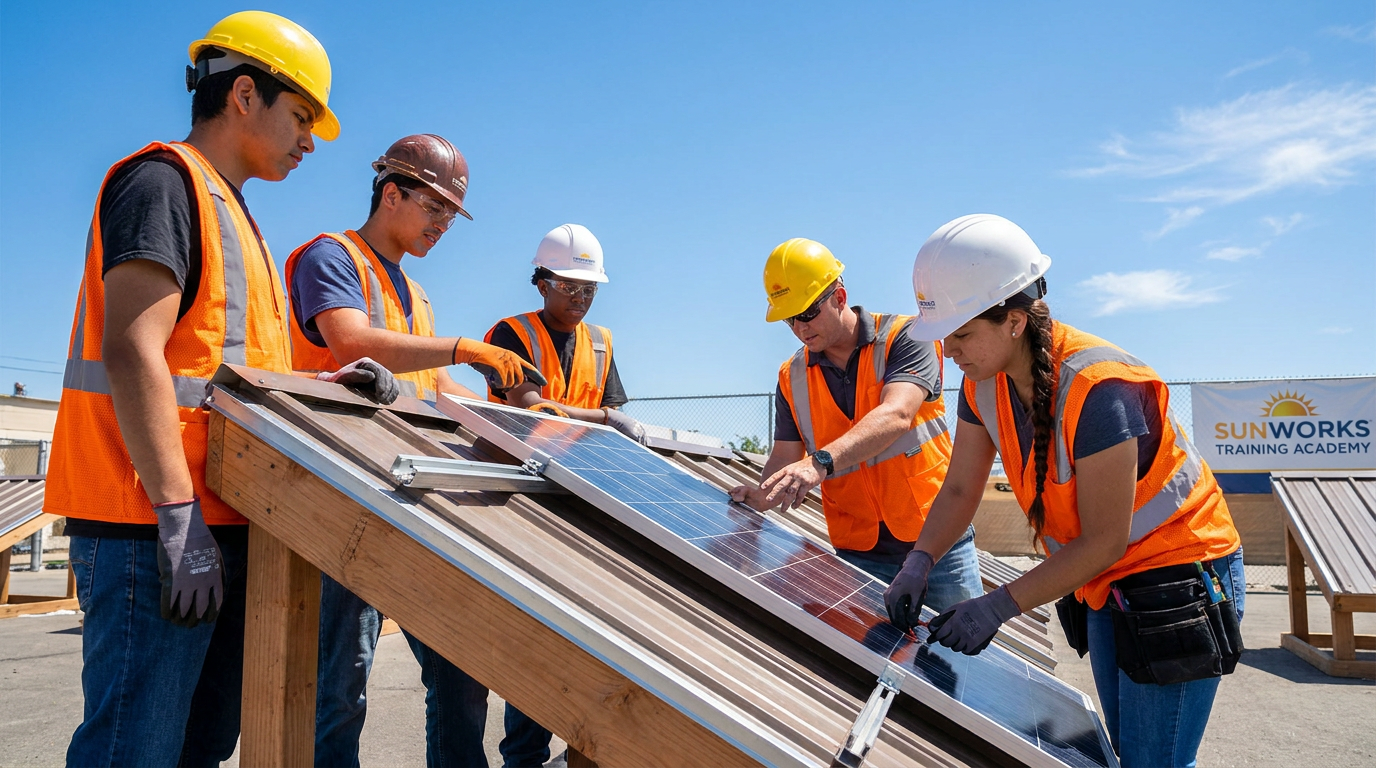
For decades, the American educational narrative was singular: a four-year university degree was the exclusive gateway to the middle class. Vocational education was often sidelined, viewed as a fallback rather than a destination. But in 2026, the economic reality has fundamentally shifted. The fastest-growing jobs in the country do not require a bachelor's degree. They require a toolbelt, a safety harness, and highly specialized technical training.[1]
This shift is being driven by the massive, global transition toward renewable energy. As billions of dollars in public and private capital flow into grid modernization, battery storage, and clean power generation, a new class of professional has emerged: the "green-collar" worker. From the electricians wiring rooftop solar arrays to the data scientists optimizing wind farm outputs, these roles form the backbone of the modern energy economy.[4]
The sheer scale of the demand is staggering. According to the U.S. Bureau of Labor Statistics, the two fastest-growing occupations in the entire U.S. economy over the next decade are both in the clean energy sector. Employment for wind turbine service technicians is projected to skyrocket by 50% between 2024 and 2034.[2]
Solar photovoltaic (PV) installers are close behind, with a projected growth rate of 42% over the same period. To put those numbers in perspective, the average growth rate across all U.S. occupations is roughly 3%. This unprecedented expansion is fueled by plummeting hardware costs, rising electricity demand, and aggressive federal and state climate policies that incentivize renewable deployment.[2][5]

But building a clean energy grid requires more than just capital and policy; it requires trained human hands. Currently, the industry is facing a severe bottleneck. Solar panels are being manufactured and shipped faster than trained technicians can safely install them. Recent industry censuses reveal that 86% of solar employers report difficulty filling open positions, with a significant portion describing the hiring landscape as "very difficult."[4][5]
To close this critical skills gap, the industry is reviving and modernizing one of the oldest forms of education: the apprenticeship. Unlike the traditional college route, which often saddles students with tens of thousands of dollars in tuition debt, registered apprenticeships operate on an "earn while you learn" model. Apprentices are paid employees from day one, receiving a wage that scales upward as their skills and certifications advance.[1][3]
The financial outcomes of this vocational pathway are compelling. The U.S. Department of Energy has increasingly spotlighted registered apprenticeships as a premier workforce development tool, noting that workers who complete a registered apprenticeship earn approximately $300,000 more in wages and benefits over their careers compared to those who do not.[3]
The financial outcomes of this vocational pathway are compelling.
For entry-level wind turbine technicians, the median annual pay sits at roughly $62,580, with top earners making well over $90,000. Solar PV installers earn a median of around $51,860, with clear pathways to advance into project management, system design, or independent contracting. For a career path that requires only a high school diploma and specialized vocational training, the return on investment is exceptionally high.[2][5]

Recognizing that training costs can still be a barrier, state governments are stepping in with aggressive funding mechanisms. In Nevada, the Clean Energy Fund recently launched the Solar for All Training Voucher Program. This initiative covers up to $15,000 per trainee for solar-related courses, apprenticeships, and certifications, ensuring that job seekers can turn a short vocational course into a long-term career without incurring any tuition debt.[6]
Similarly, New York State has mobilized its Energy Research and Development Authority (NYSERDA) to administer competitive grants for Clean Energy Career Pathways. These programs fund curriculum development, equipment purchases, and hands-on technical training for building electrification and offshore wind. Crucially, New York offers reduced cost-share requirements for projects that recruit heavily from disadvantaged communities, attempting to ensure the green boom is equitable.[7]
At the grassroots level, organizations are innovating to make these pathways accessible to marginalized populations who might otherwise be left behind. In the Southeast, groups like Sustainable Georgia Futures have utilized grant funding to pilot "pre-apprenticeship" programs. These initiatives are designed to meet candidates exactly where they are, preparing them for the rigors of a formal registered apprenticeship.[8]
The Georgia program is notable for its holistic approach to workforce development. Participants are not only paid to attend their introductory classes, but they are also provided with breakfast, lunch, and vital wrap-around services like childcare. By removing these logistical and financial barriers, the program allows residents from multi-generational poverty to access certifications from the Occupational Safety and Health Administration (OSHA) and the North American Board of Certified Energy Practitioners (NABCEP).[8]

Once these pre-apprentices pass their initial exams, they transition into six months of on-the-job training, working alongside certified installers at local solar companies. This direct pipeline from community recruitment to paid training to full-time employment represents the gold standard for how the clean energy transition can simultaneously serve as an engine for upward economic mobility.[8]
The work itself is not for everyone. Wind turbine maintenance requires comfort with extreme heights, physical stamina, and a willingness to travel or work offshore. Solar installation involves long days on rooftops in variable weather, carrying heavy equipment. Yet, for those who embrace the physical nature of the trades, the work offers a tangible sense of accomplishment and unparalleled job security.[4][5]

Ultimately, the rise of the green-collar apprenticeship is inadvertently solving two distinct American crises at once. It is providing the skilled labor necessary to decarbonize the power grid and combat climate change, while simultaneously offering a debt-free, high-paying alternative to the traditional four-year college degree. As the energy transition accelerates, it is the vocational students with toolbelts and safety harnesses who are quite literally building the future.[1]
How we got here
2021
The Bipartisan Infrastructure Law is passed, injecting billions into grid modernization and creating massive demand for skilled trades.
2022
The Inflation Reduction Act ties clean energy tax credits to prevailing wage and registered apprenticeship requirements.
2024
The U.S. Bureau of Labor Statistics officially projects wind turbine technicians and solar installers as the two fastest-growing occupations for the coming decade.
2025
States like Nevada and New York launch aggressive, multi-million dollar training voucher programs to close the clean energy skills gap.
2026
Industry reports reveal that 86% of solar employers are struggling to hire, prompting a nationwide surge in pre-apprenticeship funding.
Viewpoints in depth
Labor Market Analysts
Focus on the unprecedented growth rates and the severe skills shortage threatening deployment timelines.
Economists and labor analysts view the clean energy transition primarily as a massive logistical challenge. While they celebrate the creation of high-paying jobs, they warn that the current skills gap—where 86% of solar employers struggle to hire—could bottleneck statutory climate goals. Their focus is on rapidly scaling vocational infrastructure to meet the 50% projected growth in wind and 42% in solar, arguing that capital investment in renewable hardware is useless without the human capital to install and maintain it.
Vocational & Equity Advocates
Emphasize the debt-free nature of apprenticeships and the opportunity to build generational wealth in marginalized communities.
For workforce development organizations and equity advocates, the green-collar boom is a once-in-a-generation opportunity to bypass the student debt crisis. They champion the "earn while you learn" apprenticeship model as a tool for upward mobility, particularly for communities historically excluded from high-tech booms. These advocates prioritize pre-apprenticeship programs that offer wrap-around services like childcare and transportation, ensuring that the transition to a zero-emissions economy also functions as an engine for social equity.
Federal & State Policymakers
View vocational training as the critical mechanism to achieve statutory climate targets and ensure grid reliability.
Government officials approach the green workforce from a macro-policy perspective. For them, funding training vouchers and apprenticeship grants is a matter of national security and economic competitiveness. By tying tax incentives to prevailing wage and apprenticeship requirements, policymakers aim to ensure that the billions of dollars flowing into grid modernization stay within local economies, creating a durable, domestic workforce capable of sustaining long-term energy independence.
What we don't know
- Whether the current expansion of vocational training centers can scale fast enough to meet the statutory climate goals set for 2030 and 2035.
- How the integration of AI and advanced robotics in solar manufacturing might eventually shift the specific technical skills required of human installers.
- The long-term retention rates of workers entering physically demanding green trades compared to traditional indoor occupations.
Key terms
- Green-Collar Worker
- A professional employed in the environmental sectors of the economy, particularly in roles related to renewable energy, energy efficiency, and sustainability.
- Registered Apprenticeship
- A formal, government-recognized training program that combines paid on-the-job experience with technical classroom instruction.
- NABCEP Certification
- A credential issued by the North American Board of Certified Energy Practitioners, widely considered the gold standard for professionals in the solar industry.
- Pre-Apprenticeship
- A preparatory program designed to help individuals build the foundational skills and certifications needed to succeed in a formal registered apprenticeship.
- Grid Modernization
- The process of upgrading the traditional electrical grid with new technologies, such as battery storage and smart meters, to better handle renewable energy sources.
Frequently asked
What exactly is a "green-collar" job?
A green-collar job is a role that directly contributes to reducing environmental harm or improving ecological health. In the energy sector, this includes direct roles like solar panel installers and wind turbine technicians, as well as indirect roles in clean technology manufacturing and grid modernization.
Do I need a college degree to become a wind turbine technician?
No. The vast majority of wind turbine technicians and solar installers enter the field with a high school diploma followed by specialized vocational training, a certificate program, or a registered apprenticeship.
How much do these renewable energy trades pay?
According to the Bureau of Labor Statistics, the median annual pay for wind turbine service technicians is approximately $62,580, while solar photovoltaic installers earn a median of $51,860. Apprentices in these fields are paid while they learn, with wages increasing as they gain certifications.
What is a registered apprenticeship?
A registered apprenticeship is a federally or state-recognized training program that combines paid, on-the-job learning with classroom instruction. It allows workers to earn a wage from day one while avoiding the tuition debt typically associated with higher education.
Sources
Source coverage
8 outlets
4 viewpoints surfaced








[1]Factlen Editorial TeamFactlen Editorial Team
Synthesis by Factlen editorial team
Read on Factlen Editorial Team →[2]U.S. Bureau of Labor StatisticsLabor Market Analysts
Fastest growing occupations: 20 occupations with the highest projected percent change of employment between 2024–34
Read on U.S. Bureau of Labor Statistics →[3]U.S. Department of EnergyFederal & State Policymakers
Building a Clean Energy Workforce
Read on U.S. Department of Energy →[4]Green Fuel JournalLabor Market Analysts
The Policy Context Behind Job Creation in Renewable Energy
Read on Green Fuel Journal →[5]TradeColleges.orgVocational & Equity Advocates
Solar PV installer — 42% projected job growth (BLS)
Read on TradeColleges.org →[6]Nevada Clean Energy FundVocational & Equity Advocates
Nevada Solar for All Training Voucher Program
Read on Nevada Clean Energy Fund →[7]New York State (NYSERDA)Federal & State Policymakers
Clean Energy Career Pathways Training and Technical Skills Training
Read on New York State (NYSERDA) →[8]CSRWireVocational & Equity Advocates
Sustainable Georgia Futures Celebrating the Pre-Apprentices
Read on CSRWire →

Every angle. Every day.
Get education stories with full source coverage and perspective breakdowns delivered to your inbox.