
Hardside vs. Softside Luggage: The Complete Trade-Off Analysis for Travelers
Choosing between polycarbonate shells and ballistic nylon comes down to packing habits, destination, and overhead bin flexibility. Here is the definitive guide to matching your suitcase to your travel style.
By Factlen Editorial Team
- Softside Advocates
- Travelers who value flexibility, exterior organization, and the ability to squeeze carry-ons into tight overhead bins.
- Hardside Loyalists
- Travelers who prioritize absolute protection, security, and weather resistance, often favoring checked baggage for long-haul trips.
- Travel Gear Analysts
- Experts who evaluate suitcases based on material science, weight-to-durability ratios, and long-term warranty value.
What's not represented
- · Baggage Handlers who interact with both luggage types daily and see firsthand which materials fail under industrial stress.
- · Sustainable Travel Advocates concerned with the environmental impact and recyclability of polycarbonate plastics versus synthetic nylons.
Why this matters
Luggage is a long-term investment that dictates your comfort in transit. Selecting the wrong material can lead to cracked shells, water damage, or the frustration of a bag that won't compress into a tight overhead bin.
Key points
- Hardside luggage utilizes rigid materials like polycarbonate and aluminum to provide superior protection for fragile items and electronics.
- Softside luggage relies on flexible fabrics like ballistic nylon, allowing the bag to stretch and squeeze into tight overhead bins.
- Hardside suitcases typically feature a clamshell design that splits the bag in half, while softside bags use a top-lid opening for a single deep compartment.
- Softside bags offer exterior pockets for quick access to travel documents and laptops, a feature largely absent from hardside models.
- Hardside luggage is generally heavier and prone to visible scratches, whereas softside luggage is lighter but susceptible to tearing and water absorption.
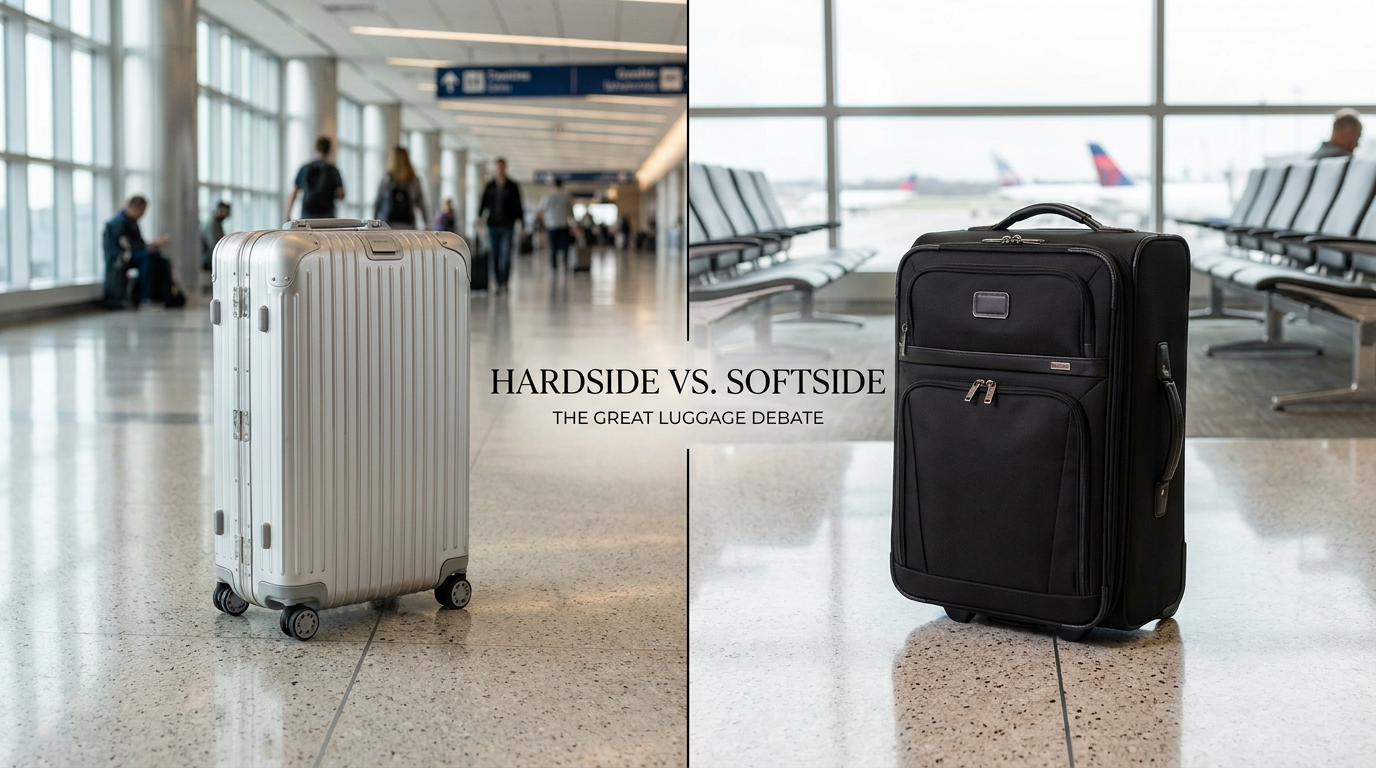
Standing in the luggage aisle or scrolling through endless online catalogs, every traveler eventually faces the same fundamental dilemma: the sleek, rigid armor of a hardside suitcase or the classic, flexible utility of ballistic nylon. It is a debate that divides frequent flyers, flight attendants, and casual vacationers alike. The choice between hardside and softside luggage is not merely an aesthetic preference; it fundamentally alters how you pack, how you navigate airport terminals, and how your belongings survive the brutal choreography of baggage handling. Making the right choice transforms a suitcase into an invisible, frictionless part of the journey, while the wrong choice can result in wrestling with an overstuffed overhead bin at six in the morning or watching a cracked shell roll off a baggage carousel.[4][6]
To understand the landscape, one must first look at the materials driving the modern luggage industry. The majority of contemporary hardside suitcases are engineered from polycarbonate, polypropylene, ABS (acrylonitrile butadiene styrene), or premium aluminum. These materials are designed to absorb impact, providing a rigid barrier against rough handling and turbulent travel conditions. Conversely, the softside market is dominated by high-density fabrics like nylon, polyester, and canvas, often treated with moisture-resistant coatings. These fabrics offer a completely different set of physical properties, prioritizing flexibility, stretch, and exterior accessibility over absolute structural rigidity.[1][2]
The argument for hardside luggage centers heavily on absolute protection and security. The rigid structure provides an unparalleled shield for fragile items, electronics, glassware, or delicate souvenirs, safeguarding them against the inevitable drops and tosses of the tarmac. Furthermore, a polycarbonate or aluminum shell cannot be slashed open by opportunistic thieves, and virtually all premium hardside options feature integrated, TSA-approved combination locks built directly into the frame. For travelers checking bags on multi-leg international journeys where baggage security and rough handling are genuine concerns, this rigid armor provides meaningful peace of mind.[1][3][4]

The evidence supporting hardside durability is compelling, particularly regarding weather resistance. A solid polycarbonate shell naturally sheds water, meaning that if a suitcase is left sitting on a rainy tarmac by baggage handlers, the contents remain completely dry. While premium softside bags utilize water-resistant chemical coatings that perform admirably in light drizzle, they cannot match the impermeable seal of a hard shell during sustained exposure to heavy precipitation or accidental liquid spills in the cargo hold. Hardside luggage also wipes clean effortlessly, allowing travelers to easily remove the scuffs, dirt, and grime accumulated during transit with a simple damp cloth.[2][3][4]
However, the case against hardside luggage highlights its inherent inflexibility and spatial limitations. The rigid exterior means the bag cannot stretch to accommodate that one last sweater or a bulky pair of shoes. Furthermore, the vast majority of hardside suitcases lack exterior pockets, forcing travelers to open the entire main compartment just to retrieve a laptop, a boarding pass, or a charging cable. This sleek, streamlined design looks highly professional, but it sacrifices the quick-grab convenience that many modern travelers rely on while navigating security checkpoints or waiting at the boarding gate.[1][3]
Additionally, while hardside materials are highly protective, they are not immune to cosmetic damage. Polycarbonate and aluminum are prone to visible scuffs, scratches, and dents over time, wearing their travel history as highly visible battle wounds. Weight is another critical factor in the case against hardside bags. While modern manufacturing has significantly reduced the weight of plastics like polypropylene, hardside suitcases generally weigh more than their softside counterparts. High-end aluminum cases can clock in at nearly twelve pounds empty, eating into strict airline weight allowances before a single item of clothing is packed.[1][3][5]
Additionally, while hardside materials are highly protective, they are not immune to cosmetic damage.
Quantifying the weight differences reveals a tangible trade-off for frequent flyers navigating strict airline baggage policies. Most premium softside carry-on bags range in weight from five to ten pounds when completely empty, utilizing lightweight fiberglass frames and high-denier nylon to keep the bulk down. In contrast, hardside options typically fall in the range of ten to fifteen pounds, depending heavily on the specific material. While ultra-lightweight polypropylene has closed the gap significantly, the heaviest aluminum hardside cases demand a substantial portion of a standard fifty-pound checked bag allowance before the traveler has even packed a pair of socks.[1][5]

Shifting to the other side of the aisle, the argument for softside luggage is built entirely around flexibility, adaptability, and organizational depth. Softside suitcases are designed to yield under pressure, featuring canvas-like or high-denier nylon exteriors that can stretch and expand to accommodate overpackers. This flexibility is a massive asset for carry-on travelers; a softside bag can often be squeezed, squished, and manipulated into tight overhead bins or under airplane seats where a rigid hardside case of the exact same dimensions would simply refuse to fit, saving the traveler from the dreaded gate-check.[1][4][5]
The organizational superiority of softside luggage is another major point in its favor. These bags almost universally feature multiple exterior pockets and zippered compartments, providing dedicated homes for documents, chargers, tablets, and quick-grab essentials. This layout is particularly beloved by business travelers and parents hauling overstuffed bags, as it allows for immediate access to crucial items without requiring the traveler to lay the suitcase flat and expose their personal belongings to the entire airport terminal. Furthermore, softside bags typically utilize a top-lid opening, creating one large, deep primary compartment that is easier to pack and requires less floor space to open in a cramped hotel room.[2][4]
The evidence against softside luggage focuses on its vulnerability to extreme conditions and wear. While high-density nylon is incredibly tough, it can still be torn, ripped, or slashed if caught on sharp machinery or targeted by thieves. Softside bags also absorb impacts rather than deflecting them, meaning fragile items packed near the edges are at a much higher risk of being crushed if the bag is dropped or buried under heavier luggage. Additionally, while the fabric can hide scratches better than plastic, it is susceptible to permanent staining, odors, and moisture penetration if exposed to heavy rain or spilled liquids.[2][3]

When analyzing the trade-offs, the packing style dictated by the suitcase's architecture is a crucial differentiator. Hardside luggage typically utilizes a clamshell design, splitting the bag into two equal halves. This forces a highly organized, 50/50 packing strategy, often requiring packing cubes to keep items from spilling out when the bag is opened. Softside luggage, with its single deep compartment, allows for more chaotic, top-down packing, easily accommodating bulky items like boots or large coats that might struggle to fit within the shallow halves of a clamshell case.[1][2]
Ultimately, the decision requires conditional guidance based on specific travel profiles and packing habits. Hardside luggage fits well when checking bags on long-haul flights, when transporting fragile electronics or delicate souvenirs, and when traveling to destinations with unpredictable, heavy weather. It is the optimal choice for travelers who prioritize absolute security, structural protection, and a sleek, modern aesthetic. These travelers typically do not mind utilizing a separate personal item, such as a backpack or a dedicated travel tote, to manage their quick-access needs while navigating through the airport terminal.[3][4][6]

Conversely, softside luggage fits well when traveling exclusively with carry-on bags, when navigating strict airline size restrictions, and when the journey requires frequent access to laptops and travel documents. It is the superior choice for chronic overpackers who rely on expandable zippers and flexible fabrics, and for business travelers who live out of their suitcases and value deep, accessible organization over rigid armor. There is no single universal winner in the luggage debate; there is only the perfect tool for the specific way you choose to explore the world, ensuring your gear supports your journey rather than hindering it.[1][4][6]
How we got here
1987
The first softside rollaboard suitcase with two wheels is invented by a Northwest Airlines pilot, revolutionizing carry-on travel.
2000s
Polycarbonate is introduced to the luggage market, making hardside suitcases significantly lighter and more resilient than older plastic models.
2010s
The rise of four-wheel 'spinner' luggage dominates both the hardside and softside markets, changing how travelers navigate airports.
2020s
Smart luggage features, such as integrated USB charging ports and TSA-approved locking systems, become standard across premium hardside models.
Viewpoints in depth
Hardside Loyalists
Travelers who prioritize absolute protection and security for their belongings.
This camp argues that the primary function of luggage is to act as a protective vault. They point to the realities of modern air travel, where checked bags are routinely thrown, crushed under heavier items, and left on rainy tarmacs. For these travelers, the inability to overpack or access exterior pockets is a worthwhile trade-off for the guarantee that fragile souvenirs, expensive electronics, and tailored clothing will arrive completely undamaged. They heavily favor polycarbonate and aluminum shells with integrated TSA locks, viewing softside bags as vulnerable to both weather and opportunistic theft.
Softside Advocates
Travelers who prioritize flexibility, speed, and organizational efficiency.
Softside advocates view luggage as a dynamic tool that must adapt to the traveler, rather than a rigid box that dictates packing habits. This camp is heavily populated by frequent business travelers and carry-on purists who rely on the ability to squeeze a slightly overstuffed bag into a crowded overhead bin. They argue that the exterior pockets of a softside bag are non-negotiable for navigating security lines efficiently, allowing instant access to laptops and liquids. To them, the rigid clamshell design of hardside luggage is an inefficient use of space that makes packing and unpacking in small hotel rooms unnecessarily difficult.
What we don't know
- How upcoming changes to airline carry-on size restrictions might disproportionately affect the viability of rigid hardside suitcases.
- Whether advances in ultra-lightweight composite materials will eventually eliminate the weight penalty currently associated with hardside luggage.
- How the increasing integration of smart tracking technology directly into luggage frames will impact the durability and repairability of both styles.
Key terms
- Polycarbonate
- A highly durable, lightweight thermoplastic polymer used in premium hardside luggage that flexes upon impact to prevent cracking.
- Ballistic Nylon
- A thick, synthetic nylon fabric originally developed for military body armor, prized in softside luggage for its extreme tear resistance.
- Clamshell Design
- A suitcase architecture that opens perfectly in half, requiring the user to pack items equally in two separate, shallow compartments.
- ABS (Acrylonitrile Butadiene Styrene)
- A cheaper, rigid plastic commonly used in budget hardside luggage that is more prone to cracking than polycarbonate.
- Spinner Wheels
- A four-wheel luggage system that allows the suitcase to stand upright and glide in 360 degrees, reducing strain on the traveler's arm.
Frequently asked
Is hardside or softside luggage better for carry-on?
Softside is generally better for carry-on travel because its flexible fabric can be squeezed into tight overhead bins, and exterior pockets provide quick access to laptops and boarding passes.
Does hardside luggage crack easily?
Cheap ABS plastic can crack under pressure, but premium polycarbonate and aluminum hardside bags are engineered to flex and absorb impact without breaking.
Which type of luggage is more waterproof?
Hardside luggage offers superior water resistance, as solid polycarbonate and aluminum naturally repel water, whereas softside fabrics can eventually absorb moisture during heavy rain.
Can I overpack a hardside suitcase?
It is much harder to overpack a hardside suitcase due to its rigid shell, though some modern hardside models feature zippered expansion gussets to add a few extra inches of space.
Sources
Source coverage
6 outlets
3 viewpoints surfaced





[1]Forbes VettedTravel Gear Analysts
Hardside Vs. Softside Luggage 2024
Read on Forbes Vetted →[2]TravelproSoftside Advocates
Hardside vs Softside Luggage - What's Best for You?
Read on Travelpro →[3]CALPAKHardside Loyalists
Hard vs. Soft Luggage: Choosing The Right Bag
Read on CALPAK →[4]Empire Luggage CenterTravel Gear Analysts
Hardside vs. Softside Luggage: How to Choose the Right Suitcase
Read on Empire Luggage Center →[5]BG BerlinHardside Loyalists
Hardside Vs Softside Luggage | A Comparison
Read on BG Berlin →[6]Factlen Editorial TeamTravel Gear Analysts
Synthesis by Factlen editorial team
Read on Factlen Editorial Team →
Every angle. Every day.
Get shopping stories with full source coverage and perspective breakdowns delivered to your inbox.