
Inside the High-Stakes US-Iran Peace Talks in Switzerland
US and Iranian delegations have opened critical negotiations in Switzerland to finalize a fragile 60-day ceasefire, though renewed clashes in Lebanon and threats over the Strait of Hormuz threaten to derail the diplomatic effort.
By Factlen Editorial Team
- US Administration
- Demands an end to proxy attacks, a halt to nuclear enrichment, and open shipping lanes, using sanctions relief as leverage.
- Iranian Leadership
- Demands immediate implementation of the MoU—specifically ending Israeli operations in Lebanon and releasing frozen assets.
- Regional Mediators
- Focused on de-escalation, preventing a broader Middle East war, and securing global energy chokepoints.
What's not represented
- · Lebanese Civilians
- · Global Energy Importers
- · Israeli Government
Why this matters
A permanent resolution to the US-Iran conflict would stabilize global energy markets, which rely on the Strait of Hormuz for 20% of the world's oil supply. Failure to reach a deal within the 60-day window risks reigniting a broader Middle East war and sending fuel prices soaring.
Key points
- US and Iranian delegations are meeting in Switzerland to finalize a 60-day interim peace agreement.
- Iran claims to have closed the Strait of Hormuz over ceasefire violations in Lebanon, though the US disputes this.
- President Trump threatened to strike Iran and impose tolls on the strait if the agreement collapses.
- Iran is demanding the release of up to $25 billion in frozen assets and an end to Israeli operations in Lebanon.
- The US is seeking permanent, verifiable constraints on Iran's nuclear enrichment program.
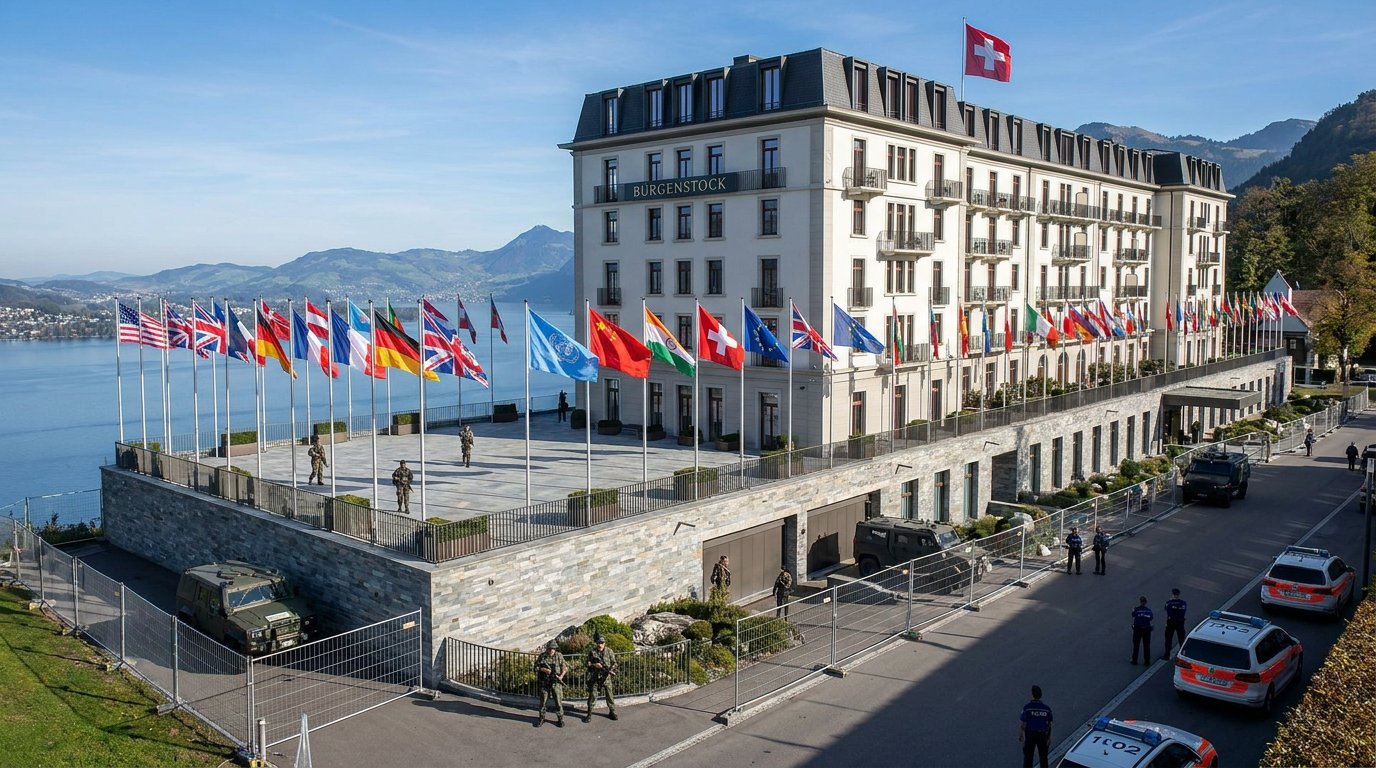
The serene Lake Lucerne in Switzerland is currently hosting one of the most consequential diplomatic summits of the decade. United States Vice President JD Vance and Iranian Parliament Speaker Mohammad Bagher Ghalibaf have opened indirect and direct technical talks at the Bürgenstock resort, attempting to convert a fragile memorandum of understanding (MoU) into a permanent peace treaty. The high-level negotiations mark a critical juncture in the ongoing effort to de-escalate tensions that have repeatedly threatened to engulf the entire Middle East in a devastating regional conflict.[1][2]
The stakes are monumental. The negotiations, mediated by Pakistan and Qatar, aim to formally end the recent US-Israel war on Iran, halt the cascading violence in Lebanon, and secure the Strait of Hormuz—a vital maritime chokepoint that handles roughly a fifth of global oil supplies. Both delegations recognize that failure to reach a comprehensive agreement could trigger immediate economic shockwaves, sending global energy prices soaring and forcing international shipping companies to reroute their entire fleets away from the Persian Gulf.[1][7]
The diplomatic framework rests on a 14-point MoU signed in mid-June, which established a strict 60-day ceasefire window. During this highly compressed period, negotiators must resolve deeply entrenched disputes over sanctions relief, the unfreezing of billions in state assets, and the long-term future of Iran's nuclear program. The agreement was designed as an interim measure to halt active hostilities while diplomats hash out the complex technical details required for a lasting, verifiable treaty between the two historic adversaries.[3][4]

However, the talks began under a cloud of immediate crisis. Just hours before the delegations arrived in Switzerland, Iran's Islamic Revolutionary Guard Corps (IRGC) announced it was closing the Strait of Hormuz to commercial traffic. The sudden declaration sent a jolt through international markets and immediately threatened to derail the diplomatic progress that mediators had spent weeks painstakingly assembling behind closed doors. Iranian military officials framed the closure as a necessary and proportionate response to what they described as blatant violations of the ceasefire agreement by allied forces.[1][3]
Tehran justified the closure by accusing the United States and Israel of acting in 'bad faith' and violating Article 1 of the MoU, which mandates a cessation of hostilities on all fronts, including southern Lebanon. Iranian leadership insists that the interim agreement explicitly prohibits the continuation of military operations in Lebanese territory, and they view the ongoing presence of Israeli troops as a fundamental breach of the foundational terms that brought them to the negotiating table in the first place.[3][7]
The reality on the water remains fiercely contested. While Iranian state television broadcast the closure order, US Central Command (CENTCOM) swiftly disputed the claim, stating that the waterway remained open and that 55 merchant ships carrying over 17 million barrels of oil had safely transited over the weekend. American military officials emphasized that they are actively monitoring the situation and remain fully prepared to ensure that the vital shipping lane remains navigable for international commerce, regardless of Tehran's public declarations.[2][4]

The dispute over the strait immediately spilled into domestic US politics. President Donald Trump took to social media and Fox News to issue a stark warning, threatening to hit Iran 'very hard' and suggesting the US might impose its own tolls on ships passing through the strait if Tehran did not back down. The president's aggressive posture underscored the immense political pressure facing the administration to project strength while simultaneously engaging in delicate peace negotiations with a longtime adversary.[2][5]
Trump's bellicose rhetoric from Washington complicated the delicate task facing Vice President Vance in Switzerland. Iranian negotiators accused the US of desperation, warning that the entire 60-day memorandum could collapse if threats continued. The public exchange of hostilities highlighted the profound lack of trust between the two nations, forcing mediators from Qatar and Pakistan to work overtime just to keep the respective delegations focused on the technical agenda rather than the escalating war of words playing out in the global press.[2][4]
Despite the public posturing, the technical talks proceeded. Vance, flanked by US envoys Jared Kushner and Steve Witkoff, expressed hope that the two adversaries could 'turn over a new leaf' and permanently alter the security architecture of the Middle East. The US delegation arrived with a clear mandate to push past the immediate friction and secure binding commitments that would fundamentally reshape the strategic balance of the region, prioritizing long-term stability over short-term diplomatic grievances. Vance emphasized that returning to the old paradigm of perpetual conflict was not the administration's preference.[2][4]
Despite the public posturing, the technical talks proceeded.
For the Iranian delegation, led by Ghalibaf and Foreign Minister Abbas Araghchi, the sequence of implementation is absolutely non-negotiable. Iranian Foreign Ministry spokesman Esmaeil Baghaei stated that Tehran will not discuss final concessions—including any limitations on its nuclear program—until the US fulfills its initial commitments. The Iranian strategy hinges on securing tangible, irreversible economic and security benefits before relinquishing any of its strategic leverage, reflecting a deep-seated institutional wariness of American diplomatic promises. They argue that the MoU's phased approach must be strictly adhered to.[6][7]
Chief among those commitments is the unfreezing of Iranian state funds held abroad. Article 11 of the MoU reportedly outlines a phased release of up to $25 billion in frozen assets, a massive sum that could dramatically alter Iran's domestic economic landscape. These funds, long trapped in international accounts due to sweeping US sanctions, represent a critical lifeline for a government that has struggled to manage soaring inflation, currency devaluation, and widespread public dissatisfaction over the state of the national economy.[4][6]
Iranian President Masoud Pezeshkian announced on Sunday that an initial tranche of $6 billion, currently held in Qatar, would be released as the talks commenced. This financial relief is viewed as a critical domestic victory for the Iranian leadership, which has faced severe economic strain from years of sanctions. The successful repatriation of these funds is essential for Pezeshkian to demonstrate to his domestic constituency that engaging in diplomacy with Washington can yield concrete, material benefits for the Iranian populace.[1][6]

Article 10 of the agreement is equally vital to Tehran, as it requires the US to issue waivers facilitating Iranian oil exports. The resumption of normalized energy trade is the primary economic incentive keeping Iran at the negotiating table. For decades, the Iranian economy has been heavily reliant on hydrocarbon revenues, and the prospect of legally re-entering the global oil market without the constant threat of secondary US sanctions is a prize that the leadership in Tehran is highly motivated to secure.[6]
In exchange for these sweeping economic concessions, the United States is demanding strict constraints on Iran's nuclear ambitions. Washington's ultimate goal is to lock Tehran into a verifiable agreement that permanently prevents the development of a nuclear weapon. US negotiators are pushing for comprehensive oversight mechanisms, including unfettered access for international inspectors and hard caps on uranium enrichment levels, arguing that such measures are the only way to guarantee long-term security for American allies in the region.[2][4]
This remains a significant hurdle. President Pezeshkian has publicly insisted that Iran will 'never give up our right to enrich uranium,' setting the stage for grueling technical debates over enrichment caps and international inspections. The Iranian position maintains that its nuclear program is entirely peaceful and intended solely for civilian energy and medical research, a claim that Western intelligence agencies have long viewed with profound skepticism. Bridging this fundamental gap in trust will be the defining challenge of the Bürgenstock summit.[5][6]

The negotiations are further complicated by the ongoing violence in Lebanon. The MoU explicitly links the US-Iran detente to a ceasefire between Israel and Hezbollah, effectively intertwining two of the region's most intractable conflicts. This linkage means that any localized flare-up along the Israel-Lebanon border has the potential to instantly derail the broader diplomatic effort in Switzerland, placing an enormous burden on mediators to simultaneously manage multiple, highly volatile flashpoints. The interconnected nature of these proxy battles makes isolating the US-Iran dynamic nearly impossible.[3][7]
Over the weekend, Israeli strikes in southern Lebanon killed at least 16 people, prompting Hezbollah to retaliate and further inflaming the situation. Iran considers the continued presence of Israeli forces in Lebanese territory a direct violation of the interim agreement, and has used the ongoing clashes as justification for its aggressive posture in the Strait of Hormuz. The violence underscores the fragility of the ceasefire and the immense difficulty of enforcing a cessation of hostilities across a sprawling, multi-front proxy war.[3][7]
The diplomatic tightrope Vance is walking has also drawn intense scrutiny back home. Republican hardliners have criticized the administration's willingness to grant sanctions relief, comparing the current effort to the Obama-era nuclear deal that Trump previously dismantled. Domestic critics argue that unfreezing billions of dollars will only empower Tehran to further fund its network of regional proxies, creating a political vulnerability for the administration as it attempts to sell the merits of the peace plan to a deeply skeptical American public.[4]
As the 60-day clock ticks down, the mediators from Qatar and Pakistan face the daunting task of keeping both sides focused on technical details rather than public grievances. The mediating teams are working around the clock to compartmentalize the various disputes, hoping to build momentum through small, incremental agreements on issues like maritime security and asset transfers before tackling the seemingly insurmountable divide over nuclear enrichment and regional proxy warfare. Their success hinges on preventing external provocations from collapsing the fragile trust established thus far.[1][4]
The outcome in Bürgenstock will likely determine whether the Middle East steps back from the brink of a devastating regional war, or plunges back into a conflict that could severely disrupt the global economy. With billions of dollars, the free flow of international energy, and the specter of nuclear proliferation all hanging in the balance, the delegations in Switzerland are acutely aware that the window for a peaceful resolution is rapidly closing. The next several weeks will test the limits of international diplomacy.[2][4]
How we got here
Feb 2026
The US and Israel launch strikes on Iran, triggering a broader regional conflict and retaliatory attacks.
April 2026
A temporary two-week ceasefire is announced between the United States and Iran.
Mid-June 2026
Mediators finalize a 14-point Memorandum of Understanding, establishing a 60-day window for a final deal.
June 20, 2026
Iran announces the closure of the Strait of Hormuz, citing Israeli violations of the ceasefire in Lebanon.
June 21, 2026
High-level technical talks officially begin at the Bürgenstock resort in Switzerland.
Viewpoints in depth
US Administration's View
The US seeks to permanently dismantle Iran's nuclear weapons capability while ensuring the unhindered flow of global energy.
For Washington, the 60-day window is an opportunity to lock Tehran into a verifiable, long-term agreement that neutralizes its nuclear program. US negotiators view the unfreezing of assets and the lifting of oil sanctions not as capitulations, but as necessary leverage to force Iranian compliance. However, the administration maintains a hard line on regional security, insisting that Iran must rein in proxy groups like Hezbollah and threatening severe military and economic consequences—including novel 'tolls' on the Strait of Hormuz—if the talks fail.
Iranian Leadership's View
Tehran demands the immediate delivery of promised economic relief and an end to Israeli military operations before discussing its nuclear program.
Iran approaches the Bürgenstock summit with deep skepticism regarding US commitments. Iranian officials insist that the sequence of the agreement is paramount: the US must first unfreeze billions in state assets and issue waivers for oil exports to prove its sincerity. Furthermore, Tehran views the ongoing Israeli strikes in southern Lebanon as a direct violation of the ceasefire's first article. Until these baseline conditions are met, Iranian leadership refuses to entertain concessions on its uranium enrichment program, which it defends as a sovereign right.
Regional Mediators' View
Qatar and Pakistan are focused on preventing a broader regional war and stabilizing the global economy through pragmatic diplomacy.
The mediating nations view the US-Iran conflict as an existential threat to regional stability and global energy markets. For Qatar and Pakistan, the priority is keeping both delegations at the table and focused on technical implementation rather than public rhetoric. They emphasize the catastrophic economic fallout that would accompany a permanent closure of the Strait of Hormuz or a full-scale regional war, urging both Washington and Tehran to prioritize pragmatic compromises over ideological victories.
What we don't know
- Whether the $6 billion in Qatari-held assets has actually been transferred to Tehran's control.
- If Israel will agree to withdraw its forces from southern Lebanon to satisfy Iran's demands.
- How the US plans to enforce its proposed 'tolls' on the Strait of Hormuz if negotiations fail.
Key terms
- Memorandum of Understanding (MoU)
- A preliminary agreement outlining the framework and conditions for a final, binding peace treaty.
- Strait of Hormuz
- A narrow, strategically vital waterway between the Persian Gulf and the Gulf of Oman, through which 20% of the world's oil passes.
- Sanctions Waivers
- Official exemptions granted by the US government allowing certain countries to purchase Iranian oil without facing financial penalties.
- Uranium Enrichment
- The process of increasing the concentration of the U-235 isotope, which can be used for civilian nuclear power or, at high levels, nuclear weapons.
Frequently asked
Why are the US and Iran negotiating in Switzerland?
Switzerland has historically acted as a neutral diplomatic venue and represents US interests in Iran, making it an ideal location for high-stakes indirect and direct talks.
Is the Strait of Hormuz actually closed?
The situation is heavily contested. Iran's military claims it has closed the strait to commercial traffic, but US Central Command reports that dozens of merchant ships continue to pass through safely.
What does Lebanon have to do with the US-Iran talks?
Iran considers Hezbollah a key ally and has made the cessation of Israeli military operations in southern Lebanon a strict precondition for finalizing the broader peace agreement.
Sources
Source coverage
7 outlets
3 viewpoints surfaced







[1]Al JazeeraIranian Leadership
Iran war day 114: US, Iranian delegations in Switzerland for key talks
Read on Al Jazeera →[2]The Washington PostUS Administration
JD Vance holds peace talks with Iran as Trump threatens strikes over Hormuz
Read on The Washington Post →[3]CBS NewsIranian Leadership
Iran recloses Strait of Hormuz over alleged violations in Lebanon: Iranian state TV
Read on CBS News →[4]PBSUS Administration
High-level U.S.-Iran talks on their interim deal to end the war had a tense start Sunday in Switzerland
Read on PBS →[5]The GuardianRegional Mediators
Middle East live: Trump threatens Iran after JD Vance hails 'great progress' made in Switzerland talks
Read on The Guardian →[6]Yeni ŞafakIranian Leadership
Iran says US talks focus on war end, sanctions relief, assets
Read on Yeni Şafak →[7]India TodayRegional Mediators
Iran closes Strait of Hormuz as Lebanon strikes cloud US talks
Read on India Today →

Every angle. Every day.
Get news politics stories with full source coverage and perspective breakdowns delivered to your inbox.