
2026 Rivian R2 vs. Tesla Model Y: The Electric SUV Showdown
Rivian's highly anticipated R2 finally hits the road to challenge the newly refreshed 2026 Tesla Model Y, offering buyers a stark choice between rugged outdoor utility and refined street performance.
By Factlen Editorial Team
- Outdoor Utility Advocates
- Buyers and reviewers who prioritize ruggedness, cargo space, and off-road capability.
- Efficiency & Tech Purists
- Drivers who value aerodynamic range, charging speed, and advanced software.
- Practical Family Buyers
- Focus on price parity, seating capacity, and everyday usability.
What's not represented
- · Traditional Automaker Loyalists
- · Budget-Conscious EV Shoppers
Why this matters
For years, the Tesla Model Y has been the undisputed king of the electric family SUV market. The arrival of the Rivian R2 gives buyers the first genuine, similarly priced alternative that doesn't just copy Tesla's homework, but offers a completely different philosophy on what an EV should be.
Key points
- The 2026 Rivian R2 and refreshed Tesla Model Y Performance trims both start at roughly $58,000.
- Rivian's R2 prioritizes rugged off-road capability, offering 9.6 inches of ground clearance and 90.1 cubic feet of cargo space.
- Tesla's Model Y focuses on aerodynamic efficiency, delivering superior highway range from a smaller battery and faster acceleration.
- The R2 features a native NACS port, granting it seamless access to Tesla's Supercharger network.
- Choosing between the two comes down to a preference for outdoor utility versus street-oriented performance and advanced software.
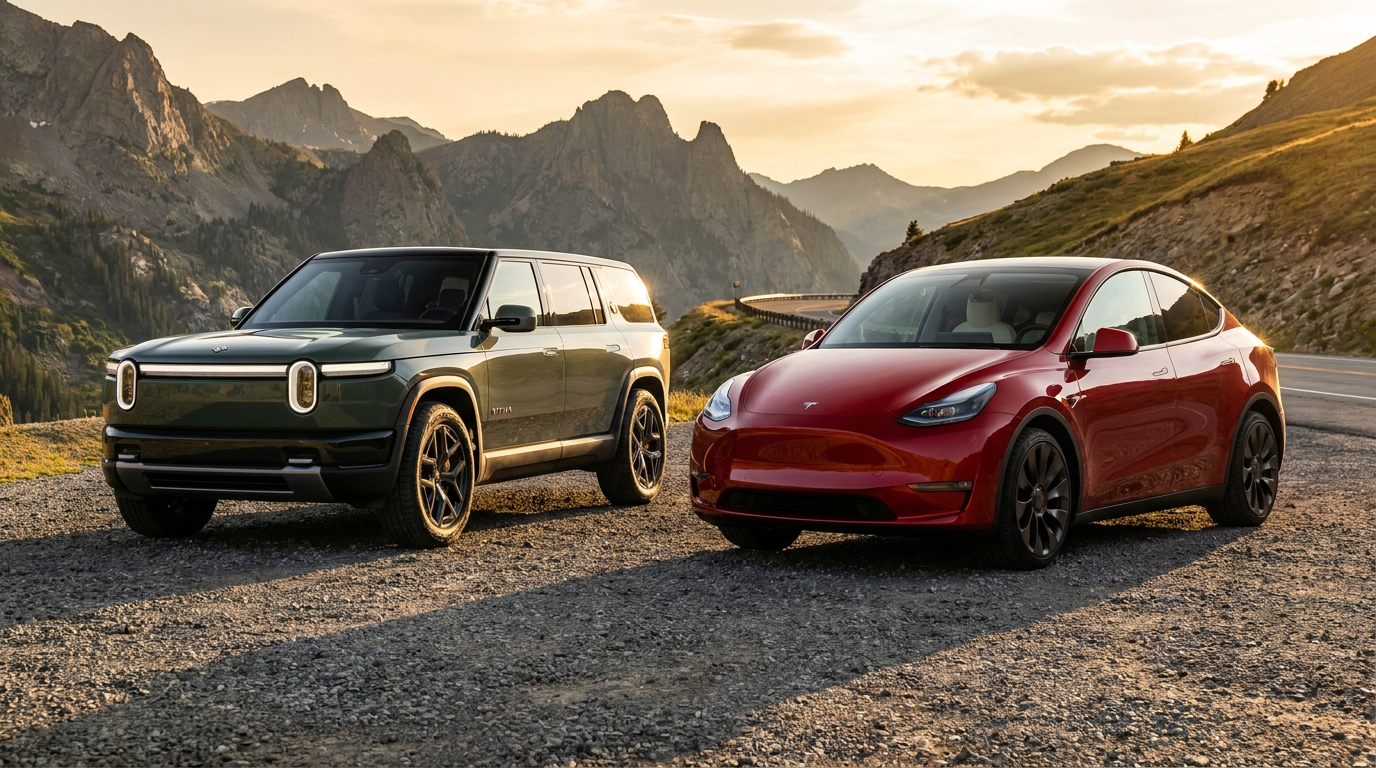
The electric SUV market has reached a pivotal milestone in the summer of 2026. For years, the Tesla Model Y has dominated global sales, serving as the default choice for families transitioning to electric vehicles. Now, Rivian has officially launched the R2, a compact SUV designed specifically to challenge Tesla's crown. With both vehicles offering Performance trims priced nearly identically at roughly $58,000, buyers are no longer choosing between price tiers, but between fundamentally different automotive philosophies. This rivalry represents a maturing market where consumers can finally select a vehicle that perfectly matches their lifestyle without compromising on electric range or charging infrastructure.[1][4]
Tesla has not rested on its laurels while waiting for the competition to catch up. The 2026 Model Y, internally known as the 'Juniper' refresh, brings significant updates to the world's best-selling car. The exterior now features sleek front and rear lightbars that give it a more modern, aggressive stance, while the interior boasts softer materials, available ventilated seats, and a noticeably quieter cabin. Engineers have also reworked the suspension, addressing long-standing complaints about a harsh ride by introducing adaptive damping borrowed from the Model Y Performance line. These refinements ensure the Model Y remains a formidable benchmark for any newcomer.[2][3]
On the other side of the ring, the Rivian R2 arrives as a scaled-down version of the acclaimed R1S, retaining the brand's signature boxy silhouette and stadium-shaped headlights. Built from the ground up for adventure, the R2 prioritizes utility and off-road capability in a smaller, more maneuverable footprint that fits easily into standard garages. Crucially, it features a native North American Charging Standard (NACS) port right out of the factory. This means Rivian owners can plug directly into Tesla's ubiquitous Supercharger network without needing a bulky adapter, neutralizing one of Tesla's biggest historical advantages.[1][6]

When comparing performance, the numbers reveal a tight race with distinct trade-offs. The argument for the Tesla Model Y Performance centers on raw speed and aerodynamic efficiency. It sprints from zero to sixty miles per hour in a blistering 3.3 seconds and squeezes up to 327 miles of range from a relatively compact battery pack. The evidence against the Model Y in this arena is its lower ground clearance of 6.6 inches, which severely limits its capability off the pavement and makes it vulnerable to scraping on rocky trails or deep snow.[4][5]
Conversely, the case for the Rivian R2 Performance highlights brute force and all-terrain versatility. It delivers a massive 656 horsepower and achieves a zero to sixty time of 3.6 seconds—nearly matching the Tesla despite its brick-like aerodynamics. The evidence supporting its outdoor pedigree includes a towering 9.6 inches of ground clearance and available 32-inch all-terrain tires. However, the argument against the R2 is its inherent aerodynamic drag; achieving its 330-mile maximum range requires a significantly larger, heavier 87.9-kilowatt-hour battery pack, making it less efficient per mile and more expensive to charge over time than the Tesla.[4][6]
Conversely, the case for the Rivian R2 Performance highlights brute force and all-terrain versatility.
Interior space and cargo capacity present another stark contrast between the two models. The argument for the Rivian R2 is sheer volume and practical packaging. Its squared-off roofline and clever interior layout yield 90.1 cubic feet of total storage, including a spacious 5.2-cubic-foot front trunk that easily swallows muddy gear or groceries. The evidence against the Tesla Model Y in this category is its sloping, coupe-like roofline, which restricts total cargo capacity to roughly 76 cubic feet and limits the front trunk to a smaller 4.1 cubic feet, making it less ideal for hauling bulky, square items.[4][5]

However, the Model Y counters with passenger flexibility and software maturity. The argument for Tesla is its optional third row, allowing seating for up to seven passengers in certain configurations—a feature the strictly five-seat Rivian R2 simply cannot match. On the technology front, Tesla's mature Full Self-Driving software remains a major selling point for highway commuters who want a hands-off experience in heavy traffic. While Rivian's new autonomous suite promises point-to-point hands-free driving utilizing high-resolution cameras and radar, the evidence against it is simply a lack of real-world testing compared to Tesla's billions of miles of data.[3][5]
Driving dynamics further separate the two SUVs, highlighting their divergent engineering goals. The case for the Model Y rests on its street-oriented handling; it feels planted, agile, and sporty on twisty roads, benefiting immensely from its lower center of gravity and stiffer chassis. The evidence against the Rivian R2 on asphalt is its lighter, slower steering and noticeable body roll through corners. This is a direct and necessary trade-off for its superior bump absorption, longer suspension travel, and off-road articulation when navigating muddy trails or rutted forest service roads.[2][7]

Ultimately, choosing between these two exceptional electric SUVs comes down to lifestyle and daily use cases. The Rivian R2 fits well when your weekends involve dirt roads, camping gear, and a desire for maximum cargo space in a rugged, easily cleanable package. It is the perfect vehicle for those who view their car as a basecamp for outdoor adventures. It does not fit well when your priority is maximum energy efficiency, sports-car-like cornering on pavement, or the need to occasionally haul seven passengers to soccer practice.[1][4][5]
On the other hand, the Tesla Model Y fits well when you want a highly efficient, proven commuter with access to the most mature driver-assistance software on the market and a sporty, engaging drive on paved roads. It remains the undisputed champion of seamless road trips and aerodynamic design. It does not fit well when you need to navigate rocky trails, require maximum vertical cargo space for bulky items, or simply want a vehicle that stands out from the millions of other Model Ys already dominating suburban driveways.[2][3][5]
How we got here
March 2024
Rivian officially unveils the R2, announcing its target price and 2026 production timeline.
Early 2026
Tesla rolls out the 'Juniper' refresh for the Model Y, introducing updated styling and improved suspension.
Spring 2026
The first Rivian R2 Performance Launch Edition models begin rolling off the assembly line.
June 2026
The Rivian R2 hits the consumer market, initiating the first direct, price-matched competition with the Tesla Model Y.
Viewpoints in depth
Outdoor Utility Advocates
Buyers and reviewers who prioritize ruggedness, cargo space, and off-road capability.
This camp views the Rivian R2 as a breath of fresh air in an EV market saturated with aerodynamic, street-focused crossovers. They argue that an SUV should be able to handle rough trails, carry bulky camping gear, and survive the elements. For these drivers, the R2's 9.6 inches of ground clearance, boxy cargo area, and durable interior materials far outweigh the aerodynamic penalties that reduce its overall efficiency. They see the R2 as a true utility vehicle, whereas the Model Y is viewed more as a lifted hatchback.
Efficiency & Tech Purists
Drivers who value aerodynamic range, charging speed, and advanced software.
For this group, the Tesla Model Y remains the gold standard of electric vehicle engineering. They point to Tesla's ability to extract 327 miles of range from a smaller battery pack as proof of superior powertrain efficiency and aerodynamic design. Furthermore, they argue that Tesla's mature Full Self-Driving software and deeply integrated infotainment ecosystem provide a daily driving experience that newer competitors cannot yet match. To them, the Rivian's boxy shape is an unnecessary compromise for off-road capabilities that most owners will rarely use.
What we don't know
- How Rivian's new autonomous driving suite will perform in real-world conditions compared to Tesla's mature Full Self-Driving software.
- Whether Rivian can scale production of the R2 quickly enough to meet the massive consumer demand and avoid long waitlists.
- The exact pricing and specifications for the entry-level Rivian R2 trims slated to arrive later in the year.
Key terms
- NACS (North American Charging Standard)
- The charging plug design originally developed by Tesla, which has now been adopted by most major automakers, including Rivian, for seamless access to the Supercharger network.
- Frunk
- A front trunk located under the hood of an electric vehicle where an internal combustion engine would traditionally sit.
- Adaptive Damping
- A suspension system that automatically adjusts the shock absorbers in real-time to improve ride comfort and handling based on road conditions.
- Torque Vectoring
- A technology that allows a vehicle to vary the amount of power sent to each wheel, significantly improving grip and cornering on slippery or uneven surfaces.
Frequently asked
Does the Rivian R2 use the same charger as the Tesla Model Y?
Yes, the 2026 Rivian R2 features a native North American Charging Standard (NACS) port, allowing it to use Tesla Superchargers without an adapter.
Which SUV has more cargo space?
The Rivian R2 offers significantly more storage, with 90.1 cubic feet of total space compared to the Model Y's 76 cubic feet, largely due to its boxy design.
Can the Rivian R2 seat seven people?
No, the Rivian R2 is strictly a five-seater, whereas the Tesla Model Y offers an optional third row that increases capacity to seven passengers.
Are both vehicles capable off-road?
While the Model Y can handle light dirt roads, the Rivian R2 is purpose-built for off-roading, featuring 9.6 inches of ground clearance and available all-terrain tires.
Sources
Source coverage
7 outlets
3 viewpoints surfaced







[1]EdmundsOutdoor Utility Advocates
2027 Rivian R2 First Impression
Read on Edmunds →[2]Top GearEfficiency & Tech Purists
Tesla Model Y Review 2026
Read on Top Gear →[3]The DrivenEfficiency & Tech Purists
Tesla Model Y 6-Seater Arrives in Australia
Read on The Driven →[4]CarBuzzPractical Family Buyers
Here's Every Way The Rivian R2 Beats The Tesla Model Y
Read on CarBuzz →[5]Car ConfectionsPractical Family Buyers
2027 Rivian R2 vs. 2026 Tesla Model Y: Which EV SUV is Best?
Read on Car Confections →[6]Car and DriverOutdoor Utility Advocates
2027 Rivian R2: What We Know So Far
Read on Car and Driver →[7]CarwowOutdoor Utility Advocates
Rivian R2 vs Tesla Model Y: prices and standard equipment
Read on Carwow →
Every angle. Every day.
Get automotive stories with full source coverage and perspective breakdowns delivered to your inbox.