
How Hawaii is Rewriting the Rules of Travel with 'Regenerative Tourism'
Moving beyond traditional sustainability, Hawaii's new tourism model asks visitors to actively restore the islands' ecosystems and communities.
By Factlen Editorial Team
- Regenerative Advocates
- Argue that tourism must actively restore ecosystems and communities, moving beyond simply minimizing harm.
- Academic Observers
- Note the theoretical promise of the model but warn against greenwashing and the persistence of extractive business practices.
- Local Communities & Practitioners
- Emphasize the need for tourism to respect cultural heritage, manage hotspots, and provide tangible benefits to residents.
What's not represented
- · Budget travelers priced out by the shift toward high-spending demographics
- · Airline executives managing reduced flight capacities to the islands
Why this matters
As global destinations buckle under the weight of mass tourism, Hawaii is pioneering a model that asks visitors to heal rather than consume. If successful, this shift from 'sustainable' to 'regenerative' travel could redefine how we vacation, ensuring that our leisure time actively funds the restoration of the places we love.
Key points
- Hawaii is transitioning from 'sustainable tourism' (minimizing harm) to 'regenerative tourism' (actively restoring ecosystems).
- The Mālama Hawaiʻi program incentivizes visitors to volunteer in conservation efforts in exchange for hotel discounts.
- The state's 2026-2030 strategic plan prioritizes destination stewardship and high-spending, low-impact travelers over raw arrival numbers.
- Recent data shows the strategy is working: visitor arrivals have stabilized, but total visitor spending has increased.
- Critics warn that large hospitality corporations must adopt structural changes to avoid 'greenwashing' the regenerative label.
For decades, the implicit contract of a tropical vacation was simple: visitors arrive, consume the natural beauty, and leave their money behind. But in Hawaii, a profound shift is underway that is rewriting the rules of global travel. Driven by the strain of record-breaking arrival numbers and a deepening desire to protect the archipelago's fragile ecosystems, local leaders and guides are championing a new paradigm. They are asking travelers not just to visit, but to actively participate in the healing of the land. This movement represents a fundamental departure from the traditional hospitality model, transforming the tourist from a passive consumer into an active steward of the destination.[5]
The philosophy driving this change is known as "regenerative tourism," a concept that is rapidly gaining traction in academic and industry circles. For years, the gold standard in the travel industry was "sustainable tourism," which focused primarily on minimizing harm. Sustainability asks visitors to reduce their carbon footprint, reuse their hotel towels, and avoid damaging coral reefs—essentially striving to maintain the status quo. Regenerative tourism, however, sets a much higher bar. It demands that the act of travel leaves the destination measurably better than it was before. It is a proactive approach that seeks to restore degraded ecosystems, revitalize local cultures, and inject net-positive benefits directly into the host communities.[3][4]
The catalyst for this ambitious pivot was the sheer weight of mass tourism. In 2019, Hawaii welcomed a record 10.4 million visitors, a volume that placed immense pressure on the state's infrastructure, beaches, and freshwater supplies. The subsequent pandemic pause provided a rare moment of clarity for residents and policymakers alike, prompting a statewide reckoning. The Hawaii Tourism Authority (HTA) recognized that returning to the old volume-driven model was untenable. Instead, they began to pivot their strategic focus away from merely marketing the islands to actively managing the destination, prioritizing the well-being of the community and the environment over raw arrival numbers.[2]

The most visible manifestation of this shift is the Mālama Hawaiʻi program. Rooted in the Hawaiian value of "mālama," which translates to "to care for" or "to give back," the initiative invites visitors to engage in meaningful voluntourism experiences during their stay. Rather than spending every day lounging on the beach, tourists are encouraged to dedicate a portion of their trip to hands-on conservation work. The program operates as a collaboration between the state's tourism authority, local non-profit organizations, and dozens of hospitality partners, creating a structured pathway for visitors to make a tangible difference.[5]
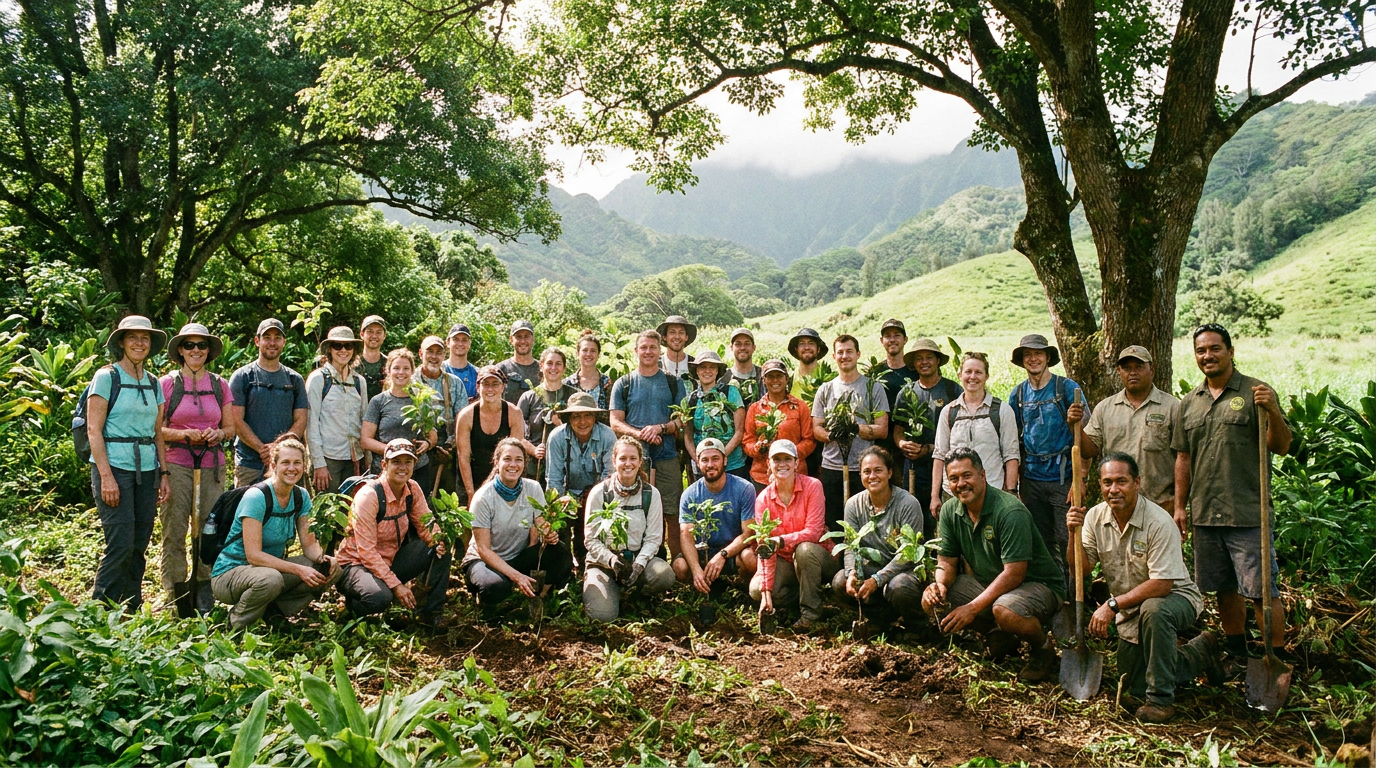
The activities offered through the program are deeply intertwined with the ecological and cultural fabric of the islands. Visitors might find themselves wading into the mud to help restore a traditional loʻi kalo (taro terrace), clearing invasive plant species from a dense tropical rainforest, or rebuilding the ancient stone walls of a loko iʻa (Hawaiian fishpond). Other opportunities include participating in organized beach cleanups to remove marine debris or planting native trees to aid in reforestation efforts. These experiences are often led by local guides and cultural practitioners who share the history and significance of the land, providing a richer, more authentic connection to Hawaii than a standard sightseeing tour could ever offer.[1][5]
To incentivize participation, the tourism industry has aligned its economic levers with these conservation goals. Many participating hotels and resorts offer significant perks to guests who complete a verified Mālama Hawaiʻi volunteer activity. These rewards can range from a complimentary fourth night's stay to waived resort fees or substantial dining credits. By tying financial incentives to ecological stewardship, the program effectively subsidizes the cost of doing good, making regenerative practices accessible and appealing to a broader demographic of travelers who might not have otherwise considered volunteering on their vacation.[5]
To incentivize participation, the tourism industry has aligned its economic levers with these conservation goals.
The underlying ethos of this movement is beautifully captured by the traditional Hawaiian concept of the "hoʻiwai." In the sophisticated agricultural system of the loʻi kalo, water is drawn from a stream, circulated through the taro fields where it gathers nutrients, and then returned to the stream. The hoʻiwai is the point of return, ensuring that the water flows back into the ecosystem richer and more life-sustaining than when it was diverted. Regenerative tourism seeks to emulate this model of reciprocity. The goal is for the influx of visitors and their capital to act like the water in the loʻi, nourishing the local community and environment before flowing back out, leaving an abundance in their wake.[7]
This philosophy is now codified in the state's long-term economic planning. The Hawaii Tourism Authority's strategic plan for 2026 to 2030 explicitly centers on destination stewardship and regenerative practices. The agency is actively funding community-led initiatives that protect natural resources and perpetuate Native Hawaiian culture. Furthermore, their marketing efforts have shifted toward attracting "mindful travelers"—visitors who tend to stay longer, spend more, and demonstrate a willingness to respect local customs and environments. The strategy is a deliberate move away from the high-volume, low-margin tourism that previously defined the market.[1][2]

Early economic indicators suggest that this strategy is beginning to bear fruit. Recent data from the spring of 2026 shows that while the total number of visitor arrivals to Hawaii has slightly stabilized or declined compared to previous peaks, total visitor spending has actually increased. Travelers are spending significantly more on an average daily basis, injecting more capital into the local economy even as the physical footprint of tourism lightens. This decoupling of economic growth from sheer visitor volume is a crucial milestone in proving that a regenerative model can be financially viable for a destination heavily reliant on the travel sector.[2]
Academic observers note that Hawaii's experiment is of global significance. Researchers studying the intersection of climate goals and the hospitality industry argue that the transition from sustainable to regenerative tourism is not just a marketing trend, but an ecological necessity. As destinations worldwide grapple with biodiversity loss and the impacts of climate change, the traditional "do less harm" approach is increasingly viewed as insufficient. The regenerative model, which integrates systems thinking and community-centered evaluation, offers a blueprint for how the global travel industry might transform itself into a mechanism for environmental healing rather than degradation.[3][4]
However, the transition is not without its critics and challenges. Some academic studies and local advocates warn that while the rhetoric of regenerative tourism is powerful, the reality on the ground can be uneven. There are concerns that some large-scale, for-profit operators may simply rebrand their existing experiential add-ons as "regenerative" while maintaining fundamentally extractive business models. Critics argue that true regeneration requires a deeper structural shift—one that transfers real decision-making power and economic benefits directly to Indigenous communities and local residents, rather than just adding a volunteer day to a luxury resort package.[6]

The ultimate test for Hawaii will be whether it can scale these regenerative practices across a mass-market destination. It is one thing to operate a successful eco-lodge that restores a few acres of forest; it is entirely another to transform an industry that processes millions of visitors annually and accounts for a massive portion of the state's gross domestic product. Balancing the economic imperatives of the hotel and airline industries with the ecological limits of the islands requires constant negotiation, rigorous data tracking, and a willingness to enforce strict limits on capacity at vulnerable natural hotspots.[6][7]
Despite these hurdles, the momentum on the ground is palpable, driven largely by the passion of local guides and community organizations. These grassroots leaders are shifting the dynamic from a demand-driven model—where tourist expectations dictate the experience—to a supply-driven model, where the community decides what resources they are willing to share. Local guides are no longer just pointing out landmarks; they are acting as cultural ambassadors and ecological stewards, teaching visitors how to interact respectfully with the environment. By centering local knowledge and prioritizing the health of the ʻāina (land), they are slowly reshaping the culture of Hawaiian tourism from the bottom up.[1][4]
If Hawaii can successfully navigate this complex transition, it will offer a profound lesson for the rest of the world. The archipelago is proving that travel does not have to be a zero-sum game where the visitor's pleasure comes at the expense of the destination's health. By inviting tourists to become active participants in the restoration of the islands, Hawaii is pioneering a future where tourism is not just an industry to be managed, but a powerful, regenerative force that can heal both the land and the people who walk upon it.[7]
How we got here
2019
Hawaii welcomes a record 10.4 million visitors, placing unprecedented strain on local infrastructure and ecosystems.
2020
The Hawaii Tourism Authority pivots its strategic plan from marketing-driven growth to destination management.
2021
The Mālama Hawaiʻi program launches, offering hotel incentives for visitors who participate in local volunteer work.
2025
HTA unveils its 2026-2030 strategic plan, cementing regenerative tourism as the core framework for the state's visitor industry.
Spring 2026
Economic data reveals that while visitor arrivals have stabilized, total visitor spending has significantly increased, validating the new strategy.
Viewpoints in depth
The Regenerative Advocates' view
Tourism must evolve from a consumptive industry into a restorative force.
Proponents of the regenerative model, including state tourism boards and environmental nonprofits, argue that the traditional goal of 'sustainability' is no longer sufficient. They assert that simply minimizing harm does not address the historical degradation caused by decades of mass tourism. Instead, they advocate for a system where visitor dollars and labor actively fund the restoration of coral reefs, reforestation projects, and the preservation of Indigenous culture, turning travel into a net-positive intervention.
The Academic Observers' view
The model is theoretically sound but vulnerable to corporate greenwashing.
Researchers and academic institutions acknowledge the necessity of the regenerative shift but remain skeptical of its execution in a mass-market context. They point out that while community-led initiatives are genuinely restorative, large-scale hospitality corporations often co-opt the terminology without changing their underlying extractive business models. These observers stress that true regeneration requires systemic changes in governance and a transfer of economic power to local residents, rather than just adding superficial volunteer activities to luxury vacation packages.
The Local Communities' view
Tourism must be supply-driven and respect the limits of the land and people.
For local guides, cultural practitioners, and residents, the shift toward regenerative tourism is about reclaiming agency. They emphasize that tourism should no longer be dictated by the demands of the visitor, but rather by what the community is willing to share. This perspective prioritizes the management of overcrowded hotspots, the protection of sacred sites, and the assurance that the economic benefits of travel are felt directly by the people who live and work in the destination year-round.
What we don't know
- Whether mass-market hospitality chains will fundamentally change their business models or simply use regenerative terminology as a marketing tool.
- How the deliberate shift toward higher-spending tourists will impact the accessibility of Hawaii for budget-conscious travelers.
- If the regenerative model can be successfully scaled to other global destinations facing similar overtourism crises.
Key terms
- Regenerative Tourism
- An approach to travel that aims to actively restore and improve the ecological and social health of a destination, creating a net-positive impact.
- Sustainable Tourism
- A traditional travel model focused on reducing negative environmental and social impacts to maintain the current status quo.
- Mālama
- A foundational Hawaiian value that translates to 'to care for,' 'to protect,' or 'to give back.'
- Loʻi Kalo
- Traditional Hawaiian irrigated taro terraces, often used as a metaphor for regenerative systems because they return nutrient-rich water to the ecosystem.
- Voluntourism
- A form of tourism in which travelers participate in voluntary work, typically for an environmental or community cause, during their trip.
Frequently asked
What is the difference between sustainable and regenerative tourism?
Sustainable tourism focuses on minimizing negative impacts and maintaining the status quo. Regenerative tourism goes a step further, actively seeking to restore ecosystems and leave the destination better than it was found.
What is the Mālama Hawaiʻi program?
It is a state-backed initiative that encourages visitors to participate in volunteer activities—such as beach cleanups or native tree planting—often in exchange for hotel discounts or free nights.
Does volunteering on vacation actually help the local economy?
Yes. By participating in regenerative activities, visitors help fund and provide labor for local conservation efforts. Additionally, data shows that 'mindful travelers' who engage in these programs tend to spend more money locally during their stay.
Are there concerns about this new tourism model?
Some academic observers and local advocates worry about 'greenwashing,' where large corporations use regenerative terminology as a marketing tool without making meaningful changes to their extractive business practices.
Sources
Source coverage
7 outlets
3 viewpoints surfaced






[1]Kauai NowLocal Communities & Practitioners
Hawaiʻi Tourism Authority issues a request for proposals for projects exemplifying regenerative tourism
Read on Kauai Now →[2]TravelAge WestLocal Communities & Practitioners
4 Things We Learned at the Hawaii Tourism Conference
Read on TravelAge West →[3]MDPIAcademic Observers
Advancing Global Climate and Biodiversity Goals Through Regenerative Tourism
Read on MDPI →[4]Athens Journal of TourismAcademic Observers
Beyond Sustainability: Regenerative Pathways in Hospitality and Tourism Development
Read on Athens Journal of Tourism →[5]Go HawaiiRegenerative Advocates
Mālama Hawaiʻi | Travel With Care
Read on Go Hawaii →[6]Taylor & FrancisAcademic Observers
Hawai'i is shifting toward regenerative tourism, yet extractive logics persist
Read on Taylor & Francis →[7]Factlen Editorial TeamLocal Communities & Practitioners
Synthesis by Factlen editorial team
Read on Factlen Editorial Team →
Every angle. Every day.
Get travel stories with full source coverage and perspective breakdowns delivered to your inbox.