
How Data Center REITs Became the Landlords of the AI Boom
As artificial intelligence drives unprecedented demand for specialized computing power, data center construction has eclipsed traditional office real estate. Here is how Real Estate Investment Trusts are financing and building the physical backbone of the AI era.
By Factlen Editorial Team
- Infrastructure Bulls
- Focus on the massive growth in construction and the insatiable demand from tech hyperscalers.
- Yield Investors
- Value the REIT structure for its stable dividend yields and long-term, recession-resistant leases.
- Market Pragmatists
- Highlight the risks of capital intensity, interest rate sensitivity, and supply chain bottlenecks.
What's not represented
- · Local Municipalities
- · Environmental Groups
- · Utility Grid Operators
Why this matters
The artificial intelligence revolution is not just happening in software—it requires the largest physical infrastructure buildout in modern history. Understanding data center REITs reveals how the billions of dollars powering AI are actually being spent, and how everyday investors are gaining exposure to the tech boom through commercial real estate.
Key points
- U.S. data center construction spending has hit a record $50 billion annualized rate, officially surpassing traditional office building construction.
- Data center REITs provide the physical space, power, and cooling infrastructure required by tech giants to run artificial intelligence models.
- AI workloads require specialized, ultra-dense facilities with liquid cooling, pushing construction costs to $1 billion or more per campus.
- Power scarcity and grid access have become the ultimate bottlenecks, creating a deep economic moat for operators with existing utility agreements.
The American real estate landscape has quietly crossed a historic threshold. In March 2026, annualized spending on data center construction in the United States surged past $50 billion, officially eclipsing traditional office building investment for the first time. This represents a staggering 437% increase since the beginning of 2021, fundamentally reshaping the hierarchy of commercial real estate.[1]
The catalyst for this concrete-and-steel boom is the relentless expansion of artificial intelligence. As generative AI models transition from research laboratories to enterprise production, the physical infrastructure required to train and run them has become the world's most sought-after asset class.[1][5]

Behind this massive buildout is a specialized financial vehicle: the Data Center Real Estate Investment Trust, or REIT. While traditional REITs manage shopping malls, logistics warehouses, or apartment complexes, data center REITs own and operate the highly secure, climate-controlled facilities that house the internet's central nervous system.[4][6]
These companies do not typically own the servers or the data itself. Instead, they provide the "powered shell" and the critical environment—leasing physical space, uninterruptible power supplies, advanced cooling systems, and high-bandwidth connectivity to tech giants and enterprises.[4]
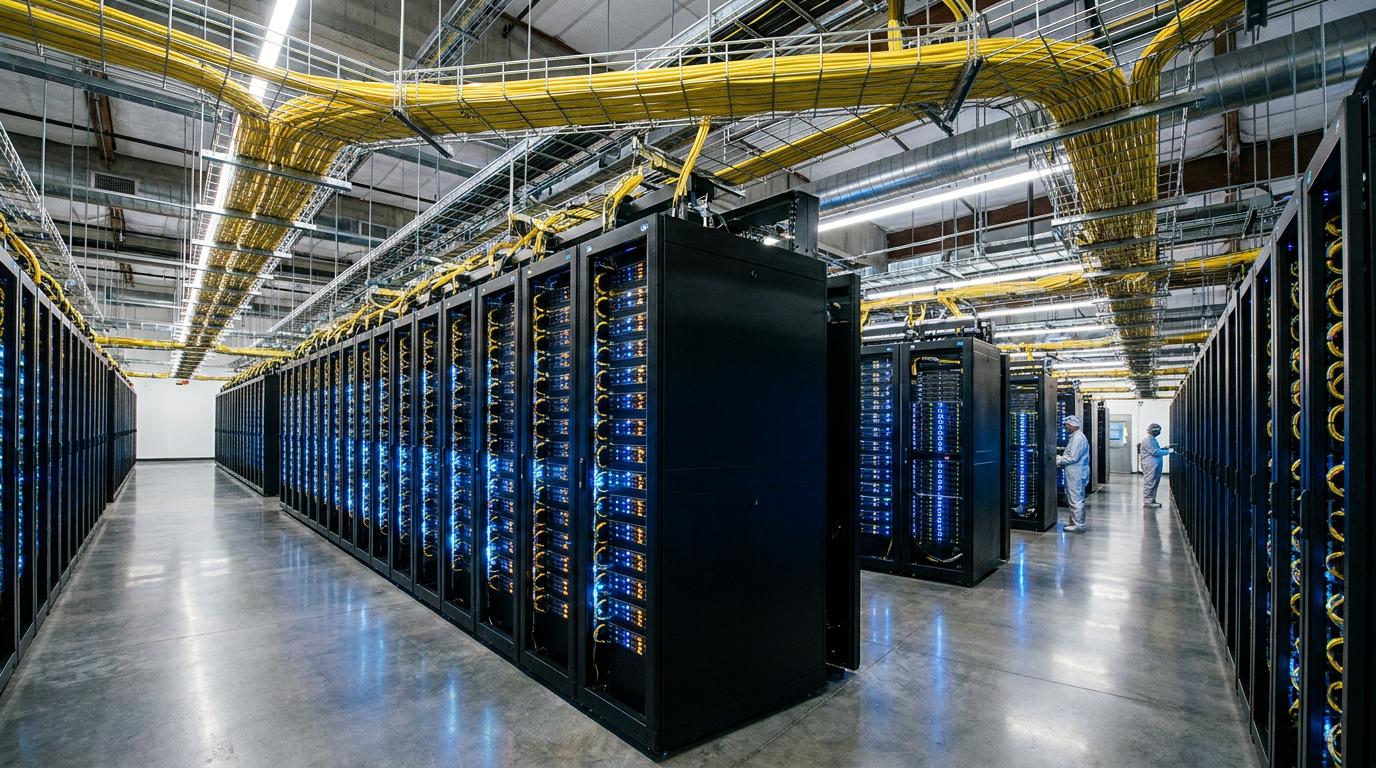
The demands of artificial intelligence have radically altered what these facilities must provide. Traditional cloud computing data centers were built for standard server racks, but AI workloads require ultra-dense computing clusters packed with power-hungry graphics processing units (GPUs).[2][4]
This density generates immense heat, forcing data center REITs to retrofit existing sites and design new campuses with direct-to-chip liquid cooling and heavily reinforced flooring. The capital required to build these AI-ready facilities is staggering, often running between $1 billion and $2 billion for a single campus.[2][5]

To fund this expansion, the industry relies heavily on the public markets. By law, REITs must distribute at least 90% of their taxable income to shareholders as dividends. This structure prevents them from hoarding cash for research and development, meaning they must continuously raise capital through equity and debt to fund new construction.[6]
Two dominant players have emerged at the forefront of this infrastructure arms race: Equinix and Digital Realty. Together, these publicly traded behemoths operate hundreds of facilities globally and are deploying unprecedented sums to capture the AI wave.[1][2]
Two dominant players have emerged at the forefront of this infrastructure arms race: Equinix and Digital Realty.
Equinix, the world's largest data center REIT, has committed to spending between $4 billion and $5 billion annually through 2029. The company's strategy hinges on doubling its total capacity over the next five years, focusing heavily on its "xScale" hyperscale program and private AI solutions that offer ultra-low latency connections.[2]
Digital Realty is matching this aggressive posture. In early 2026, the company closed a $3.25 billion U.S. hyperscale data center fund, drawing capital from sovereign wealth funds and pensions to develop massive AI campuses across six major American metropolitan areas.[3]
The customer base for these mega-campuses is highly concentrated among the "hyperscalers"—tech titans like Amazon, Microsoft, Google, and Meta. Industry analysts project these companies will spend a combined $700 billion on AI capital expenditures in 2026 alone.[3]

To secure the specialized space they need, hyperscalers are signing long-term leases spanning five to fifteen years. For the REITs, these ironclad contracts with investment-grade tenants provide highly predictable, recession-resistant cash flows that appeal to institutional dividend investors.[6]
However, the ultimate bottleneck in the AI infrastructure boom is not capital or silicon, but electricity. AI training clusters require massive amounts of power, often demanding 100 megawatts or more for a single campus—enough to power a small city.[4]
Utilities are struggling to upgrade grid infrastructure and deliver new substation capacity fast enough to meet this demand. Consequently, data center REITs that already possess secured grid access and long-term power purchase agreements have developed a nearly insurmountable economic moat.[4]

Despite the explosive growth, the sector faces significant headwinds. Supply chain disruptions continue to plague the industry, with lead times for critical components like industrial transformers and specialized cooling equipment stretching into years, complicating construction timelines.[2]
Furthermore, as highly capital-intensive entities, data center REITs are sensitive to interest rates. Elevated borrowing costs make financing new multi-billion-dollar campuses more expensive, potentially squeezing profit margins if lease rates cannot keep pace with the cost of debt.[5][6]
There is also the looming question of demand sustainability. While current projections assume exponential AI growth, any plateau in enterprise AI adoption or a sudden pop in the broader AI investment bubble could leave operators with overbuilt, highly specialized capacity.[6]
How we got here
1960
The U.S. Congress creates the Real Estate Investment Trust (REIT) structure to allow everyday investors to buy shares in commercial real estate portfolios.
Early 2021
Annualized U.S. data center construction spending sits at roughly $9 billion, a fraction of the spending on traditional office buildings.
Late 2023
The generative AI boom accelerates, forcing tech giants to rapidly secure specialized, high-density physical infrastructure for their GPU clusters.
March 2026
Data center construction spending officially eclipses office buildings, hitting a record $50 billion annualized rate.
Viewpoints in depth
Infrastructure Bulls
Focus on the massive growth in construction and the insatiable demand from tech hyperscalers.
Companies like Amazon, Microsoft, and Google view physical data center capacity as an existential requirement for their AI ambitions. Rather than tying up hundreds of billions of dollars in real estate development, they prefer to partner with REITs that can navigate local zoning, power procurement, and construction. For hyperscalers and the investors backing them, the priority is speed to market and securing ultra-dense, liquid-cooled environments, making them willing to sign decade-long leases to guarantee their compute capacity.
Yield Investors
Value the REIT structure for its stable dividend yields and long-term, recession-resistant leases.
For institutional and retail investors, data center REITs represent a defensive growth play. They value the sector not just for its exposure to the AI boom, but for the underlying real estate fundamentals: long-term, ironclad leases with investment-grade tech giants. From this perspective, the true value of a data center REIT lies in its secured power agreements and grid access, which create high barriers to entry that protect existing facilities from sudden market oversupply.
Market Pragmatists
Highlight the risks of capital intensity, interest rate sensitivity, and supply chain bottlenecks.
Skeptics caution that the current data center construction boom exhibits classic signs of a capital-intensive bubble. They point to the severe backlog in industrial electrical equipment—such as transformers and specialized cooling units—which threatens to delay project deliveries and inflate costs. Furthermore, they argue that because REITs rely heavily on debt to finance new construction, a prolonged period of high interest rates could compress profit margins, especially if the anticipated wave of enterprise AI monetization fails to materialize and hyperscalers suddenly pull back on their capital expenditures.
What we don't know
- Whether the massive $700 billion in projected hyperscaler capital expenditures will translate into sustainable software revenue, or if it represents an infrastructure bubble.
- How quickly municipal power grids can upgrade their substations to meet the unprecedented 100+ megawatt demands of new AI campuses.
- The long-term environmental impact and regulatory response to the massive water and electricity consumption required by liquid-cooled AI facilities.
Key terms
- REIT (Real Estate Investment Trust)
- A corporate structure that owns and operates income-producing real estate, required by law to distribute at least 90% of its taxable income to shareholders as dividends.
- Hyperscaler
- Massive technology companies, such as Amazon, Google, and Microsoft, that dominate the cloud computing and artificial intelligence industries.
- Powered Shell
- A commercial real estate lease where the landlord provides the physical building and the heavy electrical and cooling infrastructure, leaving the tenant to install their own servers.
- Colocation
- A data center model where multiple different companies rent space, power, and cooling within the same physical facility.
- Liquid Cooling
- An advanced thermal management system that pumps liquid directly to computer chips to remove the extreme heat generated by artificial intelligence processors.
Frequently asked
What exactly does a data center REIT own?
They own the physical building, the cooling systems, the heavy-duty electrical infrastructure, and the security systems. They typically do not own the actual servers or the data, which belong to their tenants.
Why do AI data centers cost more to build than traditional ones?
AI workloads require ultra-dense server racks that generate immense heat. This necessitates expensive direct-to-chip liquid cooling systems and heavily reinforced flooring to support the weight of the equipment.
How do these companies make money?
They generate revenue by signing long-term leases—often spanning 5 to 15 years—with tech companies and enterprises that pay for physical space, power capacity, and network connectivity.
What are the main risks to this industry?
The sector is highly sensitive to interest rates due to the massive debt required for construction. Additionally, supply chain bottlenecks for electrical transformers and the risk of an AI spending slowdown could impact future profitability.
Sources
Source coverage
6 outlets
3 viewpoints surfaced






[1]BenzingaInfrastructure Bulls
Equinix, Digital Realty REITs In Focus As AI Frenzy Drives $50 Billion Data Center Construction Surge
Read on Benzinga →[2]S&P GlobalInfrastructure Bulls
Digital Realty, Equinix ramp up datacenters as AI drives demand
Read on S&P Global →[3]The AI Consulting NetworkInfrastructure Bulls
AI Data Center REIT Investment Guide
Read on The AI Consulting Network →[4]Data Center KnowledgeYield Investors
What Is a Data Center REIT?
Read on Data Center Knowledge →[5]ForbesMarket Pragmatists
Data Center Stocks: A 2026 Investment Guide
Read on Forbes →[6]The Motley FoolYield Investors
Best Data Center REITs for 2026 and How to Invest
Read on The Motley Fool →
Every angle. Every day.
Get real estate stories with full source coverage and perspective breakdowns delivered to your inbox.