
AI Unlocks the Sperm Whale 'Phonetic Alphabet,' Revealing Complex Language Parallels
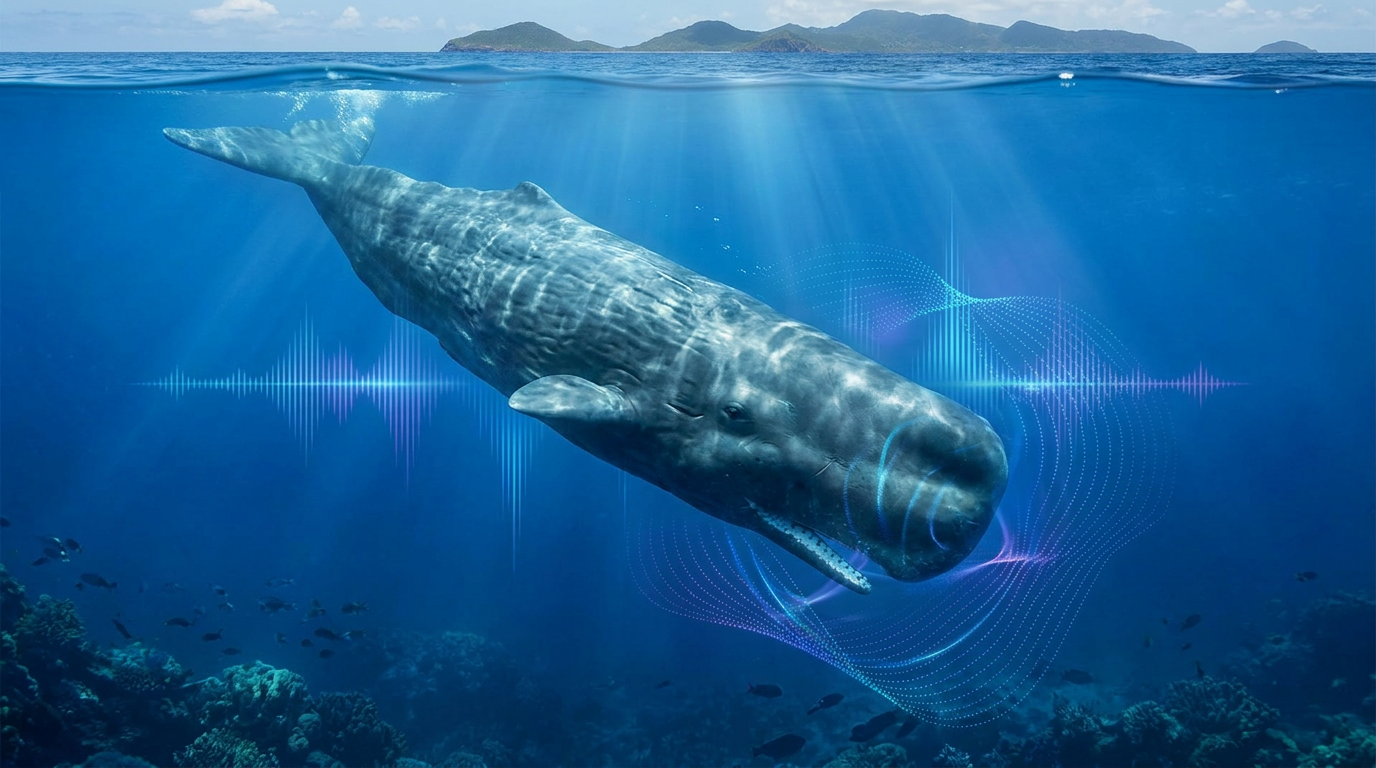
Using advanced machine learning, researchers have decoded a phonetic alphabet in sperm whale communication, revealing striking structural similarities to human language. The breakthrough, powered by a new open-source AI tool called Whale Tales, marks a historic milestone in interspecies understanding.
By Factlen Editorial Team
- Marine Biologists & Conservationists
- This camp views the AI translation as definitive proof of deep social complexity in the ocean.
- AI & Linguistics Researchers
- This group focuses on the technical triumph of applying human-centric AI to non-human datasets.
- Legal & Ethical Scholars
- These experts are exploring how interspecies translation demands new legal rights for nature.
What's not represented
- · Commercial Fishing Industry
- · Naval Sonar Operators
Why this matters
Proving that humans are not the only species with a complex, culturally transmitted language fundamentally shifts our relationship with the natural world. It opens the door to AI-mediated interspecies communication and provides a powerful new legal framework for marine conservation.
Key points
- Project CETI researchers have used AI to identify a 'phonetic alphabet' in sperm whale communication.
- Machine learning analysis reveals that whale 'codas' contain structures functionally similar to human vowels and diphthongs.
- A new open-source AI software package called Whale Tales successfully synchronized drone footage and audio of a rare whale birth.
- The AI analysis proved that non-kin whales use specific vocal shifts to coordinate support during the birthing process.
- Legal scholars are using these findings to advocate for 'more-than-human rights' and stronger ocean protections.
For decades, the rhythmic clicks echoing through the deep ocean were a profound mystery, widely recognized by scientists as a form of communication but remaining entirely opaque to human understanding. Now, an unprecedented international coalition of marine biologists, cryptographers, linguists, and artificial intelligence researchers has successfully cracked the foundational structure of the sperm whale language. By deploying state-of-the-art machine learning models against massive acoustic datasets, the team has achieved what was once considered science fiction: the first empirical translation of a non-human communication system. This milestone not only redefines our understanding of marine biology but also showcases the extraordinary potential of AI to bridge the gap between species.[2][7]
Project CETI (the Cetacean Translation Initiative) has officially announced the discovery of a comprehensive 'sperm whale phonetic alphabet,' revealing that the animals' vocalizations possess a structural complexity remarkably similar to human speech. By applying advanced natural language processing algorithms to thousands of hours of underwater recordings gathered off the coast of the Caribbean island of Dominica, the research team successfully identified 156 distinct basic components in the whales' calls. These components function much like phonemes in human language, combining in highly specific, rule-bound ways to convey complex information across vast underwater distances.[1][5]
Sperm whales communicate using rapid, rhythmic sequences of acoustic clicks known as 'codas.' Until recently, scientists struggled to parse the subtle, micro-second variations in these sounds, often dismissing them as simple echolocation or basic identification markers. However, the new AI analysis demonstrated that whales actively differentiate their codas through elongated clicks, shortened tempos, and rising or falling tones. Functionally, these acoustic variations behave exactly like vowels and diphthongs in human languages such as Mandarin, Latin, or Slovenian, allowing the whales to inject immense nuance and context into their daily conversations.[1][5]

The discovery suggests a profound and fascinating case of independent evolution on Earth. Humans and sperm whales last shared a common ancestor more than 90 million years ago, long before the evolutionary tree branched into modern terrestrial primates and deep-sea mammals. Yet, despite existing in entirely different physical environments, both species independently developed highly complex, phonological communication systems to manage their intricate social lives. This parallel development indicates that the structural rules of language might be a universal requirement for any highly social, cooperative species, regardless of whether they live on land or in the ocean.[1][7]
'I think it's another humbling moment that we're not the only species with rich, communicative, communal and cultural lives,' noted David Gruber, the founder and lead of Project CETI. The initiative's data suggests that these marine mammals have been passing vital cultural information—such as foraging techniques, navigational routes, and social hierarchies—from generation to generation for over 20 million years. This deep ancestral knowledge is entirely encoded in their acoustic codas, representing a continuous chain of oral history that predates human existence by an unimaginable margin.[1][6]
To achieve this historic breakthrough, the researchers had to build entirely new computational tools from the ground up. Standard artificial intelligence models, including the Large Language Models that power modern chatbots, are designed exclusively for human text and speech data. This required the CETI team to engineer bespoke machine learning architectures capable of processing non-human acoustic patterns without injecting anthropocentric bias. By stripping away human linguistic assumptions, the AI was able to analyze the raw acoustic geometry of the whale clicks, finding patterns that human ears and traditional software had completely missed.[6][7]
This technological leap culminated in the Spring 2026 release of 'Whale Tales,' a proprietary, open-source software package that combines advanced computer vision with multiscale network analysis. The software allows researchers to seamlessly synchronize high-resolution drone footage of whale pods with deep-water hydrophone recordings. By merging these two data streams, the AI can map specific vocalizations to physical behaviors in real time, allowing scientists to see exactly which whale is 'speaking' and how the rest of the pod physically reacts to the communication.[2][7]

The software allows researchers to seamlessly synchronize high-resolution drone footage of whale pods with deep-water hydrophone recordings.
The unprecedented power of this AI-driven approach was vividly demonstrated when the CETI team recorded a sperm whale birth—a remarkably rare event that few humans have ever witnessed. Using the Whale Tales software, the AI automatically segmented the drone footage and the accompanying audio, revealing a highly coordinated social response that would have been impossible to decode manually. The software tracked the movements and vocalizations of every individual in the pod, providing a minute-by-minute translation of the event.[2][4]
As the pregnant female went into labor, the surrounding pod immediately assembled in a tight, protective formation around her, shielding her from potential predators. The AI analysis of their codas during the event showed distinct, measurable shifts in vocal styles, indicating collective attentiveness and urgent, real-time communication. Crucially, the data proved that non-kin members of the pod—whales not directly related to the mother—were actively communicating and coordinating to support the birthing process and protect the newborn calf, showcasing a level of altruistic cooperation rarely documented outside of human societies.[3][4]
These groundbreaking findings, recently published in the prestigious journals Science and Scientific Reports, provide empirical proof of the deep social structure that shapes sperm whale life. The pods operate as complex matrilineal families, where enduring bonds dictate how they travel, forage, and raise their young together. The AI data confirms that these are not just biological populations moving by instinct, but true cultural communities that rely on continuous, nuanced communication to survive in the harsh environment of the deep ocean.[2][3]

The ability to translate these intricate social interactions is now pushing the boundaries of global environmental law. Recognizing the profound ethical implications of understanding another species' language, Project CETI has partnered with leading legal scholars from New York University’s More-Than-Human Life (MOTH) program. Together, they are exploring how AI-assisted translation fundamentally changes our legal obligations to the natural world, moving beyond basic conservation to acknowledge the cognitive and cultural rights of marine mammals. The collaboration aims to draft new frameworks that reflect the reality of animal consciousness.[5][7]
These scholars are actively exploring how AI translation can establish 'more-than-human rights'—a revolutionary legal framework that would grant stronger, enforceable protections to oceans and marine life based on their proven cognitive complexities. If whales possess a translatable language and a shared culture, advocates argue, their oceanic habitats require the exact same legal defense and preservation status as human cultural heritage sites. This shift could severely restrict commercial shipping, deep-sea mining, and naval sonar operations in areas where these communicative pods reside.[5][7]
While the discovery of the phonetic alphabet is a monumental first step, true two-way communication remains a longer-term, highly complex goal. Project CETI aims to fully comprehend at least 20 different vocalized expressions—such as specific commands for diving, foraging, or sleeping—within the next five years. Achieving this will require gathering exponentially more data and refining the AI models to understand regional dialects, as different clans of sperm whales are known to use distinct acoustic variations that act much like human accents or regional slang.[1][7]

Researchers caution that the current state of interspecies translation is still in its absolute infancy. 'At the moment we are like a two-year-old, just saying a few words,' Gruber explained regarding the team's current comprehension levels. 'In a few years' time, maybe we will be more like a five-year-old.' The team is deliberately moving slowly, prioritizing the ethical implications of their work and ensuring that any future attempts to broadcast AI-generated codas back to the whales are done without causing ecological disruption or distress.[1][7]
Yet, the trajectory of this research is undeniably clear and profoundly optimistic. By open-sourcing tools like the Whale Tales software to the broader cetacean research community, the initiative is actively accelerating a global, collaborative effort to decode the ocean. The ultimate legacy of this AI breakthrough may not just be the accumulation of scientific knowledge, but a fundamental, irreversible reshaping of human empathy toward the natural world, proving once and for all that we are not alone in our capacity for language.[2][5][7]
How we got here
1950s
Scientists first confirm that sperm whales vocalize using clicks.
2020
Project CETI is founded to apply machine learning to whale communication.
2024
Initial research hints at a phonetic structure in sperm whale codas.
March 2026
AI analysis of a whale birth reveals complex non-kin cooperation.
April 2026
Researchers officially detail the sperm whale 'phonetic alphabet'.
Viewpoints in depth
Marine Biologists & Conservationists
This camp views the AI translation as definitive proof of deep social complexity in the ocean.
For decades, biologists have observed the tight-knit matrilineal families of sperm whales, but lacked the tools to prove the depth of their social bonds. The AI-driven discovery that non-kin members coordinate and communicate during vulnerable moments—like a birth—validates theories that these pods operate as highly advanced societies. Conservationists argue this data is critical for establishing protected marine corridors, as it proves we are dealing with cultural communities rather than just biological populations.
AI & Linguistics Researchers
This group focuses on the technical triumph of applying human-centric AI to non-human datasets.
Linguists and computer scientists emphasize the sheer difficulty of the CETI project. Standard Large Language Models are trained on billions of human words, but whale codas required building bespoke machine learning architectures from scratch to avoid anthropocentric bias. The discovery that sperm whales independently evolved phonological structures—like vowels and diphthongs—90 million years after diverging from our common ancestor is considered a landmark finding in the study of how language universally develops.
Legal & Ethical Scholars
These experts are exploring how interspecies translation demands new legal rights for nature.
Scholars from programs like NYU's MOTH (More-Than-Human Life) argue that if AI can prove whales possess language, culture, and generational knowledge, our legal systems must adapt. They are pushing for 'more-than-human rights,' suggesting that whale habitats should be legally defended with the same rigor as human cultural heritage sites. Furthermore, they are actively debating the ethics of two-way communication, questioning whether humans have the right to broadcast into the whales' acoustic networks.
What we don't know
- Whether the 156 identified codas combine to form complex grammar and syntax, or if they represent holistic concepts.
- How regional dialects among different sperm whale clans affect their ability to communicate with one another.
- Whether humans will ever be able to ethically and accurately broadcast AI-generated responses back to the whales.
Key terms
- Coda
- A rapid sequence of acoustic clicks used by sperm whales to communicate with one another.
- Phonology
- The system of relationships among the speech sounds that constitute the fundamental components of a language.
- Natural Language Processing (NLP)
- A branch of artificial intelligence that helps computers understand, interpret, and manipulate human—and now animal—language.
- Multiscale Network Analysis
- A computational method used to study complex social interactions across different levels of a group, such as a whale pod.
Frequently asked
Can humans talk back to sperm whales yet?
Not yet. While AI has identified the phonetic alphabet and basic structures of their communication, researchers are currently focused on listening and translating rather than broadcasting messages back.
What is the Whale Tales software?
It is a new open-source AI tool developed by Project CETI that uses computer vision and audio analysis to synchronize drone footage of whales with their underwater vocalizations.
Why do sperm whales click?
They use clicks both for echolocation to navigate and hunt in the deep ocean, and in complex sequences called codas to communicate socially with their families.
Sources
Source coverage
7 outlets
3 viewpoints surfaced







[1]The GuardianAI & Linguistics Researchers
Analysis shows whales' coda vocalizations are 'highly complex' and remarkably similar to our own
Read on The Guardian →[2]Project CETIMarine Biologists & Conservationists
A Sperm Whale Is Born: Using high-resolution drone footage and AI
Read on Project CETI →[3]ScienceMarine Biologists & Conservationists
Cooperation by Non-kin During Birth Underpins Sperm Whale Social Complexity
Read on Science →[4]Scientific ReportsMarine Biologists & Conservationists
Description of a Collaborative Sperm Whale Birth and Shifts in Coda Vocal Styles
Read on Scientific Reports →[5]The Explorers ClubLegal & Ethical Scholars
Project CETI: Exploring one of the most ambitious scientific discoveries of our time
Read on The Explorers Club →[6]BioneersAI & Linguistics Researchers
Project CETI's mission to crack the code of sperm whale communication
Read on Bioneers →[7]Factlen Editorial TeamLegal & Ethical Scholars
Synthesis by Factlen editorial team
Read on Factlen Editorial Team →

More in ai
See all 5 stories →Offline AI
How Local AI Works: Running Large Language Models Offline in 2026
10 sources
Medical AI
AI Transitions from Hype to Clinical Reality with New Cancer Diagnostics and Drug Discoveries
6 sources
AI Interpretability
Inside the Black Box: How Mechanistic Interpretability is Decoding AI's Hidden Thoughts
7 sources
Every angle. Every day.
Get ai stories with full source coverage and perspective breakdowns delivered to your inbox.