
How Cryptographic 'Nutrition Labels' Are Solving the Political Deepfake Problem
A shift from AI detection to mathematical provenance is giving fact-checkers and voters reliable tools to verify authentic media in the 2026 elections.
By Adel Khoury
Share this story
In short
- Fact-checkers are shifting from trying to detect AI deepfakes to relying on cryptographic proof of authentic media.
- The C2PA standard embeds a secure 'nutrition label' into photos and videos at the moment they are captured.
- Major social media platforms now preserve this metadata and display verification badges to users.
For years, the political fact-checking ecosystem has been locked in a losing arms race. As generative AI models became capable of producing photorealistic video and flawless audio of public figures, traditional detection tools struggled to keep pace. Fact-checkers were forced to play defense, constantly scanning the internet to debunk synthetic media after it had already gone viral.[1][2]
The paradigm is now fundamentally shifting from a defensive posture—trying to catch fakes—to an offensive one: mathematically proving what is real. This approach, known as media provenance, has reached technical maturity and widespread platform adoption just in time for the 2026 global election cycle, offering a structural solution to digital impersonation.[2]
At the core of this shift is the Coalition for Content Provenance and Authenticity (C2PA), an open technical standard that acts as a "nutrition label" for digital media. Rather than guessing if a video is synthetic after the fact, C2PA embeds a cryptographic signature into the file at the exact moment of capture, directly on the camera's hardware.
Claim 1: Cryptographic provenance is fundamentally more reliable than AI-based detection. The National Institute of Standards and Technology (NIST) recently concluded a comprehensive evaluation of synthetic media defenses, highlighting a stark divergence in efficacy between the two approaches.
According to the NIST data, AI detection models degrade rapidly as generative tools update their architectures, often resulting in false positives that flag real media as fake. In contrast, cryptographic watermarking maintains a near-perfect verification rate, provided the metadata remains intact through the upload process.
The Stanford Internet Observatory corroborates this in their 2026 provenance report, noting that fact-checkers are increasingly abandoning detection scanners. Instead, they are relying on hardware-level signatures to verify official campaign releases, government broadcasts, and on-the-ground photojournalism.[1]
Claim 2: Social platforms are successfully preserving and displaying these signals. Historically, social media networks stripped metadata from uploads to save server space and protect user privacy, a practice that inadvertently destroyed provenance data and rendered C2PA useless on the open web.
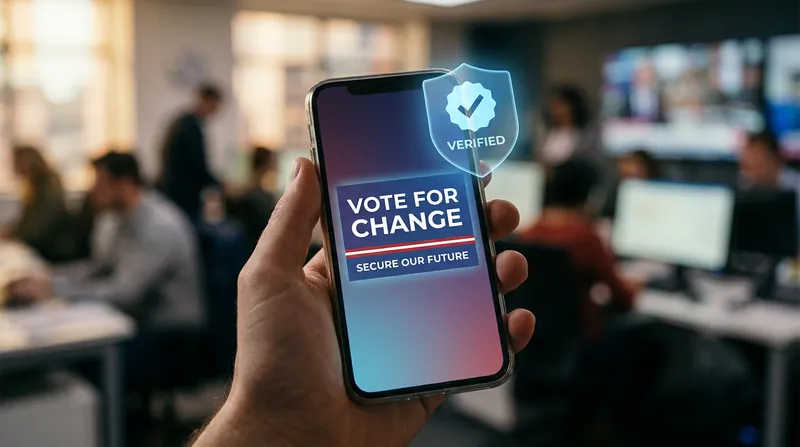
That bottleneck has largely been cleared. Major platforms have updated their ingestion pipelines to read and preserve C2PA data by default. When a user uploads a cryptographically signed video, the platform verifies the signature and displays a "Verified Origin" badge directly to viewers, ensuring the chain of custody is visible.
This infrastructure is already actively filtering the 2026 midterms. Campaigns are increasingly using secure-enclave cameras to record speeches and press conferences. This ensures that any subsequent deepfakes can be easily debunked simply by pointing to the lack of an official cryptographic signature on the fraudulent video.
Claim 3: Voters understand and trust the new verification UI. A critical unknown during the development of C2PA was whether everyday users would actually change their consumption behavior based on a small metadata badge, or if they would ignore it entirely.
A field study published in the Journal of Online Trust and Safety provides strong affirmative evidence. Researchers found that voters exhibited a 65% increase in self-reported trust when viewing media accompanied by a clear provenance indicator, compared to identical media presented without the label.
However, the evidence also surfaces transparent uncertainty regarding demographic divides. The same study noted that users over the age of 65 frequently ignored or misunderstood the badge, suggesting that user interface design still requires significant refinement to achieve universal comprehension across all age groups.
The primary vulnerability remaining in the system is known as the "Analog Hole." While the digital cryptography is robust, the physical world remains a weak point. If a user plays a verified video on a monitor and records it with a secondary smartphone camera, the new file lacks the original signature, breaking the chain of trust.[2]
Despite these edge cases, the fact-checking landscape has fundamentally improved. By establishing a "zero-trust" baseline where unlabeled media is treated with inherent skepticism, the burden of proof has shifted away from the fact-checkers and back onto the creators, empowering voters to demand mathematical proof of reality.[1][2]
Key terms
- Content Credentials (C2PA)
- An open technical standard that securely attaches information about the origin and edit history of a piece of digital media.
- Cryptographic Hash
- A complex mathematical algorithm that generates a unique digital fingerprint for a file, ensuring it hasn't been tampered with.
- The Analog Hole
- A vulnerability where digital security is bypassed by physically recording a screen or playing audio through a speaker into a new microphone.
- Media Provenance
- The verifiable chain of custody showing exactly where a piece of media originated and how it was altered before reaching the viewer.
Frequently asked
Can the C2PA metadata be faked by bad actors?
It is mathematically infeasible to forge the cryptographic signature itself. However, bad actors can strip the metadata entirely, which is why the system relies on users learning to distrust unlabeled media.
What happens if I take a screenshot of a verified image?
Taking a screenshot creates a brand new file on your device, which breaks the original chain of custody. The screenshot will not carry the original 'Verified Origin' badge.
Does this mean anonymous speech is no longer allowed?
No. C2PA is an opt-in standard. Creators can choose to publish anonymously without credentials, but viewers will know the media lacks verified provenance and can adjust their trust accordingly.
Viewpoints in depth
Provenance Advocates
Focus on cryptographic certainty as the only sustainable defense.
Technology coalitions and academic researchers argue that the AI detection arms race is fundamentally unwinnable. Because generative models are trained specifically to fool discriminators, detection software will always lag behind generation capabilities. They argue that establishing a secure chain of custody from the camera sensor to the viewer's screen is the only mathematical guarantee of reality, shifting the internet toward a model where authenticity must be proven rather than assumed.
Detection Proponents
Emphasize the need to identify malicious media that intentionally lacks provenance.
While acknowledging the value of C2PA, some AI safety researchers warn that provenance alone is insufficient. Because bad actors will simply choose not to use secure cameras or will strip metadata from their deepfakes, the internet will still be flooded with unlabeled, highly convincing synthetic media. This camp argues that robust AI scanning tools remain necessary to actively flag and throttle malicious content that attempts to fly under the radar.
Free Expression Defenders
Highlight the risks of a fully authenticated internet for vulnerable populations.
Civil liberties organizations caution against making provenance a mandatory requirement for algorithmic reach. They argue that if social platforms begin heavily downranking all media that lacks a cryptographic signature, it will disproportionately harm political dissidents, whistleblowers, and independent creators who rely on anonymity or lack access to expensive secure hardware. They advocate for a balanced approach where verified media is elevated, but unverified media is not automatically censored.
- Provenance Advocates
- Argue that cryptographic proof of reality is the only scalable, long-term solution to generative AI misinformation.
- Detection Proponents
- Believe we must continue developing AI scanning tools to catch malicious deepfakes that intentionally omit provenance metadata.
- Free Expression Defenders
- Warn that making identity verification mandatory for all media could endanger anonymous speech and political dissidents.
Perspectives this story doesn't cover
- Independent journalists who cannot afford enterprise-grade secure cameras
- Voters in regions with low digital literacy who may misinterpret the badges
Sources
Source coverage
2 outlets
3 viewpoints surfaced


- [1]Stanford Internet ObservatoryProvenance Advocates
The Shift from Detection to Provenance in Political Fact-Checking
Read on Stanford Internet Observatory → - [2]Factlen Editorial Team
Synthesis by Factlen editorial team
Read on Factlen Editorial Team →
More in News & Politics
See all →Project 2025
FACT CHECK: Evaluating Donald Trump's Claim That He 'Knows Nothing' About Project 2025
6 sources
Medical Triage
FACT CHECK: Evaluating Claims That COVID-19 Vaccines Were Denied to White People Due to Race
4 sources
Immigration Policy
Evidence Pack: Evaluating Claims That Haitian TPS Recipients Are a Drain on Welfare Programs
1 sources

Digital Provenance
Evidence Pack: Evaluating Claims That Open-Source Watermarking is Successfully Flagging AI Political Ads
2 sources
Comments
Every angle. Every day.
Get News & Politics stories with full source coverage and perspective breakdowns, free every day.