
How Bidirectional Charging is Turning EVs into Massive Home Batteries in 2026
Vehicle-to-Home (V2H) and Vehicle-to-Grid (V2G) technologies are moving from pilot programs to driveways, allowing electric vehicles to power houses during outages and earn money from the grid.
By Factlen Editorial Team
- Homeowners
- Value bidirectional charging primarily for blackout resilience and maximizing the financial return on their vehicle purchase.
- Grid Operators
- View the millions of parked EVs as a massive, distributed battery network essential for balancing the fluctuations of renewable energy.
- Automakers
- Balance the marketing appeal of whole-home backup against the technical challenges of battery degradation and warranty liabilities.
What's not represented
- · Traditional generator manufacturers facing market disruption
- · Renters who cannot install home charging infrastructure
Why this matters
An electric vehicle battery holds roughly ten times the energy of a standard home backup battery. Unlocking that capacity can protect your home from multi-day blackouts and significantly lower your energy bills without requiring a separate $13,000 battery installation.
Key points
- Bidirectional charging allows EVs to send power out of their batteries, not just take it in.
- An average EV battery holds 5 to 10 times more energy than a standard dedicated home battery.
- V2H (Vehicle-to-Home) can power a typical house for several days during a blackout.
- V2G (Vehicle-to-Grid) allows owners to sell energy back to utilities, earning hundreds of dollars annually.
- Specialized bidirectional chargers are required, costing between $1,500 and $8,000 to install.
- The ISO 15118-20 standard is rapidly expanding compatibility across new EV models in 2026.
For roughly 95 percent of its life, the most expensive component of an electric vehicle sits entirely idle. Whether parked in a driveway overnight or sitting in an office lot during the day, the massive lithium-ion battery inside a modern EV does nothing but wait for the next commute [5]. But in 2026, a fundamental shift in charging technology is transforming these vehicles from passive transportation into active, mobile energy assets.[5][6]
To understand the scale of this shift, consider the math of home energy storage. A dedicated residential battery, like the popular Tesla Powerwall, holds 13.5 kilowatt-hours (kWh) of energy—enough to keep essential home circuits running for about eight to twelve hours during a blackout [1]. By contrast, a Ford F-150 Lightning carries a 131 kWh battery [1]. That is nearly ten times the capacity, sitting right in the garage.[1]

The technology unlocking this dormant power is called bidirectional charging. Historically, EV charging has been a strict one-way street: AC power flows from the grid, gets converted to DC power, and fills the car's battery [4]. Bidirectional systems rewrite that rule, allowing the vehicle to push stored DC power back out, converting it to AC to run external loads [4].[4][6]
This two-way flow comes in three distinct flavors, often referred to by their acronyms. The simplest is Vehicle-to-Load (V2L). This requires no special home hardware; it simply provides a standard 120V or 240V outlet on the vehicle itself [1]. Drivers use V2L to plug in camping fridges, power tools at a job site, or run a few extension cords into the house during an emergency [5].[1][5]

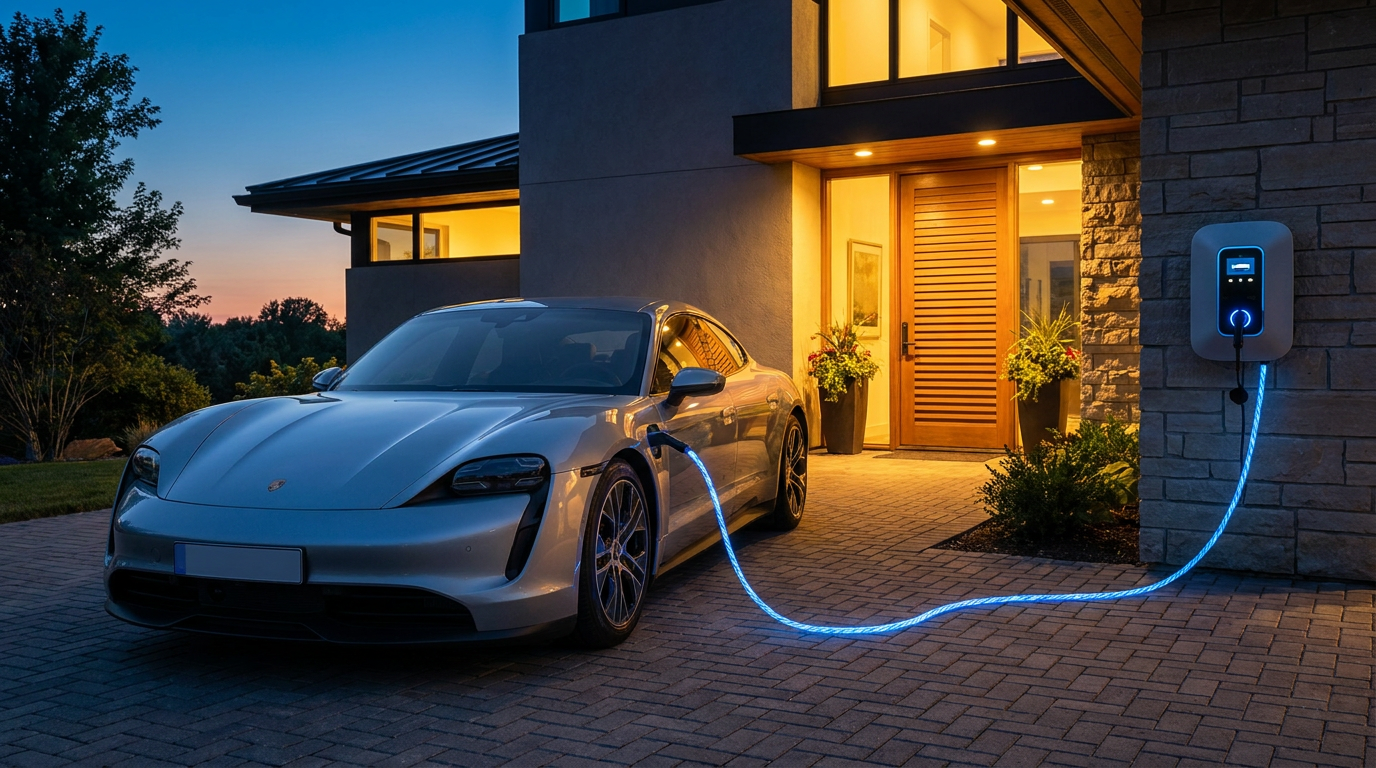
The second, and currently most impactful, tier is Vehicle-to-Home (V2H). Instead of running extension cords, V2H integrates directly with a home's electrical panel [1]. When the grid goes down, a transfer switch isolates the house, and the EV seamlessly takes over as a whole-home generator [4]. A fully charged F-150 Lightning can keep a typical household running for three to ten days without requiring any lifestyle compromises [1].[1][4]
Beyond emergency backup, V2H offers daily financial benefits through "time-of-use" arbitrage. Homeowners can charge their EV overnight when electricity rates are rock-bottom, and then use the car to power their house during the late afternoon when grid prices peak [5]. If paired with rooftop solar, the car can soak up excess midday sun and discharge it after sunset, creating a highly efficient, self-sustaining energy loop [5].[5][6]
However, V2H requires specific, and often expensive, hardware. A standard Level 2 wall charger cannot pull power out of a car. Homeowners need a dedicated bidirectional charger, which contains a heavy-duty inverter to handle the DC-to-AC conversion [1]. Units like the Wallbox Quasar 2 or the Ford Charge Station Pro are physically larger and more complex than standard chargers [3].[1][3]
However, V2H requires specific, and often expensive, hardware.
The economics, however, still heavily favor V2H over dedicated home batteries. Installing a single Tesla Powerwall typically costs between $12,500 and $14,500 [1]. A bidirectional charger setup, including the necessary panel integration and transfer equipment, ranges from $1,500 to $8,000 [1]. Because the consumer has already paid for the massive battery when they bought the car, the marginal cost of adding home backup is drastically lower [1].[1][6]

The third and most complex flavor is Vehicle-to-Grid (V2G). Here, the EV does not just power the owner's house; it exports surplus energy all the way back into the public utility grid [5]. For grid operators, this is the holy grail. Instead of firing up expensive, carbon-heavy "peaker plants" when millions of people turn on their ovens at 6:00 PM, utilities can draw a tiny fraction of power from thousands of plugged-in EVs [5].[5][6]
In exchange for stabilizing the grid, EV owners get paid. Pilot programs analyzed across the UK, the Netherlands, Japan, and California show that households participating in V2G programs earn a median of $420 to $780 per year in grid services and bill savings [2]. The car literally earns its keep while parked.[2]
Despite the promise, V2G faces steep regulatory hurdles. Exporting power beyond the home's internal wiring requires strict utility interconnection agreements, specialized metering, and program enrollment [4]. Utilities must ensure that thousands of cars pushing power simultaneously do not overwhelm local transformers [4]. Consequently, while V2H is commercially available today, V2G remains largely confined to regional pilot programs and specific utility partnerships [3].[3][4]
A persistent consumer anxiety surrounding bidirectional charging is battery degradation. If a car is constantly micro-cycling to power a house or support the grid, will the battery wear out prematurely? Early data suggests the impact is minimal [2]. Smart software manages the state of charge, keeping the battery in its healthiest middle range and avoiding deep discharges [5]. Furthermore, automakers supporting the tech are explicitly structuring their warranties to cover bidirectional use [2].[2][5]
Compatibility remains the biggest bottleneck in 2026. The "holy grail" of plugging any EV into any house does not yet exist [3]. Both the vehicle and the charger must speak the same bidirectional language. Historically, only the CHAdeMO plug standard (used by the Nissan Leaf) supported this natively [1]. But the industry is rapidly shifting.[1][3]

The rollout of the ISO 15118-20 communication protocol has finally brought bidirectional capabilities to the dominant CCS and NACS charging standards [4]. Ford leads the truck segment, while Hyundai and Kia's E-GMP platform vehicles offer robust V2L and emerging V2H support [1]. Volkswagen recently made waves by unlocking bidirectional capabilities for its 77 kWh ID models via a free over-the-air software update [6].[1][4][6]
The most notable holdout is Tesla. As of mid-2026, the company has not enabled bidirectional charging on its consumer fleet of Model 3, Y, S, or X vehicles [3]. Industry analysts point out that Tesla has a vested interest in protecting its highly lucrative Powerwall home battery business, making them hesitant to let their cars cannibalize their stationary storage sales [3].[3][6]
Ultimately, bidirectional charging represents a profound psychological shift in vehicle ownership. A car is no longer just a depreciating asset used for mobility. It is a mobile energy vault that can shield a family from extreme weather blackouts, optimize household energy costs, and accelerate the broader transition to a renewable grid [5].[5][6]
How we got here
Early 2010s
Nissan introduces the Leaf with CHAdeMO, the first major standard to support bidirectional flow.
2022
Ford launches the F-150 Lightning with Intelligent Backup Power, bringing V2H to the mainstream US market.
2024
The ISO 15118-20 standard is finalized, paving the way for CCS and NACS bidirectional compatibility.
2025
European V2G pilot programs demonstrate consistent annual revenue for participating households.
Mid-2026
Major automakers, including VW, begin unlocking V2H capabilities via over-the-air software updates.
Viewpoints in depth
Homeowners
Focused on resilience against blackouts and maximizing the ROI of their vehicle purchase.
For the average consumer, the appeal of bidirectional charging is deeply practical. Power outages caused by extreme weather are becoming more frequent, and dedicated home batteries like the Tesla Powerwall remain prohibitively expensive for many. By utilizing the massive battery they already purchased inside their EV, homeowners can secure multi-day backup power for a fraction of the cost. Additionally, those on time-of-use electricity plans see V2H as a daily financial tool, allowing them to avoid pulling power from the grid during expensive evening peak hours.
Grid Operators
View EVs as a massive distributed battery network to balance renewable energy fluctuations.
Utility companies face a growing crisis: solar and wind power are intermittent, and evening demand spikes strain aging infrastructure. Grid operators view the millions of parked EVs as a decentralized, multi-gigawatt battery reserve. By incentivizing owners to plug in and participate in V2G programs, utilities can draw a tiny amount of power from thousands of cars simultaneously. This "virtual power plant" model is vastly cheaper and cleaner than building new natural gas peaker plants to handle evening demand surges.
Automakers
Balancing the marketing appeal of home backup against the warranty risks of battery degradation.
Car manufacturers are walking a tightrope. On one hand, offering a vehicle that can power a house is a massive competitive advantage and a brilliant marketing hook. On the other hand, automakers are terrified of warranty liabilities. EV batteries are rated for a certain number of charge cycles, and using the car to run a house every day accelerates that wear. Consequently, manufacturers are heavily investing in smart battery management software to ensure that V2H/V2G micro-cycling occurs only in the battery's healthiest middle-charge states, protecting the pack's longevity.
What we don't know
- Whether Tesla will eventually capitulate and enable bidirectional charging on its consumer fleet.
- How quickly local utility companies will standardize the permitting process for V2G grid interconnection.
- The long-term, real-world impact of daily V2H cycling on battery degradation over a 10-year lifespan.
Key terms
- V2L (Vehicle-to-Load)
- A feature allowing users to plug standard 120V or 240V appliances directly into an outlet on the electric vehicle.
- V2H (Vehicle-to-Home)
- A system where an electric vehicle powers an entire house through the home's electrical panel, typically during a blackout or peak pricing hours.
- V2G (Vehicle-to-Grid)
- A technology that allows an electric vehicle to sell stored energy back to the public utility grid to help balance supply and demand.
- ISO 15118-20
- The international communication standard that allows modern CCS and NACS charging plugs to safely manage two-way power flow.
- Bidirectional Inverter
- Hardware inside a V2H charger that converts the car's DC battery power into the AC power required by household appliances.
Frequently asked
Can any electric vehicle power a house?
No. Both the vehicle and the home charger must specifically support bidirectional charging. While standard on some new models, many older EVs lack the necessary hardware.
Will powering my home void my car's battery warranty?
Automakers that officially support V2H, such as Ford and Nissan, explicitly cover bidirectional use under their battery warranties, though usage limits may apply.
Do I need solar panels to use V2H?
No. You can charge your EV from the grid during cheap off-peak hours and discharge it to power your home during expensive peak hours, entirely without solar.
Why doesn't Tesla support bidirectional charging?
As of 2026, Tesla has not enabled V2H on its consumer vehicles, a move industry analysts attribute to protecting sales of their dedicated Powerwall home batteries.
Sources
Source coverage
6 outlets
3 viewpoints surfaced






[1]NuWatt EnergyHomeowners
Bidirectional EV Charging & V2H in 2026: Can Your EV Replace a Home Battery?
Read on NuWatt Energy →[2]Energy SolutionsGrid Operators
Can Your EV Power Your Home? V2G & V2H Explained
Read on Energy Solutions →[3]AMP RenewablesAutomakers
The honest truth about V2H and V2G in 2026
Read on AMP Renewables →[4]NeoChargeAutomakers
Bidirectional EV charging can power your home (V2H) or potentially the grid (V2G)
Read on NeoCharge →[5]EleportGrid Operators
Vehicle-to-Grid (V2G) charging is finally a reality in 2026
Read on Eleport →[6]Factlen Editorial Team
Synthesis by Factlen editorial team
Read on Factlen Editorial Team →
More in shopping
See all 106 stories →E-Bikes
The 2026 E-Bike Buying Guide: How to Choose the Right Electric Bicycle
8 sources

Gear Showdown
Garmin inReach Mini 2 vs. Zoleo: Which Satellite Communicator Belongs in Your Pack?
9 sources

Material Science
Plant-Based Leather vs. Traditional Leather: The 2026 Material Comparison
11 sources

Used EVs
The 2026 Guide to Buying a Used EV: Navigating Battery Health, Depreciation, and the Post-Tax-Credit Market
8 sources
Every angle. Every day.
Get shopping stories with full source coverage and perspective breakdowns delivered to your inbox.