
How AI and Particle Accelerators Are Reading the Unreadable Herculaneum Scrolls
Nearly 2,000 years after Mount Vesuvius turned an ancient Roman library into carbonized lumps of ash, machine learning is allowing researchers to read the lost texts without ever opening them.
By Factlen Editorial Team
- Digital Archaeologists
- Focus on the non-invasive technological pipeline, prioritizing the development of better X-ray scans and automated 3D segmentation.
- Classical Papyrologists
- Emphasize the human element of translation, historical context, and the profound cultural value of recovering lost Greco-Roman literature.
- Open-Source Technologists
- View the breakthrough as a triumph of crowdsourced machine learning, proving that decentralized AI competitions can solve intractable scientific problems.
What's not represented
- · Italian Cultural Heritage Officials
- · Field Archaeologists advocating for further excavation
Why this matters
The Herculaneum papyri represent the only intact library surviving from the classical world. Unlocking them could multiply the volume of known Greco-Roman literature, fundamentally rewriting our understanding of ancient philosophy, science, and history.
Key points
- The Herculaneum scrolls were carbonized by the eruption of Mount Vesuvius in 79 AD and cannot be physically opened.
- Researchers use high-resolution X-ray scans to create 3D models of the scrolls' internal layers.
- Because the ancient ink is carbon-based, it is invisible to the human eye on X-ray scans.
- Machine learning models were trained to detect microscopic 'crackle patterns' left by the ink on the papyrus.
- The AI has successfully revealed thousands of characters of lost Greek philosophy without hallucinating text.
- Automating the digital unwrapping process could soon allow scholars to read the remaining 800 scrolls.
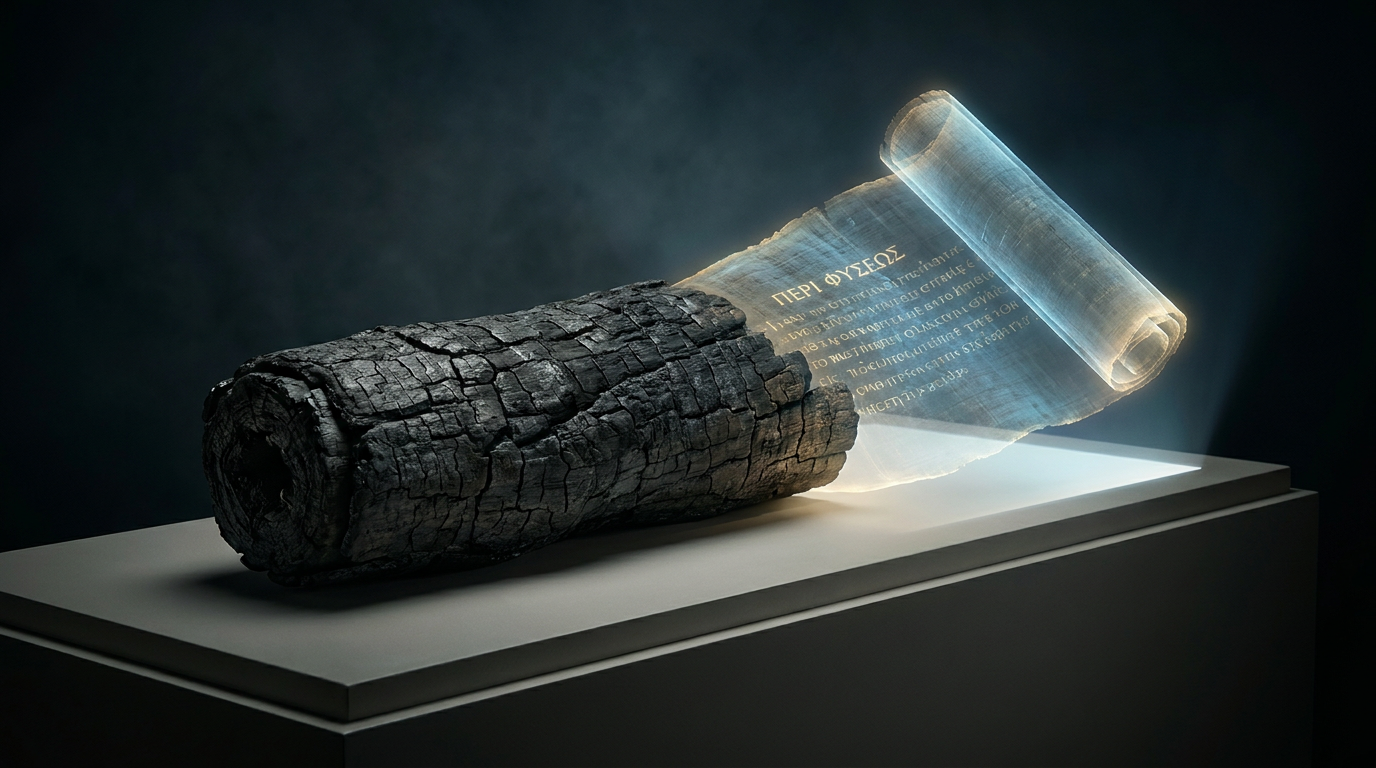
When Mount Vesuvius erupted in 79 AD, it did not just bury the citizens of Pompeii and Herculaneum; it entombed their knowledge. In the luxury seaside town of Herculaneum, a massive pyroclastic surge engulfed a sprawling estate believed to belong to Julius Caesar's father-in-law. Inside the estate was a vast library of papyrus scrolls. The intense, oxygen-deprived heat of the volcanic ash instantly carbonized the scrolls, turning them into brittle lumps of charcoal before they could burn away.[4][5]
For nearly 1,700 years, the library sat undisturbed under 60 feet of volcanic rock. When workers digging a well in 1752 finally stumbled upon the "Villa of the Papyri," they recovered more than 800 of these blackened, log-like artifacts. But discovery quickly turned to frustration. The scrolls were so fragile that any physical attempt to unroll them caused the carbonized papyrus to shatter into dust. For over two and a half centuries, the only surviving intact library from the classical world remained entirely unreadable.[3][5]
Today, that ancient silence has been broken. A convergence of particle physics, 3D imaging, and artificial intelligence has achieved what generations of archaeologists deemed impossible: reading the scrolls without ever opening them. The breakthrough, catalyzed by a global crowdsourcing competition called the Vesuvius Challenge, has rapidly accelerated from deciphering a single word to extracting entire columns of lost philosophical texts.[1][7]
The foundation for this revolution was laid by Dr. Brent Seales, a computer scientist at the University of Kentucky. Seales pioneered a technique called "virtual unwrapping." By placing the charred scrolls inside high-resolution X-ray micro-computed tomography (micro-CT) scanners—and later, particle accelerators like the UK's Diamond Light Source—his team could map the internal 3D structure of the rolled papyrus. Software could then trace the spiraling layers and digitally flatten them onto a computer screen.[1][4]

But the Herculaneum scrolls presented a unique, seemingly insurmountable physics problem. Unlike medieval manuscripts written with metal-based inks that glow brightly on X-rays, the Roman scribes at Herculaneum used a carbon-based ink made of soot and water. On a CT scan, carbon ink sitting on carbonized papyrus is practically invisible. The 3D scans successfully unrolled the pages, but the pages appeared completely blank.[5][6]
To solve the ink problem, Seales partnered with Silicon Valley entrepreneurs Nat Friedman and Daniel Gross in 2023 to launch the Vesuvius Challenge. They released thousands of 3D X-ray images of the scrolls to the public, alongside open-source virtual unwrapping tools, and offered over $1 million in prize money to anyone who could write software capable of detecting the invisible ink.[1][6]
To solve the ink problem, Seales partnered with Silicon Valley entrepreneurs Nat Friedman and Daniel Gross in 2023 to launch the Vesuvius Challenge.
The critical insight came from a contestant who noticed a faint "crackle pattern" on the surface of the digital papyrus—microscopic textural changes left behind where the wet ink had originally dried and altered the papyrus fibers. Luke Farritor, a 21-year-old college student, trained a machine learning model to hunt for this specific crackle pattern across the vast 3D datasets. In late 2023, his neural network highlighted a cluster of shapes that formed the Greek word "πορφύρα" (porphyras), meaning purple.[5][6]

That single word shattered the dam. Farritor teamed up with two other researchers, Youssef Nader and Julian Schilliger, to refine the AI models. By early 2024, their combined algorithms successfully revealed 15 columns of text containing more than 2,000 characters, claiming the $700,000 grand prize. Classical scholars immediately identified the text as a previously unknown work by the Epicurean philosopher Philodemus, discussing how music, food, and art influence human pleasure.[1][3][5]
The pace of discovery has only accelerated since. In 2025, researchers successfully identified the title of another still-sealed scroll—"On Vices"—and generated the first internal images of a scroll housed at the Bodleian Libraries in Oxford. Within those Oxford scans, scholars quickly spotted the ancient Greek word "διατροπή" (diatrope), meaning disgust, proving that the AI pipeline could be applied to scrolls scattered across different museums globally.[2][4]
The mechanism driving these discoveries relies entirely on pattern recognition, not language comprehension. The machine learning models are trained strictly to detect the physical presence of ink based on voxel (3D pixel) density and texture. The AI has no understanding of Greek or Latin; it operates like a blind copyist, meticulously highlighting microscopic surface anomalies. It is then up to human papyrologists to look at the AI's output, translate the fragmented letters, and reconstruct the historical context.[2][7]
This separation of labor is viewed as a massive advantage by historians. Because the AI does not "know" what it is reading, it cannot hallucinate or guess missing words based on modern linguistic biases. It simply maps the physical reality of the carbonized artifact, ensuring that the recovered texts remain authentic primary sources.[2][7]
The challenge now is scaling the technology. Digitally tracing the tightly wound, crushed layers of papyrus—a process called segmentation—has historically required hundreds of hours of manual human labor per square centimeter. Open-source developers are currently building next-generation algorithms that automate this segmentation, allowing the AI to "see" the boundaries of the burned sheets and smooth out the digital folds instantly.[1][4]

If this automated pipeline can be perfected, the implications for classical history are staggering. The 800 scrolls currently sitting in museum vaults represent only a fraction of what may still be buried. Archaeologists believe the unexcavated lower levels of the Villa of the Papyri could hold thousands more scrolls, potentially containing lost works by Aristotle, Sophocles, or early Roman historians.[3][5]
For centuries, the eruption of Mount Vesuvius was viewed as one of history's great cultural tragedies. Yet, in a profound irony, the volcanic ash that destroyed Herculaneum is precisely what preserved its library from the damp rot of the Italian climate. Now, armed with particle accelerators and neural networks, researchers are finally unlocking a time capsule that has waited two millennia to be read.[5][7]
How we got here
79 AD
Mount Vesuvius erupts, burying the Villa of the Papyri and carbonizing its library.
1752
Workers excavating Herculaneum discover the blackened scrolls, but early attempts to open them destroy the artifacts.
2015
Dr. Brent Seales pioneers 'virtual unwrapping' using X-ray micro-CT scans to read closed scrolls.
March 2023
The Vesuvius Challenge launches, releasing 3D scans of the scrolls and offering a $1 million prize pool.
Late 2023
An AI model detects the first word, 'purple', hidden within the carbonized layers.
Early 2024
A team of students wins the $700,000 grand prize by deciphering over 2,000 characters of a lost philosophical text.
2025
Researchers successfully identify scroll titles and image the interior of scrolls housed at Oxford's Bodleian Libraries.
Viewpoints in depth
The Digital Archaeologists' View
The primary hurdle is no longer reading the ink, but scaling the physical and digital processing pipelines.
For computer scientists and imaging specialists, the Herculaneum breakthrough is fundamentally a data and scaling problem. The AI models have proven they can detect the ink, but preparing the data for the AI—specifically the 'segmentation' process of tracing the crumpled, spiraling layers of papyrus in 3D space—remains intensely laborious. This camp is focused on developing next-generation algorithms that can automatically detect the boundaries of the burned sheets and mathematically smooth out the distortions. Their ultimate goal is to create an industrialized pipeline where a scroll can be scanned at a particle accelerator and fully transcribed by software in a matter of days, rather than years.
The Classical Papyrologists' View
Technology is merely the delivery mechanism; the true value lies in human translation and historical contextualization.
Historians and classicists view the AI as a highly advanced magnifying glass. They emphasize that the machine learning models do not understand language—they merely output images of Greek letters. It is up to human scholars to piece together fragmented words, correct for ancient scribal errors, and translate the text into modern languages. This camp is thrilled by the prospect of recovering lost works by major figures like Aristotle or early Roman historians, noting that the Herculaneum library could single-handedly multiply the volume of surviving Greco-Roman literature. They advocate for careful, peer-reviewed interpretation of the texts to ensure the ancient voices are accurately understood.
The Open-Source Technologists' View
The breakthrough proves the superiority of decentralized, crowdsourced problem-solving over siloed academic research.
For the tech entrepreneurs and software developers involved, the Vesuvius Challenge is a masterclass in incentive design. By open-sourcing the 3D datasets and offering substantial financial bounties, the organizers bypassed traditional academic bottlenecks and attracted talent from outside the archaeological establishment—including undergraduate students and aerospace interns. This camp argues that the rapid success of the challenge should serve as a blueprint for solving other intractable scientific mysteries, demonstrating that when global talent is given open access to high-quality data, breakthroughs happen exponentially faster.
What we don't know
- How many more scrolls remain buried in the unexcavated lower levels of the Villa of the Papyri.
- Whether the library contains lost works of major historical significance, such as missing texts by Aristotle or Livy, or primarily niche Epicurean philosophy.
- If the automated segmentation algorithms will be robust enough to handle the most severely crushed and deformed scrolls in the collection.
Key terms
- Virtual Unwrapping
- A digital technique that uses 3D X-ray scans to map the internal layers of a rolled object and digitally flatten them on a computer screen.
- Micro-CT Scan
- Micro-computed tomography, an advanced X-ray imaging technique that creates incredibly high-resolution 3D models of the inside of an object.
- Segmentation
- The painstaking process of digitally tracing the individual, spiraling layers of papyrus within the 3D scan so they can be separated and flattened.
- Epicureanism
- An ancient Greek system of philosophy founded by Epicurus, which taught that the highest good is modest, sustainable pleasure and freedom from fear.
Frequently asked
Why can't researchers just unroll the scrolls?
The intense heat of the Mount Vesuvius eruption turned the papyrus into brittle charcoal. Any physical attempt to unroll them causes the scrolls to shatter into dust.
Why didn't X-rays work initially?
Roman scribes used a carbon-based ink made of soot. Because the ink and the burned papyrus are both made of carbon, they look identical on standard X-ray scans.
Does the AI translate the ancient Greek?
No. The AI is only trained to detect the physical texture of the ink on the papyrus. Human scholars must still read, translate, and interpret the resulting images.
What kind of texts are in the library?
So far, the deciphered texts are mostly philosophical works, particularly from the Epicurean school of Greek philosophy, discussing topics like pleasure, vices, and music.
Sources
Source coverage
7 outlets
3 viewpoints surfaced







[1]Vesuvius ChallengeDigital Archaeologists
Resurrect an ancient library from the ashes of a volcano
Read on Vesuvius Challenge →[2]University of OxfordClassical Papyrologists
Historic breakthrough in the endeavour to decipher text preserved on papyrus scrolls
Read on University of Oxford →[3]National Endowment for the HumanitiesClassical Papyrologists
The original scroll, decoded by AI
Read on National Endowment for the Humanities →[4]The GuardianOpen-Source Technologists
Writing on PHerc. 172 papyrus, found at Roman mansion in Herculaneum, revealed
Read on The Guardian →[5]Smithsonian MagazineOpen-Source Technologists
How Artificial Intelligence Is Making 2,000-Year-Old Scrolls Readable Again
Read on Smithsonian Magazine →[6]Understanding AIDigital Archaeologists
How AI is reading the unreadable
Read on Understanding AI →[7]Factlen Editorial Team
Synthesis by Factlen editorial team
Read on Factlen Editorial Team →
Every angle. Every day.
Get culture stories with full source coverage and perspective breakdowns delivered to your inbox.