
How AI and Drone Swarms Are Revolutionizing Humanitarian Mine Clearance
Faced with an unprecedented scale of unexploded ordnance, demining organizations are deploying artificial intelligence and thermal-equipped drones to map hazard zones exponentially faster than human teams.
By Factlen Editorial Team
- Humanitarian Deminers
- Focused on safely returning contaminated land to civilian use and ensuring technology is robust before deployment.
- Defense Technologists
- Focused on rapid deployment, force protection, and the ability to retrain AI models against emerging battlefield threats.
- Academic Researchers
- Focused on the physics of sensor accuracy, thermal imaging limitations, and reducing false positive rates in AI models.
What's not represented
- · Local farmers awaiting land clearance
- · Civilian victims of unexploded ordnance
Why this matters
Clearing landmines is the critical first step in post-conflict recovery. By exponentially speeding up detection, this technology directly accelerates the return of displaced families and the restoration of global agricultural supply chains.
Key points
- An estimated 110 million unexploded landmines contaminate global conflict zones, with Ukraine currently the most heavily mined country.
- Humanitarian organizations are shifting from slow, dangerous manual probing to an "imagery-first" approach using drones and AI.
- Machine learning algorithms can reduce the time needed to analyze minefield imagery from several days to just a few hours.
- Thermal sensors can detect surface mines with 90% accuracy by identifying temperature differences between explosives and soil.
- Deeply buried ordnance and dense vegetation still pose significant challenges, meaning AI serves as a force multiplier rather than a complete replacement for human deminers.
Around the world, an estimated 110 million unexploded landmines and explosive remnants of war lie hidden beneath the soil. These dormant threats kill or maim thousands of civilians annually, rendering vast tracts of agricultural land unusable and preventing displaced populations from returning home. Following the 2022 Russian invasion, Ukraine has become the most heavily mined country on Earth, surpassing even legacy conflict zones like Afghanistan and Syria. The sheer scale of the contamination has forced a reckoning with how clearance operations are conducted.[1][3]
For decades, the humanitarian mine action community has relied on a painstaking, dangerous, and highly manual methodology. Deminers physically walk the terrain, sweeping the ground with handheld metal detectors and gently probing the dirt with sticks to locate buried threats. It is a treacherous process where a single misstep can be fatal. Furthermore, traditional metal detectors cannot distinguish between a live artillery shell and a rusted nail or spent bullet casing. This leads to a staggeringly high rate of false positives, churning up harmless scrap metal and drastically slowing down clearance operations to a crawl.[5][8]
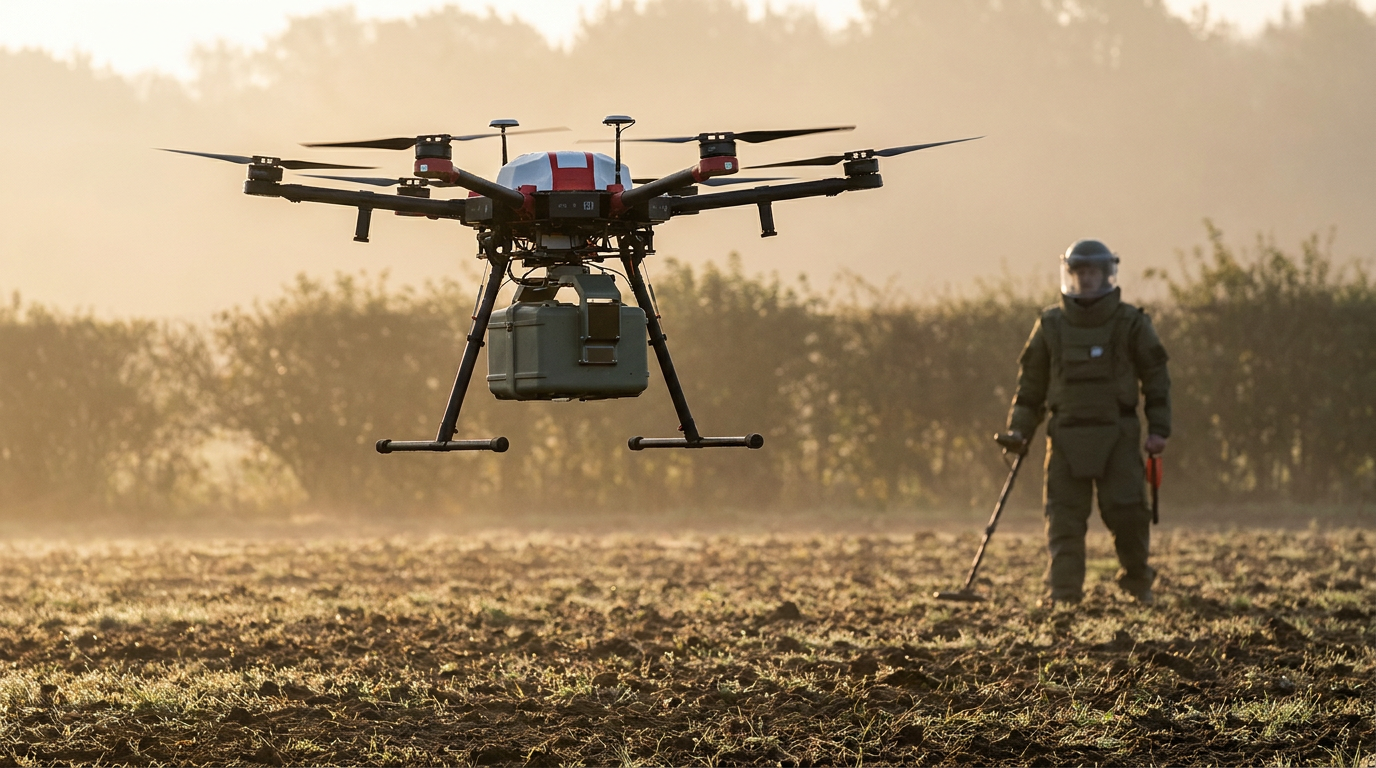
To accelerate this process and protect human lives, organizations are rapidly shifting toward an "imagery-first" approach, replacing manual probing with uncrewed aerial vehicles (UAVs) and artificial intelligence. By flying commercial drones over suspected hazardous areas, deminers can capture thousands of high-resolution images without ever stepping into the minefield. This aerial perspective allows teams to map the exact boundaries of contamination, overlaying danger zones with the locations of schools, hospitals, and population centers to prioritize which areas require immediate intervention.[1][2]
The primary claim driving this technological shift is a massive, exponential reduction in analysis time. The HALO Trust, the world's largest humanitarian landmine clearance organization, recently partnered with Amazon Web Services (AWS) to process the staggering 11 terabytes of drone data it has collected over Ukraine. This data volume is equivalent to more than 10,000 copies of the Encyclopedia Britannica, and manually reviewing it is a logistical bottleneck that delays critical clearance work.[3]

According to Matthew Abercrombie, HALO’s Head of Research and Development, human analysts previously required three to five days to manually stitch together and inspect imagery for an average minefield. By deploying machine learning models to automatically flag explosive anomalies and signs of human activity, that timeline has been compressed to a "matter of hours." This acceleration allows field teams to deploy faster and target their manual clearance efforts exclusively on confirmed threat coordinates.[1]
The second major claim centers on the accuracy of thermal sensing combined with deep learning algorithms. Researchers from Columbia University and Binghamton University have demonstrated that drones equipped with long-wave infrared cameras can detect the subtle temperature differentials between an explosive casing and the surrounding soil. Because landmines are dense objects, they heat up and cool down at a different rate than the natural environment around them.[5]
Because metal and plastic absorb and radiate heat differently than dirt or vegetation, mines become highly visible to thermal sensors at specific times of day. In controlled trials conducted at military training grounds, this airborne system identified surface-laid anti-personnel mines, grenades, and projectiles with 90 percent accuracy. By sensing these temperature differences, the AI can map out a highly accurate threat landscape, vastly outperforming the speed and reliability of human visual inspection.[5]
Because metal and plastic absorb and radiate heat differently than dirt or vegetation, mines become highly visible to thermal sensors at specific times of day.
This capability is not just theoretical; it is already scaling in active conflict zones. Safe Pro Group, a developer of AI-enabled situational awareness tools, recently announced that its proprietary machine learning platform has achieved over 50,000 confirmed landmine and unexploded ordnance (UXO) detections in Ukraine. This milestone represents a significant leap from academic trials to real-world humanitarian application, proving that commercially available drones can be retrofitted into powerful demining assets.[6]

Safe Pro’s system, trained on a massive dataset of 2.75 million drone images, can identify more than 150 different types of explosive threats, including cluster munitions and ambush drones. By converting raw aerial data into rapidly shareable, high-resolution 2D and 3D hazard maps, the AI provides ground teams with precise coordinates. This scalable approach to situational awareness prevents wasted effort and ensures that multiple organizations working in the same region share a common operating picture.[2][6]
Military forces are also adopting these AI-driven tools to protect frontline personnel and maintain mobility in contested environments. The UK’s Defence Science and Technology Laboratory (Dstl) recently concluded extensive trials of AI-powered drones for the British Army under Project Ground Area Reconnaissance and Assurance (GARA). The objective is to explore new technologies that speed up the arduous task of dealing with high explosives on the modern battlefield.[4]
During these exercises in Essex, quadcopters utilized a suite of optical, thermal, and computer vision algorithms to seek out, identify, and geolocate munitions. The system introduces a digital "reconnaissance layer" that keeps human operators safely removed from the explosive hazard. Crucially, the trial demonstrated that the AI models can be rapidly retrained in the field; if an operator spots a new type of explosive device, they can upload the image to update the system's recognition capabilities instantly.[4]

Despite these breakthroughs, the evidence reveals transparent uncertainty regarding the technology's limitations. AI and drone detection are not yet a silver bullet, and the mine action community remains highly cautious about over-relying on automated systems where a false negative costs lives. Humanitarian organizations stress that technology is only adopted once it is robust and mature, as the margin for error in explosive ordnance disposal is absolute zero.[2]
The most significant limitation facing aerial detection is depth. A study published in the journal MDPI evaluated the use of the YOLOv5 deep learning model for UXO detection via thermal imaging. The researchers found that while surface and shallow-buried mines were easily identified, deeply buried ordnance was almost impossible to detect from the air because the thick layer of soil completely masked the object's thermal signature from the drone's sensors.[7]
Environmental conditions also heavily dictate the success of these systems. Thermal detection is highly time-dependent; the MDPI study noted that the best detection precision occurs strictly within a 30-to-120-minute window after sunrise or sunset, when the temperature contrast between the mine and the earth is most pronounced. Furthermore, dense vegetation, tall grass, and forest canopies physically obstruct aerial sensors, requiring teams to fall back on traditional ground-based methods in overgrown areas.[7]

Additionally, modern warfare has seen a proliferation of low-metal or entirely plastic-cased mines, which are notoriously difficult to detect. While AI can spot the visual or thermal footprint of a plastic mine resting on the surface, identifying them underground remains a persistent challenge that standard drone sensors cannot yet solve. High-tech mines equipped with magnetic influence sensors can even detonate when exposed to the magnetic field of a traditional detector.[8]
To address these blind spots, researchers are developing next-generation ground sensors to complement aerial AI. The HALO Trust is currently testing handheld devices built by the Australian company MRead, which use magnetic resonance to detect the actual molecular identity of explosive compounds. By directly identifying the explosive material rather than the metal casing, these sensors completely ignore harmless scrap metal, drastically reducing false alarms during the manual excavation phase.[1][2]
Ultimately, AI and drones are not replacing human deminers; they are acting as a vital force multiplier. By rapidly mapping the danger zones, eliminating false positives, and identifying surface threats from the sky, technology ensures that when a human does step into a minefield, they know exactly where the threat lies. The end goal is not just finding explosives, but confidently returning safe, productive land to the communities that desperately rely on it.[2][8]
How we got here
2014-2021
Early academic research begins exploring the use of commercial drones and thermal imaging to detect surface-laid mines.
2022
The Russian invasion of Ukraine creates the most heavily mined landscape in the world, accelerating the need for rapid clearance tech.
Mid-2024
The HALO Trust partners with AWS to deploy machine learning models capable of processing massive volumes of drone imagery.
Early 2026
Safe Pro Group surpasses 50,000 confirmed AI-powered landmine and UXO detections in Ukraine.
April 2026
The British Army successfully trials AI-powered drones that can be rapidly retrained in the field to identify emerging explosive threats.
Viewpoints in depth
Humanitarian Deminers
Focused on safely returning contaminated land to civilian use and ensuring technology is robust before deployment.
For non-governmental organizations like The HALO Trust, the ultimate metric of success is not just the number of mines removed, but the amount of land returned to productive civilian use. Humanitarian deminers view AI and drones as vital tools to triage massive areas of contamination, allowing them to focus their manual labor on confirmed threat zones. However, they maintain a highly cautious approach to automation. Because a single false negative can result in a civilian casualty, these organizations insist that AI must serve as an assistive mapping tool rather than a complete replacement for human verification and physical excavation.
Defense Technologists
Focused on rapid deployment, force protection, and the ability to retrain AI models against emerging battlefield threats.
Military research agencies and defense contractors approach AI demining through the lens of force protection and operational mobility. For groups like the UK's Defence Science and Technology Laboratory (Dstl) and Safe Pro Group, the priority is keeping soldiers out of the hazard zone while maintaining the speed of an advancing force. They emphasize the adaptability of machine learning models—specifically the ability to rapidly retrain algorithms in the field when adversaries deploy novel, improvised explosive devices. To this camp, the rapid iteration of software is just as important as the hardware carrying it.
Academic Researchers
Focused on the physics of sensor accuracy, thermal imaging limitations, and reducing false positive rates in AI models.
The academic community is primarily concerned with the underlying physics and data science of remote detection. Researchers from institutions like Columbia University and those publishing in journals like MDPI focus heavily on the limitations of current sensors. They point out that while AI excels at identifying surface anomalies, the technology is still fundamentally constrained by environmental factors like soil depth, dense vegetation, and the time of day. This camp advocates for multi-modal sensor fusion—combining thermal imaging, LiDAR, and magnetic resonance—to overcome the physical barriers that currently prevent drones from detecting deeply buried, plastic-cased mines.
What we don't know
- How quickly AI models can be adapted to detect entirely novel, improvised explosive devices (IEDs) that do not match historical training data.
- Whether drone-based thermal detection can be effectively scaled in dense jungle environments, where thick canopies block aerial sensors.
- The long-term cost-effectiveness of deploying advanced drone swarms in underfunded, developing nations compared to traditional manual labor.
Key terms
- Unexploded Ordnance (UXO)
- Explosive weapons, such as bombs, shells, grenades, and landmines, that did not explode when they were deployed and still pose a risk of detonation.
- Thermal Sensing
- Technology that detects the infrared radiation (heat) emitted by objects, allowing drones to spot temperature differences between a landmine and the surrounding earth.
- False Positive
- An instance where a detection system incorrectly identifies a harmless object, such as a piece of scrap metal, as an explosive threat.
- Magnetic Resonance Detection
- An advanced sensor technology that identifies the specific molecular signature of explosive compounds, rather than just detecting the presence of metal.
Frequently asked
How does AI detect buried landmines?
AI analyzes high-resolution thermal and optical imagery captured by drones. It looks for specific temperature differentials and visual patterns that distinguish explosive casings from surrounding soil and vegetation.
Can drones completely replace human deminers?
No. Drones and AI are used to rapidly map hazard zones and identify surface threats, but human deminers and remote-controlled robots are still required to physically excavate and neutralize the explosives.
Why are traditional metal detectors inefficient?
Traditional metal detectors cannot differentiate between a live mine and harmless scrap metal like rusted nails or spent bullet casings, leading to a high rate of false positives that slows down clearance.
What are the limitations of drone-based mine detection?
Aerial sensors struggle to detect deeply buried ordnance or mines hidden under dense forest canopies. Thermal imaging is also highly dependent on the time of day, working best shortly after sunrise or sunset.
Sources
Source coverage
8 outlets
3 viewpoints surfaced








[1]The HALO TrustHumanitarian Deminers
Eradicating landmines with drones and AI
Read on The HALO Trust →[2]Geo Week NewsDefense Technologists
How Drones and AI Are Helping Clear 36,000 Landmines in Ukraine
Read on Geo Week News →[3]ReliefWebHumanitarian Deminers
Artificial Intelligence to Help Accelerate Landmine Clearance - Ukraine
Read on ReliefWeb →[4]New AtlasDefense Technologists
AI-powered drones make mine clearing faster and safer
Read on New Atlas →[5]Columbia MagazineAcademic Researchers
Drones and AI Are New Recruits in Battle Against Land Mines
Read on Columbia Magazine →[6]Safe Pro GroupDefense Technologists
Safe Pro Celebrates 50,000th AI-Powered Landmine Detection Milestone
Read on Safe Pro Group →[7]MDPIAcademic Researchers
UAV Thermal Imaging for Unexploded Ordnance Detection by Using Deep Learning
Read on MDPI →[8]UN NewsHumanitarian Deminers
Deminers race to keep up with military technology
Read on UN News →
Every angle. Every day.
Get defense security stories with full source coverage and perspective breakdowns delivered to your inbox.