
DOE Restarts $8.8 Billion Home Efficiency Rebates, Excludes Funding for Electrification Switch
The Department of Energy has updated its guidance for the $8.8 billion Home Energy Rebates program, effectively removing direct funding for homeowners switching from fossil fuel furnaces to electric heat pumps. The new rules prioritize a "fabric-first" weatherization approach, requiring comprehensive insulation and air sealing before HVAC upgrades can qualify for federal dollars.

- Weatherization Advocates
- Argue that sealing the building envelope is essential before electrifying heating to prevent high bills and grid strain.
- Electrification Proponents
- Argue that the rule change creates a bureaucratic hurdle that will slow the transition away from fossil fuels.
- State Energy Offices
- Focused on the logistical challenge of reprogramming their rebate portals and retraining contractors to meet the new federal compliance deadlines.
Perspectives this story doesn't cover
- Low-income homeowners
- HVAC manufacturers
The short answer
- The DOE has updated guidance for the $8.8 billion Home Energy Rebates program.
- Direct funding for switching from fossil fuels to electric heat pumps has been removed from the HEAR program.
- Homeowners must now prioritize weatherization and insulation before qualifying for HVAC rebates.
- Heat pump subsidies now require proving a 20 percent overall reduction in home energy use through the HOMES program.
On August 10, 2026, a quiet deadline passed in Georgia that signaled a massive shift in how American homeowners will upgrade their houses.[2]
The deadline was set by the U.S. Department of Energy's updated guidance for the $8.8 billion Home Energy Rebates program, which fundamentally alters who gets paid to install an electric heat pump and under what conditions.[1][5]
For the past two years, homeowners and contractors anticipated that the Inflation Reduction Act's flagship rebate programs would heavily subsidize the switch from fossil fuel furnaces to electric heating.[4]
But under the new rules finalized this summer, the DOE has effectively excluded direct funding for "fuel switching" under the primary electrification rebate umbrella, pivoting instead to a strict "fabric-first" weatherization mandate.[4][5]
The shift means that a homeowner looking to replace an aging natural gas furnace with a high-efficiency electric heat pump can no longer simply claim a point-of-sale rebate for the equipment swap alone.[4]
Instead, the updated guidance requires homes to undergo comprehensive weatherization—such as air sealing, insulation, and duct repair—before any HVAC upgrade can qualify for federal dollars.[1]
The mechanism behind this change lies in the two distinct pools of money created by the 2022 law: the Home Efficiency Rebates (HOMES) and the Home Electrification and Appliance Rebates (HEAR).[1]
Initially, the HEAR program was viewed as the primary vehicle for fuel switching, offering up to $14,000 per household for low- and moderate-income families to electrify their appliances.[1]
However, the DOE's May 2026 program notice explicitly removed fuel-switching projects from the streamlined HEAR approval track, citing statutory limitations and the need to prioritize overall energy reduction.[2][4]
This leaves homeowners with a more complex pathway: to get a heat pump subsidized, they must now prove a 20 percent overall reduction in home energy use through the HOMES program.[1]
Achieving that 20 percent threshold almost always requires upgrading the building envelope first. If a home is drafty or poorly insulated, dropping a new heat pump into the existing footprint won't meet the federal performance metrics.[5]
For a local buyer or owner planning a renovation, this changes the math entirely. A simple heat pump installation might now require a prerequisite investment in attic insulation and window sealing to unlock the federal funds.[5]
State energy offices are currently scrambling to adjust their rollouts. Georgia, for instance, required all fuel-switching HEAR scopes of work to be submitted by early August to beat the implementation deadline for the new federal rules.[2]
Other states, like California, have already fully reserved their initial single-family HEEHRA allocations, leaving waitlisted homeowners to navigate the new rules when Phase II funding eventually opens.[3]
Proponents of the new guidance argue that dropping a heat pump into a leaky house is a recipe for high winter electricity bills and grid strain, making weatherization a necessary prerequisite.
Critics, however, view the rule change as a bureaucratic roadblock that will strand millions of low-income families with aging gas infrastructure, as the upfront cost of comprehensive weatherization remains prohibitive even with partial rebates.[4]
The uncertainty now centers on how third-party aggregators and contractors will package these upgrades. Some energy auditors are developing bundled services that roll the insulation and the heat pump into a single financed project.[5]
Ultimately, the era of the standalone heat pump rebate has been replaced by a whole-home performance standard. For homeowners, the path to a subsidized electric transition is still open, but it now requires sealing the envelope before pulling the plug on gas.[5]
Jargon, explained
- Home Efficiency Rebates (HOMES)
- A performance-based federal rebate program that rewards homeowners for achieving whole-home energy savings of 20 percent or more.
- Home Electrification and Appliance Rebates (HEAR)
- A federal program providing point-of-sale discounts to low- and moderate-income households for purchasing high-efficiency electric appliances.
- Fuel Switching
- The process of replacing a fossil fuel-powered appliance, such as a natural gas furnace, with an electric alternative like a heat pump.
- Building Envelope
- The physical separator between the conditioned and unconditioned environment of a building, including the roof, walls, windows, and foundation.
- Weatherization
- The practice of protecting a building and its interior from the elements, typically by adding insulation and sealing leaks to improve energy efficiency.
Sources
Source coverage
5 outlets
3 viewpoints surfaced





- [1]U.S. Department of EnergyWeatherization Advocates
Home Energy Rebates Programs
Read on U.S. Department of Energy → - [2]Georgia Environmental Finance AuthorityState Energy Offices
HEAR Program Update
Read on Georgia Environmental Finance Authority → - [3]California Energy CommissionState Energy Offices
Inflation Reduction Act Residential Energy Rebate Programs
Read on California Energy Commission → - [4]Inside Climate NewsElectrification Proponents
DOE Restarts Home Efficiency Rebates, and Electrification Is the Biggest Loser
Read on Inside Climate News → - [5]Factlen Editorial Team
Synthesis by Factlen editorial team
Read on Factlen Editorial Team →
Comments

More in Home
See all →Building Physics
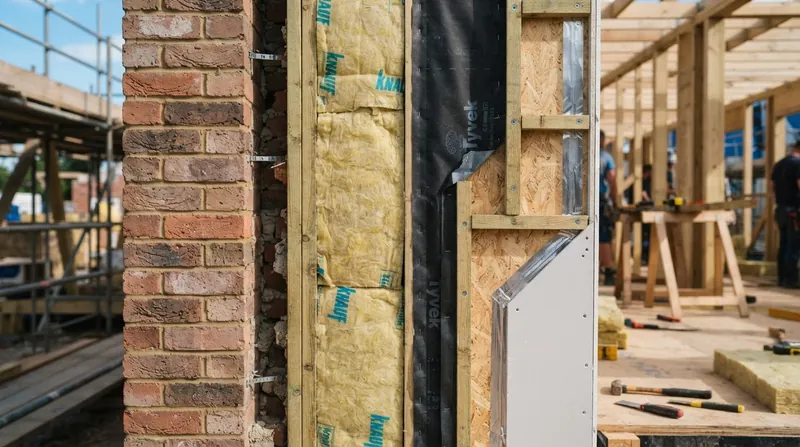
The 0.13 m²K/W Internal Surface Resistance: How the ISO 6946 Standard Defines the Baseline for a Wall's Thermal Performance
6 sources
Accessibility Standards
The 800 Millimeter Clear Opening: How International Accessibility Standards Dictate Doorway Width
5 sources
Radio Frequencies
The 868 MHz vs. 915 MHz Divide: How Regional Radio Frequencies Dictate Smart Home Compatibility
5 sources

Appliance Standards
The 0.5 Watt Limit: How International Standards Regulate Appliance Standby Power Consumption
6 sources
Every angle. Every day.
Get Home stories with full source coverage and perspective breakdowns delivered to your inbox.