
Deliberative Polling: The Evidence Behind 'Thinking Before Voting'
As traditional polling struggles with low response rates and superficial answers, a method called 'deliberative polling' is gaining traction for its ability to measure what citizens think when given the time and resources to understand complex issues.
By Factlen Editorial Team
- Deliberative Democracy Advocates
- Researchers and civic leaders who believe structured deliberation is the key to curing extreme polarization.
- Civic Reformers
- Commentators who argue that the current political system artificially inflates division by relying on snap-judgment polls.
- Pragmatic Skeptics
- Analysts who acknowledge the method's benefits but question its high logistical costs and lack of binding authority.
What's not represented
- · Elected Officials
- · Grassroots Organizers
Why this matters
Traditional polls capture snap judgments, often rewarding outrage and polarization. Deliberative polling offers a roadmap for how democracies can make complex decisions—from tech regulation to climate policy—based on informed consensus rather than partisan reflexes.
Key points
- Traditional polling often captures uninformed snap judgments, rewarding political polarization.
- Deliberative polling measures what citizens think after reviewing balanced evidence and discussing trade-offs.
- Experiments consistently show that deliberation reduces extreme partisanship and shifts voters toward the ideological center.
- The method has successfully guided real-world policy, from flood management in Uganda to transit planning in Argentina.
- New AI-assisted video platforms are allowing these resource-intensive deliberations to scale globally.
- Critics note that the process is expensive, prone to participant drop-off, and relies on policymakers voluntarily adopting the results.
The crisis of modern public opinion is largely a crisis of measurement: traditional polls capture snap judgments, often fueled by partisan media and low-information environments. When a pollster calls, respondents frequently offer top-of-mind reactions to complex policies they have never actually researched.[2]
The result is a dangerous feedback loop where politicians cater to superficial outrage, assuming the public is hopelessly divided and incapable of nuance. This dynamic has contributed to a steep decline in institutional trust and a surge in affective polarization across Western democracies.[2]
But a growing body of evidence suggests the public is far more capable of compromise than traditional surveys imply. Enter "deliberative polling," an alternative methodology that seeks to measure informed consensus rather than knee-jerk division.[1]
Pioneered by James Fishkin at Stanford University's Deliberative Democracy Lab, the method asks a fundamentally different question: not what the public thinks right now, but what it would think if it had the opportunity to genuinely learn about an issue.[1][2]

The mechanism is rigorous and highly structured. First, researchers recruit a statistically representative sample of the population—ensuring a microcosm of the broader electorate—and record their baseline opinions via a standard questionnaire.[3]
Next, participants are given carefully vetted, non-partisan briefing materials outlining the pros and cons of various policy proposals. These materials are often reviewed by advisory boards of competing experts to ensure absolute neutrality.[3]
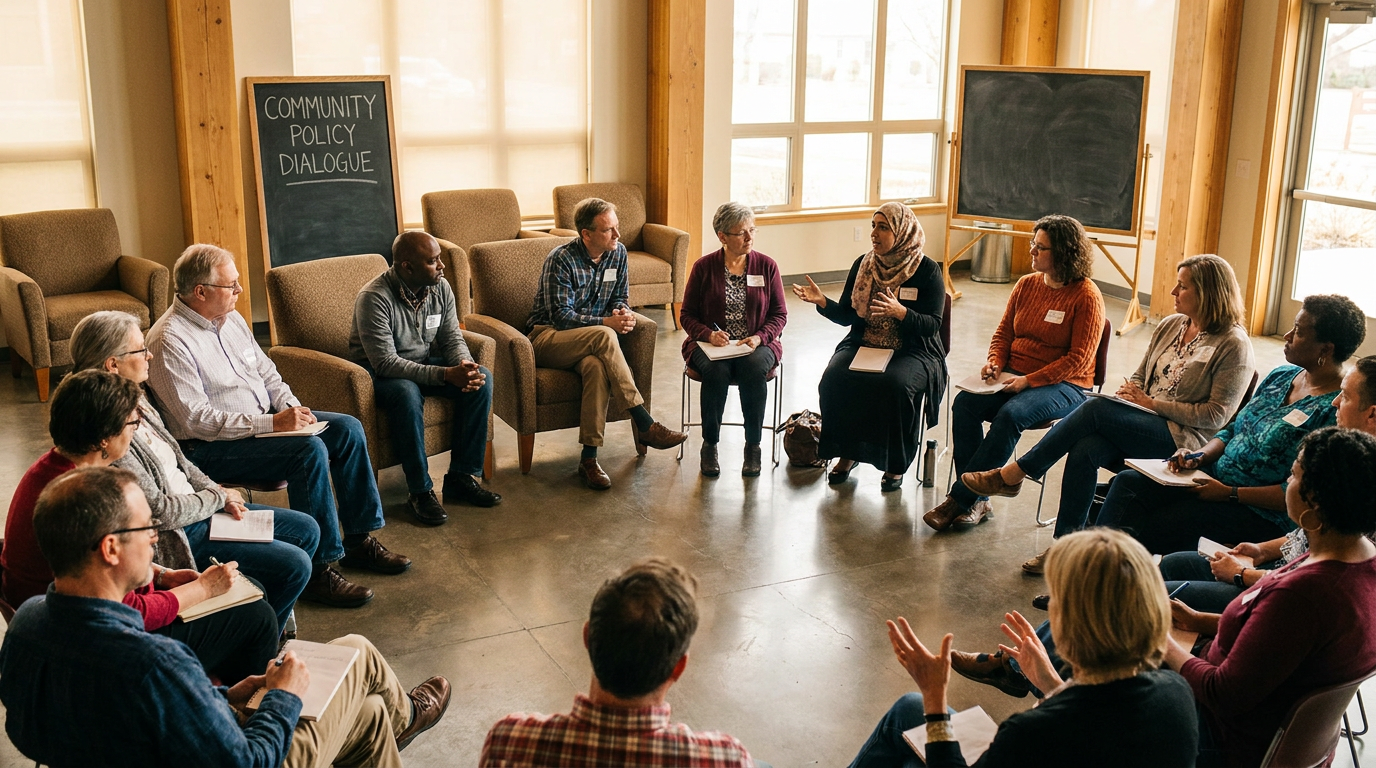
The core of the process is the deliberation itself: participants gather—either in person over a weekend or online—to discuss the issues in small, moderated groups. They also participate in plenary sessions where they can directly question panels of experts and policymakers.[1][3]
Finally, the participants are polled again using the exact same questions they answered at the beginning. By comparing the pre- and post-deliberation data, researchers can accurately measure how informed discussion shifts public opinion.[3]
The evidence for the method's efficacy is striking, particularly regarding its ability to depolarize voters. When citizens are removed from their standard media diets and asked to solve problems collaboratively, extreme partisan views consistently soften.[2][5]
The evidence for the method's efficacy is striking, particularly regarding its ability to depolarize voters.
In the "America in One Room" series, which has convened representative samples of the U.S. electorate multiple times since 2019, researchers have repeatedly documented this shift toward the ideological center across a wide range of hot-button issues.[1][5]
During a 2023 session focused entirely on democratic reform, for instance, support for ranked-choice voting surged by an average of 11 percentage points among Republicans and independents once the mechanics and trade-offs of the system were fully explained in a neutral setting.[1]

A June 2025 experiment in the pivotal swing state of Pennsylvania yielded similar results: 200 voters from across the political spectrum spent four days discussing immigration, healthcare, and the economy. Post-event data showed a marked decrease in polarization, with traditionally partisan proposals gaining bipartisan support once the underlying facts were laid out.[5]
Beyond merely measuring opinion, evidence shows deliberative polling has demonstrated tangible policy efficacy around the world, helping governments break legislative gridlock.[4]
In the Mount Elgon region of Uganda, local government had struggled for years to implement flood management policies due to a profound lack of community trust and poor communication with local farmers.[4]
A deliberative poll involving 442 residents allowed citizens to assess the environmental evidence and propose nuanced solutions. Instead of a deeply unpopular blanket ban on land use, the community agreed to build homes on higher ground while retaining farming access to floodplains—a compromise that policymakers successfully implemented.[4]

Despite these successes, scaling deliberative polling has historically been hindered by immense logistical costs. Flying hundreds of people to a single location, housing them, and paying them for their time is a barrier to widespread adoption.[6]
To solve this scalability problem, Stanford researchers developed the AI-assisted Online Deliberation Platform, a custom video discussion tool designed specifically to facilitate equitable, structured civic conversations.[1]
The platform's AI actively manages speaker queues, nudges quiet participants to share their views, and automatically detects and mitigates toxic behavior. This allows deliberations to scale to thousands of users simultaneously without requiring an army of human moderators.[1]
This technological leap has attracted major tech companies seeking public input on complex ethical dilemmas. In late 2025, an "Industry-Wide Forum" convened by Stanford used the platform to ask 503 participants in the U.S. and India how autonomous AI agents should be developed, regulated, and deployed.[1]

However, the evidence regarding the method's long-term viability contains transparent uncertainties. Critics point out that the significant time commitment required for deliberation inevitably leads to participant attrition, which can skew the final sample toward more highly educated or politically engaged citizens.[3][6]
Furthermore, because deliberative polls are advisory rather than legally binding, policymakers can simply ignore the results if the informed consensus conflicts with their political interests or donor pressures.[3]
Nevertheless, as democratic backsliding and polarization continue to challenge institutions globally, deliberative polling offers a proven, evidence-based blueprint for restoring civic trust. It proves that when treated with respect and given the right tools, the public is fully capable of navigating the hardest choices of our time.[2][6]
How we got here
1988
Political scientist James Fishkin first introduces the concept of Deliberative Polling.
1996
The first National Issues Convention brings deliberative polling to a national U.S. audience.
2019
The inaugural 'America in One Room' event gathers 526 voters in Texas, demonstrating significant depolarizing effects.
2021
Uganda utilizes deliberative polling to successfully resolve a contentious local dispute over flood management and land use.
2025
Stanford's Deliberative Democracy Lab launches an AI-assisted platform to scale global deliberations, hosting an Industry-Wide Forum on AI agents.
Viewpoints in depth
Civic Reformers
Advocates who view deliberative polling as a cure for democratic backsliding.
This camp argues that the current crisis of democracy is largely a crisis of communication. They point to data showing that when everyday citizens are removed from the toxic incentives of social media and partisan news, they are highly capable of nuanced, respectful compromise. Reformers believe deliberative polling should be institutionalized—perhaps even replacing traditional public comment periods—to give policymakers a true mandate based on informed consensus rather than the loudest voices.
Pragmatic Skeptics
Researchers and analysts who question the scalability and real-world impact of the method.
While acknowledging the impressive data generated by these experiments, skeptics highlight the immense logistical hurdles. Asking citizens to dedicate days to reading briefing materials and debating policy inevitably leads to attrition, which they argue can skew the final sample toward the highly educated or politically obsessed. Furthermore, they note that without a binding legal mechanism, deliberative polls remain expensive academic exercises that politicians can easily ignore if the results contradict their agendas.
Tech & Industry Adopters
Corporations utilizing deliberation to navigate complex product ethics.
For the technology sector, deliberative polling offers a way to crowdsource legitimacy for difficult product decisions. Companies developing AI agents or regulating virtual reality platforms face ethical dilemmas with no clear right answers. By funding and participating in large-scale online deliberative forums, these organizations hope to align their development roadmaps with the considered values of the public, preempting regulatory backlash and building consumer trust.
What we don't know
- Whether policymakers will ever formally bind their decisions to the outcomes of deliberative polls.
- How effectively AI moderators can handle highly emotional or culturally nuanced disputes compared to human facilitators.
- Whether the depolarizing effects of a deliberative poll persist long-term after participants return to their regular media diets.
Key terms
- Deliberative Polling
- A research method that measures how public opinion changes when a representative sample of citizens is given balanced information and time to discuss a specific issue.
- America in One Room
- A series of large-scale deliberative polling experiments in the U.S. that gather representative samples of the electorate to discuss major national policies.
- Representative Sample
- A small group of people chosen to accurately reflect the demographic and political makeup of the entire population.
- Affective Polarization
- The phenomenon where citizens not only disagree on policy but actively distrust or dislike members of the opposing political party.
Frequently asked
What is the difference between a regular poll and a deliberative poll?
A regular poll measures snap judgments based on a person's existing knowledge. A deliberative poll measures what a representative sample of the public thinks after they have been given balanced information and time to discuss the issue with experts and peers.
Does deliberative polling actually change people's minds?
Yes. Extensive evidence shows that when citizens are exposed to balanced facts and respectful discussion, extreme partisan views often soften, and support for nuanced, compromise policies increases.
Are the results of deliberative polls legally binding?
No. They are advisory tools used to inform policymakers, though some advocates argue they should be more formally integrated into government decision-making.
How is AI being used in this process?
AI is used to moderate online video deliberations by managing speaker queues, nudging quiet participants to speak, and detecting toxic behavior, which allows the process to scale beyond expensive in-person gatherings.
Sources
Source coverage
6 outlets
3 viewpoints surfaced






[1]Stanford Deliberative Democracy LabDeliberative Democracy Advocates
Deliberative Polling: America in One Room and Global Initiatives
Read on Stanford Deliberative Democracy Lab →[2]Democracy JournalCivic Reformers
The Depolarizing Power of Deliberative Polling
Read on Democracy Journal →[3]ParticipediaPragmatic Skeptics
Deliberative Polling: Influence, Outcomes, and Effects
Read on Participedia →[4]DemocracyNextDeliberative Democracy Advocates
Deliberation and democracy in Africa
Read on DemocracyNext →[5]The FulcrumCivic Reformers
The Partisan Bashing Power of Deliberative Democracy
Read on The Fulcrum →[6]Factlen Editorial TeamPragmatic Skeptics
Synthesis by Factlen editorial team
Read on Factlen Editorial Team →
Every angle. Every day.
Get data analysis stories with full source coverage and perspective breakdowns delivered to your inbox.