
Defining the Risk Spectrum: How Core, Value-Add, and Opportunistic Strategies Dictate Real Estate Returns
Institutional and private capital deploy four distinct strategies to balance cash flow against development risk. Understanding this spectrum reveals why some investors buy stabilized high-rises while others acquire vacant land.

Share this story
In short
- Real estate investments are categorized into four strategies based on risk and return: Core, Core-Plus, Value-Add, and Opportunistic.
- Core investments prioritize capital preservation, targeting 7% to 10% returns by acquiring fully leased, Class A properties.
- Value-Add strategies target 11% to 15% returns by acquiring outdated properties and forcing appreciation through renovations and rent increases.
Institutional capital is currently split on how to deploy equity in a 6.7% interest rate environment. One faction argues that the only defensible move is acquiring fully stabilized, Class A properties with long-term corporate tenants, accepting lower yields in exchange for capital preservation and zero operational risk. The opposing camp insists that high borrowing costs mathematically break low-yield acquisitions, making aggressive renovations or ground-up development the only viable path to outpace debt service.[6]
That divide illustrates the fundamental spectrum of commercial real estate investing. Rather than treating all property acquisitions as identical, the industry categorizes assets into four distinct buckets based on their risk profile and the amount of physical or operational intervention required: Core, Core-Plus, Value-Add, and Opportunistic.[1][2]
At the most conservative end sits the Core strategy. These are fully stabilized, Class A properties located in primary markets, boasting high occupancy rates and creditworthy tenants on long-term leases. According to Origin Investments, "Core investments are synonymous with income and capital preservation." Investors in this tier typically utilize low leverage—often between 0% and 40%—and target annualized returns in the 7% to 10% range.[1]
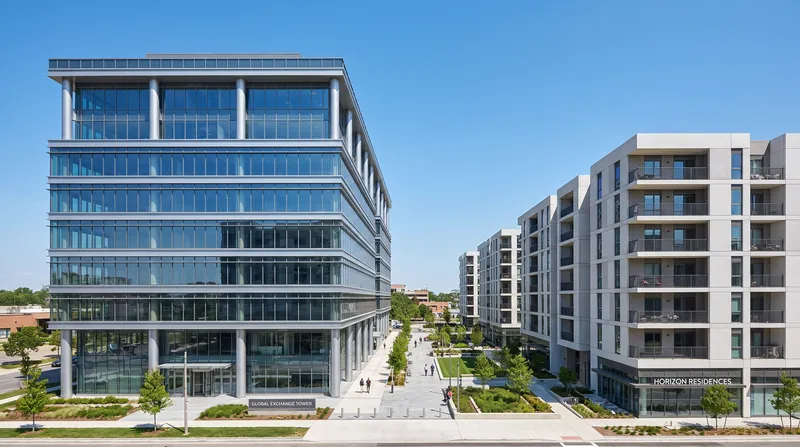
For a local buyer, a Core asset looks like a newly constructed, fully leased grocery-anchored shopping center or a downtown high-rise apartment building with a 95% occupancy rate. The buyer is not looking to change the property; they are purchasing a reliable, bond-like coupon. The primary risk is macroeconomic shifts, not execution.[3][6]
Moving slightly up the risk curve introduces Core-Plus. These properties are fundamentally sound but offer minor avenues for improvement. They might be 10 to 15 years old, requiring light cosmetic updates, or they might have leases rolling over in the near term that can be marked up to current market rates.[2][5]
A Core-Plus acquisition might involve purchasing a suburban office building where the lobby feels dated, or a multifamily complex where a new owner can implement a modest utility bill-back program. The leverage increases slightly, typically sitting between 40% and 60%, with target returns stretching into the 9% to 12% bracket. The asset still generates immediate cash flow, but the owner takes on a small degree of operational risk.[1][5]
The middle of the spectrum—and the primary battleground for modern syndicators—is the Value-Add strategy. This approach targets Class B or Class C properties that suffer from deferred maintenance, poor management, or outdated floor plans. As SmartAsset outlines, "Value-add properties often have cash flow when you buy them, but have the potential to increase that cash flow over time."[3]
Value-Add is fundamentally a forced-appreciation play. The buyer acquires the asset with a specific business plan to increase the net operating income. CBRE Investment Management notes that "Value-add strategies seek to generate a significant portion of their total return from capital appreciation." This requires heavier leverage, often 60% to 75%, and targets returns between 11% and 15%.[4]
In practice, a Value-Add execution involves purchasing a 1980s-vintage apartment complex, vacating units as leases expire, and injecting $15,000 per unit into new kitchens, flooring, and appliances. The owner then returns the units to the market at a $400 monthly rent premium. The risk here is execution: if renovation costs spike or the local market cannot absorb the higher rents, the projected returns collapse.[6]
At the furthest edge of the risk spectrum lies the Opportunistic strategy. This bucket encompasses ground-up development, massive repositioning of entirely vacant buildings, or the acquisition of severely distressed assets. Valiance Capital states plainly that "Opportunistic investments are the riskiest of all real estate investment strategies."[5]
An Opportunistic project generates zero cash flow at acquisition. The investor is buying raw land to build a 500-unit apartment complex, or purchasing an abandoned shopping mall to rezone and convert it into a mixed-use logistics hub. The capital is entirely locked up during the entitlement, permitting, and construction phases, which can span three to five years.[2][6]
Because the investor is absorbing maximum execution, zoning, and market-timing risk, the required yield is correspondingly high. Opportunistic strategies target annualized returns of 20% or more. The leverage profile is highly complex, often involving expensive construction debt, mezzanine financing, and preferred equity.[1][5]
The return profile of an Opportunistic deal follows a steep J-curve. Investors endure years of negative cash flow and capital calls while the project is built. The payoff only arrives at the end of the timeline, either through a massive refinancing event once the property is stabilized or an outright sale to a Core investor.[3][6]
The current 6.7% interest rate environment has severely compressed the margins between these strategies. When debt costs sit at 3%, a Core asset yielding 5% makes mathematical sense. When debt costs rise to nearly 7%, that same Core asset generates negative leverage, forcing investors to either buy entirely in cash or move further out on the risk curve into Value-Add territory to find yields that clear the cost of borrowing.[6]
The choice between these four lanes ultimately dictates the daily reality of the property owner. A Core investor manages a spreadsheet and a quarterly distribution; a Value-Add syndicator manages a construction crew and a leasing team; an Opportunistic developer manages city council zoning meetings and supply chain logistics. The yield is simply the market's compensation for the specific type of friction the investor is willing to endure.[6]
Key terms
- Stabilized Asset
- A property that is fully built, operational, and has reached a high, consistent occupancy rate, typically above 90%.
- Forced Appreciation
- The process of increasing a property's value through active improvements, such as renovations or better management, which directly increases its net operating income.
- J-Curve
- A trendline showing an initial steep drop followed by a dramatic rise, commonly used to describe the cash flow of a development project that requires heavy upfront capital before generating returns.
- Net Operating Income (NOI)
- A property's total revenue minus its operating expenses, serving as the primary metric used to determine the asset's market value.
Frequently asked
What is the safest real estate investment strategy?
The Core strategy is considered the safest. It involves buying fully stabilized, Class A properties in prime locations with long-term tenants, minimizing operational and leasing risks.
Why do investors choose Value-Add over Core?
Investors choose Value-Add to achieve higher returns through forced appreciation. By renovating an outdated property and raising rents, they can significantly increase the asset's value rather than relying solely on market appreciation.
What makes an Opportunistic investment so risky?
Opportunistic investments often involve ground-up development or massive repositioning. The investor takes on zoning risks, construction delays, cost overruns, and years of negative cash flow before the property generates any income.
Viewpoints in depth
Capital Preservation Advocates
Investors who prioritize protecting their principal and generating immediate, reliable yield.
For institutional funds, pension systems, and risk-averse private buyers, the primary goal of real estate is wealth preservation, not wealth creation. This camp argues that the execution risks inherent in construction and heavy renovation are rarely priced correctly. By acquiring Core assets—such as a fully leased Amazon distribution center or a Class A high-rise—they eliminate operational friction. The lower yield is viewed as an acceptable insurance premium paid to avoid the catastrophic losses that can occur when a development project stalls or a renovation budget blows out.
Forced-Appreciation Syndicators
Operators who believe the best risk-adjusted returns come from buying underperforming assets and actively improving them.
The Value-Add camp views Core investing as mathematically inefficient, particularly in a high-rate environment where debt service eats the entirety of a stabilized property's yield. These operators argue that real estate's true power lies in forced appreciation. By acquiring a neglected 1980s apartment complex, replacing the management team, and upgrading the interiors, they can artificially drive up the net operating income. To this group, the execution risk of a renovation is highly manageable and represents the only reliable way to generate double-digit returns without taking on the existential risks of ground-up development.
High-Yield Developers
Risk-tolerant firms that target outsized returns by taking on the entitlement, zoning, and construction risks that other buyers avoid.
Opportunistic investors operate on the premise that the highest margins are found where capital is most scarce. They argue that buying existing buildings forces an investor to pay retail prices for someone else's finished product. By taking on the immense friction of acquiring raw land, navigating municipal zoning boards, and managing multi-year construction timelines, these developers create entirely new assets at a wholesale cost basis. They accept years of negative cash flow and illiquidity in exchange for the potential to achieve 20% or greater annualized returns upon stabilization.
- Forced-Appreciation Syndicators
- Operators who believe the best risk-adjusted returns come from buying underperforming assets and actively improving them.
- Capital Preservation Advocates
- Investors who prioritize protecting their principal and generating immediate, reliable yield over maximizing total return.
- High-Yield Developers
- Risk-tolerant firms that target outsized returns by taking on the entitlement, zoning, and construction risks that other buyers avoid.
Perspectives this story doesn't cover
- Retail Tenants
- Municipal Zoning Boards
Sources
Source coverage
6 outlets
3 viewpoints surfaced






- [1]Origin InvestmentsCapital Preservation Advocates
What are Core, Core Plus, Value-Add and Opportunistic Investments?
Read on Origin Investments → - [2]Triland PropertiesHigh-Yield Developers
What are the four main investment strategies in commercial real estate?
Read on Triland Properties → - [3]SmartAssetForced-Appreciation Syndicators
Core, Core Plus, Value-Add and Opportunistic Real Estate Investing
Read on SmartAsset → - [4]CBRE Investment ManagementForced-Appreciation Syndicators
VALUE-ADD REAL ESTATE
Read on CBRE Investment Management → - [5]Valiance CapitalHigh-Yield Developers
Understanding the Differences Between: Core, Core Plus, Value-Add, and Opportunistic Investments
Read on Valiance Capital → - [6]Factlen Editorial Team
Synthesis by Factlen editorial team
Read on Factlen Editorial Team →

More in Real Estate
See all →Development Finance
The Residual Land Valuation Mechanism: How Construction Costs and Profit Margins Dictate Site Acquisition
4 sources

Title Law
Why Deeds of Trust Allow Lenders to Bypass the Judicial Foreclosure Process
7 sources

Retail Real Estate
Malls Emerge as Top-Performing Commercial Real Estate Asset Class Following 13 Percent Value Surge
5 sources

1031 Exchanges
IRS Rules for Defining Like-Kind and Held-for-Investment Property Under Section 1031
8 sources
Comments
Every angle. Every day.
Get Real Estate stories with full source coverage and perspective breakdowns, free every day.