
The 80 Percent Loss: How the Shift from Snow to Rain Reduces Water Storage Capacity in Mountain Watersheds
As warming temperatures shift mountain precipitation from snow to rain, downstream reservoirs are forced to release winter runoff to maintain flood-control space. This operational conflict effectively eliminates up to 80 percent of the seasonal water storage capacity that natural snowpacks historically provided.

Share this story
In short
- Rising winter temperatures are shifting mountain precipitation from snow to rain across the western United States.
- Snowpack historically acted as a free natural reservoir, holding water until the spring melt.
- Winter rainfall flows immediately into man-made reservoirs, which must maintain empty space for flood control.
On January 9, 2024, the Department of Energy published an assessment of mountain watersheds across the western United States, detailing a fundamental shift in how water moves through high-altitude terrain. The core finding centered not on a lack of precipitation, but on its physical state: as winter temperatures rise above 32 degrees Fahrenheit (0 degrees Celsius), water that once fell as snow increasingly arrives as rain.[4]
On May 22, 2023, the journal Communications Earth & Environment published an analysis of recent decreases in snow water storage across western North America, quantifying the scale of this phase change. When precipitation falls as snow, it remains locked in place across millions of acres of high-elevation terrain, effectively storing water for up to 6 to 8 months at zero cost.[1][7]
But when that same volume of water falls as rain, it flows immediately downhill, forcing a collision with the rigid operating rules of downstream man-made reservoirs. On September 29, 2022, Frontiers in Earth Science detailed how these precipitation phase changes track through the hydrologic cycle, from initial rainfall to final reservoir storage.[5]
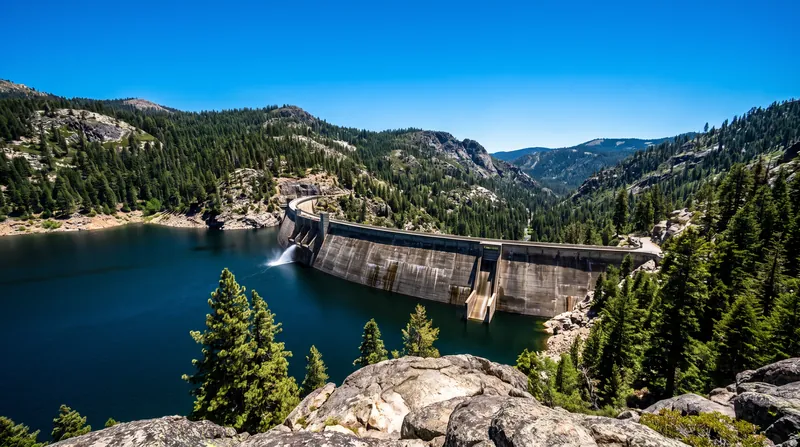
Reservoir managers operate under strict flood-control mandates during the winter months of the 12-month water year, which runs from October 1 to September 30. To protect downstream communities from catastrophic 100-year flood events, facilities must maintain a designated "flood pool"—a volume of empty space kept in reserve to absorb sudden influxes of storm water from 24-hour to 72-hour storm events.[8]
Consequently, when winter rainstorms deliver massive volumes of water into these reservoirs, managers cannot store it for the summer. "Flood pool releases mean this water cannot be stored for later beneficial use and must be managed as a hazard rather than a resource," researchers noted in a November 14, 2020, study published in Hydrology and Earth System Sciences.[8]
The net result is a massive reduction in total seasonal water storage. By comparing the volumetric capacity of the natural snowpack against the maximum allowable winter storage of downstream reservoirs, the arithmetic reveals a stark deficit.[1][8]
Because reservoirs can only capture a fraction of winter rainfall while maintaining their mandated flood pools, the transition from snow to rain effectively eliminates up to 80 percent of the storage capacity that the snowpack previously provided.[1][8][9]
This 80 percent loss represents water that physically fell on the watershed but cannot be retained for the dry summer months of July, August, and September, when agricultural and municipal demands peak.[3][5][9]
The National Oceanic and Atmospheric Administration (NOAA) has documented large declines in snowpack across the U.S. West, driven by these warming winter temperatures.[2]
These declines are not uniform; they are most pronounced at lower and middle elevations, where the temperature hovers near the freezing point. At these critical transition elevations, a temperature increase of just 1.5 to 2.0 degrees Celsius is enough to flip the precipitation phase from snow to rain.[1][2][8]
In laboratory settings, researchers have also quantified the compounding effect of "rain-on-snow" events. When warm rain falls on an existing snowpack, it accelerates the melting process, causing the snow to release its stored water 4 to 8 weeks ahead of the historical schedule.[6]
A study published in the journal Water examined the snowmelt volume from these rain-on-snow events under controlled temperature and rainfall conditions, confirming that the addition of liquid water rapidly degrades the structural integrity of the snowpack.[6]
This accelerated melt further front-loads the runoff into the winter months, exacerbating the flood-pool conflict at downstream reservoirs and increasing the volume of water that must be released prematurely.[5][6][8]
To adapt to this loss in natural storage, the California Department of Water Resources and other agencies are exploring alternative strategies. One approach is forecast-informed reservoir operations, which uses advanced 5-day to 14-day weather forecasting to safely hold more water in reservoirs during the winter if no major storms are on the horizon.[3][8]
Another strategy involves managed aquifer recharge, where excess winter runoff is deliberately directed onto porous landscapes to percolate into underground groundwater basins, effectively using the earth itself as a replacement reservoir.[8]
However, these adaptations require significant infrastructure investments and regulatory changes. Until these systems are implemented at scale, the shift from snow to rain will continue to strip mountain watersheds of their primary water storage mechanism, leaving downstream communities to navigate the gap between winter floods and summer deficits.[4][7][8][9]
Key terms
- Snow Water Equivalent (SWE)
- A common measurement of the amount of liquid water contained within a snowpack.
- Flood Pool
- A designated volume of empty space in a reservoir kept in reserve to absorb sudden influxes of storm water and prevent downstream flooding.
- Rain-on-Snow Event
- A weather event where warm rain falls on an existing snowpack, accelerating the melting process and increasing immediate runoff.
- Managed Aquifer Recharge
- The deliberate routing of excess surface water into underground basins to replenish groundwater supplies.
- Forecast-Informed Reservoir Operations
- A water management strategy that uses advanced weather forecasting to safely adjust reservoir levels and retain more water when no storms are predicted.
Frequently asked
Why can't reservoirs just store the winter rain?
Reservoirs are legally required to maintain empty space, known as a flood pool, during the winter to absorb sudden storm runoff and protect downstream communities from flooding. If they fill up with early winter rain, they risk overflowing during subsequent storms.
Does the shift to rain mean less total water is falling?
Not necessarily. The total volume of precipitation may remain the same, but because it falls as liquid rain instead of solid snow, it moves through the watershed too quickly to be captured and stored for the dry summer months.
How does rain falling on existing snow affect the water supply?
Warm rain on snow accelerates the melting of the snowpack. This causes the snow to release its stored water weeks or months earlier than normal, further overwhelming downstream reservoirs during the winter.
Viewpoints in depth
Hydrologists and Climate Scientists
Focus on the physical phase change of precipitation and the loss of natural storage.
Researchers emphasize that the total volume of precipitation is less critical than its physical state. They argue that the loss of the snowpack represents a structural failure of the natural water storage system, as rain moves through the watershed too quickly to be retained for the dry season. Their focus is on quantifying these losses and modeling future runoff scenarios.
Water Infrastructure Managers
Prioritize flood control and the operational constraints of existing dams.
Reservoir operators view winter rainfall primarily as a flood hazard rather than a water resource. Bound by strict federal and state regulations, they must maintain empty flood pools to protect downstream communities from catastrophic inundation. They argue that without new infrastructure or dynamic forecasting tools, they have no choice but to release winter rain, regardless of summer water demands.
Agricultural and Municipal Consumers
Concerned with the downstream impacts of reduced summer water allocations.
End-users of mountain water face the direct consequences of this storage loss. With reservoirs unable to capture winter rain, agricultural districts and city water utilities face severe allocation cuts during the summer months. They advocate for rapid investment in alternative storage solutions, such as managed aquifer recharge and new surface reservoirs, to replace the lost snowpack.
- Hydrologists and Climate Scientists
- Focus on the physical phase change of precipitation and the loss of natural storage.
- Water Infrastructure Managers
- Prioritize flood control and the operational constraints of existing dams.
- Agricultural and Municipal Consumers
- Concerned with the downstream impacts of reduced summer water allocations.
Perspectives this story doesn't cover
- Indigenous tribes with historical water rights
- Environmental conservation groups focused on river ecosystems
Sources
Source coverage
9 outlets
3 viewpoints surfaced









- [1]Communications Earth & EnvironmentHydrologists and Climate Scientists
Recent decreases in snow water storage in western North America
Read on Communications Earth & Environment → - [2]NOAA Climate.govHydrologists and Climate Scientists
Large declines in snowpack across the U.S. West
Read on NOAA Climate.gov → - [3]California Department of Water ResourcesWater Infrastructure Managers
Climate Change and Water
Read on California Department of Water Resources → - [4]Department of EnergyHydrologists and Climate Scientists
Snow-Capped Mountains at Risk from Climate Change
Read on Department of Energy → - [5]Frontiers in Earth ScienceHydrologists and Climate Scientists
Tracking the impacts of precipitation phase changes through the hydrologic cycle in snowy regions: From precipitation to reservoir storage
Read on Frontiers in Earth Science → - [6]Water (MDPI)Hydrologists and Climate Scientists
Snowmelt Volume from Rain-on-Snow Events Under Controlled Temperature and Rainfall: A Laboratory Experimental Study
Read on Water (MDPI) → - [7]Water Resources ResearchHydrologists and Climate Scientists
Effects of Snow Water Storage on Hydrologic Partitioning Across the Mountainous, Western United States
Read on Water Resources Research → - [8]Hydrology and Earth System SciencesWater Infrastructure Managers
Precipitation-phase partitioning at landscape scales to regional scales
Read on Hydrology and Earth System Sciences → - [9]Factlen Editorial TeamAgricultural and Municipal Consumers
Synthesis by Factlen editorial team
Read on Factlen Editorial Team →

More in Environment
See all →Climate Extremes
Copernicus Data Shows European River Flows Hit Lowest Summer Levels Since 1992
8 sources
Nile Basin Hydropolitics
Egyptian PM Calls Nile Water Security an 'Existential Issue' at UN, Rejecting GERD 'Fait Accompli'
5 sources

Statehood Law
UN General Assembly Adopts First Declaration Affirming Statehood for Island Nations Facing Sea Level Rise
6 sources

Hydrological Cycle
The 96.5 Percent Saline Constraint: How Earth's Hydrological Architecture Limits Accessible Freshwater to 0.007 Percent
5 sources
Comments
Every angle. Every day.
Get Environment stories with full source coverage and perspective breakdowns, free every day.