
Copernicus Data Shows European River Flows Hit Lowest Summer Levels Since 1992
A summer of compounding climate extremes pushed Europe's major waterways to record lows, disrupting freight, agriculture, and energy infrastructure. The continent also faced unprecedented heat stress, with more than half of Europe experiencing feels-like temperatures above 38 degrees Celsius.

Climate scientists and environmental monitors argue that Europe's water infrastructure is fundamentally failing under the weight of compounded climate extremes, pointing to the lowest river flows in modern history as proof that current usage is unsustainable. Meanwhile, industrial operators and freight companies maintain that while the dry conditions are severe, the continent's waterways remain functional working arteries that simply require adaptive management and load adjustments rather than drastic usage restrictions.[2][4]
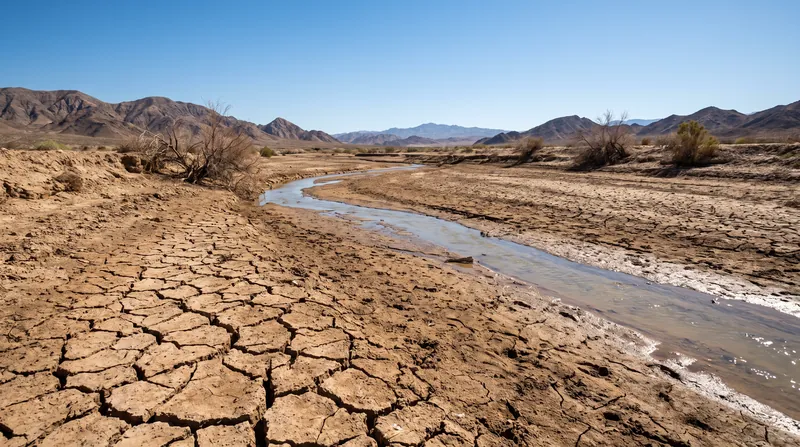
The scale of the shortfall became clear on Friday when the Copernicus Climate Change Service released its seasonal assessment. The combined summer flow across 12 major European rivers fell to the lowest level since the European Flood Awareness System began tracking the data in 1992. Record or near-record low flows simultaneously struck the Rhine, Danube, Po, Loire, Rhône, and Seine during July and August.[1][4]
Below-average river flow dominated much of the continent throughout the season. The low-flow conditions already affecting central and eastern Europe in the spring intensified and expanded westwards through June and July. By August, the largest river flow deficits were concentrated in parts of western Europe, though exceptional conditions persisted along almost the entire lengths of the Rhine and the Vistula.[1]
“Europe experienced a summer of compounded climate extremes in 2026,” said Samantha Burgess, the strategic lead for climate at the European Centre for Medium-Range Weather Forecasts. “Record heat stress, widespread dry conditions, exceptionally low river flows, and unusually warm seas occurred together across large parts of the continent.”[1][5]
When a working river runs shallow, a cargo barge must leave part of its load on the dock so its hull clears the riverbed. A lightly loaded barge still pays the same crew and burns roughly the same fuel, meaning every tonne of cargo costs more to deliver. These logistical bottlenecks ripple through the broader economy, driving up raw material costs for manufacturers.[4]
The low water levels simultaneously disrupted the continent's energy and agricultural sectors. Nuclear power plants in France, which rely on river water for cooling, faced mounting pressure to reduce output just as cooling demand peaked. Meanwhile, farmers drawing irrigation water from the banks of the Po and the Danube had to make do with a severely restricted supply during the crucial growing season.[1][2]
The heat stress threshold
The dry riverbeds were driven by relentless temperatures that began unusually early in the spring. Western Europe recorded its warmest summer on record, with an average temperature of 21.7 degrees Celsius. That figure sits 2.5 degrees above the 1991–2020 average and surpasses the previous benchmark set during the deadly summer of 2003.[1][5]
The persistence of the heat broke historical patterns. In 2026, there were 17 days when at least 60 percent of western Europe experienced temperatures above 30 degrees Celsius. By comparison, the region saw 11 such days in 2003 and just seven in 2025. Exceptional warmth extended well beyond the core summer months, with record-breaking daily temperatures occurring in May and September.[1][2]
This sustained warmth pushed a record 52 percent of the European continent into very strong heat stress by the end of the season. Copernicus defines this category as a feels-like temperature of 38 degrees Celsius or higher. At this threshold, the human body's natural cooling systems become overwhelmed, raising the risk of heatstroke and organ failure.[1][5][8]
An even broader area faced prolonged exposure to slightly lower extremes. Around 80 percent of Europe experienced strong heat stress, defined as feels-like temperatures above 32 degrees Celsius, on a record 41 days.[1][8]
“Summer 2026 demonstrated how heat stress is becoming both more widespread and more persistent,” Burgess noted, adding that it remains the leading cause of weather-related mortality globally.[1][8]
Compounding environmental pressures
The combination of intense heat and parched landscapes fueled an exceptionally active wildfire season. By September 2, the total area burned across the European Union was almost twice the 2006–2025 average for that point in the year. Spain and France saw particularly extensive fire activity that forced evacuations and destroyed agricultural land.[1][2]
Smoke from those fires combined with extreme heat to degrade air quality across the continent. The Copernicus Atmosphere Monitoring Service reported that wildfire emissions in Europe by the end of the summer were among the ten highest recorded since 2003. This exposed millions of residents to dangerous levels of ground-level ozone and particulate pollution.[1]
The continent's surrounding waters offered no cooling relief. Europe's seas remained exceptionally warm throughout the summer, with record or near-record sea-surface temperatures recorded along much of the Atlantic coast. The western and central Mediterranean also experienced strong to exceptional marine heatwave conditions, defined by prolonged periods of unusually warm ocean temperatures.[1][2]
Warm seas can worsen heat on nearby land by reducing overnight cooling and increasing humidity, which adds to the overall heat stress. Globally, surface air relative humidity over land in August fell to the fourth-lowest value for the month since 1979, continuing a 40-year downward trend that limits the environment's ability to recover from heat spikes.[1]
Adapting to structural deficits
The simultaneous failure of multiple environmental buffers highlights a structural vulnerability in the European economy. The consequences extended far beyond broken temperature records, directly affecting water availability, energy systems, and transport networks. The close link between climate change and energy security became impossible to ignore as power plants struggled to draw sufficient cooling water.[1][2]
Regulators and industry groups are now forced to plan for a baseline where summer droughts are the expectation rather than the exception. Drought conditions have been increasing over the last 45 years in Europe, and by the end of August 2026, drought affected almost half of the continent, fundamentally altering how water resources are managed.[8]
“As the climate continues to warm, events like these underscore the importance of building resilience to increasingly interconnected climate risks,” Burgess said.[1][5]
The immediate challenge for policymakers is determining how to allocate a shrinking water supply among competing industrial, agricultural, and residential demands before the next dry season begins. Without structural changes to usage patterns, the continent's major waterways will struggle to support the economic activity that currently depends on them.[1][2]
Key points
- The combined summer flow of 12 major European rivers fell to the lowest level since records began in 1992.
- A record 52 percent of the continent experienced very strong heat stress, with feels-like temperatures exceeding 38 degrees Celsius.
- Low water levels forced cargo barges to carry lighter loads, increasing delivery costs and straining supply chains.
- Wildfires burned nearly twice the historical average area, exposing millions of residents to dangerous air pollution.
What we don’t know
- How European regulators will prioritize water access between agriculture, energy, and freight during future droughts.
- Whether logistics companies will invest in new, shallower-draft fleets or shift cargo to rail and road networks.
- The total financial cost the low river flows imposed on the European economy this summer.
How we got here
May 2026
An unusually early heatwave strikes western Europe, setting record-breaking daily temperatures.
July 2026
Low-flow conditions expand westward, affecting the Rhine, Danube, and Seine.
August 2026
Global surface air relative humidity over land falls to its fourth-lowest value since 1979.
September 2026
Wildfire burned area across the European Union reaches nearly twice the 2006–2025 average.
October 2026
Copernicus releases data confirming the lowest European summer river flows since 1992.
- Environmental Monitors
- Climate scientists emphasize that the compounding extremes prove current usage models are unsustainable.
- Industrial and Freight Operators
- Commercial users maintain that the waterways remain functional but require adaptive load management.
- General Public and Media
- Broad observers focusing on the widespread heat stress, health impacts, and historical records broken this summer.
Perspectives this story doesn't cover
- Local municipalities managing residential drinking water supplies
- Hydropower plant operators facing reduced generation capacity
Sources
Source coverage
8 outlets
3 viewpoints surfaced








- [1]Copernicus Climate Change ServiceEnvironmental Monitors
Copernicus: Record heat stress and low river flows marked Europe's 2026 summer
Read on Copernicus Climate Change Service → - [2]Balkan Green Energy NewsEnvironmental Monitors
Data confirm European river flows at poorest levels in modern history
Read on Balkan Green Energy News → - [3]EU PerspectivesIndustrial and Freight Operators
Europe's hottest summer on record took a toll on rivers, energy and transport
Read on EU Perspectives → - [4]ToBriefIndustrial and Freight Operators
Europe's working rivers carry less water, and their barges carry less cargo
Read on ToBrief → - [5]Sustainability OnlineEnvironmental Monitors
Europe reported its third warmest summer on record in 2026
Read on Sustainability Online → - [6]blue NewsGeneral Public and Media
Lowest river flows in Europe in over 30 years
Read on blue News → - [7]SUR in EnglishGeneral Public and Media
Riverbeds this summer had not been this dry for 30 years
Read on SUR in English → - [8]RTL TodayGeneral Public and Media
A record 52
Read on RTL Today →
More in Environment
See all →Statehood Law
UN General Assembly Adopts First Declaration Affirming Statehood for Island Nations Facing Sea Level Rise
6 sources
Hydrological Cycle
The 96.5 Percent Saline Constraint: How Earth's Hydrological Architecture Limits Accessible Freshwater to 0.007 Percent
5 sources
Water Infrastructure
The C × T Concept: How Contact Time and Concentration Dictate Water Disinfection Efficacy
6 sources
Global Water Storage
WMO Report Confirms Decade-Long Decline in Global Freshwater Storage, Citing 2025 as One of Driest Years for River Flows
3 sources
Comments
Every angle. Every day.
Get Environment stories with full source coverage and perspective breakdowns, free every day.