
Rising Bond Yields and Currency Volatility Test Asian Bank Balance Sheets Ahead of Q3 Earnings
Major Asia-focused lenders are navigating a complex macroeconomic environment as rising long-term bond yields and currency fluctuations pressure capital buffers. While deposit bases remain strong, the recent global bond rout has exposed vulnerabilities in securities portfolios across the region.
By Madison Lane

Share this story
The U.S. 10-year Treasury yield surged to a multi-year high of 5.34% in early October 2026 before stabilizing around 5.11%. That sharp upward movement in global borrowing costs is now testing the balance sheets of major Asia-focused financial institutions. As lenders prepare to report third-quarter earnings, the mechanics of bond pricing are threatening to erode capital buffers across the region.[2][3][4]
When long-term interest rates rise, the market value of existing fixed-income securities falls. For banks holding massive portfolios of government debt, this inverse relationship creates immediate mark-to-market paper losses. While these institutions continue to generate strong interest income from their core lending operations, the unrealized losses on their securities portfolios can diminish their overall book value and regulatory capital ratios.[3][4]
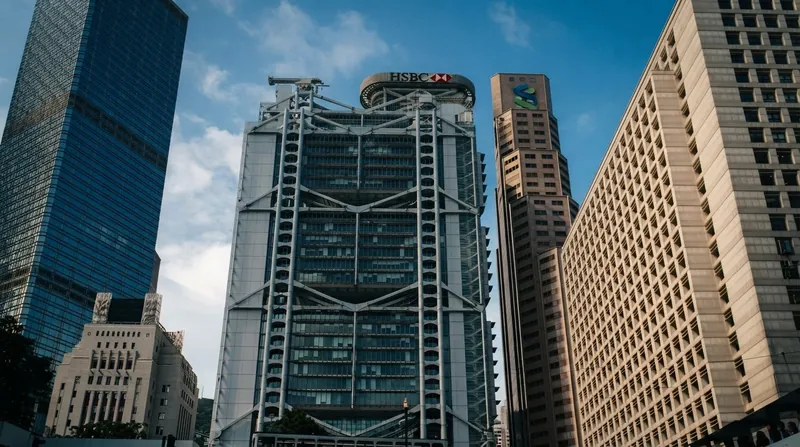
The immediate equity market reaction has been severe across major financial hubs. During the early October bond selloff, shares of London-headquartered HSBC fell 3.8%, while Standard Chartered dropped 9%. Southeast Asian lenders faced similar downward pressure, with Singapore's DBS Group shedding 3.2% and Oversea-Chinese Banking Corporation declining nearly 9% as investors repriced the sector's risk profile.[1][2][4]
In total, Singapore's major banks lost $22.4 billion in market value over a short trading window in mid-October 2026. The aggressive selloff was driven by investor fears that impending earnings downgrades could jeopardize the city-state's reputation as a regional financial safe haven. Despite these sharp equity declines, the underlying retail deposit bases of these institutions remain robust and highly liquid.[5][6]
The mechanics of capital pressure
"There is a liquidity impact, the capital impact, and there is a profit and loss impact," said Harsh Wardhan Modi, co-head of Asia-Pacific financials at JPMorgan. He noted that rising yields weigh heavily on asset values, which in turn erodes bank capital and restricts the ability to raise new funds. This dynamic ultimately leads to negative revisions in earnings per share.[2][4]
Institutional investors monitor these capital buffers closely because they dictate a bank's capacity to distribute dividends and fund future loan growth. If a bank's regulatory capital ratio drops too close to mandated minimums, management must retain earnings rather than returning them to shareholders. Consequently, even if day-to-day operational profits appear healthy, balance sheet stress can force highly conservative capital management strategies.[3][4]
The earnings outlook for the third quarter of 2026 remains distinctly mixed across the sector. Financial analysts project that HSBC will report a 33% increase in pretax profit for the July-to-September period, buoyed by wider net interest margins on its extensive global loan book. In contrast, Standard Chartered is expected to post broadly flat quarterly profits compared to the previous year.[1][2][4]
Singapore's DBS Group faces a slightly more challenging near-term forecast, with analysts predicting a 3.2% decline in net profit for the same period. The divergence highlights how different asset mixes and geographic exposures dictate a bank's resilience to the current macroeconomic strain. Lenders with heavier reliance on wholesale funding are feeling the squeeze more acutely than those with massive retail deposit bases.[1][2][4]
Currency volatility and regional risks
Beyond the direct impact of U.S. Treasury yields, Asian banks are navigating highly localized macroeconomic pressures. In Japan, rising government bond yields are creating substantial unrealized losses for domestic lenders holding long-duration debt. Moody's analysts have warned that institutions like Norinchukin and Japan Post Bank are particularly exposed to this domestic rate normalization and face potential credit downgrades.[3][4]
In Southeast Asia, persistent inflation and foreign exchange volatility are beginning to strain asset quality across emerging markets. Moody's highlighted that banks operating in the Philippines and Indonesia face mounting risks as currency fluctuations increase uncertainty for corporate borrowers with foreign-denominated debt. Elevated inflation simultaneously reduces domestic retail borrowers' repayment capacity, pushing up potential non-performing loan ratios.[1][4]
"Currency fluctuations can increase uncertainty for lenders with foreign currency exposures, while elevated inflation can strain borrowers' repayment capacity," noted The Economic Times in its regional sector preview. This dual macroeconomic threat forces regional banks to provision more capital for potential loan defaults, further compressing their net interest margins just as funding costs rise.[1]
Wealth management revenues, a crucial growth engine for international banks like HSBC and Standard Chartered, also face near-term headwinds. Earlier in 2026, these lenders benefited from significant capital inflows from Chinese investors seeking offshore diversification in Singapore and Hong Kong. However, tighter offshore tax scrutiny from Beijing may slow that lucrative momentum in the third quarter.[4]
Navigating the fourth quarter
Despite these immediate pressures, industry analysts maintain that the long-term wealth management growth story in Asia remains structurally intact. The ongoing accumulation of private wealth across the region provides a durable fee-income base that can partially offset the volatility in net interest margins and the mark-to-market losses embedded within massive sovereign bond portfolios.[4]
The broader economic context also offers some vital stabilization for the financial sector. While the U.S. Federal Reserve's rate path dictates global funding costs, several Asian central banks have maintained sufficient foreign exchange reserves to defend their currencies. This macroeconomic anchoring helps prevent localized liquidity crises from spiraling into systemic banking failures across the continent.[1][2]
As the third-quarter earnings season unfolds, market focus will remain squarely on balance sheet resilience rather than top-line revenue growth. Institutional investors will scrutinize how effectively management teams have hedged their interest rate exposures and whether they have successfully rotated out of the most vulnerable long-duration assets before yields spiked further.[3][4]
The performance of Asia-focused banks through the end of 2026 will depend heavily on the trajectory of global bond markets. If U.S. Treasury yields remain elevated above the 5% threshold, the pressure on capital buffers will persist, forcing lenders to prioritize balance sheet defense over aggressive regional expansion or enhanced shareholder returns.[2][3]
The regulatory environment adds another layer of complexity to this financial balancing act. Central banks across the Asia-Pacific region are closely monitoring liquidity metrics, ensuring that institutions maintain adequate high-quality liquid assets to survive prolonged market stress. Lenders that fail to demonstrate robust risk management frameworks may face stricter capital requirements heading into 2027.[2][4]
For retail and corporate clients, the downstream effects of this capital squeeze will likely manifest in tighter lending standards. As banks move to protect their balance sheets from further bond market volatility, they may increase the cost of credit for new borrowers, subtly slowing the pace of economic expansion across the region's most dynamic emerging markets.[1][3]
Key points
- The U.S. 10-year Treasury yield's surge past 5.3% has inflicted mark-to-market paper losses on the massive bond portfolios held by Asian lenders.
- Singapore's major banks lost $22.4 billion in market value during a mid-October selloff driven by fears of impending earnings downgrades.
- Analysts project a mixed third quarter, with HSBC expected to post a 33% profit increase while DBS faces a forecasted 3.2% decline.
- Currency volatility and persistent inflation in Southeast Asian markets are raising concerns about future asset quality and loan defaults.
What we don’t know
- Whether the recent stabilization of U.S. Treasury yields around 5.11% will hold, or if further spikes will inflict additional capital damage before year-end.
- Exactly how much capital individual banks have provisioned to cover potential loan defaults stemming from currency depreciation in emerging markets.
- The extent to which tighter offshore tax scrutiny from Beijing will permanently slow wealth management inflows into Hong Kong and Singapore.
How we got here
Early Oct 2026
The U.S. 10-year Treasury yield touches a multi-year high of 5.34%, triggering a global bond market selloff.
Mid-Oct 2026
Singapore's major banks shed $22.4 billion in market value as investors reprice the sector's risk profile.
Late Oct 2026
Major Asia-focused lenders, including HSBC and Standard Chartered, prepare to report third-quarter earnings amid heightened balance sheet scrutiny.
- Financial Analysts
- Focus on the mechanical erosion of capital buffers due to mark-to-market bond losses.
- Credit Rating Agencies
- Emphasize the growing risks to asset quality from inflation and currency depreciation.
- Equity Investors
- Prioritize near-term dividend capacity and earnings per share revisions.
Perspectives this story doesn't cover
- Corporate borrowers in emerging Asian markets facing higher debt servicing costs.
- Retail depositors navigating the changing interest rate environment.
Sources
Source coverage
6 outlets
3 viewpoints surfaced






- [1]The Economic TimesEquity Investors
Asia-focused banks face bond market risks ahead of Q3 earnings
Read on The Economic Times → - [2]MarketScreenerFinancial Analysts
Asia-focused banks face capital squeeze due to inflation, bond turbulence
Read on MarketScreener → - [3]FinimizeFinancial Analysts
Higher Yields Are Testing Asia's Big Banks Ahead Of Q3
Read on Finimize → - [4]Traders UnionCredit Rating Agencies
Asia-focused banks face margin and capital pressure ahead of quarterly earnings
Read on Traders Union → - [5]AsianomistEquity Investors
Singapore's Major Banks Shed $22.4 Billion Amid Selloff Fears
Read on Asianomist → - [6]MintEquity Investors
A selloff in Singapore bank shares driven by fears of earnings downgrades is threatening one of Asia's best-performing major stock benchmarks this year, putting the city-state's safe haven status to the test
Read on Mint →
More in Finance
See all →Corporate Finance
Myers' Debt Overhang: Why Highly Leveraged Firms Reject Profitable Investments
6 sources

Global Debt
IMF Urges Advanced Economies to Cut Soaring Debt as Bond Yields Hit Multi-Decade Highs
5 sources

Sovereign Debt
UNCTAD Report Finds 3.7 Billion People Live in Nations Spending More on Debt Service Than Health
8 sources

Macroeconomics
When Sovereign Borrowing Costs Exceed GDP Growth: How the (r − g) Snowball Effect Dictates the Debt-Stabilizing Primary Balance
5 sources

Comments
Every angle. Every day.
Get Finance stories with full source coverage and perspective breakdowns, free every day.