
Countertop Steam Ovens vs. Air Fryers: The 2026 Trade-Off Analysis
As countertop steam ovens challenge the dominance of air fryers, choosing the right appliance comes down to a fundamental trade-off between high-heat crunch and nutrient-preserving moisture.
By Factlen Editorial Team
- Crispy Convenience Seekers
- Advocates for the speed, affordability, and satisfying textures provided by air fryers.
- Nutrient-Conscious Cooks
- Prioritizes the preservation of vitamins, moisture, and natural flavors through gentle steam cooking.
- Combi-Oven Enthusiasts
- Demands the versatility of both steam and dry heat, willing to invest in premium hybrid appliances.
What's not represented
- · Microwave loyalists who prefer absolute speed over texture
- · Professional chefs who rely on built-in wall ovens rather than countertop units
Why this matters
Countertop space is the most valuable real estate in any kitchen. Understanding the distinct physics of convection versus steam cooking ensures you invest in the appliance that actually matches your daily dietary goals, rather than gathering dust next to the toaster.
Key points
- Air fryers use rapid convection to mimic deep frying, cutting calories by up to 80% but potentially degrading heat-sensitive vitamins.
- Countertop steam ovens use pressurized vapor to cook gently, retaining up to 90% of Vitamin C and preserving food moisture.
- Dedicated steam ovens cannot crisp or brown food, making them unsuitable for traditional fried snacks.
- Combi-steam ovens offer both technologies in one unit but require a larger footprint and a significantly higher budget.
- Air fryers fit best for speed and crunch, while steam ovens excel at batch cooking, delicate proteins, and reheating without drying out.
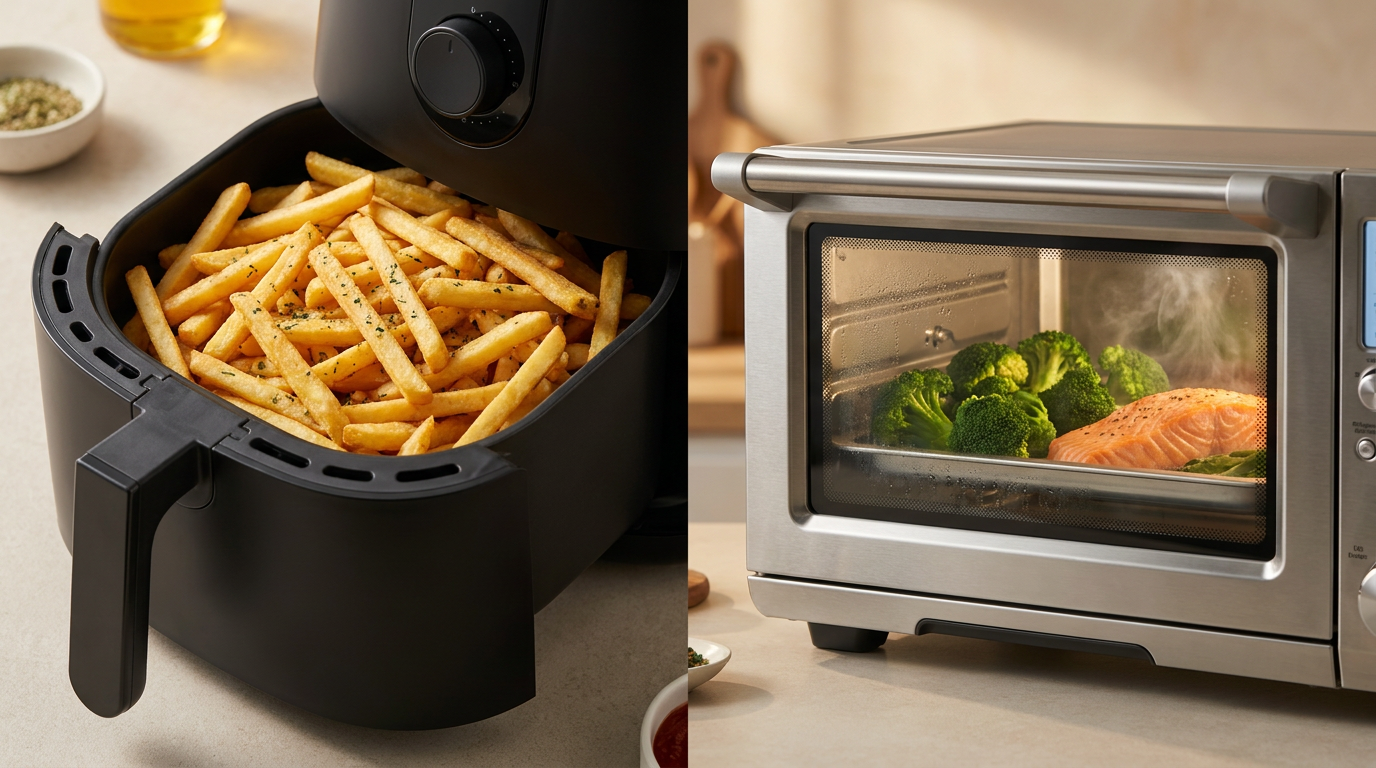
The battle for countertop real estate in 2026 has crystallized into a choice between two fundamentally different culinary philosophies. On one side is the air fryer, a high-heat convection powerhouse that has dominated kitchens for the past decade by promising the crunch of deep-fried food without the caloric guilt. On the other side is the countertop steam oven, a rising challenger adapted from professional kitchens that uses pressurized water vapor to prioritize nutrient retention and moisture.[7]
Choosing between them requires understanding the distinct physics of how they transfer heat to food. Air fryers rely on Rapid Air Technology, utilizing a powerful fan to circulate superheated air—often reaching 400 degrees Fahrenheit—around a compact cooking chamber. This rapid circulation creates a convection effect that aggressively drives off surface moisture, triggering the Maillard reaction to crisp the exterior while cooking the interior.[1][7]
Countertop steam ovens operate on an entirely different thermodynamic principle. Instead of dry heat, they generate continuous steam from an integrated water reservoir, enveloping food in a highly humid environment. Because water molecules conduct heat significantly more efficiently than dry air, steam ovens can cook food rapidly at lower temperatures, typically hovering around the boiling point of 212 degrees Fahrenheit, without ever drying out the ingredients.[2][3]
The argument for the air fryer is anchored in speed, texture, and caloric reduction. By eliminating the need for large vats of cooking oil, air frying can reduce the total calorie content of a meal by 70 to 80 percent compared to traditional deep frying. The evidence for its efficiency is equally compelling, with the concentrated heat circulation reducing overall cooking times by 20 to 30 percent compared to a conventional oven.[1][4]

Against the air fryer, however, is the issue of nutrient degradation. The same dry, high heat that creates a perfect golden-brown crust can be detrimental to heat-sensitive and water-soluble vitamins. Clinical nutrition studies indicate that exposing vegetables to the intense environment of an air fryer can significantly reduce their vitamin C and B-complex content, while also raising the risk of forming acrylamides—compounds created when starchy foods are subjected to extreme temperatures.[1][4]
The argument for the steam oven centers on unparalleled nutritional preservation and food quality. The gentle, moist heat prevents the breakdown of delicate cellular structures in vegetables and proteins. Nutritional analyses demonstrate that steaming can retain up to 80 to 90 percent of the vitamin C in vegetables, vastly outperforming the 45 to 60 percent retention rate seen in air frying.[1][2]

Furthermore, the evidence supporting steam ovens highlights their superiority in reheating and batch cooking. While microwaves and traditional ovens inevitably draw moisture out of day-old food, introducing steam revitalizes leftovers, making a refrigerated chicken breast or a slice of lasagna taste freshly prepared. For bakers, the humid environment is also the secret to achieving the perfect oven spring and a crackly crust on artisan breads.[2][3]
Furthermore, the evidence supporting steam ovens highlights their superiority in reheating and batch cooking.
Against the steam oven is the reality of cost, maintenance, and the absence of crunch. While entry-level air fryers can be purchased for under fifty dollars, countertop steam ovens are premium appliances that typically start around two hundred dollars and can easily exceed one thousand dollars for advanced models. They also require regular descaling and wiping down of the evaporator dish to prevent rust and mold.[1][2]
Most crucially, a pure steam oven cannot brown or crisp food. A steamed chicken wing will be perfectly cooked and juicy, but its skin will remain soft and pale. For households that rely on the satisfying crunch of frozen breaded snacks, french fries, or roasted root vegetables, a standalone steam oven will inevitably feel like a disappointment.[2][4]
Recognizing these inherent trade-offs, the appliance industry in 2026 has increasingly pivoted toward combi-steam ovens. Devices from brands like Anova, Fotile, and Ciarra attempt to bridge the gap by offering both steam generation and dry convection heating in a single unit. These hybrid machines allow cooks to inject steam during the initial cooking phase to retain interior moisture, then switch to dry heat to crisp the exterior.[2][6]

However, combi-ovens come with their own set of compromises. They demand a significantly larger footprint on the counter, often rivaling the size of a large microwave, and their complex engineering pushes them into the highest price tiers. Furthermore, while they perform both tasks admirably, their larger internal cavities mean they cannot match the sheer speed of a dedicated, compact air fryer when it comes to quickly crisping a handful of fries.[2][6]
Ultimately, the decision comes down to matching the appliance to specific household habits. The air fryer fits well when a household prioritizes speed, craves crispy textures, frequently cooks frozen breaded foods, and operates on a tighter budget or with limited counter space. It is the definitive tool for replicating the indulgence of fried foods with a fraction of the fat.[1][7]
Conversely, the air fryer does not fit well when a cook prioritizes maximum nutrient retention, frequently prepares delicate proteins like fish, or regularly bakes artisan breads and sponge cakes. In these scenarios, the aggressive dry heat becomes a liability rather than an asset.[1][4]

The countertop steam oven fits well when a household focuses on vegetable-forward diets, values the precise cooking of fish and poultry, and wants the ultimate tool for reheating leftovers without degrading their texture. It is an investment in food quality and nutritional integrity, rewarding cooks who are willing to learn its nuances.[2][5]
The steam oven does not fit well when the primary goal is quick, crispy comfort food, or when budget and maintenance are primary concerns. For those who simply want to tap a button and walk away with a plate of golden-brown nuggets, the steam oven overcomplicates a task that the air fryer mastered a decade ago.[1][7]
How we got here
2010
Philips introduces the first modern air fryer at the IFA consumer electronics show in Berlin.
2016
Countertop combi-steam ovens begin trickling into the consumer market, led by brands like Cuisinart.
2020
The Anova Precision Oven launches, bringing professional-grade steam injection to home countertops.
2024
Major appliance brands release compact 8-in-1 and 12-in-1 combi-steam ovens to compete directly with air fryers.
2026
Steam ovens reach mainstream adoption as consumers prioritize nutrient retention and versatile batch cooking.
Viewpoints in depth
Crispy Convenience Seekers
Advocates for the speed, affordability, and satisfying textures provided by air fryers.
For this camp, the primary metric of a countertop appliance is its ability to deliver comfort food quickly and with less guilt. They argue that the air fryer's ability to reduce caloric intake by 70 to 80 percent compared to deep frying makes it the ultimate practical health tool for the average household. The convenience of pre-programmed settings, minimal cleanup, and the unmatched ability to crisp frozen foods or reheat pizza solidifies the air fryer as an indispensable daily driver, even if it sacrifices some delicate nutrients in the process.
Nutrient-Conscious Cooks
Prioritizes the preservation of vitamins, moisture, and natural flavors through gentle steam cooking.
This perspective views the aggressive dry heat of air fryers as detrimental to high-quality ingredients. By relying on steam, they argue, cooks can retain up to 90 percent of heat-sensitive vitamins while completely eliminating the need for cooking oils. For these users, the steam oven is not just a cooking appliance but an investment in dietary health, excelling at preparing vibrant vegetables, perfectly flaky fish, and revitalized leftovers without the textural degradation caused by microwaves or convection fans.
Combi-Oven Enthusiasts
Demands the versatility of both steam and dry heat, willing to invest in premium hybrid appliances.
Culinary enthusiasts and early adopters argue that choosing between steam and air frying is a false dichotomy. They champion combi-steam ovens that offer precise humidity control alongside high-heat convection. While acknowledging the steeper learning curve, larger footprint, and higher price tags of devices from Anova or Fotile, this camp believes the ability to proof dough, steam-bake artisan bread, and achieve a perfectly juicy yet crispy roast chicken makes the combi-oven the only countertop appliance a serious kitchen actually needs.
What we don't know
- Whether the long-term maintenance and descaling requirements of combi-steam ovens will limit their mass-market appeal compared to the simplicity of air fryers.
- How quickly the price of true humidity-controlled combi-ovens will drop to compete with mid-tier air fryers.
Key terms
- Rapid Air Technology
- A cooking method that uses a powerful fan to circulate superheated air at high speeds, mimicking the effects of deep frying.
- Maillard Reaction
- A chemical reaction between amino acids and reducing sugars that gives browned food its distinctive flavor and crispy texture.
- Combi-Steam Oven
- A hybrid appliance that combines traditional dry convection heating with steam generation for versatile cooking.
- Acrylamides
- Potentially harmful chemical compounds that can form in starchy foods when cooked at very high temperatures.
- Descaling
- The maintenance process of removing mineral buildup from the water reservoir and internal components of a steam oven.
Frequently asked
Can a steam oven make food crispy like an air fryer?
A dedicated steam oven cannot crisp food. However, a combi-steam oven can inject steam to cook the interior and then switch to dry convection heat to crisp the exterior.
Do air fryers destroy vitamins in vegetables?
The high, dry heat of an air fryer can degrade heat-sensitive and water-soluble nutrients like Vitamin C, though it retains more nutrients than traditional boiling.
Which appliance is better for reheating leftovers?
Steam ovens are vastly superior for reheating most meals, as the added moisture prevents food from drying out, whereas air fryers are only better for reheating already-fried foods.
Are combi-steam ovens worth the higher price?
For serious home cooks who bake bread, prepare delicate proteins, and want professional-level control, the investment is worth it. For casual cooks, a basic air fryer is usually sufficient.
Sources
Source coverage
7 outlets
3 viewpoints surfaced







[1]The Air Fryer InsiderCrispy Convenience Seekers
Air Fryer vs Steam Oven: Which is Better for Your Kitchen?
Read on The Air Fryer Insider →[2]Steam & BakeNutrient-Conscious Cooks
The 8 Best Countertop Steam Ovens in 2026
Read on Steam & Bake →[3]ReviewedNutrient-Conscious Cooks
What is a steam oven and why do you need one?
Read on Reviewed →[4]Cooking with JadeCrispy Convenience Seekers
Air Fryer vs Steam Oven: The Ultimate Guide for Vegan Cooking
Read on Cooking with Jade →[5]Yale ApplianceCombi-Oven Enthusiasts
Best Steam Ovens for 2026
Read on Yale Appliance →[6]Homes & GardensCombi-Oven Enthusiasts
Smeg Countertop Air Fry Oven review: a chic combi-steam option
Read on Homes & Gardens →[7]Factlen Editorial TeamCombi-Oven Enthusiasts
Synthesis by Factlen editorial team
Read on Factlen Editorial Team →

More in shopping
See all 7 stories →Coffee Tech
Flat vs. Conical Burr Grinders: The 2026 Trade-Off Analysis
8 sources
Home Espresso
Semi-Automatic vs. Super-Automatic Espresso Machines: The 2026 Trade-Off Analysis
6 sources
Laundry Appliances
Front-Load vs. Top-Load Washers: The 2026 Trade-Off Analysis
6 sources
Home Electrification
Heat Pump vs. Tankless Water Heaters: The 2026 Trade-Off Analysis
6 sources
Every angle. Every day.
Get shopping stories with full source coverage and perspective breakdowns delivered to your inbox.