
A Retrospective on the ICC Men's T20 World Cup: Records, Legends, and India's Historic 2026 Triumph
From its inception in 2007 to India's record-breaking third title in 2026, the ICC Men's T20 World Cup has reshaped international cricket with iconic moments and statistical milestones.
By Factlen Editorial Team
- Cricket Historians & Analysts
- Focus on the statistical evolution, format growth, and tactical innovations driven by the tournament.
- Indian Cricket Supporters
- Celebrate India's historic third title, their dominance at home, and the legacy of their legendary players.
- Global Fans & Neutrals
- Value the entertainment, dramatic moments, and the growth of the T20 format worldwide.
What's not represented
- · Associate Nation Players
- · Franchise League Owners
Why this matters
The T20 World Cup has become the primary engine for cricket's global expansion, turning the shortest format of the game into a high-stakes spectacle that defines modern players' legacies. Understanding its history provides crucial context for how the sport is evolving ahead of the 2028 tournament.
Key points
- The ICC Men's T20 World Cup has grown into cricket's premier global tournament since its inception in 2007.
- India secured a historic third title in 2026, defeating New Zealand by 96 runs in Ahmedabad.
- Virat Kohli holds the all-time tournament record for most runs with 1,292.
- Bangladesh's Shakib Al Hasan is the leading wicket-taker in the competition's history with 50 dismissals.
- The 2026 final saw India post 255/5, the highest total ever recorded in a T20 World Cup final.
Since its inception in 2007, the ICC Men's T20 World Cup has fundamentally reshaped the landscape of international cricket. Originally viewed by some traditionalists as a fleeting, entertainment-focused experiment, the shortest format of the game quickly evolved into a high-octane spectacle that captivates millions worldwide. Over ten editions, the tournament has provided a grand stage for the sport's most explosive batters, cunning bowlers, and dramatic finishes. From the inaugural bowl-out between India and Pakistan to the modern era of 250-plus totals, the T20 World Cup has consistently pushed the boundaries of what is possible on a cricket field. It has turned regional stars into global icons, accelerated the sport's expansion into new markets, and forced a tactical revolution in how the game is played and analyzed.[6][8]
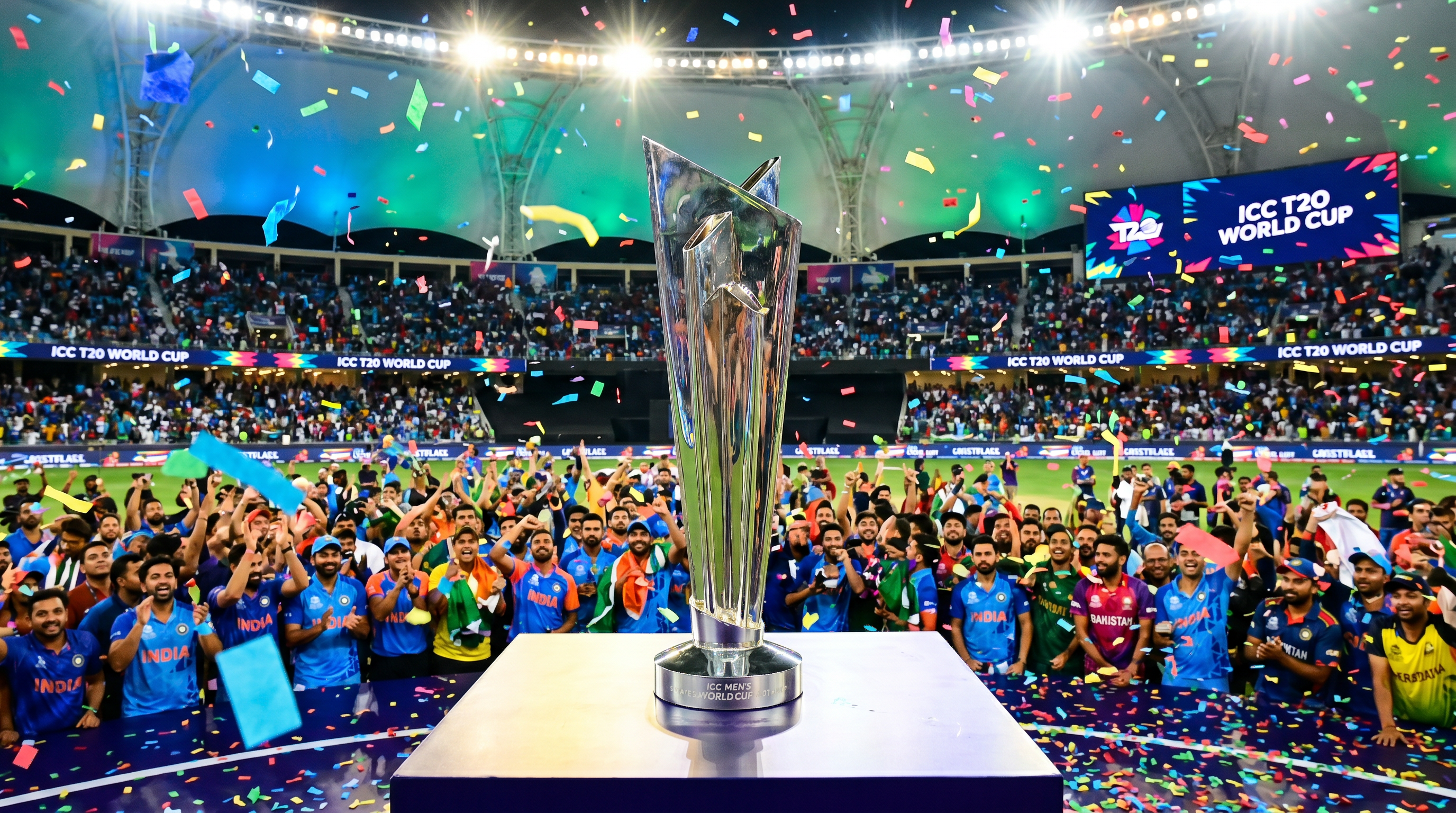
The most recent chapter of this storied history was written in March 2026, when India secured a historic third T20 World Cup title. Co-hosted by India and Sri Lanka, the tenth edition of the tournament culminated in a spectacular final at the massive Narendra Modi Stadium in Ahmedabad. Playing in front of a roaring home crowd of over 86,000 fans, the Indian side dismantled New Zealand by 96 runs to retain the trophy they had previously won in the West Indies in 2024. The victory was a landmark moment on multiple fronts: India became the first team to win three T20 World Cup titles, the first to successfully defend the championship in back-to-back editions, and the first host nation to lift the coveted trophy on home soil.[1][2]
That 2026 final perfectly encapsulated the rapid evolution of T20 batting. India posted a staggering 255 for 5 in their allotted twenty overs, shattering the record for the highest total ever recorded in a T20 World Cup final. The innings was anchored by a masterful, aggressive performance from Sanju Samson, who smashed 89 runs off just 46 deliveries to earn Player of the Tournament honors. Supported by blistering half-centuries from Abhishek Sharma and Ishan Kishan, the Indian batting lineup completely overwhelmed the New Zealand attack. In response, pace spearhead Jasprit Bumrah delivered a clinical spell of fast bowling, taking four wickets for just 15 runs to dismantle the Kiwi chase and secure the Player of the Match award on the grandest stage.[1][2]

India's 2026 triumph serves as a poetic bookend to the tournament's origins. The very first T20 World Cup in 2007, held in South Africa, was also won by India under the visionary leadership of a young MS Dhoni. That inaugural tournament set the tone for the format's explosive future, highlighted by Yuvraj Singh's legendary feat of hitting six consecutive sixes in a single over off England's Stuart Broad. The 2007 final itself remains one of the most iconic matches in cricket history, with India defending a modest total against arch-rivals Pakistan. The match culminated in Joginder Sharma's nerve-wracking final over and a historic five-run victory that ignited India's enduring obsession with T20 cricket and paved the way for the creation of franchise leagues.[3][7]
India's 2026 triumph serves as a poetic bookend to the tournament's origins.
Beyond collective team triumphs, the T20 World Cup has been defined by staggering individual records that highlight the sustained brilliance required to succeed in such a volatile format. Indian maestro Virat Kohli stands alone at the summit of the run-scoring charts, having amassed a remarkable 1,292 runs across his World Cup career. Kohli's consistency is virtually unmatched in the format, boasting 15 fifty-plus scores and a reputation for flawlessly anchoring chases under immense pressure. Meanwhile, the sheer unadulterated power of the format is best exemplified by West Indies legend Chris Gayle, who remains one of only two players—alongside Pakistan's Sahibzada Farhan—to register multiple centuries in T20 World Cup history, terrorizing bowling attacks with his effortless boundary-hitting.[4][6]

While batters often steal the headlines and the highlights in T20 cricket, the World Cup's history is equally shaped by the bowlers who have mastered the art of containment and deception. Bangladesh's Shakib Al Hasan holds the all-time record for the most wickets in the tournament's history, claiming 50 dismissals over a remarkable career spanning nine editions. His left-arm spin and tactical acumen made him a constant threat in the middle overs. Similarly, Sri Lanka's Lasith Malinga used his unique sling action and lethal, pinpoint yorkers to capture 38 World Cup wickets, playing a pivotal role in his nation's run to the 2014 title. In recent years, modern quicks like India's Arshdeep Singh and Afghanistan's Fazalhaq Farooqi have continued this legacy, sharing the record for the most wickets in a single tournament with 17 each in 2024.[5][8]
The tournament's rich lore is also built on moments of sheer, unscripted drama that have left indelible marks on the sport's collective memory. Few instances rival the climax of the 2016 final in Kolkata, where the West Indies needed a daunting 19 runs off the final over against England. Carlos Brathwaite etched his name into cricketing immortality by launching Ben Stokes for four consecutive sixes, securing the West Indies' second title and prompting Ian Bishop's iconic "Remember the name!" commentary broadcast worldwide. England would eventually find their own historic redemption, winning the 2022 edition in Australia to become the first men's team to hold both the ODI and T20 World Cup trophies simultaneously, showcasing their white-ball dominance.[3][7]

As the dust settles on the 2026 edition, the ICC Men's T20 World Cup stands undisputed as the premier global event in modern cricket. The recent tournament featured 20 teams competing across 55 matches, drawing more than 1.3 million spectators and highlighting the sport's expanding global footprint with the inclusion of emerging nations like Italy. With the 2028 edition set to be co-hosted by Australia and New Zealand, the competition's legacy of high-stakes entertainment, statistical milestones, and unforgettable heroics is primed to continue. As tactics evolve and new stars emerge, the T20 World Cup remains the ultimate proving ground for the world's finest cricketers and the most thrilling spectacle for fans across the globe.[1][8]
How we got here
September 2007
India wins the inaugural ICC World Twenty20 in South Africa, defeating Pakistan in a thrilling final.
April 2016
Carlos Brathwaite hits four consecutive sixes in the final over to win the West Indies their second T20 World Cup title.
November 2022
England defeats Pakistan in Melbourne to become the first men's team to hold both the ODI and T20 World Cup trophies simultaneously.
June 2024
India ends an 11-year global trophy drought by winning the T20 World Cup in the West Indies and USA.
March 2026
India defeats New Zealand in Ahmedabad to become the first team to win three T20 World Cup titles and successfully defend the crown.
Viewpoints in depth
Cricket Historians
Focusing on the statistical evolution and format growth.
Historians of the game view the T20 World Cup as the catalyst that modernized cricket. What began in 2007 as a brief, experimental tournament has evolved into the sport's primary financial and cultural engine. Analysts point to the steady increase in average scores and the development of specialized skills—like 360-degree batting and variation-heavy death bowling—as direct results of the World Cup's high-stakes environment. The tournament has effectively bridged the gap between traditional cricket nations and emerging markets.
Indian Supporters
Celebrating a legacy of dominance and historic milestones.
For Indian cricket fans, the T20 World Cup is deeply intertwined with the nation's sporting identity. The inaugural 2007 victory under MS Dhoni sparked a domestic revolution that birthed the IPL, while the recent back-to-back titles in 2024 and 2026 cemented India's status as a modern dynasty. Supporters view the 2026 triumph in Ahmedabad as the pinnacle of this journey, celebrating the team's ability to handle immense home pressure and the passing of the torch to a new generation of aggressive players like Sanju Samson.
Global Fans & Neutrals
Valuing unpredictability, drama, and individual heroics.
Neutral observers cherish the T20 World Cup for its inherent volatility and capacity for dramatic upsets. Unlike longer formats, a single brilliant over can alter the course of a T20 match, making the tournament highly unpredictable. Global fans often point to moments like Carlos Brathwaite's final-over heroics in 2016 or the Netherlands' stunning upsets over major nations as the true essence of the competition, proving that on any given day, the gap between heavyweights and underdogs can vanish.
What we don't know
- Whether any team will ever manage to win three consecutive T20 World Cup titles.
- How the expansion of the tournament format will impact the dominance of traditional cricketing powerhouses in future editions.
Key terms
- T20 International (T20I)
- The shortest format of international cricket, where each team is restricted to batting for a maximum of 20 overs.
- Bowl-out
- A former method of breaking tied matches where bowlers aimed at unguarded stumps, famously used in the 2007 tournament before being replaced by the Super Over.
- Super Over
- A one-over eliminator used to determine the winner of a tied T20 match.
- Death overs
- The final few overs of a T20 innings, typically characterized by aggressive batting and specialized bowling tactics like yorkers.
Frequently asked
Who has won the most T20 World Cup titles?
India holds the record for the most titles, having won the tournament three times (2007, 2024, and 2026).
Who is the all-time leading run-scorer in the tournament?
India's Virat Kohli is the highest run-scorer in T20 World Cup history, with 1,292 runs across his career.
Who holds the record for the most wickets?
Bangladesh's Shakib Al Hasan holds the record for the most wickets, claiming 50 dismissals across nine editions.
What is the highest team score in a T20 World Cup final?
India set the record for the highest score in a final by posting 255/5 against New Zealand in 2026.
Sources
Source coverage
8 outlets
3 viewpoints surfaced








[1]Al JazeeraGlobal Fans & Neutrals
India become T20 World Cup champions for the third time
Read on Al Jazeera →[2]The GuardianGlobal Fans & Neutrals
India retain T20 World Cup with 96-run final win over New Zealand
Read on The Guardian →[3]Financial ExpressIndian Cricket Supporters
ICC Men's T20 World Cup: Top 10 greatest moments in history
Read on Financial Express →[4]Business StandardGlobal Fans & Neutrals
T20 World Cup key stats: Top 10 highest run-scorers & wicket-takers
Read on Business Standard →[5]SportsBoomGlobal Fans & Neutrals
Most wickets taken in T20 World Cup history
Read on SportsBoom →[6]BritannicaCricket Historians & Analysts
ICC Men's T20 World Cup history and records
Read on Britannica →[7]VedantuIndian Cricket Supporters
T20 World Cup Winners List
Read on Vedantu →[8]WikipediaCricket Historians & Analysts
ICC Men's T20 World Cup
Read on Wikipedia →

More in sports
See all 6 stories →Women's Soccer
Women's Football Hits $3 Billion Revenue Milestone as Global Fanbase Surges
0 sources

Tactics
Tiki-Taka 2.0: Inside Spain's Tactical Evolution for the 2026 World Cup
0 sources

Preview
England's 2026 World Cup Outlook: Inside Thomas Tuchel's High-Stakes Group L Campaign
0 sources
College Baseball
Troy Trojans Complete Historic Cinderella Run to Reach First Men's College World Series
0 sources
Every angle. Every day.
Get sports stories with full source coverage and perspective breakdowns delivered to your inbox.