
World Curling Expands Team Ranking System with Three New Competition Series for 2026-27 Season
The World Curling Federation has overhauled its team ranking system, introducing the Champion, Elite, and Challenger series to better categorize international events and clarify competitive pathways.

- World Curling Officials
- Argue the tiered system brings much-needed clarity and fairness to a bloated calendar, rewarding teams that compete against the toughest international fields.
- Elite Touring Teams
- Value the Champion and Elite series for protecting the prestige of major championships, ensuring their ranking isn't diluted by teams farming points at smaller events.
- Developing Nations & Regional Clubs
- View the Challenger Series as a crucial, protected pathway to build points and gain international experience without facing immediate elimination by top-tier powerhouses.
The casual fan assumes curling rankings work like a simple ladder: win a bonspiel, climb a rung. But the reality of the international circuit has always been far more chaotic, with teams chasing points across vastly different levels of competition. Now, the World Curling Federation is correcting the math, proving that not all ice is equal.[1][6]
Starting in the 2026-2027 season, the World Curling Team Ranking System (WCTRS) is being ripped down to the studs and rebuilt into three distinct tiers: the Champion Series, the Elite Series, and the Challenger Series. The comprehensive overhaul aims to better categorize international events and provide a clearer picture of the competitive landscape.[1][2]
The stakes are immense. Rankings dictate who gets invited to the lucrative Grand Slam of Curling events, who secures national team funding, and ultimately, who punches a ticket to the Olympic Games. By categorizing every event on the calendar, World Curling is drawing a hard line on what truly constitutes elite competition.[2][3]
At the top of the pyramid sits the Champion Series. This is the undisputed heavyweight division, encompassing the World Championships, European Championships, World Qualification Events, National Championships, and the Grand Slam of Curling. Events in this tier receive a fixed Importance Factor or an increased value, ensuring that the sport's crown jewels yield the highest ranking rewards.[1][2]
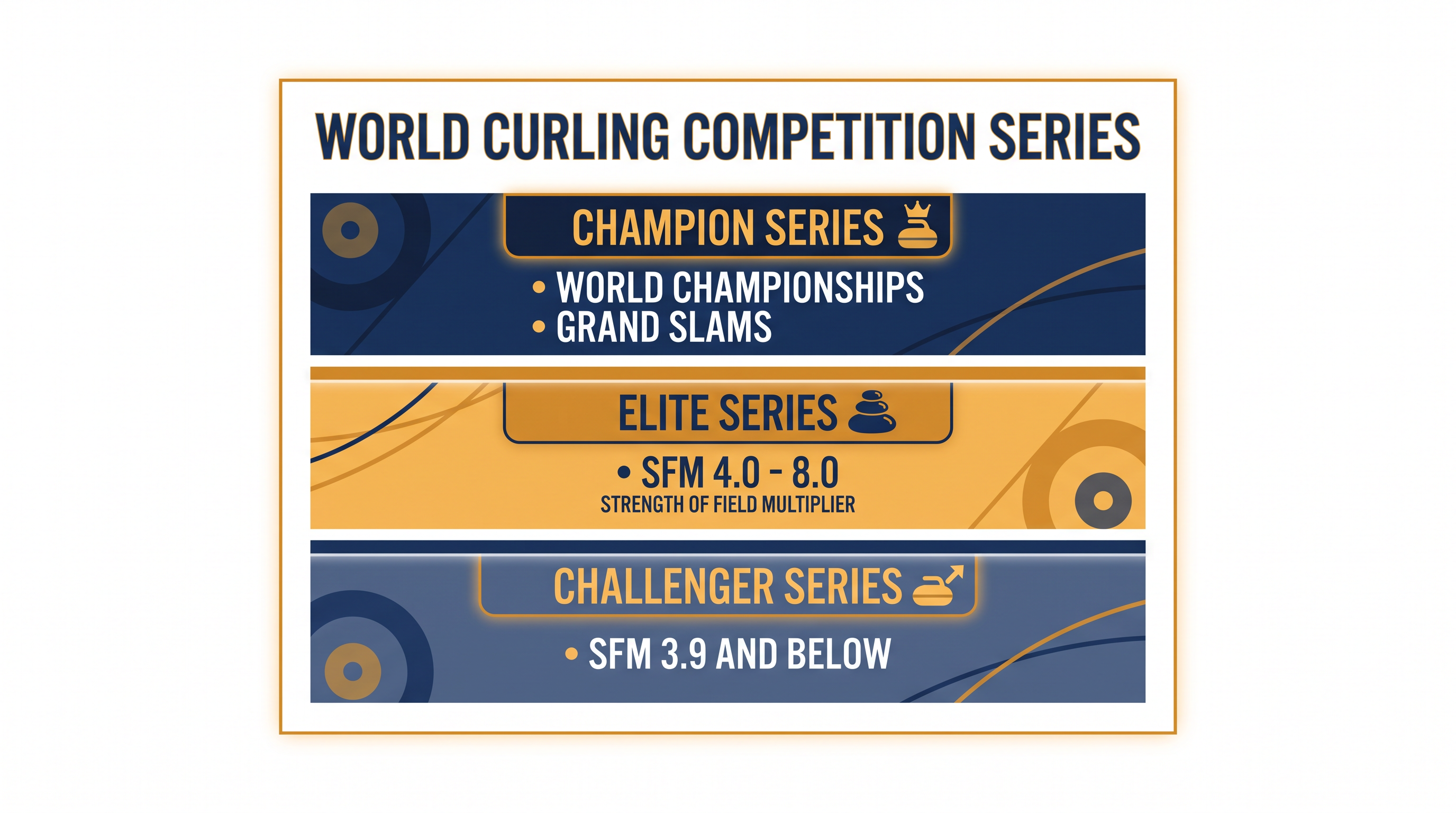
Just below that is the Elite Series, designed for high-level international tour events. To qualify for this tier, a tournament must carry a Strength of Field Multiplier (SFM) between 4.0 and 8.0. These are the battlegrounds where internationally diverse fields clash for substantial prize purses, serving as the primary proving ground for teams looking to break into the Grand Slam circuit.[1][2]
Just below that is the Elite Series, designed for high-level international tour events.
Finally, the Challenger Series captures the grassroots and developmental side of the tour. Featuring events with an SFM of 3.9 and below, this tier focuses on intermediate, local, or regional competitions. While the points payout is lower, it provides a vital, formalized runway for emerging teams and developing curling nations to establish their footing.[1][2]
The overhaul addresses a long-standing grievance on the ice: the sheer volume of events had made the global standings nearly impossible to parse. In recent years, the explosion of the curling circuit meant teams could theoretically farm points at weaker regional events to artificially inflate their world ranking.[2][5]
Under the new WCTRS rules, the math tightens. The overall world ranking will still cap a team's counting events at eight, phasing out prior-year results over the course of the season. However, the new individual Series rankings will cap at five counting events, giving fans and sponsors a crystal-clear picture of who is dominating at each specific level of the sport.[1][5]
The system also introduces ruthless tie-breakers. There are no shared podiums in the new WCTRS. If two teams are tied on points, the team that achieved their total in fewer events takes the higher rank. If they remain deadlocked, both teams must drop their lowest-scoring event until the tie breaks—a sudden-death statistical shootout.[1]
For national bodies like Curling Canada and USA Curling, the changes trigger an immediate strategic shift. High-performance directors must now carefully map out their teams' schedules, balancing the pursuit of high-yield Champion Series points against the risk of early exits in stacked fields. The era of the scattered bonspiel schedule is over; the era of targeted, high-stakes series curling has arrived.[3][4][6]
The stakes
Rankings dictate which teams qualify for lucrative Grand Slam events, secure national funding, and ultimately reach the Olympic Games. By separating the tour into three distinct tiers, World Curling is fundamentally changing how teams build their season schedules and ensuring that only the most battle-tested rosters reach the top.
The essentials
- World Curling is overhauling its Team Ranking System for the 2026-27 season by introducing three distinct competition tiers.
- The Champion Series will house the sport's premier events, including World Championships and the Grand Slam of Curling.
- The Elite Series will feature high-level international tour events with a Strength of Field Multiplier between 4.0 and 8.0.
- The Challenger Series will serve as a developmental tier for regional events with an SFM of 3.9 or lower.
- The new system aims to prevent teams from inflating their world ranking by accumulating points at weaker regional bonspiels.
Timeline
2019
World Curling introduces the World Qualification Event to streamline championship entries.
2022
The Pan Continental Curling Championships are created to qualify teams from the Americas and Pacific-Asia zones.
June 2025
World Curling announces initial tweaks to the Strength of Field Multiplier calculations.
July 2026
The governing body officially unveils the Champion, Elite, and Challenger Series for the 2026-27 season.
August 2026
National associations begin adjusting their internal qualification pathways to align with the new three-tier system.
Perspectives explored
World Curling Officials
Argue the tiered system brings much-needed clarity and fairness to a bloated calendar, rewarding teams that compete against the toughest international fields.
Administrators emphasize that the explosion of international events made the old ranking system difficult to parse. By categorizing tournaments by their Strength of Field Multiplier (SFM), the governing body believes it is protecting the integrity of the sport's premier events while providing a transparent ladder for emerging talent. The new structure ensures that a team's ranking accurately reflects the caliber of opponents they consistently face.
Elite Touring Teams
Value the Champion and Elite series for protecting the prestige of major championships, ensuring their ranking isn't diluted by teams farming points at smaller events.
For top-tier rinks, the new structure is a welcome defense of their grueling schedules. Competing in Grand Slams and World Championships carries immense risk against stacked fields. The fixed Importance Factor for Champion Series events guarantees that surviving a gauntlet of top-10 teams yields a proportional reward, preventing lower-tier teams from overtaking them by winning multiple weaker bonspiels.
Developing Nations & Regional Clubs
View the Challenger Series as a crucial, protected pathway to build points and gain international experience without facing immediate elimination by top-tier powerhouses.
Associations outside the traditional curling strongholds see the Challenger Series as a lifeline. With events capped at an SFM of 3.9, developing teams can compete for points and prize money against peer-level opponents. This formalized lower tier ensures that grassroots growth isn't stifled by the financial and competitive barriers of the Elite Series, giving rising programs a clear roadmap to international relevance.
Sources
Source coverage
6 outlets
3 viewpoints surfaced






[1]World CurlingWorld Curling Officials
Changes to the World Curling Team Ranking System for the 2026–2027 season
Read on World Curling →[2]SportsInElite Touring Teams
A ranking system designed to better reflect the level of each competition
Read on SportsIn →[3]Curling CanadaElite Touring Teams
Canadian Team Ranking System (CTRS) & World Curling Team Ranking System (WCTRS) Points Structure
Read on Curling Canada →[4]USA CurlingDeveloping Nations & Regional Clubs
Remaining berths in the 2026 Nationals determined by World Curling Team Ranking System
Read on USA Curling →[5]Curling CentralDeveloping Nations & Regional Clubs
World Curling announced their 2026-2027 World Curling Team Ranking update
Read on Curling Central →[6]Factlen Editorial Team
Synthesis by Factlen editorial team
Read on Factlen Editorial Team →
Comments

More in sports
See all 26 stories →Transfer Market
Morgan Rogers Becomes Most Expensive British Footballer Ever in £117M Chelsea Move
6 sources

Football Governance
UEFA Retains Boycott Threat Against FIFA Over Failed World Cup Stake Sale and Governance Crisis
8 sources
Transfer Market
Borussia Dortmund Prepares €50 Million Final Push for 1. FC Köln Winger Said El Mala
5 sources

Locker Room Culture
The Three 'Strict Rules' of Jose Mourinho's Real Madrid Reign
6 sources

Every angle. Every day.
Get sports stories with full source coverage and perspective breakdowns delivered to your inbox.