
Antarctic Ice Sheet Hit Climate Tipping Point 1 Million Years Ago, Revealing New Instability Risk
Supercomputer simulations reveal that Antarctica's ice sheet became highly volatile after crossing a carbon dioxide threshold one million years ago, challenging models that assume ice melts gradually.
By Sofia Matos

- Paleoclimate Researchers
- Focuses on the historical 240 ppm CO2 threshold and the mechanics of the Mid-Pleistocene Transition.
- Climate Forecasters
- Emphasizes the risk of relying on gradual-change models and the need to incorporate tipping points into sea-level rise projections.
- General Science Media
- Highlights the dramatic shift in Earth's history and the vulnerability of the ice sheet to modern warming.
- Factlen Editorial Team
- Synthesizes the mechanism of the tipping point and its relevance to contemporary climate policy.
How we got here
3 million years ago
Earth's climate operated on 41,000-year glacial cycles with a relatively stable Antarctic ice sheet.
1 million years ago
The Mid-Pleistocene Transition began, shifting Earth to 100,000-year glacial cycles.
During the transition
Atmospheric CO2 dropped below 240 ppm, triggering a tipping point that made the ice sheet highly reactive.
May 2026
Researchers publish supercomputer simulations confirming this ancient threshold, warning of similar risks today.
Why it matters
Current sea-level rise projections largely assume that ice melts gradually as temperatures rise. Discovering that Antarctica's ice sheet has previously crossed a threshold into sudden, violent instability means our forecasts for coastal flooding could be underestimating how quickly the oceans will rise.
When projecting future sea-level rise, climate models generally assume that ice sheets respond to warming in a gradual, somewhat predictable way. As temperatures climb, the ice is expected to retreat at a steady pace. But new evidence from Earth's ancient past suggests this assumption is dangerously flawed. About one million years ago, the Antarctic ice sheet crossed an invisible line and began reacting to climate changes far more violently than it had before—proving that ice sheets do not always melt slowly, but can abruptly shift into entirely new states of instability.[3][4]
The discovery, published in Nature Geoscience, reveals that during a period known as the Mid-Pleistocene Transition, Antarctica's massive ice sheet hit a critical tipping point. Researchers from the IBS Center for Climate Physics at Pusan National University found that once atmospheric carbon dioxide dropped below a specific threshold, the ice sheet's behavior fundamentally changed.[1][5]
"After this transition, the Antarctic ice sheet reacts much more strongly to changes in climate forcing," explains lead author Kyung-Sook Yun. The system stopped evolving gradually and instead became highly responsive to even minor shifts in ocean and air temperatures, amplifying the continent's ice loss and gain over subsequent millennia.[1][2][4][5]
To uncover this hidden threshold, the team combined an advanced paleoclimate simulation—reconstructing Earth's climate over the past three million years—with a sophisticated ice-sheet model. Running on one of South Korea's fastest supercomputers, the simulations pinpointed the exact trigger: an atmospheric carbon dioxide level of roughly 240 parts per million.[4][5][6]
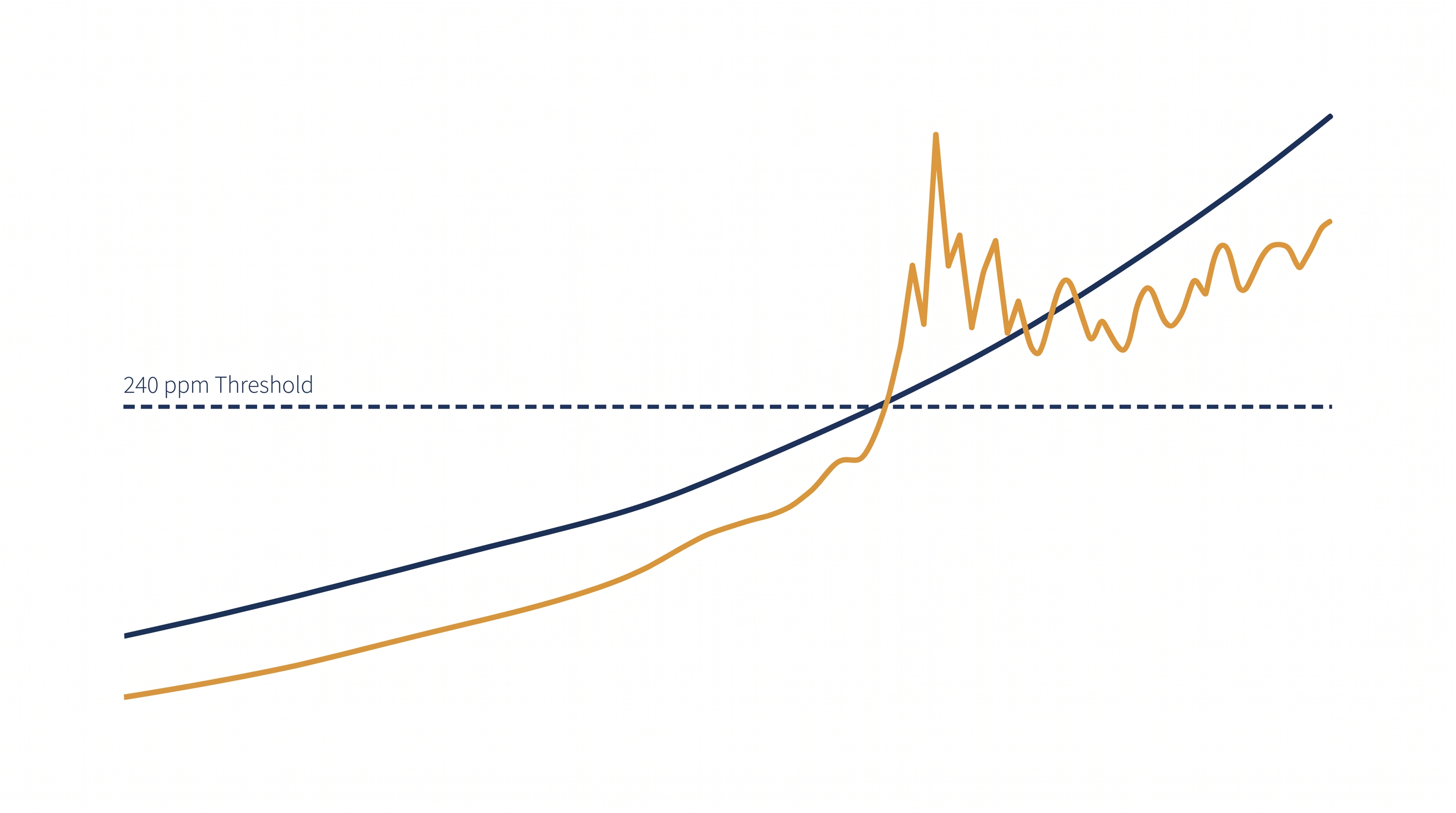
Below that 240 ppm mark, the ice sheet's response amplified suddenly. The same climatic forces were acting on it, but the ice had a fundamentally different, more volatile reaction. This historical precedent is alarming for modern climate forecasters, who rely on gradual-change models to predict sea-level rise along the world's coastlines.[3][8]
Below that 240 ppm mark, the ice sheet's response amplified suddenly.
The mechanics of this ancient shift involved a combination of physical factors. Colder ocean temperatures during glacial periods reduced melting beneath floating ice shelves. Simultaneously, lower global sea levels reduced pressure on the bedrock beneath the ice, allowing the land to slowly rise and support thicker coastal ice.[2][5]
Together, these processes created the larger, more persistent Antarctic ice sheets that defined Earth's subsequent ice age cycles. However, this increased size came with increased sensitivity. The ice was now primed to react dramatically to any future warming or cooling, a trait that continues to govern its behavior today.[2][6][8]
This is not the only evidence that Antarctica is a complex system of tipping points. Earlier this year, researchers at the Potsdam Institute for Climate Impact Research demonstrated that the Antarctic ice sheet does not behave as a single entity, but as a set of interacting basins with different critical thresholds.[7]
Those scientists warned that parts of West Antarctica may have already crossed their tipping points at today's roughly 1.3 degrees Celsius of global warming. This localized crossing could commit the region to long-term, irreversible ice loss over the coming centuries, regardless of immediate emissions cuts.[7][8]
The Nature Geoscience findings add a crucial historical dimension to these warnings. If the ice sheet has crossed sensitivity thresholds before, it can do so again. "Our findings suggest that the Antarctic ice sheet was more sensitive to external forcings than previously assumed," notes co-author Axel Timmermann, raising important questions about its future response to global warming.[2][6]
For coastal cities worldwide, the implications are profound. If forecasts built on gradual change miss the moment the system lurches, preparations for sea-level rise could fall disastrously short. The ancient ice of Antarctica is sending a clear message: climate change is not always a slow creep; sometimes, it is a sudden leap.[3][4][8]
What to know
- Antarctica's ice sheet crossed a critical climate tipping point roughly one million years ago.
- Once atmospheric CO2 dropped below 240 ppm, the ice sheet became highly reactive to temperature changes.
- The discovery challenges modern climate models that assume ice sheets will melt gradually as the planet warms.
- Colder oceans and lower sea levels during the Mid-Pleistocene Transition helped create larger, more sensitive ice sheets.
- Researchers warn that parts of West Antarctica may have already crossed similar tipping points today.
Where opinion splits
Paleoclimate Researchers
Uncovering the mechanics of the Mid-Pleistocene Transition.
Paleoclimatologists argue that understanding the past is the only way to accurately model the future. By reconstructing three million years of climate data, they demonstrated that the Antarctic ice sheet is not a static block of ice, but a dynamic system capable of sudden regime shifts. The identification of the 240 ppm CO2 threshold provides a concrete target for modelers, proving that once a specific boundary is crossed, the ice sheet's response to temperature changes amplifies dramatically.
Climate Forecasters
Warning against the assumption of gradual sea-level rise.
For forecasters and glaciologists, the discovery of a historical tipping point is a red flag for modern projections. Current models generally assume that ice melts at a steady, predictable pace as temperatures rise. Forecasters warn that if the ice sheet can switch regimes at a threshold, forecasts built on gradual change risk missing the moment the system lurches. This means that current estimates for coastal flooding could be significantly underestimating both the speed and severity of future sea-level rise.
Sources
Source coverage
8 outlets
4 viewpoints surfaced







[1]Nature GeosciencePaleoclimate Researchers
Increased sensitivity of the Antarctic Ice Sheet to decreasing CO2 across the Mid-Pleistocene Transition
Read on Nature Geoscience →[2]ScienceDailyGeneral Science Media
Antarctica's ice sheet hit a climate tipping point 1 million years ago
Read on ScienceDaily →[3]Earth.comClimate Forecasters
Scientists discover a hidden tipping point in Antarctica's ice
Read on Earth.com →[4]India TodayGeneral Science Media
A million years ago, Antarctica changed. We're still feeling the effects.
Read on India Today →[5]SciTechDailyGeneral Science Media
Antarctica Suddenly Became Far More Sensitive to Climate Change 1 Million Years Ago
Read on SciTechDaily →[6]EurekAlertPaleoclimate Researchers
Antarctica's ice sheet hit a climate tipping point 1 million years ago
Read on EurekAlert →[7]PIK PotsdamClimate Forecasters
New study identifies sequence of critical thresholds for Antarctic ice basins
Read on PIK Potsdam →[8]Factlen Editorial TeamFactlen Editorial Team
Synthesis by Factlen editorial team
Read on Factlen Editorial Team →
Comments
Every angle. Every day.
Get science stories with full source coverage and perspective breakdowns delivered to your inbox.