
Will Doubling the Federal Overtime Premium Save the Middle Class or Crush Small Business?
Proposals to increase the federal overtime rate from time-and-a-half to double time aim to boost worker pay and incentivize hiring, but economists warn the policy could trigger unintended consequences like base-wage cuts and strict hour caps.
By Rohan Kapoor


- Labor Advocates
- Argue that doubling the premium is necessary to deter overwork and fairly compensate employees.
- Business Groups
- Contend that a double-time mandate will force widespread hour cuts and harm small enterprises.
- Labor Economists
- Focus on the unintended consequences of wage adjustments and the substitution effect.
What everyone gets wrong about mandating higher overtime pay is the assumption that employers will simply absorb the cost and hand workers a massive raise. The popular narrative suggests that moving the federal overtime premium from time-and-a-half to double time will instantly rescue the middle class by pouring thousands of extra dollars into the pockets of anyone working a 50-hour week. The economic evidence corrects this cleanly: when labor becomes artificially expensive, companies do not just open their checkbooks. Instead, they restructure the work. They cut base wages, cap hours, and accelerate automation, triggering a complex reshuffling of the labor market where the actual winners and losers rarely match the political talking points.[5]
The baseline rules of American labor have remained remarkably static since the Fair Labor Standards Act (FLSA) of 1938 established the 40-hour workweek and the 1.5x overtime premium. For nearly nine decades, that time-and-a-half multiplier has been the unquestioned standard. However, a renewed legislative push in 2026, highlighted by the introduction of the "Double the Wage for Overtime Act" in the U.S. Senate, seeks to fundamentally alter that equation by requiring employers to pay double a worker's regular hourly rate for any hours worked beyond 40 in a week.[2]
The intent behind doubling the premium is transparent and well-meaning. Proponents argue that it compensates workers for the increasing physical and mental toll of long hours in an era of high living costs. Furthermore, the policy is designed to act as a punitive tax on employers who chronically overwork a skeleton crew. By making overtime prohibitively expensive, the legislation theoretically forces companies to hire additional workers to spread the load, thereby reducing burnout and lowering unemployment simultaneously.[1][2]
Labor economists, however, view the overtime premium through the lens of two competing forces: the substitution effect and the scale effect. The substitution effect is the exact mechanism policymakers hope to trigger. When the marginal cost of an overtime hour spikes to twice the base rate, employers are heavily incentivized to substitute those expensive hours with new, straight-time hires. If this force dominates, the policy successfully creates jobs and redistributes work more evenly across the labor pool.
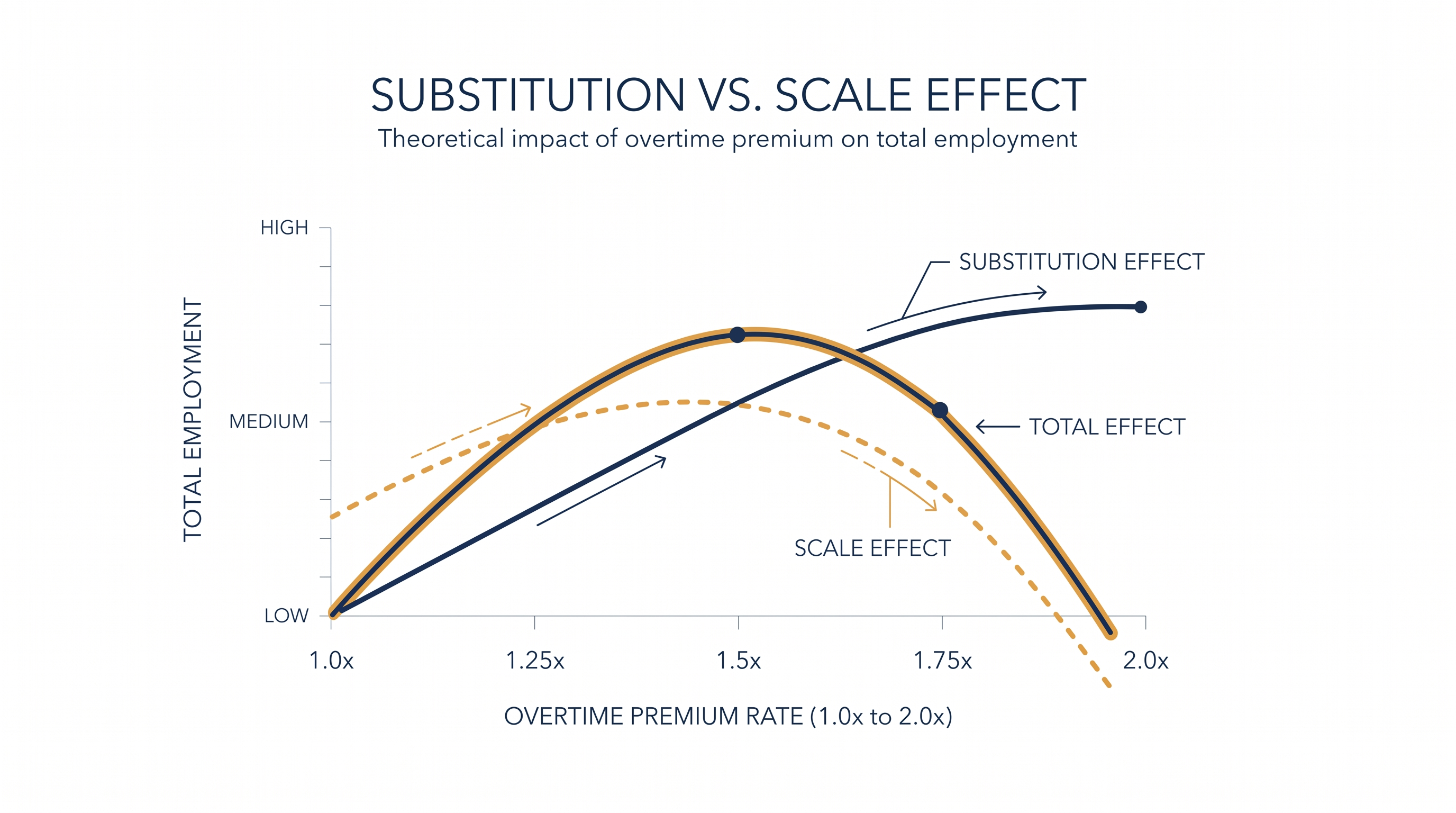
But the substitution effect does not operate in a vacuum; it is constantly fighting the scale effect. The scale effect occurs when the overall cost of production rises so significantly that the firm simply produces less, reducing total employment across the board. If the mandate makes labor too expensive to sustain current output levels, businesses will scale back operations entirely. In theory and in practice, if the scale effect outweighs the substitution effect, a higher overtime premium actually destroys jobs rather than creating them.
Historical analyses of proposals to raise the premium to double time reveal that the promised hiring boom is often a mirage. A comprehensive review by the Congressional Research Service found that the maximum employment gains from a double-time mandate would be remarkably modest—ranging from just 0.5% to 1.8% in manufacturing and nonmanufacturing sectors. The reason the job-creation engine stalls is that employers possess multiple levers to offset the new regulatory costs, and they pull them aggressively.[3]
Historical analyses of proposals to raise the premium to double time reveal that the promised hiring boom is often a mirage.
The most potent lever is the adjustment of the base wage. If an employer and an employee have implicitly agreed on a total weekly compensation for a 50-hour week, a mandated increase in the overtime premium can be entirely neutralized if the employer lowers the worker's straight-time hourly rate. While minimum wage laws prevent this for the lowest earners, companies can and do suppress the base pay of middle-income workers to ensure their total weekly take-home pay remains exactly the same, rendering the double-time mandate economically invisible.[3]
Another well-documented employer response is the "bunching" phenomenon. Research from the University of California, Riverside, analyzing expansions in overtime coverage, demonstrates that firms will often raise base salaries just enough to push workers over the federal exemption threshold. By giving a worker a slight bump in base pay to reclassify them as an exempt salaried employee, the company avoids the overtime premium entirely. This tactic effectively caps the upside for the worker while demanding the same long hours.
So, who actually wins in a double-time regime? The workers most likely to see a genuine financial windfall are those whose hours cannot be easily capped, redistributed, or automated. Think of nurses covering a critical hospital floor, specialized technicians running a continuous production line, or emergency responders. For these essential, highly skilled roles, employers have no choice but to absorb the higher premium, resulting in a direct transfer of wealth to the worker.[1]
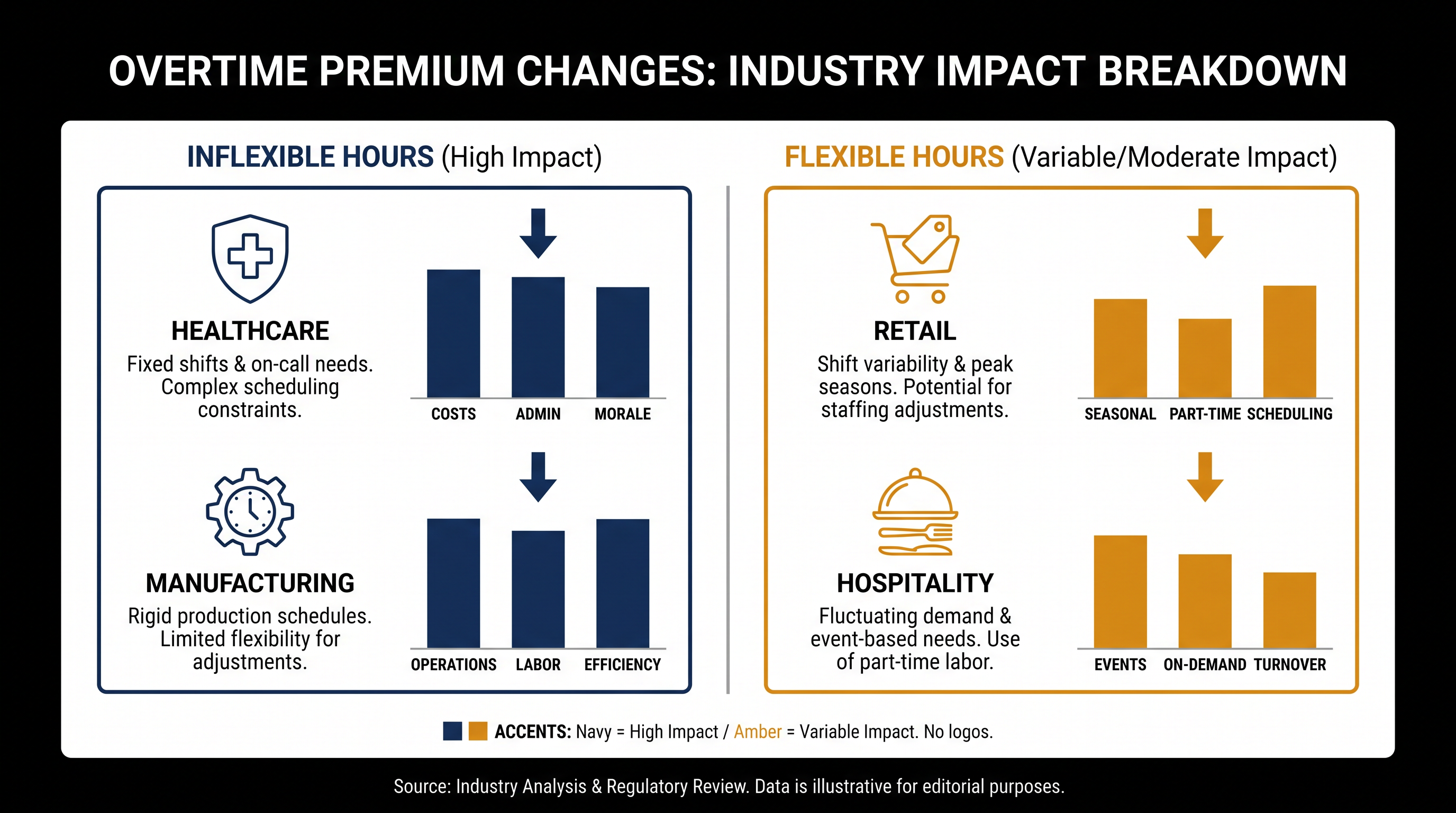
Conversely, the workers most likely to lose out are those in retail, hospitality, and general administration. For these roles, labor is highly interchangeable. Faced with a double-time mandate, employers will strictly cap these workers at 40 hours per week, utilizing scheduling software to send them home the minute they hit the threshold. While this grants the worker more free time, it entirely eliminates the overtime pay they may have relied upon to pay rent or buy groceries, effectively resulting in a pay cut.[1]
Small businesses face the steepest challenge in navigating this dynamic. Unlike massive corporations that can dynamically schedule a vast, cross-trained workforce to avoid overtime entirely, a small retailer or independent restaurant often relies on a handful of key employees to cover unexpected gaps or sick calls. For these enterprises, the double-time premium cannot be easily engineered away; it simply becomes a direct hit to already razor-thin margins.[5]
Furthermore, any policy that artificially spikes the marginal cost of labor fundamentally alters the return on investment for automation. A double-time mandate accelerates the adoption of technologies designed specifically to eliminate the need for human overtime. When the cost of a 45th hour of labor doubles, the capital expenditure required to install self-checkout kiosks, automated inventory systems, and AI-driven logistics suddenly becomes highly attractive, permanently destroying the hours the policy meant to regulate.[5]

International evidence supports the idea that aggressive overtime premiums successfully reduce extreme hours, but rarely in the way advocates hope. A study by the American Economic Association examining a mandatory increase in the overtime premium rate found that while it successfully decreased the incidence of extreme overtime, there was limited evidence that those reduced hours were redistributed to unemployed workers or those working shorter days. The work simply vanished, or was absorbed through higher productivity demands during straight-time hours.[4]
The debate over doubling the federal overtime premium is ultimately a debate about how to force a structural change in the modern workplace. While the policy is a blunt instrument that carries severe unintended consequences—from base-wage stagnation to strict hour caps—it forces a necessary reckoning over the true cost of a 50-hour workweek. It will not unilaterally save the middle class, nor will it instantly crush small business, but it will undeniably trade the promise of higher pay for a select few against a more rigid, automated labor market for everyone else.[5]
The stakes
Understanding the economic mechanics of overtime premiums is crucial for workers who rely on extra hours to make ends meet, as well-intentioned policies can inadvertently lead to strict hour caps and base-wage stagnation.
The essentials
- Proposals to double the federal overtime premium aim to deter overwork and boost pay.
- Economists warn the policy triggers a 'scale effect' that can reduce overall employment.
- Employers often respond to higher premiums by cutting base wages or capping hours at 40.
- Highly specialized workers are most likely to benefit, while retail and hospitality workers may lose hours.
- The mandate accelerates business investment in automation to avoid expensive human labor.
Perspectives explored
Labor Advocates
Argue that doubling the premium is necessary to deter overwork and fairly compensate employees.
Advocates point out that the 1.5x premium was established in 1938 and has lost its deterrent effect as the cost of benefits has risen. They argue that employers currently find it cheaper to overwork a single employee and pay time-and-a-half than to hire a second worker and pay for their health insurance and benefits. A double-time mandate, in their view, restores the original intent of the FLSA by making overwork prohibitively expensive.
Business Groups
Contend that a double-time mandate will force widespread hour cuts and harm small enterprises.
Industry representatives argue that labor is already the highest fixed cost for most businesses. They warn that doubling the overtime premium will not result in higher take-home pay for workers, but rather strict 40-hour caps enforced by scheduling software. For small businesses that cannot afford to hire additional staff to cover marginal hours, the policy represents a direct threat to operational viability.
Labor Economists
Focus on the unintended consequences of wage adjustments and the substitution effect.
Economists emphasize that labor markets are highly dynamic. When the marginal cost of an hour spikes, employers adapt by suppressing base wages, reclassifying workers as exempt, or investing heavily in automation. They caution policymakers that while a double-time mandate might benefit highly specialized workers whose hours cannot be capped, it will likely reduce total compensation for interchangeable hourly workers who rely on overtime to make ends meet.
Sources
Source coverage
5 outlets
3 viewpoints surfaced





[1]NewsweekLabor Advocates
Potential Economic Effects of the Double the Wage for Overtime Act
Read on Newsweek →[2]U.S. SenateLabor Advocates
Gallego Introduces Double the Wage for Overtime Act
Read on U.S. Senate →[3]Congressional Research ServiceLabor Economists
Reduced Working Hours: Cure for Unemployment or Economic Burden?
Read on Congressional Research Service →[4]American Economic AssociationLabor Economists
Labour Input Adjustment to an Increase in the Overtime Premium
Read on American Economic Association →[5]Factlen Editorial TeamBusiness Groups
Synthesis by Factlen editorial team
Read on Factlen Editorial Team →
Comments


Every angle. Every day.
Get perspectives stories with full source coverage and perspective breakdowns delivered to your inbox.