
US Interceptor Missile Inventories Inadequate for Conflict with China, Experts Warn
Wargames and defense analyses reveal that the U.S. military lacks the interceptor missile stockpile and industrial surge capacity required to sustain a prolonged conflict in the Pacific.

- Defense Industrial Base Advocates
- Argues that the shortfall is a result of inconsistent funding and demands long-term, multi-year procurement contracts.
- Strategic Planners
- Focuses on the operational risks of limited magazine depth and the need to fundamentally alter how forces are deployed.
- Cost-Curve Critics
- Argues that kinetic interceptors are an economically unsustainable defense and advocates for a rapid pivot to non-kinetic technologies.
Perspectives this story doesn't cover
- Chinese Defense Analysts
- Frontline Service Members
Common questions
Why can't the U.S. just build more factories quickly?
Missile manufacturing requires highly specialized, multi-tier supply chains (like thermal batteries and solid rocket motors) and cleared workforces that take years to establish.
Can U.S. Navy ships reload their missiles at sea?
Currently, no. Once a destroyer empties its vertical launch cells, it must return to a friendly port with specialized cranes to reload, removing it from the fight.
Are lasers a solution to the missile shortage?
Directed energy weapons offer an 'infinite magazine' and are being deployed, but they are not yet powerful or reliable enough to replace kinetic interceptors against advanced ballistic threats.
The short answer
- The U.S. lacks the interceptor missile inventory needed for a prolonged conflict with China.
- Wargames indicate the U.S. could exhaust critical munitions within the first week of a Taiwan Strait conflict.
- Decades of peacetime procurement dismantled the defense industrial base's surge capacity.
- U.S. ships cannot reload vertical launch cells at sea, forcing them to retreat once their magazines are empty.
The United States military currently lacks the interceptor missile inventory required to sustain a prolonged, high-intensity conflict with China. This is the short version of a complex structural problem that has alarmed defense planners, congressional committees, and think tanks across Washington. The core issue is not a lack of technological capability—American interceptors are among the most advanced in the world—but a severe deficit in industrial capacity and stockpile volume. In a scenario where the U.S. must defend Taiwan or its own forward bases in the Pacific, the brutal math of modern warfare heavily favors the side with the most munitions.[1][5]
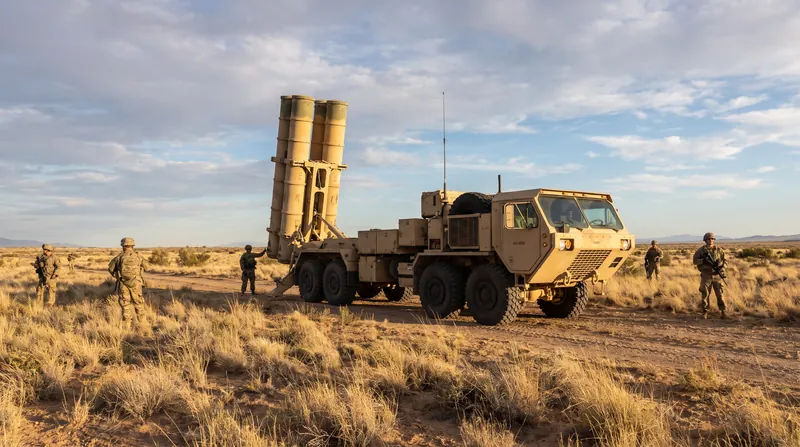
The People's Liberation Army Rocket Force (PLARF) has spent the last two decades systematically mass-producing thousands of offensive ballistic and cruise missiles designed specifically to target American assets. In contrast, the United States relies on highly sophisticated, exquisitely engineered, and slowly produced interceptors, such as the Patriot PAC-3 and the Navy's Standard Missile-6 (SM-6). This asymmetry creates a fundamental strategic vulnerability: the U.S. military can shoot down incoming threats with remarkably high success rates, but it will simply run out of defensive bullets long before China runs out of offensive targets.[2][4]
The mechanism driving this vulnerability is known in naval and defense circles as "magazine depth." A U.S. Navy Arleigh Burke-class guided-missile destroyer, for example, typically features 96 vertical launch system (VLS) cells. These cells must carry a carefully balanced mix of offensive land-attack cruise missiles, anti-submarine rockets, and defensive interceptors. Once a ship fires its allocated interceptors to survive a concentrated incoming barrage, its magazine is empty. Crucially, it cannot reload these massive weapons at sea; the vessel must withdraw from the combat zone and return to a secure, friendly port equipped with specialized crane facilities to restock, effectively removing it from the fight.[4][5]
Wargames and classified simulations consistently highlight this logistical bottleneck as a critical point of failure. According to a landmark report by the Center for Strategic and International Studies (CSIS) titled "Empty Bins in a Wartime Environment," the U.S. would likely exhaust its inventory of critical precision-guided munitions—particularly long-range anti-ship missiles and advanced air-defense interceptors—within the first week of a major conflict in the Taiwan Strait. The report concluded that the U.S. defense industrial base is currently structured for peacetime procurement and is entirely inadequately prepared for the massive consumption rates inherent to great power war.[1]
The root of this shortfall lies deep within the structure of the defense industrial base itself. For the past thirty years, following the end of the Cold War, the Pentagon optimized its procurement strategies for peacetime efficiency and counter-insurgency operations. The system heavily prioritized "just-in-time" manufacturing, minimizing overhead, reducing stockpiles, and eliminating idle factory capacity to save taxpayer dollars. While this lean approach was economically viable during the Global War on Terror—where the U.S. dropped precision bombs in entirely uncontested airspace—it systematically dismantled the robust surge capacity required to rapidly mass-produce complex weapons during a crisis.[1][3]
Building a modern interceptor missile is not a matter of simply turning on a factory line or adding a night shift. These weapons require highly specialized, tightly regulated components, including solid rocket motors, specialized thermal batteries, and military-grade microelectronics. The supply chains for these sub-components are incredibly fragile, often relying on single-source domestic suppliers or sub-tier vendors that require years of lead time to expand their own production lines. A bottleneck at a single ball-bearing manufacturer or chemical propellant supplier can halt the entire final assembly of an SM-6 or Patriot missile.[2][3]
Building a modern interceptor missile is not a matter of simply turning on a factory line or adding a night shift.
Prime contractors are attempting to scale up operations, but the physics of heavy industrial expansion are inherently slow. Lockheed Martin, for instance, has invested heavily in new facilities to increase the production of the Patriot PAC-3 Missile Segment Enhancement (MSE). However, moving from an annual production rate of roughly 300 missiles to a target of 600 missiles takes several years of facility construction, tooling, and specialized workforce training. Even at this doubled capacity, the annual output does not quickly close a historical deficit measured in the thousands when compared against the PLARF's rapidly expanding inventory.
Beyond sheer volume, the United States finds itself on the wrong side of the economic cost curve. A Chinese DF-26 intermediate-range ballistic missile costs a fraction of the advanced SM-3 or SM-6 interceptor required to reliably track and defeat it in flight. Furthermore, standard air defense doctrine often dictates firing two interceptors at every incoming ballistic threat to ensure a high probability of a kill. This means the U.S. is spending tens of millions of dollars to intercept a threat that costs the adversary significantly less, accelerating the rapid depletion of both defense budgets and physical magazines.[2][4]
The strategic consequences of empty magazines are profound and far-reaching. If U.S. carrier strike groups and forward operating bases in locations like Guam and Japan exhaust their defensive screens, they become highly vulnerable to saturation strikes. To preserve these multi-billion-dollar assets and the thousands of sailors aboard them, naval commanders would be forced to pull them back beyond the "first island chain," effectively ceding the immediate battlespace to Chinese forces. This forced withdrawal would severely complicate any American effort to resupply Taiwan or project sustained combat power into the contested waters of the South China Sea.[1][4]
Recognizing the severity of this industrial crisis, the Department of Defense recently released its first-ever National Defense Industrial Strategy. The comprehensive framework aims to rebuild wartime surge capacity, incentivize multi-year procurement contracts to give private industry stable demand signals, and aggressively onshore critical supply chains. However, policy documents and strategic frameworks take time to translate into concrete capital investments. Once funds are allocated, those capital investments take years to yield finished, deployable weapons on the flightline or in the launch tubes of the fleet.[3]
To bridge this dangerous gap in the near term, the U.S. military is increasingly looking to non-kinetic defenses to supplement its interceptor stocks. Electronic warfare systems, cyber disruption tactics, and directed energy weapons—such as high-energy shipboard lasers and high-power microwaves—offer the theoretical promise of an "infinite magazine." If a destroyer can blind an incoming missile's radar seeker or fry its internal electronics with a laser, it saves a precious kinetic interceptor for a harder target. Yet, these technologies remain largely unproven against massed, hypersonic, or highly advanced ballistic threats in a chaotic, real-world combat environment.[2][5]
Allied integration represents another critical node in solving the systemic shortfall. The United States is actively working with key Indo-Pacific partners like Japan and Australia to establish co-production facilities for precision munitions on foreign soil. By distributing the manufacturing load across the Pacific, the alliance hopes to create a more resilient, decentralized supply chain that cannot be crippled by a single strike on a U.S. mainland factory or a disruption in trans-Pacific shipping. Japan's recent, historic moves to ease its post-war defense export restrictions are a direct, calculated response to this shared vulnerability.[3][5]
Ultimately, the glaring gap between offensive mass and defensive capacity is not a temporary glitch in the procurement system, but a structural reality of modern great power competition. The era of uncontested American air and naval dominance relied on an industrial base that no longer exists in the required scale or agility. Rebuilding that capacity is now a central, urgent pillar of U.S. national security policy, but the transition will inevitably be measured in decades, leaving a precarious window of strategic vulnerability in the interim.[1][5]
Why it matters
If the U.S. cannot adequately defend its forward bases and aircraft carriers from missile barrages, it risks losing the ability to project power or protect allies in the Indo-Pacific, fundamentally altering global security dynamics.
Jargon, explained
- Magazine Depth
- The total number of munitions a ship, aircraft, or ground unit can carry and fire before needing to reload.
- Vertical Launch System (VLS)
- The standardized silo system on naval ships used to store and fire a variety of missiles.
- Solid Rocket Motor (SRM)
- The propulsion system used in most military missiles, currently facing severe supply chain bottlenecks.
- PLARF
- The People's Liberation Army Rocket Force, China's strategic and tactical missile command.
Sources
Source coverage
5 outlets
3 viewpoints surfaced





- [1]Center for Strategic and International Studies (CSIS)Defense Industrial Base Advocates
Empty Bins in a Wartime Environment: The Challenge to the U.S. Defense Industrial Base
Read on Center for Strategic and International Studies (CSIS) → - [2]RAND CorporationStrategic Planners
U.S. Military Magazine Depth and the Challenge of Great Power Conflict
Read on RAND Corporation → - [3]U.S. Department of DefenseDefense Industrial Base Advocates
DoD Releases First-Ever National Defense Industrial Strategy
Read on U.S. Department of Defense → - [4]U.S. Naval Institute NewsStrategic Planners
Navy Needs More Interceptors to Counter China's Anti-Ship Ballistic Missiles
Read on U.S. Naval Institute News → - [5]Factlen Editorial TeamCost-Curve Critics
Synthesis by Factlen editorial team
Read on Factlen Editorial Team →
Comments

More in Defense & Security
See all →Indo-Pacific Posture
US Deploys Typhon Missile System to Okinawa as China and Russia Condemn Move
6 sources
Strait of Hormuz
Iran Intercepts 19 Commercial Vessels and Resumes Minelaying in Strait of Hormuz
6 sources

UNSC Reform
Russia Threatens UN Security Council Veto on Permanent Seats for Germany and Japan
5 sources

RouterOS Security
MikroTrick Exploit Chain Grants Unauthenticated Full Admin Access to Global MikroTik Routers
5 sources

Every angle. Every day.
Get Defense & Security stories with full source coverage and perspective breakdowns delivered to your inbox.