
Harvard Youth Poll Data Finds Trust in Federal Government Hits Record Low of 15% Among Young Americans
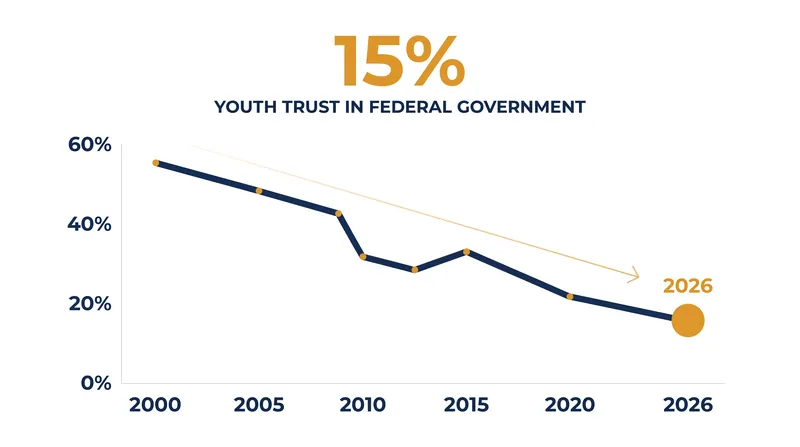
New data from the Spring 2026 Harvard Youth Poll reveals that only 15% of Americans under 30 trust the federal government, driven by economic pressure and a profound loss of perceived political agency.
By Sofia Matos

- Structural Reform Advocates
- Argue that low trust is a rational response to a system that fails to deliver economic security and requires fundamental democratic overhaul.
- Institutional Defenders
- Emphasize that while macro-level trust is low, public satisfaction with specific federal services remains high, suggesting a perception gap.
- Historical Contextualists
- View the current polling as the continuation of a decades-long decline driven by partisan polarization and historical crises.
Summary
- Trust in the federal government among Americans aged 18-29 has fallen to a record low of 15%, according to the Spring 2026 Harvard Youth Poll.
- Half of young adults now believe they have no say in what the government does, a 15-point increase since 2017.
- Overall public trust across all age groups sits at just 17%, down from a historical high of 77% in 1964.
- Despite macro-level distrust, public satisfaction with direct federal services and local government remains significantly higher.
Exactly 15 percent. That is the share of Americans under the age of 30 who currently trust the federal government to do the right thing most of the time.[1]
This figure, captured in the Spring 2026 edition of the Harvard Youth Poll, represents the lowest level of institutional faith recorded in the survey's 26-year history. It is not an anomaly, but the sharpest edge of a broader collapse in civic confidence that spans generations, geographies, and political affiliations, requiring a rigorous look at what the data actually measures.[1][7]
To understand the mechanics of this decline, researchers look beyond simple policy disagreements and track a metric known as "perceived agency." The evidence reveals a structural break in how young citizens view their relationship with the state.[1][4]
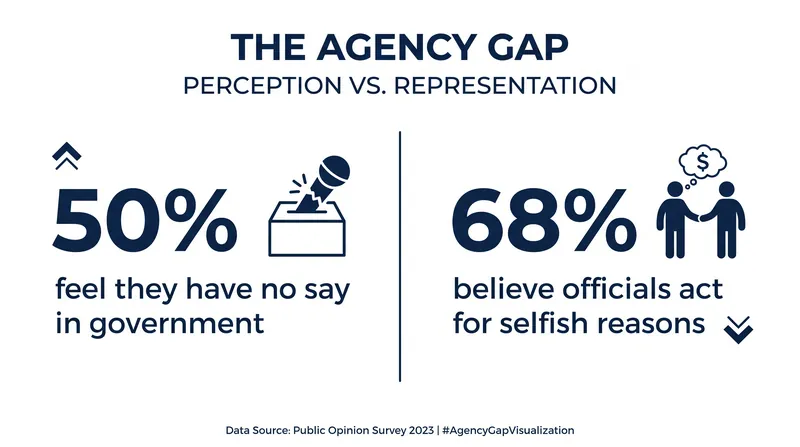
According to the Harvard Kennedy School Institute of Politics, 50% of young adults now agree with the statement that "people like me don't have any say about what the government does." This represents a 15-point surge since 2017, indicating that the primary driver of distrust is no longer just anger at specific legislative outcomes, but a fundamental belief that the system is entirely unresponsive to public input.[1]
This loss of agency is tightly coupled with economic pressure in the polling data. The cross-tabs show that 45% of youth report struggling to make ends meet, and only 29% expect to be better off economically than their parents. When economic mobility stalls, the data suggests that faith in the institutions tasked with managing the economy predictably follows.[1]
The skepticism extends deeply into the perceived motivations of those in power. A striking 68% of young Americans now believe that elected officials are motivated primarily by selfish reasons, with the share who "strongly agree" jumping from 26% in 2017 to 39% today.[1]
While the youth data is particularly stark, it mirrors a macro-level trend documented extensively by the Pew Research Center. In late 2025, Pew found that overall public trust in the federal government sat at just 17%—a staggering fall from the 77% high recorded in 1964.[2]
While the youth data is particularly stark, it mirrors a macro-level trend documented extensively by the Pew Research Center.
Historical polling data shows that this erosion did not happen overnight. The decline began during the Vietnam War and Watergate, stabilized briefly during the economic booms of the 1980s and late 1990s, and has remained trapped below 30% since the 2008 financial crisis.[2][5][6]
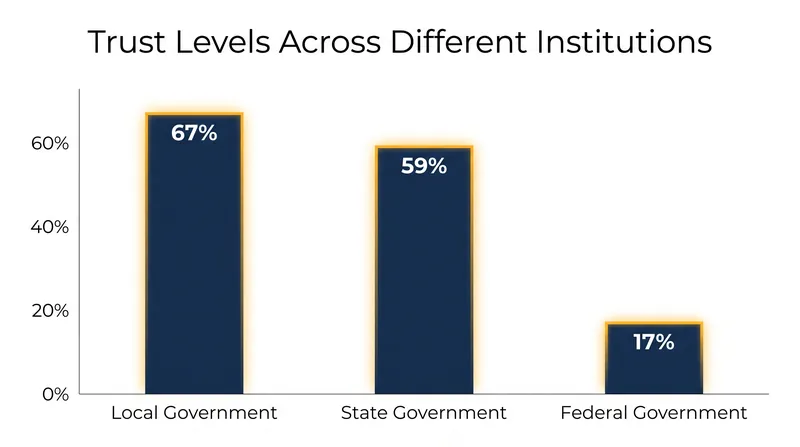
However, the data also reveals a fascinating paradox known as the "proximity effect." While the federal government suffers from historic distrust, local institutions fare significantly better in the exact same surveys.[4]
Analysis by the National Academy of Public Administration highlights that 67% of Americans trust their local government to handle local problems, and 59% trust their state government. The closer the institution is to the citizen's daily life, the higher the baseline of measurable confidence.[4]
Furthermore, there is a measurable gap between macro-level distrust and micro-level satisfaction. The Partnership for Public Service tracks citizen interactions with specific federal agencies and found that customer satisfaction with federal services actually reached a seven-year high recently, scoring 69.7 out of 100.[3][4]
This suggests that when citizens interact with the government as a service provider—renewing a passport, receiving a benefit, or visiting a national park—the system works reasonably well. The crisis of trust is heavily concentrated in the government's role as a representative policymaking body.[3][7]
What the current data models cannot definitively answer is whether this youth disillusionment is a permanent generational scar. Political scientists debate whether Gen Z will carry this 15% trust baseline into middle age, or if their confidence will naturally rise as they accumulate wealth and political power over the coming decades.[7]
The immediate stakes, however, are clear in the electoral data. Only 33% of young voters say they trust the upcoming 2026 elections will be conducted fairly, highlighting a profound uncertainty about the integrity of the process itself.[1]

As the United States navigates its next major electoral cycle, the evidence pack is unambiguous: political participation among young Americans is no longer being driven by institutional enthusiasm, but is increasingly characterized by profound skepticism and a demand for structural responsiveness.[1][7]
Definitions
- Perceived Agency
- A citizen's belief that their actions, voice, and votes can actually influence government policy and societal outcomes.
- Proximity Effect
- The polling phenomenon where citizens express significantly higher trust in local and state institutions compared to distant federal bodies.
- Macro-Level Distrust
- Broad skepticism toward the government as a whole, which often contrasts with higher satisfaction in specific, individual interactions with government services.
- 15%
- Youth trust in federal government
- 50%
- Feel they have no say in government
- 17%
- Overall US public trust in government
- 67%
- Trust in local government
Chronology
1964
Public trust in the federal government reaches a historic peak of 77%.
2008
Following the financial crisis, overall public trust drops below 30% and fails to recover.
2017
The Harvard Youth Poll records that 35% of young Americans feel they have no say in government.
Dec 2025
Pew Research Center data confirms overall public trust remains stagnant at 17%.
April 2026
The 52nd Harvard Youth Poll reveals youth trust has plummeted to an unprecedented 15%.
Analysis by camp
Structural Reform Advocates
Argue that low trust is a rational response to a system failing to deliver economic security.
This camp, which includes many economic populists and youth organizers, views the 15% trust figure not as a failure of civic education, but as an accurate read of the current economic reality. They point to the polling cross-tabs showing that only 29% of young Americans expect to out-earn their parents. From this perspective, the loss of perceived agency is a highly rational response to a legislative system that has struggled to address structural issues like housing affordability and wage stagnation, necessitating fundamental democratic overhauls rather than mere messaging shifts.
Institutional Defenders
Emphasize the gap between abstract political distrust and concrete satisfaction with government services.
Researchers focused on public administration highlight a crucial paradox in the data: while 'The Government' as an abstract concept is deeply unpopular, the actual machinery of the state often functions well. They point to data from the Partnership for Public Service showing that customer satisfaction with specific federal interactions recently hit a seven-year high. This camp argues that the crisis is primarily one of political polarization and communication, suggesting that trust can be rebuilt by better highlighting the competent, day-to-day delivery of local and federal services.
Historical Contextualists
View the current polling as the continuation of a decades-long decline rather than a sudden crisis.
Analysts looking at the long-term Pew Research Center data emphasize that the baseline of American civic trust has been broken since the Vietnam War and Watergate. In 1964, 77% of the public trusted the government; by 1980, that number had already collapsed. This perspective argues that the current youth data is simply the latest chapter in a 60-year trend of institutional erosion, exacerbated by modern algorithmic media but fundamentally rooted in a long-standing American skepticism of centralized federal power.
Limits of the evidence
- Whether the 15% trust level represents a permanent generational shift or a temporary life-stage effect that will rebound as Gen Z ages.
- How the profound skepticism regarding election fairness (33% trust) will precisely impact youth voter turnout models in the 2026 midterms.
- The exact degree to which algorithmic social media consumption accelerates the feeling of political voicelessness compared to traditional economic factors.
Significance
When an entire generation loses faith in the responsiveness of its democratic institutions, political participation shifts from constructive engagement to systemic skepticism, fundamentally altering voter turnout models and the long-term stability of the electoral process.
Sources
Source coverage
7 outlets
3 viewpoints surfaced







[1]Harvard Kennedy School Institute of PoliticsStructural Reform Advocates
52nd Harvard Youth Poll: Spring 2026
Read on Harvard Kennedy School Institute of Politics →[2]Pew Research CenterHistorical Contextualists
Public Trust in Government: 1958-2025
Read on Pew Research Center →[3]Partnership for Public ServiceInstitutional Defenders
Trust in Government Survey
Read on Partnership for Public Service →[4]National Academy of Public AdministrationInstitutional Defenders
Building Trust in Government pt. 2: Digging Deeper into the Data
Read on National Academy of Public Administration →[5]WBURHistorical Contextualists
Why don't Americans trust the government?
Read on WBUR →[6]The Washington PostHistorical Contextualists
Public trust in government drops to new lows
Read on The Washington Post →[7]Factlen Editorial TeamStructural Reform Advocates
Synthesis by Factlen editorial team
Read on Factlen Editorial Team →
Comments

More in data analysis
See all 5 stories →


Every angle. Every day.
Get data analysis stories with full source coverage and perspective breakdowns delivered to your inbox.