
The New EU Marketing Reality: A Guide to the Anti-Greenwashing Directive and the Verifiable Claims Mandate
The EU's Empowering Consumers for the Green Transition Directive takes full effect in September 2026, banning generic 'eco-friendly' claims and offset-based 'climate neutral' labels. Here is what global brands need to know to survive the new regulatory landscape.


- Consumer Protection Advocates
- Advocates argue the directive is a necessary intervention to end an era of deceptive marketing.
- Corporate Compliance Teams
- Compliance officers are focused on the immense logistical challenge of auditing global supply chains and packaging.
- Independent Certification Bodies
- Certifiers see the regulation as a validation of rigorous, third-party environmental standards.
Summary
- The Empowering Consumers for the Green Transition (ECGT) Directive is fully active, with enforcement beginning September 27, 2026.
- Generic environmental claims like 'eco-friendly' and 'green' are strictly prohibited without recognized, excellent environmental performance.
- Companies can no longer claim a product is 'climate neutral' based purely on the purchase of carbon offsets.
- All sustainability labels must be backed by public authorities or independent, third-party certification schemes.
- The rules apply to any business selling to EU consumers, regardless of where the company is headquartered.
- Existing inventory on retail shelves is not exempt and must carry compliant messaging by the September deadline.
Many brands believe the European Union's crackdown on greenwashing was delayed when the standalone Green Claims Directive was paused in 2025. They are wrong. The Empowering Consumers for the Green Transition (ECGT) Directive is already law, and its enforcement begins on September 27, 2026.[1][2][6]
This directive fundamentally rewrites the rules of marketing and packaging across the European single market. By amending existing consumer protection frameworks, the ECGT blacklists vague environmental promises and forces companies to replace marketing spin with verifiable, third-party data.[3][7]
The most immediate casualty of the new regulatory environment is the generic green claim. Terms like "eco-friendly," "green," "climate-friendly," and "biodegradable" are now strictly prohibited across all consumer-facing communications unless a company can demonstrate recognized, excellent environmental performance.[2][6]
A product can no longer be labeled "sustainable" simply because it uses slightly less water during manufacturing or incorporates a fraction of recycled material. The environmental claim must be highly specific, contextualized, and backed by evidence that is readily available to the consumer at the point of sale.[1][7]
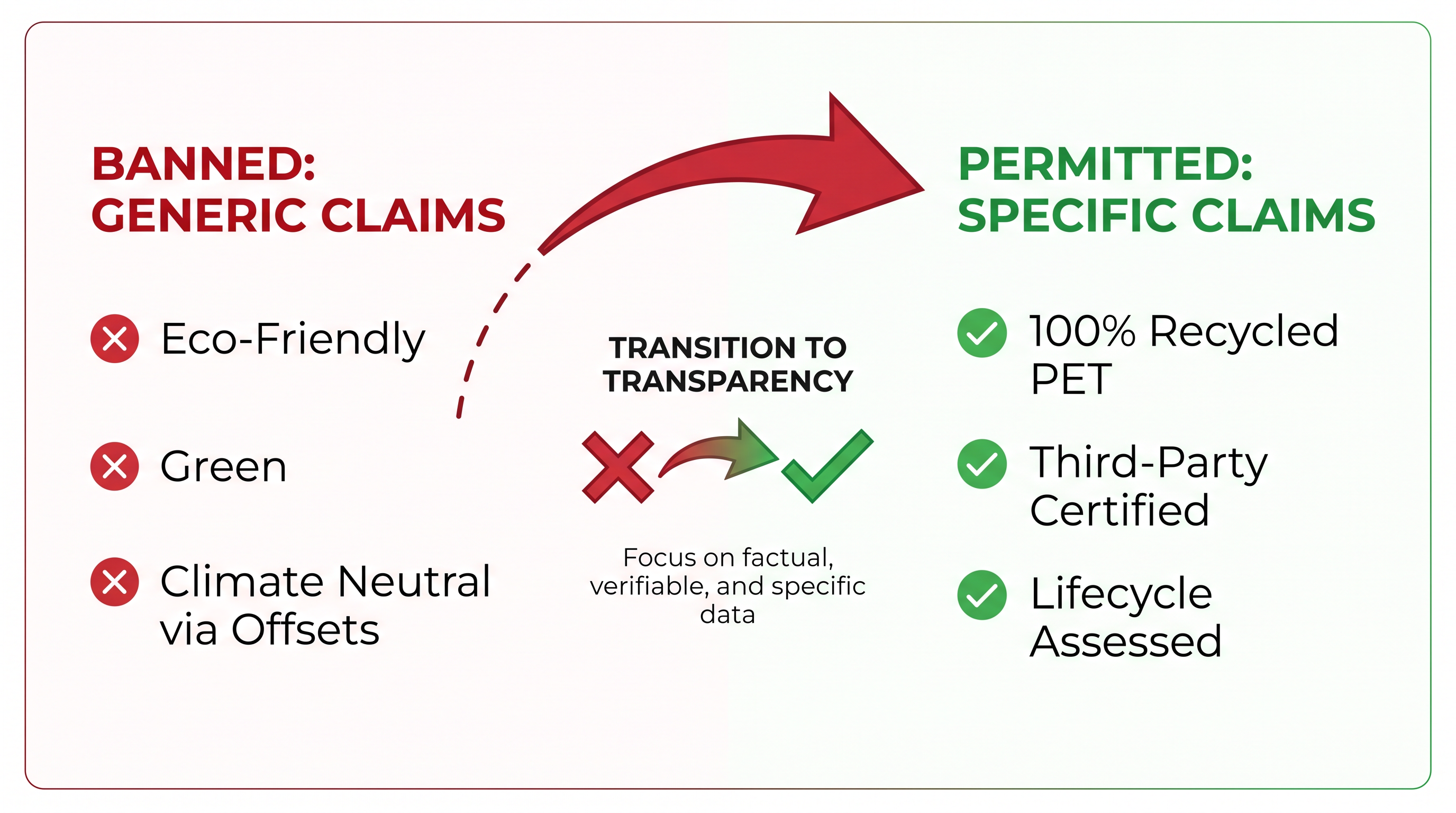
The directive also targets one of the most controversial practices in modern corporate sustainability: offset-based climate claims. From September 2026, companies are banned from claiming that a product has a neutral, reduced, or positive environmental impact based purely on the purchase of carbon offsets.[2][6]
This means the ubiquitous "climate neutral" or "carbon neutral" badges found on everything from airline tickets to coffee cups will disappear if they rely on paying third parties to plant trees or protect forests elsewhere. Companies must instead demonstrate actual lifecycle emission reductions within their own supply chains.[2][8]
To survive this new scrutiny, sustainability labels must now be backed by formal, rigorous certification schemes. Self-created corporate badges—often designed by marketing departments to look like official eco-labels—are now illegal under the updated Unfair Commercial Practices Directive.[1][3][5]
To survive this new scrutiny, sustainability labels must now be backed by formal, rigorous certification schemes.
Only labels established by public authorities or independent third-party certification schemes are permitted. Major global certifiers, such as the Programme for the Endorsement of Forest Certification (PEFC) and the Marine Stewardship Council (MSC), have already overhauled their trademark rules to align with the September 2026 deadline.[4][5]

The scope of the ECGT Directive is deliberately broad, capturing the entire global supply chain. It applies to any organization making business-to-consumer claims in the EU, regardless of where the company is headquartered or where the product is manufactured.[1][7]
If a United States-based apparel brand or an Asian electronics manufacturer sells directly to European buyers, their packaging, digital advertising, and social media campaigns must comply with the exact same evidentiary standards as a local European firm.[7]
This transition presents a massive logistical challenge for global retail operations. Crucially, the legislation does not grant a grace period for existing inventory; products already sitting on retail shelves or in warehouses must carry compliant messaging by the September deadline.[4]
Companies are currently racing to audit their entire product portfolios, stripping non-compliant language from packaging and redesigning marketing materials to avoid regulatory action. The cost of updating physical packaging across thousands of SKUs is forcing many brands to drop environmental claims entirely rather than risk non-compliance.[2][4]
Enforcement carries severe financial stakes. Because the ECGT amends core consumer protection laws, violations are treated as consumer fraud. Penalties can reach up to 4% of a company's annual turnover in the relevant member states, alongside the risk of product recalls and revenue confiscation.[1][3]
This product-level scrutiny dovetails with the broader Corporate Sustainability Reporting Directive (CSRD), which forces large companies to disclose their overall environmental impact. Regulators and consumer watchdogs will now cross-reference a brand's marketing claims against its mandatory corporate disclosures, easily flagging discrepancies.[1]
Ultimately, the new marketing reality shifts environmental claims from the purview of the advertising department to the compliance and legal teams. Brands that have invested in genuine, verifiable sustainability will find a cleared playing field, while those relying on vague optics face an abrupt and costly reckoning.[2][7][9]
Definitions
- ECGT Directive
- The Empowering Consumers for the Green Transition Directive, an EU law banning greenwashing and regulating sustainability labels.
- Greenwashing
- The practice of making misleading or unsubstantiated claims about the environmental benefits of a product or company.
- Carbon Offsetting
- Compensating for emissions by funding equivalent carbon dioxide saving elsewhere, which can no longer be used to claim a product is 'climate neutral' in the EU.
- Third-Party Certification
- An independent assessment verifying that a product meets specific environmental standards, now required for sustainability labels.
- Unfair Commercial Practices Directive (UCPD)
- The overarching EU consumer protection law that the ECGT amends to blacklist generic environmental claims.
Chronology
March 2024
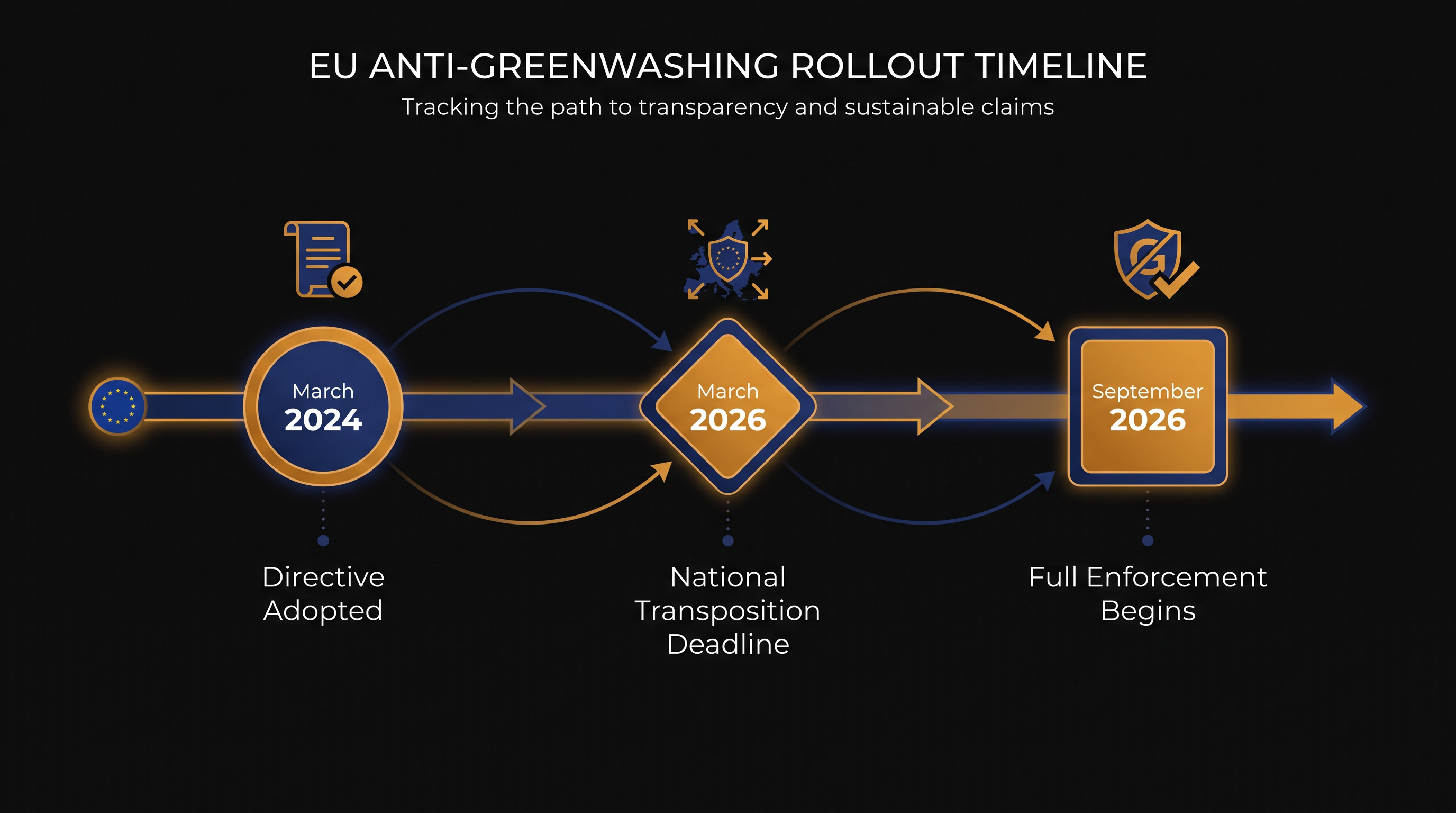
The Empowering Consumers for the Green Transition (ECGT) Directive officially enters into force.
June 2025
The European Commission pauses the standalone Green Claims Directive, leading to widespread confusion about greenwashing rules.
March 2026
Deadline for all EU member states to transpose the ECGT Directive into their national consumer protection laws.
September 2026
Full enforcement begins; all generic and unverified environmental claims are banned across the EU market.
Analysis by camp
Consumer Protection Advocates
Advocates argue the directive is a necessary intervention to end an era of deceptive marketing.
For years, consumer watchdogs have highlighted that shoppers are willing to pay a premium for sustainable goods but are routinely misled by vague marketing. By blacklisting terms like 'eco-friendly' and banning offset-based climate claims, advocates believe the EU is finally forcing companies to compete on actual environmental performance rather than advertising budgets. They view the September 2026 enforcement as a massive win for market transparency.
Corporate Compliance Teams
Compliance officers are focused on the immense logistical challenge of auditing global supply chains and packaging.
For multinational brands, the ECGT Directive represents a monumental operational hurdle. Compliance teams must audit thousands of SKUs, strip non-compliant language from existing packaging, and ensure that any remaining claims are backed by rigorous, third-party data. Because the rules apply to existing inventory on shelves by September 2026, many teams are warning of significant short-term costs and the risk of severe penalties if marketing outpaces verifiable data.
Independent Certification Bodies
Certifiers see the regulation as a validation of rigorous, third-party environmental standards.
Organizations like the FSC, PEFC, and MSC welcome the new reality, as the directive effectively outlaws self-created corporate eco-badges. By mandating that sustainability labels be backed by recognized certification schemes, these bodies anticipate a surge in demand for their verification services. They argue that standardizing what qualifies as a legitimate environmental claim protects both the consumer and the businesses making genuine sustainability investments.
Questions & answers
Does this apply to companies based outside the EU?
Yes. Any business marketing products or services directly to EU consumers must comply with the directive, regardless of where the company is headquartered.
Can we still use 'carbon neutral' on our packaging?
No, not if the claim relies on purchasing carbon offsets. Claims must be based on actual lifecycle emission reductions within the supply chain.
What happens to existing products already on store shelves?
There is no grace period for existing inventory. All packaging in the market must comply with the new rules by September 27, 2026.
Wasn't the EU greenwashing law paused?
The standalone Green Claims Directive was paused in 2025, but the ECGT Directive is fully active and serves as the primary anti-greenwashing law.
Limits of the evidence
- How aggressively individual EU member states will pursue the maximum 4% turnover penalty during the initial months of enforcement.
- Whether the European Commission will eventually revive the paused standalone Green Claims Directive to add even stricter lifecycle assessment mandates.
- How smaller e-commerce brands outside the EU will manage the compliance costs of updating their digital marketing for European IP addresses.
Significance
For decades, companies have used vague 'eco-friendly' marketing to capture premium prices without changing their environmental impact. The EU's new directive ends this era of greenwashing, forcing global brands to either back up their claims with hard data or face massive fines, fundamentally changing how products are packaged and sold worldwide.
Sources
Source coverage
9 outlets
3 viewpoints surfaced









[1]EcoClaimConsumer Protection Advocates
EU EmpCo / ECGT Directive (Green Claims, 2024/825): The complete guide for e-commerce businesses
Read on EcoClaim →[2]SenkenCorporate Compliance Teams
EU Green Claims Directive: what your claims must comply with
Read on Senken →[3]Thomson ReutersCorporate Compliance Teams
Empowering Consumers for the Green Transition Directive ((EU) 2024/825)
Read on Thomson Reuters →[4]Marine Stewardship CouncilIndependent Certification Bodies
Questions and answers about the use of the MSC label in relation to the EU Green Claims Directive
Read on Marine Stewardship Council →[5]PEFCIndependent Certification Bodies
PEFC and the EU Empowering Consumers Directive
Read on PEFC →[6]ToccoConsumer Protection Advocates
The EU's Green Claims Directive was supposed to be the parent who finally lifts the bedcover
Read on Tocco →[7]A&O ShearmanCorporate Compliance Teams
Businesses must grapple with increased regulation when making environmental claims
Read on A&O Shearman →[8]Thrust CarbonCorporate Compliance Teams
Empowering Consumers for the Green Transition: What the travel sector needs to know
Read on Thrust Carbon →[9]Factlen Editorial Team
Synthesis by Factlen editorial team
Read on Factlen Editorial Team →
Comments
Every angle. Every day.
Get guides stories with full source coverage and perspective breakdowns delivered to your inbox.