
Why Neighborhoods Are Swapping Ownership for Access With 'Libraries of Things'
Community-run lending libraries for tools, appliances, and camping gear are rapidly expanding, saving residents money while reducing environmental waste.
By Factlen Editorial Team
- Circular Economy Advocates
- Focus on reducing manufacturing emissions and diverting waste from landfills by maximizing product lifespans.
- Community Organizers
- Focus on building social cohesion, equitable access to resources, and creating physical spaces for neighbors to connect.
- Sustainable Enterprise Developers
- Focus on creating viable, scalable business models to make sharing more convenient than buying.
What's not represented
- · Traditional hardware retailers facing potential shifts in consumer purchasing habits
- · Tool manufacturers adapting to a market that prioritizes durability over volume sales
Why this matters
By shifting from individual ownership to community access, these libraries offer a practical way to combat the rising cost of living, declutter homes, and significantly reduce the environmental impact of manufacturing rarely used goods.
Key points
- Libraries of Things allow residents to borrow rarely used items like tools and appliances instead of buying them.
- The model saves members hundreds of dollars annually while clearing out household clutter.
- Sharing items drastically reduces the carbon emissions and waste associated with manufacturing new products.
- These hubs foster social connection, often hosting repair cafes and skill-sharing workshops.
The classic suburban garage is often a graveyard of good intentions. Power drills, carpet cleaners, and heavy-duty camping tents sit gathering dust, used perhaps once or twice a year before returning to the shelf. In an era marked by rising living costs and shrinking residential storage space, a quiet revolution is challenging the assumption that every household needs to own its own set of rarely used items.[7]
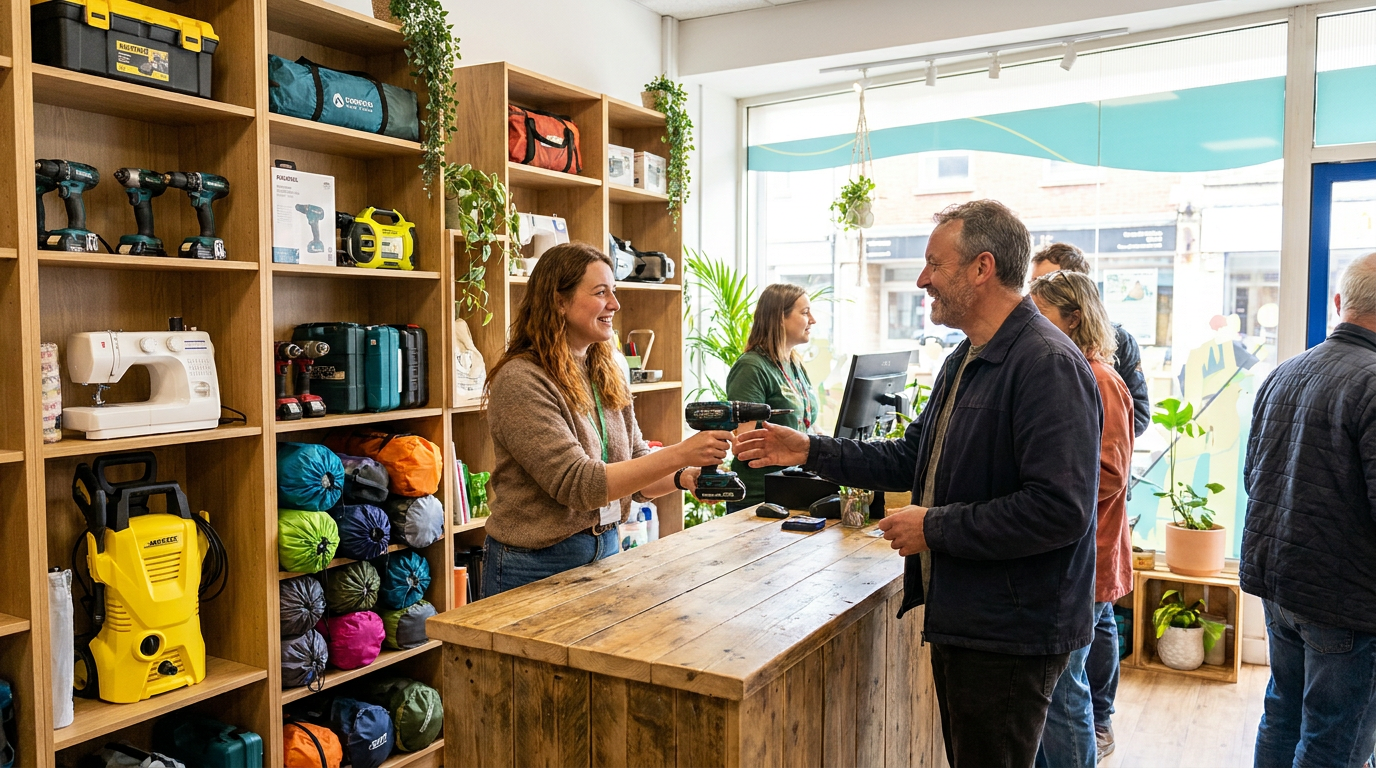
Enter the "Library of Things" (LoT). Operating on the same fundamental principle as a traditional public library, these community hubs allow residents to borrow physical goods instead of buying them. From sewing machines and pressure washers to digital projectors and pasta makers, LoTs are turning underutilized consumer goods into shared community assets.[1][4]
The movement has grown from a fringe sustainability concept into a robust global network. As of recent counts, there are over 2,000 formally established lending libraries worldwide, alongside countless informal neighborhood sharing groups. They range from volunteer-run sheds in rural towns to sophisticated, app-enabled smart lockers in major urban centers.[1][7]
The mechanics of borrowing are straightforward. Members typically pay a small annual fee—often sliding-scale or pay-what-you-can, starting around $20 to $50—which grants them access to hundreds or thousands of items. A user can reserve a hedge trimmer online, pick it up for a weekend project, and return it when finished, entirely bypassing the hardware store.[1][5]
The economic relief for households is substantial. For the cost of purchasing a single mid-tier power drill, a resident can access an entire catalog of equipment for a year. In the United Kingdom, the Library of Things network estimates that its platform has saved members over £6 million collectively, with 84% of users reporting noticeable financial benefits.[2]

Beyond individual savings, the model democratizes access to resources. Affordable access to tools lowers the barrier to entry for DIY home repairs, community garden projects, and even small business ventures. In affordable housing communities, integrated lending libraries ensure that residents can maintain and improve their spaces without taking on high-interest debt to buy equipment.[1][5]
The environmental mathematics are equally compelling. The modern consumer economy relies on a linear "make-use-dispose" pipeline that extracts raw materials, generates manufacturing emissions, and ultimately fills landfills. By maximizing the lifespan and utility of a single item across dozens of users, sharing libraries directly disrupt this cycle.[3][4]
The modern consumer economy relies on a linear "make-use-dispose" pipeline that extracts raw materials, generates manufacturing emissions, and ultimately fills landfills.
A single carpet cleaner shared among fifty households eliminates the manufacturing footprint of forty-nine identical machines. In one year alone, a UK-based LoT network recorded over 10,000 borrows, diverting an estimated 64 tonnes of waste and preventing 124 tonnes of carbon dioxide emissions associated with new production.[3]
Yet, the most profound impact of the Library of Things may be social rather than financial or environmental. In an age of increasing social isolation, these hubs act as natural gathering spaces. When neighbors come together to borrow items, they inevitably share advice, skills, and local knowledge.[2][7]
Many lending libraries have evolved into comprehensive community centers, hosting "Repair Cafes" where volunteers help residents fix broken electronics or mend torn clothing. This collaborative environment fosters a sense of belonging; surveys show that 65% of LoT members feel prouder of and better connected to their neighborhoods after joining.[2][6]

Setting up a Library of Things requires navigating several distinct operational models. The most traditional is the "share shop" or shed, often entirely volunteer-run and open a few days a week. While highly community-oriented, this model can struggle with limited hours and volunteer burnout.[6]
To increase accessibility, some cities are adopting self-service lockers placed in existing public libraries, shopping centers, or transit hubs. These automated kiosks allow residents to pick up and drop off items outside of standard working hours, requiring significantly less square footage and daily staffing.[6]
The most comprehensive model is the combined share-and-repair hub, which pairs the lending library with a dedicated makerspace. Organizations like the Edinburgh Tool Library and the Buffalo Tool Library operate out of larger facilities, offering not just the tools themselves, but the physical space and expert guidance needed to complete complex projects.[5][6]

Despite their success, sustaining a Library of Things is not without friction. Securing affordable, long-term physical space is a persistent hurdle, particularly in gentrifying urban areas. Furthermore, the logistics of maintaining, cleaning, and repairing heavily used inventory require dedicated labor, which can strain organizations reliant solely on grant funding or volunteers.[1][6]
Liability and safety also require careful management. Lending out power tools or heavy machinery necessitates clear safety waivers, user education, and rigorous maintenance schedules to ensure equipment remains safe for the next borrower.[1]
Nevertheless, the trajectory of the sharing economy suggests that collaborative consumption is moving from the margins to the mainstream. As municipalities increasingly recognize the value of circular economy initiatives, many are beginning to offer public grants or subsidized spaces to help these libraries take root.[2][4]
The Library of Things represents a profound shift in how communities define wealth and abundance. By proving that access can be just as satisfying as ownership, these neighborhood hubs are quietly building a more resilient, connected, and sustainable future—one borrowed power drill at a time.[7]
How we got here
1976
The Columbus Tool Library opens, marking one of the earliest recorded community tool lending programs.
1979
The Berkeley Public Library in California launches its tool lending program, which remains the longest continuously running system.
2014
Modern 'Library of Things' platforms begin testing self-service and digital-first borrowing models in the UK.
2024
Research identifies over 2,000 formally established lending libraries operating globally.
Viewpoints in depth
Circular Economy Advocates
Environmental groups view sharing libraries as a critical tool for reducing industrial emissions.
For sustainability advocates, the primary value of a Library of Things lies in its ability to disrupt the linear economy. Every time a community shares a power drill or a carpet cleaner, it directly reduces the demand for raw material extraction, manufacturing energy, and international shipping. By maximizing the lifespan of a single product across dozens of users, these groups argue that sharing libraries are a highly effective, localized climate solution that keeps usable materials out of landfills.
Community Organizers
Local leaders emphasize the social cohesion and equitable access created by shared resources.
Community organizers focus on the human element of the sharing economy. They point out that low-income households are disproportionately burdened by the need to purchase expensive, single-use tools for home maintenance. By providing affordable access to these items, lending libraries act as engines for economic equity. Furthermore, organizers highlight that the physical spaces housing these libraries naturally evolve into social hubs, combating urban isolation by bringing neighbors together for skill-sharing and mutual aid.
Sustainable Enterprise Developers
Platform builders focus on creating viable, scalable business models to make sharing frictionless.
Those working on the operational side of the movement argue that for sharing to truly rival retail, it must be just as convenient as buying online. These developers are focused on solving the logistical bottlenecks of volunteer burnout and limited hours by introducing smart lockers, integrated digital inventory systems, and partnerships with local governments. Their goal is to prove that a regenerative, circular business model can be financially self-sustaining while still prioritizing community impact.
What we don't know
- How traditional retail hardware and appliance brands will adapt their business models if community sharing reaches mass adoption.
- Whether local governments will begin subsidizing these libraries as standard public utilities, similar to book libraries.
- How the lifespan of consumer-grade tools will hold up under the high-frequency use of a community lending environment.
Key terms
- Circular Economy
- An economic system aimed at eliminating waste and the continual use of resources by reusing, repairing, and recycling existing materials.
- Collaborative Consumption
- A model of economic sharing where consumers rent or borrow goods rather than purchasing them outright.
- Makerspace
- A collaborative workspace inside a school, library, or separate facility for making, learning, exploring, and sharing, often equipped with specialized tools.
Frequently asked
What kind of items can I borrow from a Library of Things?
Inventories vary by location but typically include power tools, gardening equipment, camping gear, carpet cleaners, sewing machines, and party supplies.
How are these libraries funded?
Most rely on a mix of affordable annual membership fees, community grants, local government support, and volunteer labor.
What happens if an item breaks while I am using it?
Normal wear and tear is expected and handled by the library's repair volunteers. Most libraries have clear policies and liability waivers for significant damage or misuse.
Sources
Source coverage
7 outlets
3 viewpoints surfaced







[1]ShareableCommunity Organizers
Library of Things Toolkit: How to start and grow a LoT in your community
Read on Shareable →[2]Doughnut Economics Action LabSustainable Enterprise Developers
Library of Things: Making borrowing better than buying
Read on Doughnut Economics Action Lab →[3]CityChangersCircular Economy Advocates
The Sharing Economy vs the Circular Economy
Read on CityChangers →[4]Upstream SolutionsCircular Economy Advocates
Join the REAL sharing economy with a Library of Things
Read on Upstream Solutions →[5]The Tool Library BuffaloCommunity Organizers
Putting our tools to work in the community
Read on The Tool Library Buffalo →[6]Library of Things UKSustainable Enterprise Developers
Choosing the right model for your neighbourhood
Read on Library of Things UK →[7]Factlen Editorial Team
Synthesis by Factlen editorial team
Read on Factlen Editorial Team →
Every angle. Every day.
Get community stories with full source coverage and perspective breakdowns delivered to your inbox.