
WeChat Begins Testing 'Xiaowei' AI Assistant, Reshaping the Super-App Ecosystem
Tencent has launched beta testing for a native AI assistant within WeChat, allowing users to control the app, book services, and make payments through natural language commands.
By Factlen Editorial Team
- Platform Ecosystem Developers
- Viewing the AI assistant as a foundational operating system for future digital services.
- Hardware Manufacturers
- Seeing cross-platform AI protocols as a way to break down digital walled gardens.
- Market & Strategy Analysts
- Focusing on the defensive necessity of AI integration to maintain super-app dominance.
What's not represented
- · Data Privacy Advocates
- · Competing Super-App Operators
Why this matters
WeChat's integration of a native AI assistant marks a fundamental shift in how billions of people interact with digital services. By allowing AI to autonomously navigate apps, book services, and make payments, Tencent is laying the groundwork for a future where users simply state their intent, and the 'super-app' handles the execution.
Key points
- Tencent has launched small-scale beta testing for 'Xiaowei,' a native AI assistant embedded directly into WeChat.
- The assistant can execute tasks across WeChat's ecosystem, including booking rides and ordering food via Mini Programs.
- A new 'Agent-to-Agent' protocol allows third-party smartphone AI assistants to securely interact with WeChat.
- WeChat Pay introduced an 'AI Exclusive Card' to handle automated transactions securely.
- The move is seen as a critical evolution to protect the super-app model in the age of autonomous AI.
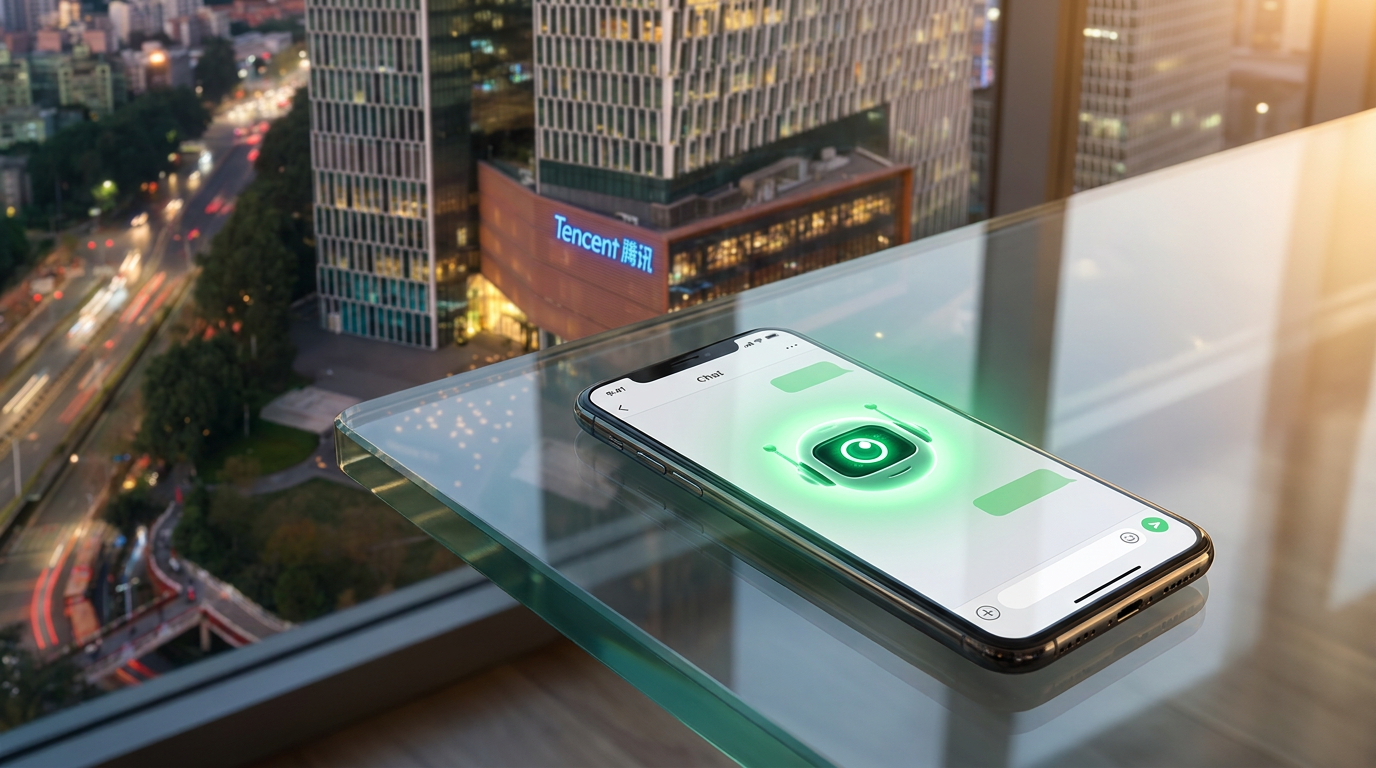
WeChat, the digital lifeblood of 1.4 billion users, is undergoing its most significant architectural shift in a decade. Tencent has officially begun small-scale beta testing of "Xiaowei," a native artificial intelligence assistant embedded directly into the super-app's core interface.[1][3]
The rollout, confirmed by Tencent in late June 2026, places a green-eyed robot icon in the upper-left corner of the WeChat home screen for selected users. Clicking it opens a dialogue box that accepts both text and voice commands, transforming how users navigate the platform's sprawling ecosystem.[3][4]
Unlike standard chatbot wrappers that simply generate text, Xiaowei is deeply integrated into WeChat's native functions. It can adjust app settings, draft and send messages to contacts, post updates to WeChat Moments, and initiate voice calls—all through natural language prompts.[3][4]
The true power of Xiaowei lies in its ability to orchestrate tasks across WeChat's millions of "Mini Programs." Users can instruct the assistant to order food delivery, book medical appointments, or hail a ride, and the AI will autonomously navigate the respective third-party services to complete the request.[1][3]

This seamless execution is achieved through internal API calls rather than simulated screen clicks. When Xiaowei triggers a payment or launches a mini-program, it communicates directly with the app's native interfaces, resulting in dramatically lower latency and higher success rates compared to external automation tools.[4]
To support this new paradigm, Tencent has rolled out specialized infrastructure for developers. The WeChat Open Platform now allows third-party mini-programs to integrate with the AI ecosystem, enabling the assistant to automatically analyze page structures and execute commands without requiring developers to rewrite their code entirely.[4]
Major Chinese tech players are already on board. E-commerce giant JD.com, local services platform Meituan, travel agency Trip.com, and ride-hailing service DiDi have all announced deep integration with the WeChat AI ecosystem, ensuring that Xiaowei can handle complex, multi-step consumer requests from day one.[3]
Handling autonomous transactions requires a new approach to financial security. In tandem with the assistant's launch, WeChat Pay introduced an "AI Exclusive Card." This feature provides dedicated, ring-fenced payment capabilities specifically for AI agents, ensuring that automated purchases remain secure and within user-defined limits.[3]

Handling autonomous transactions requires a new approach to financial security.
Under the hood, Xiaowei is powered by a pragmatic mix of artificial intelligence models. Rather than relying solely on massive, computationally expensive systems for every query, Tencent routes complex reasoning tasks to its proprietary Hunyuan large language models, while handling lighter, routine commands with highly efficient open-source models like DeepSeek.[1][4]
Perhaps the most surprising development is Tencent's willingness to open its historically guarded walled garden. The company is partnering with major Chinese smartphone manufacturers—including Vivo, Honor, Xiaomi, and Oppo—to allow their native device AI assistants to interact with WeChat.[2][5]
This cross-platform collaboration relies on a newly developed "Agent-to-Agent" (A2A) protocol. The A2A framework establishes secure boundaries, allowing a smartphone's built-in voice assistant to send a message or initiate a WeChat call without gaining unrestricted access to the user's private chat history or personal data.[5][7]
The strategic shift has been highly anticipated by the market. When rumors of the AI agent's impending launch first surfaced in early June, Tencent's stock surged by 10.5% in a single day—its largest one-day gain since 2022—adding roughly $53 billion to the company's market capitalization.[6][7]

Industry analysts view the introduction of Xiaowei as a necessary evolution for the super-app model. As AI agents become the primary interface through which users interact with digital services, platforms built on closed, manual-navigation ecosystems face a reckoning over their long-term relevance.[2]
By embedding an agent at the core of its architecture, WeChat is positioning itself not just as an application, but as an "AI operating system." The platform aims to be the foundational layer where artificial intelligence seamlessly connects user intent with real-world fulfillment.[3]
However, the transition is not without hurdles. Regulatory compliance remains a significant factor in China's tightly controlled tech sector, and the expanded data exposure surface created by cross-app AI execution will require rigorous privacy safeguards and ongoing security audits.[6]

How we got here
Dec 2025
ByteDance releases a technical preview of its Doubao mobile assistant, which WeChat briefly blocks over security concerns.
April 2026
Tencent announces plans to launch Hunyuan 3.0 and build a dedicated WeChat AI agent.
Early June 2026
Reports of WeChat's AI agent testing leak, sending Tencent's stock up 10.5%.
June 8, 2026
WeChat Open Platform releases guidelines for developers to access the AI ecosystem.
June 20, 2026
WeChat officially begins small-scale grayscale testing of the 'Xiaowei' native AI assistant.
Viewpoints in depth
Platform Ecosystem Developers
Viewing the AI assistant as a foundational operating system for future digital services.
For developers within the WeChat ecosystem, Xiaowei represents a paradigm shift from manual user navigation to intent-driven automation. By allowing the AI to directly invoke Mini Programs via native APIs, developers can bypass traditional user interface friction. This camp argues that the 'AI Exclusive Card' and direct API access will dramatically increase conversion rates for e-commerce and local services, effectively turning WeChat into an AI operating system rather than just a messaging app.
Hardware Manufacturers
Seeing cross-platform AI protocols as a way to break down digital walled gardens.
Smartphone makers like Vivo, Honor, and Xiaomi view the Agent-to-Agent (A2A) protocol as a critical victory. Historically, super-apps like WeChat operated as closed ecosystems, limiting the utility of a phone's built-in voice assistant. Hardware manufacturers argue that secure, standardized A2A communication allows their native AI to finally execute meaningful tasks—like sending messages or booking rides—without compromising user privacy, making device-level AI significantly more valuable to the end consumer.
Market & Strategy Analysts
Focusing on the defensive necessity of AI integration to maintain super-app dominance.
Financial and strategy analysts frame Tencent's move as a necessary defensive maneuver. As standalone AI agents become more capable of executing complex tasks across the web, the traditional super-app model risks obsolescence if it remains a closed, manual-entry walled garden. This perspective emphasizes that by embedding an agent at the core of its architecture, Tencent is protecting its 1.4 billion-user moat and ensuring that WeChat remains the primary digital interface for Chinese consumers.
What we don't know
- When the Xiaowei AI assistant will be rolled out to the general public beyond the current beta test.
- How regulatory bodies in China will oversee the automated execution of cross-app tasks and data sharing.
- Whether the AI assistant will eventually be made available to WeChat users outside of mainland China.
Key terms
- Agent-to-Agent (A2A) Protocol
- A secure communication standard allowing different AI assistants to exchange data and execute tasks without exposing underlying user privacy.
- Mini Programs
- Lightweight applications built inside a larger super-app that don't require separate downloads, used for services like e-commerce and ride-hailing.
- Grayscale Testing
- A software release strategy where a new feature is rolled out gradually to a small percentage of users before a full public launch.
- Super-app
- A single application that integrates a multitude of services, such as messaging, social media, and mobile payments, into one platform.
Frequently asked
How do users access the new AI assistant?
Users in the beta test see a green-eyed robot icon in the upper-left corner of the WeChat main interface, which opens a text and voice dialogue box.
Can the AI assistant make payments on my behalf?
Yes, WeChat Pay has launched a dedicated 'AI Exclusive Card' to securely handle automated transactions initiated by the agent within user-defined limits.
Does this mean third-party AI can read my WeChat messages?
Tencent claims the Agent-to-Agent (A2A) protocol establishes secure boundaries to execute cross-app tasks without compromising user privacy or exposing chat history.
Which third-party services are integrated?
Major Chinese platforms including JD.com, Meituan, Trip.com, and DiDi have announced integration with the WeChat AI ecosystem.
Sources
Source coverage
7 outlets
3 viewpoints surfaced







[1]BloombergMarket & Strategy Analysts
Tencent Tests AI Assistant for Its Super App WeChat in China
Read on Bloomberg →[2]TechWire AsiaMarket & Strategy Analysts
WeChat is letting AI agents in for the first time
Read on TechWire Asia →[3]PANewsPlatform Ecosystem Developers
WeChat AI Assistant 'Xiao Wei' Launches in Small-Scale Grayscale Testing
Read on PANews →[4]IT HomePlatform Ecosystem Developers
WeChat Native AI Assistant 'Xiaowei' Soft Launch: Control WeChat with a Single Sentence
Read on IT Home →[5]Caixin GlobalHardware Manufacturers
Tencent Opens WeChat to Handset Makers' AI Assistants
Read on Caixin Global →[6]Financial TimesMarket & Strategy Analysts
Tencent tests AI agent for WeChat super-app
Read on Financial Times →[7]South China Morning PostHardware Manufacturers
Tencent opens WeChat to third-party AI assistants from Huawei, Xiaomi
Read on South China Morning Post →

More in technology
See all 7 stories →Smart Home Tech
The End of the Walled Garden: How Matter 1.6 and Edge AI Are Rewiring the Smart Home
6 sources

Lunar Base
How Autonomous 3D Printers Will Build Humanity's First Lunar Base
7 sources

Digital Identity
The Password is Finally Obsolete: The Evidence Behind the Shift to Passkeys
8 sources
The Cozy Web
The Resurgence of the 'Cozy Web': How Digital Third Places Are Replacing Mega-Platforms
9 sources

Every angle. Every day.
Get technology stories with full source coverage and perspective breakdowns delivered to your inbox.