
UP-NS Merger Filing Reveals Over 1,000 Projected Layoffs and 500 Transfers Amid Regulatory Review
Unsealed regulatory filings for the $85 billion Union Pacific and Norfolk Southern merger project significant workforce reductions, heavily impacting regional administrative hubs. The disclosures come as the Surface Transportation Board weighs whether the historic transcontinental tie-up meets strict enhanced-competition rules.
By Noor Saidi

- Rival Carriers & Shippers
- The merger fails to meet the legal threshold for enhancing competition and threatens to destabilize the industry.
- Labor Organizations
- While some unions embrace the unprecedented job security guarantees, others fear the broader economic fallout and administrative cuts.
- Merging Railroads
- A unified coast-to-coast network is necessary to compete with the trucking industry and modernize the supply chain.
Summary
- Union Pacific and Norfolk Southern are seeking regulatory approval for an $85 billion merger to create a coast-to-coast rail network.
- The Surface Transportation Board ordered the unsealing of job data, revealing over 1,000 projected layoffs and 500 transfers.
- The job cuts will heavily impact administrative staff in regional hubs like Atlanta, which will lose hundreds of positions.
- The railroads have offered a 'Jobs for Life' guarantee to unionized field workers, splitting the labor movement's response.
- Rival carriers like BNSF are petitioning to block the deal, arguing it fails to meet the legal threshold for enhancing competition.
The common misconception about corporate megamergers is that the regulatory review is a mere formality and the resulting job cuts are kept hidden behind closed doors until the ink dries. But the proposed $85 billion tie-up between Union Pacific and Norfolk Southern—a historic deal that would create America's first true coast-to-coast railroad—is actively dismantling that assumption. Rather than sailing through a quiet approval process, the merger has triggered a highly public regulatory battle where the human and economic costs are being laid bare. At the center of this fight is the Surface Transportation Board (STB), an agency that operates under entirely different rules than standard antitrust regulators, forcing the railroads to prove their deal serves the public interest before a single track is joined.[1][3]
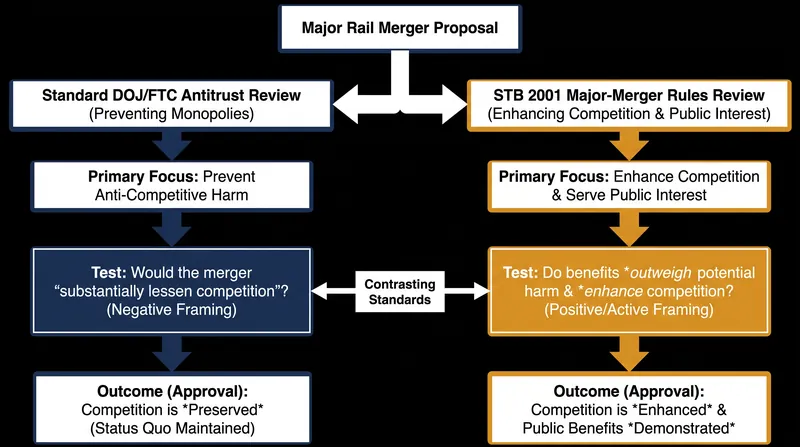
To understand why this merger is facing such intense scrutiny, one must look at the unique regulatory mechanism governing the U.S. rail industry. In most sectors, the Department of Justice or the Federal Trade Commission serves as the primary gatekeeper, evaluating whether a merger violates antitrust laws by creating a monopoly. The freight rail industry, however, answers to the STB. Following a wave of disruptive rail consolidations in the 1990s, the STB adopted stringent new major-merger rules in 2001. Under this framework, it is not enough for railroads to simply prove their merger will not harm the market; they must affirmatively demonstrate that the transaction will enhance competition and provide benefits that could not be achieved otherwise.[1][6]
This elevated burden of proof explains why no Class I railroad has attempted a transcontinental merger of this scale in a quarter-century. The proposed Union Pacific Transcontinental Railroad would span more than 50,000 route miles across 43 states, linking the Atlantic and Pacific coasts under a single corporate banner. While the railroads argue this seamless network will drastically improve supply chain efficiency, critics warn it could trigger a final wave of consolidation, forcing remaining competitors like BNSF and CSX to merge simply to survive. For a local manufacturer or agricultural producer relying on rail to move raw materials, the stakes are existential: fewer railroads historically mean fewer routing options and less leverage to negotiate shipping rates.[1][5]
The transparency of the STB's process was recently tested over the issue of workforce reductions. When Union Pacific and Norfolk Southern submitted their revised merger application in April 2026, they classified detailed data regarding job impacts as highly confidential. A coalition of labor unions immediately petitioned the STB to unseal the documents, arguing that the public and the workers had a right to know the true cost of the consolidation. In a significant July 2026 ruling, the STB sided with the unions, ordering the railroads to make the employment data public and rejecting the argument that the information was commercially sensitive.[3]
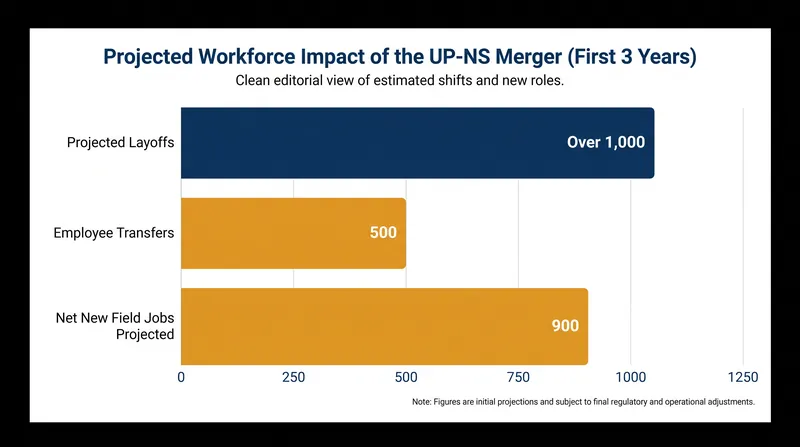
The unsealed filings revealed the concrete human impact behind the corporate synergies. According to the data, the combined entity projects more than 1,000 layoffs and 500 employee transfers over the first three years of integration. For regional hubs, these abstract corporate maneuvers translate into immediate local realities. In Atlanta, the current headquarters of Norfolk Southern, the filings indicate that hundreds of positions will be phased out or relocated to the new combined headquarters in Omaha, Nebraska. While Atlanta will remain a regional operating center, the shift fundamentally alters the economic anchor of the region's logistics sector, forcing local workers to choose between uprooting their families or finding new careers.[1][2]
The unsealed filings revealed the concrete human impact behind the corporate synergies.
In an effort to mitigate the labor backlash, Union Pacific and Norfolk Southern have introduced what they describe as an unprecedented "Jobs for Life" guarantee for their unionized field employees. Under this pledge, any union employee working at either railroad on the closing date is guaranteed employment for the remainder of their career. The companies assert that all merger-related efficiencies in the field will be achieved solely through natural attrition—such as retirements—rather than forced layoffs. They also project that the merged network will eventually add roughly 900 net new union jobs to handle an anticipated surge in freight volume.[4][8]
This guarantee has fractured the labor movement's response to the merger. Six national rail unions, representing thousands of workers, have signed on to the agreement, viewing it as the most secure employment arrangement offered to an industrial workforce in a generation. However, other powerful factions, including the International Brotherhood of Teamsters, remain fiercely opposed. Critics within the labor coalition argue that the job protections are contingent on the merger's approval and do not cover the hundreds of administrative and headquarters staff facing immediate redundancy. The divide highlights the complex trade-offs local union chapters must navigate when weighing long-term job security against immediate regional job losses.[1][8]
Beyond the workforce, the mechanics of the merger hinge on how it will affect the businesses that actually put freight on the rails. Union Pacific and Norfolk Southern argue that a single-line coast-to-coast network will save shippers $3.5 billion annually by eliminating the delays and interchange fees that occur when cargo is handed off between different railroads in cities like Chicago. To appease regulators and skeptical customers, the railroads recently filed supplemental commitments, including an expanded "Committed Gateway Pricing" program. This mechanism is designed to lock in rates and preserve routing options for customers, effectively functioning as thousands of individual haulage agreements rolled into a single enforceable pledge.[4][6]
Despite these assurances, rival railroads and industry shipper groups remain unconvinced. BNSF Railway, a primary competitor, has formally petitioned the STB to deny the amended application entirely. BNSF argues that the proposed pricing protections cover less than one percent of total rail traffic and fail to meet the STB's strict enhanced-competition threshold. Shipper coalitions have echoed these concerns, contending that the merger's promised benefits rely heavily on overly optimistic projections of converting highway truck traffic to rail. For a local business owner managing a supply chain, this regulatory debate is not academic; if the merger reduces competition without delivering the promised efficiencies, the resulting increase in freight costs will inevitably be passed down to consumers.[5][6]
The regulatory timeline remains in a state of suspended animation. The STB has accepted the revised application as complete enough for consideration but has placed the proceeding in abeyance while it reviews the supplemental information submitted in late July. Until the Board issues a ruling on the enhanced competition claims and establishes a formal procedural schedule, the entire freight industry is left waiting. What is abundantly clear is that the path to America's first transcontinental railroad will not be a quiet boardroom transaction, but a highly public, multi-year battle over the fundamental structure of the nation's supply chain.[3][6]
Definitions
- Class I Railroad
- The largest freight railroad companies in North America, defined by operating revenue. There are currently six Class I freight railroads operating in the United States.
- Surface Transportation Board (STB)
- The federal regulatory agency responsible for overseeing freight rail rates, service disputes, and industry mergers.
- Committed Gateway Pricing (CGP)
- A proposed pricing mechanism designed to lock in shipping rates and preserve routing options for customers whose freight travels across multiple rail networks.
- Transcontinental Railroad
- A continuous rail network that spans the entire width of a continent. Currently, freight moving from coast to coast in the U.S. must be handed off between eastern and western railroads.
Chronology
July 2025
Union Pacific and Norfolk Southern announce an $85 billion merger agreement to create America's first transcontinental railroad.
December 2025
The railroads file their initial 7,000-page merger application with the Surface Transportation Board.
January 2026
The STB rejects the initial application as incomplete, sending the railroads back to the drawing board.
April 2026
An amended application is filed, classifying detailed job impact data as highly confidential.
July 2026
The STB orders the railroads to unseal the employment data, revealing over 1,000 projected layoffs, while the companies submit supplemental customer protections.
Analysis by camp
The Merging Railroads' View
A unified coast-to-coast network is necessary to compete with the trucking industry and modernize the supply chain.
Union Pacific and Norfolk Southern argue that the U.S. economy requires a seamless transcontinental rail option to reduce transit times and lower costs. They point to the projected $3.5 billion in annual shipper savings and the environmental benefit of shifting millions of truckloads off the highways. From their perspective, the "Jobs for Life" guarantee proves they are committed to their workforce, and the merger's efficiencies will ultimately create more union jobs by capturing new market share.
The Rival Carriers' View
The merger fails to meet the legal threshold for enhancing competition and threatens to destabilize the industry.
Competitors like BNSF Railway contend that the merger is inherently anti-competitive and violates the STB's strict 2001 major-merger rules. They argue that the proposed customer protections, such as Committed Gateway Pricing, are inadequate and cover only a fraction of affected traffic. Rival carriers warn that approving this deal would force the remaining Class I railroads into defensive mergers, ultimately leaving the United States with only two massive rail conglomerates and drastically reducing options for shippers.
The Divided Labor View
While some unions embrace the unprecedented job security guarantees, others fear the broader economic fallout and administrative cuts.
The labor movement is split on the merger's merits. Six national rail unions support the deal, viewing the "Jobs for Life" pledge as a historic victory that protects field workers from automation and consolidation-driven layoffs. Conversely, organizations like the Teamsters and local chapters representing administrative staff strongly oppose the transaction. They point to the unsealed STB filings revealing over 1,000 projected layoffs and 500 forced relocations—particularly impacting headquarters staff in cities like Atlanta—as proof that the corporate synergies will be paid for by the workforce.
Questions & answers
What is the Surface Transportation Board (STB)?
The STB is an independent federal agency that regulates the economics of the freight rail industry. Unlike standard antitrust regulators, the STB requires merging railroads to prove their deal actively enhances competition.
How many jobs will be lost in the merger?
Unsealed regulatory filings project over 1,000 layoffs and 500 employee transfers over the first three years, heavily impacting administrative and headquarters staff in cities like Atlanta.
What is the 'Jobs for Life' guarantee?
It is a pledge by Union Pacific and Norfolk Southern that any unionized field employee working on the closing date will be guaranteed employment for their entire career, with workforce reductions handled through natural attrition.
Why are rival railroads opposing the deal?
Competitors like BNSF argue the merger fails to meet the STB's requirement to enhance competition, claiming the proposed pricing protections are inadequate and that the deal could trigger a final wave of industry consolidation.
Limits of the evidence
- Whether the STB will ultimately determine that the expanded customer pricing protections meet the 2001 major-merger rules.
- How the Department of Justice will formally weigh in on the competitive impacts during the STB's public-interest review.
- If a successful merger will immediately trigger a defensive tie-up between remaining giants like BNSF and CSX.
Significance
This merger will fundamentally reshape the American supply chain, dictating the shipping costs for everything from agricultural goods to consumer electronics. For regional economies and thousands of rail workers, the regulatory outcome will directly determine local job security and corporate investment for the next decade.
Sources
Source coverage
8 outlets
3 viewpoints surfaced







[1]The American ProspectLabor Organizations
Regulators Finally Poised to Review America's Biggest Rail Merger
Read on The American Prospect →[2]WSB-TVLabor Organizations
Hundreds of jobs being cut as Atlanta-based Norfolk Southern merges with Union Pacific
Read on WSB-TV →[3]Trains.comLabor Organizations
STB orders UP and NS to make detailed employment data public
Read on Trains.com →[4]Union PacificMerging Railroads
Union Pacific and Norfolk Southern Affirm Strength of Merger Application and Offer Unprecedented New Customer Assurances
Read on Union Pacific →[5]BNSF RailwayRival Carriers & Shippers
Opposing the UP-NS Proposed Merger: How to Make Your Voice Heard
Read on BNSF Railway →[6]Railway SupplyRival Carriers & Shippers
BNSF Asks STB to Deny Amended UP-NS Merger Application
Read on Railway Supply →[7]ForbesMerging Railroads
The Union Pacific-Norfolk Southern Merger And The Division Of Labor
Read on Forbes →[8]Washington ExaminerLabor Organizations
The Teamsters' choice on the UP-NS merger comes sharply into focus
Read on Washington Examiner →
Comments


Every angle. Every day.
Get automotive stories with full source coverage and perspective breakdowns delivered to your inbox.