
Panama Canal Fees Hit $4M to Skip Queue Amid Iran Conflict and Climate Disruption
A container ship paid a record $4 million at auction to bypass a 10-day backlog at the Panama Canal. The unprecedented fee highlights a severe shipping bottleneck driven by rerouted traffic from the Middle East and an El Niño-induced drought.
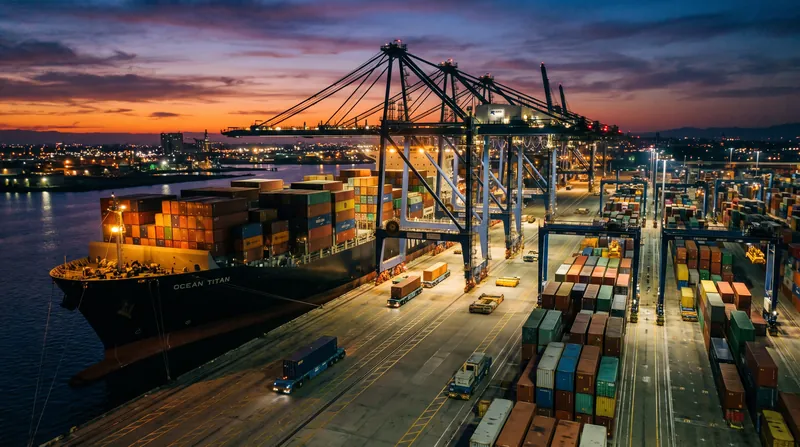
A single container ship just paid $4 million to skip the waiting line at the Panama Canal. The record-breaking auction bid by the Seaspan Benefactor highlights a severe bottleneck in global shipping, driven by two simultaneous crises: the closure of the Strait of Hormuz due to the Iran conflict, and an intensifying El Niño drought that is draining the canal's freshwater reserves.[1][4]
The seven-figure fee is not an isolated anomaly. Daily auctions for August transit slots through the canal's commonly used locks have averaged $1.1 million, a staggering 16-fold increase compared to the same period last year. For the larger Neopanamax locks, individual auction prices have recently surged as high as $3.78 million.[2][5]
While most vessels secure passage through advance reservations at a fixed rate, roughly 30 percent of the canal's traffic relies on daily auctions. These auctions allow shipowners without a booked slot to bid for expedited transit rather than languishing at anchor. Starting bids typically open at $15,000 for smaller cargo vessels and $55,000 for the largest ships, but desperation has transformed the system into a multimillion-dollar bidding war.[1][6]
The practical stakes for consumers and businesses are immediate. When shipping companies pay millions in unexpected transit fees, those costs inevitably cascade down the supply chain. The canal handles roughly 6 percent of global maritime trade, serving as a vital artery for electronics, agricultural products, and manufactured goods moving between Asia and the United States.[3]
The primary catalyst for the current congestion is the escalating conflict involving Iran, which has effectively closed the Strait of Hormuz. The strait typically handles around 20 percent of global oil and gas flows. With that route compromised, energy and chemical cargoes that previously crossed the Middle East are now hunting for westbound paths, flooding the Panama Canal queue.[3][8]
The disruption has forced Asian buyers to source more crude oil and petroleum products from the U.S. Gulf Coast. This shift in trade flows has dramatically increased demand for shipments through the Panama Canal, transforming it into the world's emergency detour. Vessels are currently facing wait times of roughly 10 days, the worst backlog on the Pacific-to-Atlantic run since May.[1][4]
Compounding the geopolitical crisis is a severe environmental challenge. The Panama Canal relies entirely on freshwater from artificial lakes, primarily Gatun Lake, to operate its complex system of locks. However, an intensifying El Niño weather pattern has brought abnormal warming to the Pacific Ocean, triggering a prolonged drought in the region.[1][2]
Water levels in Gatun Lake are currently dropping steadily during a period—May to December—when they should be rising. The reservoir is now sitting below its historical average for the 1965–2022 period, and forecasts indicate it will fall further in the coming months. Because each transit requires millions of gallons of freshwater, the canal cannot operate at full capacity when water is scarce.[2][6]
In response to the drought, the Panama Canal Authority has implemented strict draft restrictions. A ship's draft is the depth of its hull below the waterline; lowering the maximum allowable draft means vessels must carry less cargo to ride higher in the water. Over the past month, the authority announced three consecutive draft reductions for the Panamax locks, capping them at 47.5 feet by early September.[8]
These draft restrictions create a compounding economic penalty. Shipping companies are not only paying exorbitant auction fees to secure a transit slot, but they are also moving less cargo per voyage. This dual squeeze of higher costs and lower capacity threatens to erode profit margins for logistics operators and inflate prices for end consumers.[2][7]
The $4 million bid by the Seaspan Benefactor—a 10,100 TEU container ship—illustrates the brutal calculus of modern logistics. Unlike tankers, container ships operate on fixed schedules with tightly coordinated berth windows, rail appointments, and feeder connections. Missing a transit slot doesn't just delay one vessel; it breaks an entire loop of interconnected supply chains, making a multimillion-dollar premium a rational business decision.[1][4]
What remains uncertain is how long this dual crisis will persist. The geopolitical situation in the Middle East shows no immediate signs of resolution, meaning the Strait of Hormuz could remain restricted indefinitely. Simultaneously, the El Niño climate pattern is expected to continue suppressing rainfall in Panama, suggesting that draft restrictions and inflated auction fees could become the new baseline for global shipping.[3][5]
Key points
- A container ship paid a record $4 million at auction to skip a 10-day waiting line at the Panama Canal.
- Average auction prices for August transit slots have surged to $1.1 million, a 16-fold increase year-over-year.
- The closure of the Strait of Hormuz due to the Iran conflict has forced energy and chemical cargoes to reroute through Panama.
- An intensifying El Niño drought is simultaneously causing Gatun Lake water levels to drop, severely limiting canal capacity.
What we don’t know
- How long the Strait of Hormuz will remain effectively closed to commercial traffic due to the Iran conflict.
- Whether the El Niño weather pattern will persist long enough to force even more severe draft restrictions by the end of the year.
- The exact threshold at which auction prices will become entirely prohibitive for standard container shipping.
How we got here
February 2026
U.S. and Israel-led bombardment of Iran begins, effectively closing the Strait of Hormuz to commercial traffic.
May 2026
Gatun Lake water levels begin an abnormal steady decline during what is typically the rainy season, driven by El Niño.
July 2026
Auction prices for Neopanamax locks surge past $3.7 million as rerouted energy vessels flood the canal queue.
August 2026
The Seaspan Benefactor container ship pays a record $4 million at auction to secure a transit slot.
September 2026
Scheduled implementation of the Panama Canal Authority's third consecutive draft restriction, capping Panamax vessels at 47.5 feet.
- Shipping Operators
- Willing to pay massive premiums to maintain schedule integrity and avoid cascading delays.
- Canal Authority & Panama
- Balancing the economic windfall of high auction prices with the physical limitations of a climate-stressed freshwater system.
- Global Importers & Markets
- Facing inflated freight costs and delayed deliveries as geopolitical rerouting forces them into a congested chokepoint.
Perspectives this story doesn't cover
- End consumers facing downstream price inflation
- Environmental groups monitoring the ecological impact of El Niño on Gatun Lake
Sources
Source coverage
8 outlets
3 viewpoints surfaced








- [1]The GuardianGlobal Importers & Markets
Panama canal fees soar due to Iran war and El Niño as ship 'pays $4m to jump queue'
Read on The Guardian → - [2]Business StandardGlobal Importers & Markets
Explained: Why shipping costs through Panama Canal are soaring now
Read on Business Standard → - [3]TRT WorldCanal Authority & Panama
Panama Canal fees spike to $4M as Hormuz disruption reshapes global shipping routes
Read on TRT World → - [4]FlexportShipping Operators
The queue math
Read on Flexport → - [5]AzerNewsGlobal Importers & Markets
Panama Canal transit fees surge amid Middle East conflict
Read on AzerNews → - [6]Sweden HeraldShipping Operators
Sailing through the Panama Canal has reached a record high
Read on Sweden Herald → - [7]Maritime BriefsShipping Operators
Seaspan Benefactor Pays $4 Million to Expedite Panama Canal Transit
Read on Maritime Briefs → - [8]ChosunCanal Authority & Panama
Hormuz closure and El Niño squeeze Panama Canal, ships pay $4 million to pass
Read on Chosun →

More in Business
See all →Corporate Valuation
How Discounting Future Cash Flows to Present Value Determines the True Worth of an Investment
6 sources

Trade Theory
Opportunity Cost Ratios: Why Absolute Advantage Fails to Predict Global Trade Flows
10 sources
Monetary Policy
The 0.5 and 1.5 Coefficients: How the Taylor Rule Sets the Federal Funds Rate Target
6 sources
African Markets
Dangote Refinery IPO Aims to Raise $1.5 Billion in Landmark African Market Listing
4 sources
Comments
Every angle. Every day.
Get Business stories with full source coverage and perspective breakdowns, free every day.