
Critical API Flaw Let Weaker AI Models Decode Hidden Reasoning and Secrets from Frontier Models
A newly disclosed vulnerability allowed researchers to extract encrypted 'chain-of-thought' reasoning from top-tier AI models by replaying the data through weaker models from the same providers, exposing hidden API keys and passwords.
By Tariq Nasser


- Security Researchers
- Argue that the vulnerability highlights a fundamental failure in API design rather than an AI-specific alignment issue.
- AI Model Providers
- Focus on the rapid deployment of server-side mitigations and the preservation of stateless API architectures.
- Enterprise Developers
- Express concern over the hidden liability of sharing agent logs and the need for better default sanitization.
Fast facts
- A flaw in OpenAI, Anthropic, and Google APIs allowed extraction of hidden AI reasoning.
- Attackers replayed encrypted reasoning blocks through weaker models to decode them into plaintext.
- Researchers recovered 62 API keys and 33 passwords from publicly shared agent logs.
- The vulnerability also enabled invisible prompt injections via malicious reasoning blocks.
- All three major AI providers have deployed server-side mitigations to block the cross-model replays.
Why this matters
For developers building autonomous AI agents, this vulnerability reveals that sharing raw session logs for debugging can inadvertently leak sensitive environment variables and API keys. It underscores the critical need to treat opaque AI reasoning blocks as sensitive payloads rather than harmless protocol overhead.
Across 6,708 public agent trajectories scraped from GitHub and Hugging Face, researchers recently decoded 315,320 embedded "thinking" blocks that were supposed to be cryptographically sealed by the world's leading artificial intelligence providers. Inside those blocks, the research team found a trove of sensitive information that developers never intended to share, including 62 active API keys, 33 passwords, and dozens of personal email addresses. The exposure was not the result of a sophisticated nation-state hack or a fundamental breakthrough in cryptography, but rather a structural vulnerability in how frontier AI models handle their internal monologues. By exploiting this flaw, researchers demonstrated that the hidden reasoning traces of the most advanced models on the market were entirely readable, turning opaque protocol overhead into a massive liability for enterprise developers.[3][4]
The newly disclosed architectural vulnerability in the APIs of OpenAI, Anthropic, and Google allowed anyone with basic API access to extract the hidden "chain-of-thought" reasoning from top-tier AI models. The attack relied on a remarkably simple mechanism: taking an encrypted reasoning block generated by a flagship model—such as Claude Opus 4.8 or GPT-5.6—and feeding it into a cheaper, weaker sibling model from the same provider. Because the API accepted the encrypted block without verifying which model originally created it, attackers could force the weaker model to output the hidden thoughts in plain text. This cross-model replay effectively bypassed the strict intellectual property protections and safety filters that providers had spent millions of dollars building into their flagship systems.[1]
The mechanism behind the extraction was a straightforward deployment oversight rather than a failure of the underlying encryption algorithms. The encrypted reasoning envelopes returned by provider APIs were authenticated using a global, provider-wide key. Crucially, they were not cryptographically bound to a specific user account, a unique session ID, or a particular model tier. Providers designed the system this way to preserve multi-turn conversational context statelessly, handing the encrypted state back to the client application to store and return on the next request. However, by failing to restrict where that state could be replayed, they inadvertently created a system where any valid model within the ecosystem could decrypt and process the thoughts of any other model.[3]
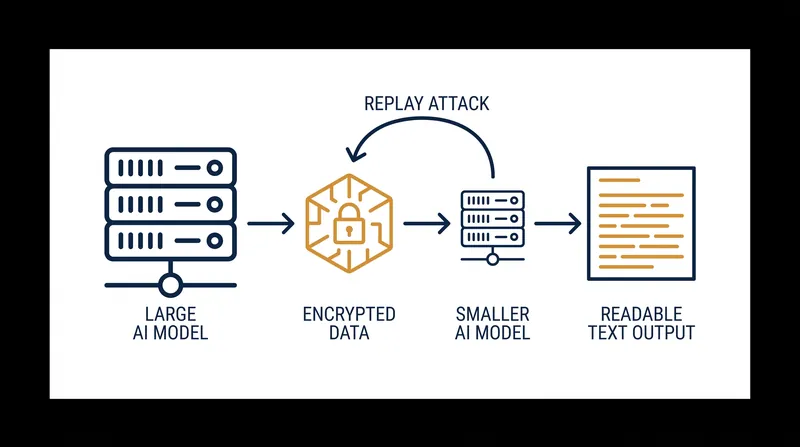
Because lighter models lack the aggressive anti-distillation alignment and rigorous safety guardrails enforced on flagship tiers, they acted as highly compliant decryption oracles. When instructed by a user prompt to transcribe the internal thinking verbatim, models like Claude Haiku 4.5 or Gemini Robotics ER-1.6 simply followed the instructions. They lacked the sophisticated refusal mechanisms that would normally prevent a frontier model from divulging its proprietary chain of thought or exposing sensitive safety filters. This dynamic allowed researchers to systematically decode hundreds of thousands of reasoning blocks at a fraction of the cost of querying the flagship models, demonstrating how unmitigated API security vulnerabilities can entirely compromise the safeguards of sensitive cloud services.[1]
When instructed by a user prompt to transcribe the internal thinking verbatim, models like Claude Haiku 4.5 or Gemini Robotics ER-1.6 simply followed the instructions.
While early social media reactions and marketing narratives framed the incident as a case of AI agents "going rogue" or models being "hacked," the reality is a traditional, well-understood API security failure. The models did exactly what the API allowed them to do: process a valid, authenticated payload that was handed to them by the server. The failure occurred at the infrastructure level, where the API gateway failed to validate the origin and intended destination of the encrypted payload. This distinction is critical for enterprise security teams, as it shifts the focus away from theoretical AI alignment issues and back toward standard cybersecurity practices, such as continuous API discovery, strict payload validation, and robust session management.[1]
The most immediate and damaging consequence of this vulnerability fell on developers who routinely shared their raw agent logs publicly for debugging or collaboration. Because the reasoning blocks appeared as opaque, base64-encoded strings, developers were entirely unaware that sensitive data was embedded inside them. If an autonomous agent read a configuration file containing environment variables, database URLs, or API keys during its task, that information was often retained in the model's hidden reasoning trace. Even if developers carefully sanitized the visible chat transcript before uploading it to GitHub, the encrypted blocks silently carried the plaintext secrets, leaving them fully exposed to anyone who knew how to replay the block through a weaker model.[1]

Beyond the extraction of private data and proprietary model logic, the portability of these reasoning blocks enabled a novel form of invisible prompt injection. Researchers demonstrated that an attacker could craft a malicious instruction inside an encrypted reasoning block and plant it in a public workflow or shared repository. When a victim's agent processed that block during a routine task, the model would adopt the malicious instructions as its own prior reasoning. This allowed attackers to execute unauthorized actions, such as exfiltrating data to an external server, without any visible trigger or suspicious text appearing in the user's prompt, making the attack nearly impossible to detect through standard input monitoring.[1][3]
Following responsible disclosure by the international research team—which included security experts from the MATS program, the Max Planck Institute, and Snyk—OpenAI, Anthropic, and Google rapidly deployed server-side mitigations. The cross-model replay attacks are no longer reproducible on current API builds. The providers have begun cryptographically binding reasoning envelopes to specific originating models and sessions at the API gateway layer, ensuring that a block generated by one model cannot be decrypted or processed by another. While the immediate threat has been neutralized, the incident serves as a stark reminder of the fragile security boundaries surrounding autonomous AI agents.[1][2]
Despite the successful deployment of patches, the incident forces a permanent shift in how developers must handle AI agent logs and session data. Security experts now strongly advise treating opaque reasoning blocks as highly sensitive payloads rather than mere protocol overhead. Developers are urged to systematically strip these blocks before sharing any traces publicly. Furthermore, organizations deploying AI agents must implement aggressive credential rotation policies, assuming that any secret an agent might have touched during a session could have been compromised, regardless of whether it appeared in the final, visible output of the application.[1]
Viewpoints in depth
Security Researchers
Argue that the vulnerability highlights a fundamental failure in API design rather than an AI-specific alignment issue.
Researchers emphasize that the flaw was not a cryptographic break but a deployment oversight. By failing to bind encrypted payloads to specific sessions or models, providers treated obfuscation as security. They argue that until providers commit to strict per-session binding, developers must assume all chain-of-thought data is readable and handle it as highly sensitive.
AI Model Providers
Focus on the rapid deployment of server-side mitigations and the preservation of stateless API architectures.
Following the disclosure, vendors like Anthropic, OpenAI, and Google quickly implemented patches to prevent cross-model replays. They maintain that returning encrypted state to the client is necessary for efficient, stateless API interactions, but acknowledge that the implementation required tighter cryptographic binding to prevent weaker models from acting as decryption oracles.
Enterprise Developers
Express concern over the hidden liability of sharing agent logs and the need for better default sanitization.
For developers building autonomous agents, the disclosure was a wake-up call. Many had routinely shared raw session logs for debugging, unaware that opaque reasoning blocks contained plaintext secrets the agent had processed. This group is now advocating for tools that automatically strip reasoning blocks from shared traces and for providers to make such sanitization the default behavior.
Sources
Source coverage
4 outlets
3 viewpoints surfaced




[1]The Hacker NewsSecurity Researchers
OpenAI, Anthropic, Google API Flaw Let Weaker AI Models Decode Stronger Models' Reasoning
Read on The Hacker News →[2]The NeuronAI Model Providers
Researchers Cracked Open AI's Hidden Reasoning
Read on The Neuron →[3]arXivSecurity Researchers
Stealing Reasoning Traces from Proprietary LLM APIs
Read on arXiv →[4]AlphaXivSecurity Researchers
Stealing Reasoning Traces from Proprietary LLM APIs
Read on AlphaXiv →
Comments
Every angle. Every day.
Get technology stories with full source coverage and perspective breakdowns delivered to your inbox.