
15-Year-Old 'Craime' Wins Street Fighter 6 at Esports World Cup, Becoming Youngest Champion
Chilean prodigy Jaime 'Craime' Bustos defeated veteran Japanese player Hibiki to claim the Street Fighter 6 title at the 2026 Esports World Cup. The 15-year-old's historic victory earned him $250,000 and secured a crucial 1,000 Club Championship points for Team Falcons.
By Xia Wu

- New Generation Advocates
- Argue that modern training tools and online netcode have democratized fighting games, allowing teenagers to bypass traditional arcade gatekeeping.
- Veteran FGC Traditionalists
- Maintain that while young players have immaculate execution, long sets and high-pressure offline environments still favor the mental fortitude built over decades.
- Esports Industry Analysts
- Focus on the organizational impact, viewing the acquisition of young talent as the most efficient way to secure Club Championship points.
Summary
- 15-year-old Jaime 'Craime' Bustos won the Street Fighter 6 tournament at the Esports World Cup in Paris.
- The Chilean prodigy defeated 30-year-old Japanese veteran Hibiki 5-2 in the grand final.
- Craime earned $250,000 in prize money and qualified for Capcom Cup 13.
- The victory awarded Team Falcons 1,000 Club Championship points, pushing them to the top of the standings.
- Craime eliminated both the EVO 2026 and EVO Japan 2026 champions during his knockout bracket run.
The fighting game community has always been a collision of generations. On one side stand the arcade-era veterans who built the scene on muscle memory, instinct, and thousands of hours in dimly lit cabinets. On the other side is the new wave of 'pad players'—online-bred prodigies who treat frame data like a math equation and execute flawless combos on standard console controllers. At the Esports World Cup 2026 in Paris, that generational divide was laid bare on the grandest stage in Street Fighter 6 history. The tension wasn't just about who would take home the trophy; it was about whose methodology would dictate the future of the sport.[3]
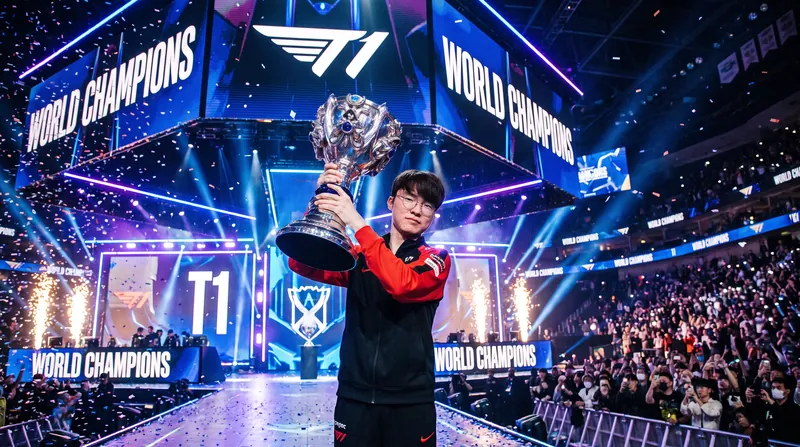
The resolution to that tension arrived in the form of a 15-year-old. In the grand final, 30-year-old Japanese veteran Hibiki—riding a miraculous Cinderella run from the Last Chance Qualifier—faced off against Jaime 'Craime' Bustos, a Chilean teenager representing Team Falcons. In a definitive 5-2 victory, Craime dismantled the veteran, becoming the youngest Esports World Cup champion in the tournament's history.[1][3][6]
The victory wasn't just a personal milestone; it carried massive structural weight. Craime walked away with $250,000 in prize money and a guaranteed qualification for the prestigious Capcom Cup 13. More importantly for the broader Esports World Cup ecosystem, his win secured 1,000 Club Championship points for Team Falcons, catapulting the organization back to the top of the overall cross-game standings.[1][2][4]
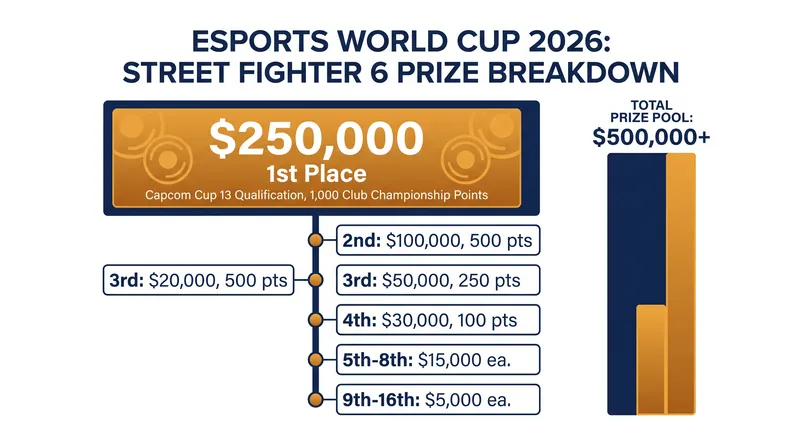
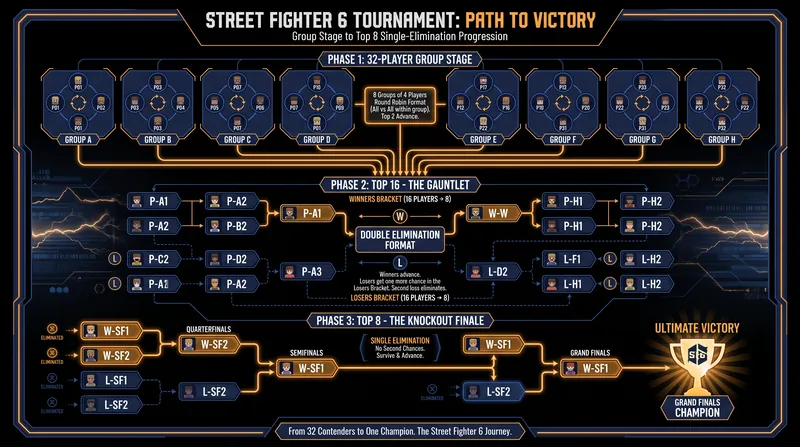
To understand the magnitude of the 15-year-old's run, one has to look at the grueling mechanism of the Street Fighter 6 bracket. The tournament began with a 32-player Group Stage, where competitors fought in best-of-five sets. Only the top 16 advanced to a secondary group phase, which then filtered down to a ruthless top-eight single-elimination knockout bracket. There was no room for a slow start, and every dropped round pushed players closer to elimination.
Craime navigated this gauntlet with terrifying efficiency. He dropped only a single game in the initial group stage, signaling early on that he was a legitimate threat. But the true test came in the knockout rounds, where he faced a murderer's row of established global champions. In the quarterfinals, he squared off against Saul Leonardo 'MenaRD' Mena II, the EVO 2026 champion and a two-time Capcom Cup winner. Craime dispatched the titan 5-3, proving his group stage dominance was no fluke.[4][6]
The momentum continued in the semifinals against Eisuke 'Yamaguchi' Yamaguchi, the EVO Japan 2026 champion. Despite Yamaguchi's pedigree and aggressive playstyle, Craime's clinical defensive mechanics and immaculate spacing neutralized the Japanese star's offense. The result was another 5-3 victory that punched the teenager's ticket to the grand final and sent shockwaves through the Paris Expo Porte de Versailles.[3][6]
The momentum continued in the semifinals against Eisuke 'Yamaguchi' Yamaguchi, the EVO Japan 2026 champion.
Hibiki, his final opponent, represented the ultimate veteran resilience. As the oldest player in the top eight, Hibiki had survived a grueling 269-competitor Last Chance Qualifier just to reach the main event. When Hibiki took the opening round of the grand final, the crowd braced for a grueling back-and-forth set. It looked, for a brief moment, as though decades of offline experience might finally trump youthful reflexes.[3][6]
But Craime's defining trait throughout the tournament was his ability to read and adjust to his opponents' game plans in real-time. He systematically slowed down Hibiki's offense and forced unfavorable approaches. Crucially, Craime ruthlessly capitalized on 'burnout' states—a core Street Fighter 6 mechanic where a player exhausts their Drive Gauge, leaving them highly vulnerable to chip damage and extended stun. Once Hibiki was in burnout, Craime's pressure became suffocating.[3]
After dropping that first round, Craime recovered to completely dominate the rest of the series. His mastery of spacing kept Hibiki at bay, allowing the Chilean teenager to close out the set 5-2 and hoist the trophy. 'I'm very, very happy for my win, and I can't wait to go back to Chile,' Craime said in the aftermath of his historic victory. 'This isn't just me, this is everyone who comes in and helps me.'[1][4]
Craime's victory is the culmination of a multi-year surge for the South American fighting game scene, and Chile in particular. He follows directly in the footsteps of his friend and rival, Derek 'Blaz' Blaz, who reached the grand finals of the Esports World Cup Street Fighter 6 tournament last year. Blaz, also 15 at the time, suffered a heartbreaking reverse sweep that left the region hungry for redemption.[3][5]
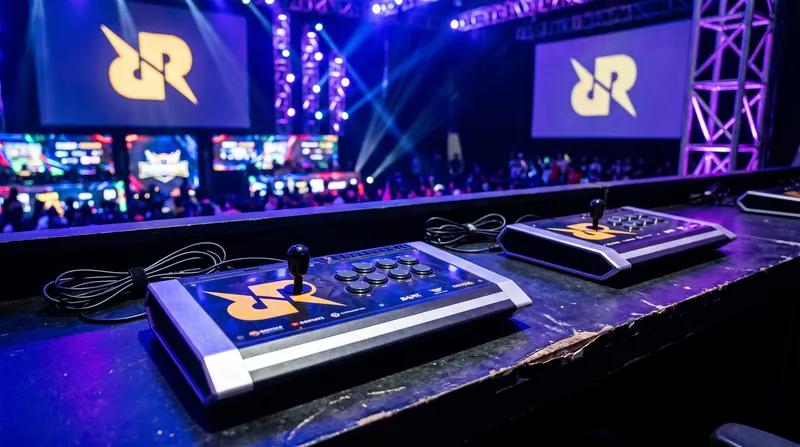
By securing the championship, Craime effectively avenged his countryman's loss and proved that the region's talent pool is both deep and sustainable. When asked about the undeniable strength of the Chilean scene, Craime simply noted, 'You know, in Chile, there's the power.' It is a power that the traditional fighting game strongholds of Japan and North America can no longer afford to underestimate.[5]
For Team Falcons, the timing of the championship was critical. The organization had experienced an uncharacteristically slow start to their Esports World Cup campaign. Craime's massive 1,000-point injection stabilized their position in the Club Championship race, giving them a vital buffer against surging rivals and proving the value of investing in young, high-ceiling talent across diverse gaming titles.[3][4]
As the dust settles in Paris, the fighting game landscape looks fundamentally different. The old guard is not gone, but the barrier to entry has been permanently shattered by a generation that learned the game through flawless online netcode and hyper-efficient training modes rather than arcade cabinets. At 15 years old, Craime is not just the youngest champion in tournament history—he is the definitive blueprint for the future of the sport.[5]
Definitions
- FGC
- The Fighting Game Community, referring to the grassroots and professional scene surrounding competitive fighting games.
- Burnout
- A state in Street Fighter 6 where a player exhausts their Drive Gauge, leaving them highly vulnerable to chip damage and extended stun.
- Rollback Netcode
- A networking technology that predicts player inputs to create a seamless, lag-free online multiplayer experience.
- Last Chance Qualifier (LCQ)
- An open tournament held just before a main event, allowing uninvited players a final opportunity to earn a spot in the bracket.
- Reverse Sweep
- Winning a match series after losing all the initial games required for the opponent to secure the victory.
Chronology
2024
Jaime 'Craime' Bustos makes his competitive debut in the fighting game scene.
August 2025
Chilean pro Derek 'Blaz' Blaz reaches the EWC Street Fighter 6 grand finals at age 15 but loses in a reverse sweep.
July 2026
30-year-old veteran Hibiki survives a 269-player Last Chance Qualifier to reach the EWC main event.
August 1, 2026
Craime defeats Hibiki 5-2 to become the youngest EWC champion in history.
Analysis by camp
The New Generation's View
Younger players argue that modern tools have democratized fighting games.
For the new wave of competitors, Craime's victory is proof that the traditional arcade apprenticeship is obsolete. Modern fighting games feature rollback netcode for lag-free online practice and highly granular training modes that allow players to mathematically dissect frame data. This technological shift enables teenagers to accumulate the equivalent of decades of arcade experience in just a few years, leveling the playing field against established veterans.
The Veterans' Perspective
Older competitors maintain that offline experience still dictates high-pressure situations.
While acknowledging the mechanical brilliance of the new generation, veteran players emphasize that tournament stamina and adaptability remain the domain of experience. Hibiki's run from a 269-player Last Chance Qualifier to the grand final is cited as evidence that mental fortitude, built over years of offline competition, is still required to navigate the grueling reality of a major international bracket.
Team Falcons' Strategy
Esports organizations view young talent as the key to cross-title dominance.
From an organizational standpoint, investing in 15-year-old prodigies is a highly efficient strategy for the Esports World Cup's Club Championship format. By scouting and securing high-ceiling players before they reach their peak market value, teams like Falcons can harvest massive point bounties across niche titles, ensuring their dominance on the overall organizational leaderboard without overspending on established superstars.
Questions & answers
Who is the youngest Esports World Cup champion?
Jaime 'Craime' Bustos, a 15-year-old from Chile, became the youngest champion by winning the Street Fighter 6 tournament.
How much prize money did Craime win?
Craime secured $250,000 in prize money for his first-place finish.
Who did Craime defeat in the grand final?
He defeated 30-year-old Japanese veteran Hibiki, who had advanced to the main event through a 269-player Last Chance Qualifier.
What is the Club Championship in the EWC?
It is a cross-game organizational leaderboard where esports teams earn points based on their players' tournament placements.
Limits of the evidence
- Whether Craime can maintain his dominance at the upcoming Capcom Cup 13 against a wider global field.
- How the influx of teenage champions will affect the long-term sponsorship and viewership demographics of the FGC.
Significance
A 15-year-old dismantling established veterans for a $250,000 prize signals a permanent generational shift in competitive gaming. It proves that modern online training tools have completely erased the traditional arcade-era barrier to entry, allowing teenagers to master complex mechanics faster than ever before.
Sources
Source coverage
6 outlets
3 viewpoints surfaced






[1]Hindustan TimesEsports Industry Analysts
Esports World Cup 2026: 15-year-old Street Fighter 6 sensation Craime becomes youngest champion in tournament history
Read on Hindustan Times →[2]RediffEsports Industry Analysts
Fifteen-year-old Chilean Jaime 'Craime' Bustos has become the youngest-ever Esports World Cup champion
Read on Rediff →[3]Esports World CupNew Generation Advocates
Jaime "Craime" Bustos Claims Street Fighter 6 at Esports World Cup 2026 Title
Read on Esports World Cup →[4]Indian ExpressEsports Industry Analysts
Esports World Cup 2026: 15-year-old Chilean prodigy Craime becomes youngest champion in EWC history
Read on Indian Express →[5]GamesBeatNew Generation Advocates
15-year-old Chilean wins Street Fighter 6 championship at Esports World Cup
Read on GamesBeat →[6]HiptherEsports Industry Analysts
Team Falcons' 15-year-old Craime wins Street Fighter 6 at Esports World Cup 2026
Read on Hipther →
Comments

Every angle. Every day.
Get gaming esports stories with full source coverage and perspective breakdowns delivered to your inbox.