
Under-Keel Water Acceleration Drops Hydrodynamic Pressure: Why Moving Ships Squat Toward the Seabed in Shallow Channels
When a vessel navigates through restricted waterways, the accelerated flow of water beneath its hull creates a localized low-pressure zone that pulls the ship downward. This hydrodynamic phenomenon dictates speed limits and cargo capacities in every major port and canal worldwide.
By Hunter Cole
In short
- The squat effect is driven by Bernoulli's principle, where water accelerating beneath a ship's hull in a confined space creates a low-pressure zone that pulls the vessel downward.
- The magnitude of the sinkage scales with the square of the ship's speed, making strict velocity limits the primary defense against shallow-water groundings.
- A ship's hull shape dictates its squat behavior, with full-form bulk carriers typically trimming by the bow and fine-form container ships trimming by the stern.
The 1992 grounding of the passenger vessel Queen Elizabeth 2 off the coast of Massachusetts remains a defining case study in maritime hydrodynamics. Traveling at 25 knots through Vineyard Sound, the liner's bow sank 2.7 feet below its stationary draft. This unexpected sinkage caused the massive ship to strike uncharted rocks.[5]
But while the QE2 was pulled downward by raw open-water speed, modern 400-meter bulk carriers navigating restricted waterways face a different mathematical reality. These massive vessels can experience even more extreme sinkage at half the speed. The geometry of a dredged channel multiplies the pressure drop beneath their hulls, turning slow transits into precise balancing acts.[3]
This phenomenon is known as the ship squat effect. It is not a mechanical failure, a structural flaw, or a cargo loading error. Instead, it is an inescapable consequence of fluid dynamics that dictates how every major port, river, and canal in the world operates.[4]
The Physics of Hydrodynamic Pressure
When a vessel moves forward, it pushes a massive volume of water ahead of its bow. To maintain the continuity of flow, that displaced water must rush back down the sides and underneath the flat bottom of the hull. This return flow fills the void left behind the ship's stern.[1]
In deep ocean waters, this return flow happens easily in three dimensions. However, when a ship enters a shallow channel, the vertical space between the keel and the seabed becomes severely restricted. The same volume of water is forced to squeeze through a much smaller cross-sectional area.
According to Bernoulli's principle, as a fluid's velocity increases, its pressure must proportionally decrease to conserve total energy. The accelerated water rushing under the restricted keel creates a localized low-pressure zone. This pressure differential effectively sucks the massive steel hull downward toward the seabed.[3]
Calculating the Sinkage Multipliers
The magnitude of this hydrodynamic sinkage is not linear; it scales with the square of the ship's speed. Doubling a vessel's velocity quadruples the squat effect. This mathematical reality makes speed the single most critical variable a harbor pilot can control when navigating shallow waters.[3]
Hull shape also dictates how a ship settles into this pressure trough, quantified by a metric called the block coefficient. Full-form vessels like oil tankers and bulk carriers, which have a block coefficient greater than 0.7, push a massive wall of water. These ships typically trim forward, grounding at the bow.[3]
Conversely, fine-form vessels such as container ships and passenger liners have sharper bows that slice through the water more efficiently. These ships tend to experience the greatest pressure drop further aft. As a result, they generally trim by the stern as they squat into the water.[1]
Channel Geometry and the Blockage Factor
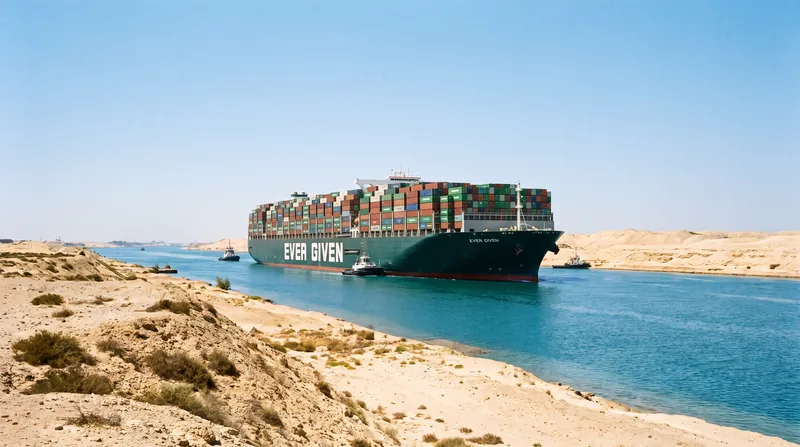
The physical boundaries of the waterway itself act as a powerful multiplier for the squat effect. In a dredged trench or a narrow transit route like the Suez Canal, the water is restricted not just vertically by the seabed, but horizontally by the channel banks.[2]
This combined restriction is expressed as the blockage factor, which compares the submerged cross-section of the ship to the total cross-section of the waterway. A high blockage factor forces water to accelerate even faster under the hull. This drastically increases the pressure drop and the resulting sinkage.[3]
Using empirical maritime formulas, a 225-meter bulk carrier traveling at 12 knots in a channel with a depth-to-draft ratio of 1.14 can experience a theoretical squat of 2.52 meters. This massive 8.2-foot sinkage easily consumes standard safety margins if not rigorously calculated before transit.[3]
The Compounding Danger of Bank Effect
The hydrodynamic forces that pull a ship downward also operate laterally when a vessel navigates off-center in a restricted canal. This asymmetrical pressure distribution is known as the bank effect. It frequently compounds the dangers of squat during complex harbor approaches.
As the hull moves closer to one side of a dredged channel, the water flow on that side is forced through a tighter space than the water on the open side. The resulting velocity spike drops the pressure on the near side. This differential sucks the ship's stern toward the bank.
"Due to the reduction of the section where the water can flow, the flow around the ship is also accelerated," notes a hydrodynamic study from the Polytechnic University of Catalonia. "The increase in the water speed under the ship causes a decrease in pressure and as a result, a vertical force is applied."[6]
When bank effect and squat effect combine, the vessel experiences a complex twisting force that degrades steering authority. Pilots must apply constant counter-rudder to maintain a straight heading. This increases drag and further complicates the under-keel clearance calculations required to keep the ship afloat.
Navigational Defenses and Port Regulations
To prevent catastrophic groundings, international maritime bodies enforce strict under-keel clearance protocols. The World Association for Waterborne Transport Infrastructure (PIANC) guidelines advise maintaining a minimum dynamic clearance of 10 percent of the ship's draft in shallow waters.[3]
Port authorities enforce these margins through mandatory speed limits in approach channels. By capping transit speeds, regulators ensure that the velocity-squared multiplier of the squat effect remains within the dredged tolerances of the waterway, protecting both the ship and the infrastructure.[2]
Modern bridge teams also rely on continuous monitoring technology, utilizing forward-looking echo sounders and dynamic draft gauges. These systems provide real-time feedback on the actual distance to the seabed. This allows pilots to reduce speed immediately if the pressure drop exceeds predictions.[3]
The Economic Stakes of Under-Keel Clearance
The squat effect forces a constant trade-off between cargo capacity and transit windows. Every additional centimeter of draft allows a bulk carrier to load roughly 100 extra tons of cargo. This incentivizes operators to push their stationary draft as close to the channel limits as possible.
However, maximizing stationary draft leaves less room to absorb hydrodynamic squat once the vessel is underway. If a ship loads too heavily, it must transit at a crawl to avoid grounding. This delays supply chains and increases fuel consumption due to the heightened resistance of shallow-water drag.[4]
However, maximizing stationary draft leaves less room to absorb hydrodynamic squat once the vessel is underway.
Ultimately, mastering the squat effect is what allows global trade to function at its current scale. Without precise calculations of how moving water alters pressure, the modern mega-ships that anchor the global economy would be unable to safely navigate the shallow coastal shelves where the world's ports reside.[4]
How we did this
- Method
- normalisation of squat magnitude across different hull forms and speeds using empirical maritime formulas
- What we found
- While high-speed passenger vessels experience extreme squat primarily due to the velocity-squared multiplier, slower full-form bulk carriers in confined channels achieve more than triple the draft sinkage at half the speed, proving that channel geometry and block coefficient are significantly more dangerous than raw speed.
- What we worked from
- QE2 high-speed open-water squat: 2.7 feet at 25 knots — UK Marine Accident Investigation Branch
- Bulk carrier restricted-channel theoretical squat: 2.52 meters (8.2 feet) at 12 knots — ShipSmith
- Limits of this analysis
- Empirical formulas provide baseline estimates; actual hydrodynamic squat varies continuously with localized bathymetry, transient wave patterns, and tidal currents.
Jargon, explained
- Squat Effect
- A hydrodynamic phenomenon where a ship moving through shallow water sinks deeper and changes trim due to a localized drop in water pressure beneath the hull.
- Under-Keel Clearance (UKC)
- The vertical distance between the lowest point of a ship's hull and the seabed.
- Bernoulli's Principle
- A principle of fluid dynamics stating that an increase in the speed of a fluid occurs simultaneously with a decrease in its pressure.
- Block Coefficient
- A metric describing how 'full' or box-like a ship's hull is, which determines whether the vessel will trim forward or backward when squatting.
- Blockage Factor
- The ratio of a ship's submerged cross-sectional area to the total cross-sectional area of the channel it is navigating.
Common questions
Does the squat effect occur in deep ocean waters?
Yes, but the effect is negligible. In deep water, the displaced water can easily flow around the hull in all directions, preventing the extreme velocity increases and pressure drops that cause severe sinkage.
Why do some ships squat at the bow while others squat at the stern?
It depends on the hull's shape. Full-form vessels like oil tankers push more water at the front, causing the greatest pressure drop and sinkage at the bow. Fine-form vessels like container ships slice through the water, shifting the lowest pressure zone to the stern.
Can a ship get stuck even if the water is deeper than its stationary draft?
Absolutely. If a ship enters a channel with only a small clearance margin and travels too fast, the hydrodynamic pressure drop can pull the hull downward by several meters, causing it to strike the seabed.
Competing readings
Naval Architects' View
Vessel designers view squat as a geometric challenge to be mitigated through hull optimization.
For naval architects, the squat effect is an inescapable variable in the initial design phase of any large vessel. They focus heavily on the block coefficient—the ratio of the hull's underwater volume to a rectangular block of the same overall dimensions. By refining the curvature of the bow and stern, designers attempt to smooth the acceleration of water under the keel, reducing the severity of the pressure drop. However, they acknowledge that physics imposes a hard limit; a hull designed to carry 200,000 tons of iron ore cannot be shaped like a speedboat, meaning commercial vessels will always remain highly susceptible to shallow-water sinkage.
Port Authorities' View
Regulators treat hydrodynamic sinkage as a primary threat to channel integrity and enforce strict transit parameters.
Harbor masters and canal authorities manage the squat effect through rigid operational constraints rather than vessel design. Because they cannot control the block coefficient of the ships entering their waters, they control the velocity-squared multiplier by enforcing strict speed limits. Organizations like the Suez Canal Authority mandate specific transit speeds and require a minimum static under-keel clearance before a vessel is cleared to enter. From the regulatory perspective, a grounding caused by squat not only damages the vessel but threatens to block vital economic arteries, making conservative safety margins non-negotiable.
Commercial Operators' View
Shipping companies navigate the constant tension between maximizing cargo payloads and maintaining safe dynamic draft.
For the companies operating the vessels, the squat effect represents a direct tax on profitability. Every centimeter of under-keel clearance required by port authorities is a centimeter of draft that cannot be used to load cargo. Operators rely on advanced empirical formulas and real-time draft monitoring to calculate exactly how much their ships will sink at a given speed, allowing them to load the maximum permissible tonnage. They view squat not just as a safety hazard, but as a complex optimization problem where precise hydrodynamic calculations yield millions of dollars in additional freight revenue.
- Naval Architects
- Vessel designers view squat as a geometric challenge to be mitigated through hull optimization.
- Port Authorities
- Regulators treat hydrodynamic sinkage as a primary threat to channel integrity and enforce strict transit parameters.
- Commercial Ship Operators
- Shipping companies navigate the constant tension between maximizing cargo payloads and maintaining safe dynamic draft.
Perspectives this story doesn't cover
- Dredging Contractors
- Marine Insurance Underwriters
Sources
Source coverage
6 outlets
3 viewpoints surfaced






- [1]Perth HydroNaval Architects
Predicting transcritical ship squat
Read on Perth Hydro → - [2]Ocean EngineeringPort Authorities
Squat effect on ships in shallow water
Read on Ocean Engineering → - [3]ShipSmithCommercial Ship Operators
Understanding Squat Effect: Why Ships 'Sink' in Shallow Waters
Read on ShipSmith → - [4]Factlen Editorial TeamCommercial Ship Operators
Synthesis by Factlen editorial team
Read on Factlen Editorial Team → - [5]UK Marine Accident Investigation BranchPort Authorities
Report of the Investigation into the Grounding of Passenger Vessel Queen Elizabeth 2
Read on UK Marine Accident Investigation Branch → - [6]Polytechnic University of CataloniaNaval Architects
Accurate prediction of hydrodynamic forces opposing a ship displacement in restricted waterways
Read on Polytechnic University of Catalonia →
More in Transportation
See all →Maritime Safety
Water Density Differentials and a 1/48th Draft Margin: How the 1966 Load Line Convention Calculates Plimsoll Freeboard Marks
9 sources
Maritime Law
How the York-Antwerp Rules and the Principle of General Average Distribute Maritime Cargo Losses
7 sources
Aviation Safety
Embraer and Honeywell Open Crisis Room After GPS Fault Disrupts Global E2 Jet Fleet
7 sources
Maritime Trade
Suez Canal Authority Declares Waterway Safe, Reports 57% Revenue Surge in August as Traffic Recovers
4 sources
Comments
Every angle. Every day.
Get Transportation stories with full source coverage and perspective breakdowns, free every day.