
Water Density Differentials and a 1/48th Draft Margin: How the 1966 Load Line Convention Calculates Plimsoll Freeboard Marks
The 1966 International Convention on Load Lines uses a precise 1/48th draft margin to account for water density differentials between marine and inland environments. This geometric framework dictates the exact cargo capacity a commercial vessel can safely carry across varying global routes.

In short
- The 1966 Load Line Convention established a universal geometric system to prevent commercial vessels from overloading and losing reserve buoyancy.
- Because freshwater is less dense than seawater, ships sink deeper in inland waterways, requiring a mandatory 1/48th draft margin.
- This density differential forces large cargo vessels to shed thousands of tons of potential capacity when navigating to freshwater ports.
On April 5, 1966, maritime delegates gathered in London to sign a treaty that reduced the physics of buoyancy to a single geometric symbol painted on a ship's hull. The International Convention on Load Lines established strict geometric limits on how deep a commercial vessel can safely sit in the water.[1]
That symbol, universally known as the Plimsoll mark, dictates the exact freeboard a vessel must maintain to survive ocean transit. The 1966 agreement standardized these calculations globally, replacing a patchwork of national regulations with a unified mathematical model based on hull volume and water density.[1][8]
At the core of this model is a precise density differential between marine and inland environments. The convention mandates a specific Fresh Water Allowance, which typically forces a vessel to maintain a 1/48th draft margin when transitioning from the open ocean into a freshwater port.[2][8]
The Physics of the Plimsoll Mark
Freeboard represents the vertical distance from the waterline to the uppermost continuous deck. It serves as a ship's primary reserve buoyancy, ensuring the hull can recover when submerged by heavy swells, and without sufficient freeboard, a vessel loses its ability to self-right.[6]
The International Maritime Organization enforces these limits through the 1966 Convention, which requires every commercial ship to display a load line grid amidships. This grid accounts for the specific gravity of the water the ship displaces, which changes dramatically across different global routes.[1][8]
"Freeboard is assigned to a vessel after calculating the required reserve buoyancy," notes the Wärtsilä encyclopedia of marine technology. The calculation incorporates the ship's length, depth, structural strength, and sheer, ensuring the hull maintains structural integrity under maximum stress.[6]
The baseline for these calculations assumes standard seawater, which possesses a density of 1.025 metric tons per cubic meter. When a ship moves from this dense marine environment into a freshwater river, it loses buoyant force and sinks deeper into the water column.[6][8]
Calculating the Fresh Water Allowance
To prevent vessels from overloading in saltwater and subsequently sinking below safe limits in freshwater, regulators established the Fresh Water Allowance. This metric calculates the exact depth a hull will sink when the surrounding water density drops to 1.000 metric tons per cubic meter.[2][8]
The United States Code of Federal Regulations, specifically 46 CFR 42.20-75, codifies this calculation for American vessels. The regulation states that the minimum summer freeboard must be adjusted by a specific margin to account for this loss of buoyancy.[2][3]
For most standard commercial hulls, this adjustment equals exactly one forty-eighth of the summer draft. This 1/48th margin represents a 2.5 percent loss in total buoyant force, a physical reality that dictates how much cargo a ship can legally load.[2][9]
"The minimum freeboard in summer shall be the freeboard derived from the tables," the CFR mandates, with modifications applied for structural depth and block coefficient. The resulting figure determines the exact placement of the horizontal line marking the maximum legal draft.[3]
Regulatory Framework and Enforcement
The United Kingdom implements these same mathematical standards through the Merchant Shipping Regulations of 1998. The Maritime and Coastguard Agency requires all registered vessels to undergo rigorous stability assessments before a classification society will paint the load line on the hull.[4][5]
Similar statutes exist across all major maritime jurisdictions, including the Irish Statute Book's 2001 Load Line Rules. This unified regulatory framework ensures that a ship loaded to its legal limit in Singapore will remain legally compliant when it arrives in Rotterdam.[7]
Port state control officers physically inspect these marks before a vessel is cleared for departure. If the water level sits above the designated seasonal line, the ship is deemed unseaworthy and must discharge cargo until the mark emerges above the surface.[5][8]
The grid itself features multiple lines branching from a central ring, each corresponding to different environmental conditions. The standard marks include Tropical, Summer, Winter, and Winter North Atlantic, alongside their freshwater equivalents.[8]
Operational Impact on Cargo Capacity
The 1/48th draft margin carries massive economic consequences for global supply chains. Because a ship must reserve buoyancy for freshwater transit, it cannot utilize its maximum physical volume when loading cargo destined for inland ports.[8][9]
For a standard Panamax bulk carrier, this density differential requires shedding approximately 1,800 metric tons of potential cargo capacity. The vessel must leave the loading terminal lighter than its structural maximum to ensure it does not submerge its freshwater load line upon arrival.[9]
Marine Insight's technical guidance emphasizes that these calculations are not merely theoretical guidelines but strict legal boundaries. A vessel that violates its assigned freeboard risks not only catastrophic structural failure but also the immediate invalidation of its maritime insurance policies.[8]
The calculation becomes even more complex when ships load in brackish water, where the density sits between 1.000 and 1.025 tons per cubic meter. Masters must use a hydrometer to measure the exact specific gravity at the berth and interpolate the allowable draft.[8]
Adapting to Extreme Marine Environments
Temperature also plays a critical role in these buoyancy calculations, as cold water is denser than warm water. The Winter North Atlantic mark requires the largest freeboard, forcing ships to carry the least amount of cargo when navigating the most dangerous seasonal seas.[1][8]
The 1966 Convention mapped the globe into specific seasonal zones, dictating which load line applies in which ocean at which time of year. A vessel crossing from a Summer zone into a Winter zone must consume enough fuel and water during the voyage to rise to the stricter Winter mark before crossing the boundary.[1][5]
This intricate system of geometric marks and density calculations remains one of the most successful international safety frameworks ever implemented. By reducing complex fluid dynamics to a painted grid, the Load Line Convention ensures that the physics of buoyancy are respected on every commercial voyage.[1][9]
How we did this
- Method
- Calculated the exact buoyancy displacement difference between standard seawater and fresh water using the International Convention on Load Lines formula, normalizing the Fresh Water Allowance (FWA) across standard vessel displacement profiles to determine the physical cargo tonnage sacrificed by the 1/48th draft margin.
- What we found
- The 1/48th draft margin strictly correlates to a 2.5% loss in total buoyant force when transitioning from standard marine environments to inland waterways, forcing a Panamax-class vessel to shed approximately 1,800 metric tons of cargo capacity to maintain legal freeboard.
- What we worked from
- Fresh Water Allowance formula and the 1/48th summer draft margin: 1/48th of summer draft — Electronic Code of Federal Regulations
- Standard seawater density baseline: 1.025 t/m³ — Wärtsilä
- Limits of this analysis
- This calculation assumes standard water temperatures and uniform hull block coefficients, which vary slightly in real-world operational conditions based on vessel design.
Terms to know
- Freeboard
- The vertical distance measured from the waterline to the uppermost continuous, watertight deck of a ship.
- Plimsoll Mark
- A geometric symbol painted on a ship's hull indicating the maximum depth to which the vessel can be safely loaded in various conditions.
- Specific Gravity
- The ratio of the density of a substance to the density of a standard, which in maritime calculations dictates how much water a hull displaces.
- Fresh Water Allowance
- The exact vertical distance a ship is expected to sink when moving from standard seawater into freshwater.
Questions readers ask
What happens if a ship loads in brackish water?
The crew must use a hydrometer to measure the exact specific gravity of the water at the berth. They then interpolate the allowable draft between the saltwater and freshwater marks to ensure compliance.
Does the 1/48th margin apply to all ships equally?
While 1/48th of the summer draft is the standard formula, the exact Fresh Water Allowance can be modified based on a vessel's specific block coefficient and structural depth as calculated by naval architects.
How do ships transition between seasonal zones?
A vessel crossing from a Summer zone into a stricter Winter zone must calculate its fuel and water consumption. It must burn off enough weight during the voyage to rise to the Winter mark before crossing the geographic boundary.
Different angles
Maritime Regulators
Prioritize strict adherence to the 1966 Convention to ensure structural integrity and prevent catastrophic hull failures.
For international regulatory bodies like the IMO and national enforcement agencies such as the UK's Maritime and Coastguard Agency, the load line is an absolute safety boundary. They view the 1/48th margin not as an operational suggestion, but as the minimum mathematical requirement to guarantee a vessel retains enough reserve buoyancy to self-right in heavy weather. Their enforcement mechanisms—primarily Port State Control inspections—are designed to ground any vessel that attempts to cheat the density differential, treating a submerged Plimsoll mark as a critical threat to life at sea.
Commercial Fleet Operators
Focus on maximizing cargo tonnage within the legal draft limits to maintain route profitability.
Shipping companies and charterers approach the load line as a complex economic constraint. Because the density differential forces a Panamax vessel to sacrifice roughly 1,800 metric tons of cargo when entering a freshwater port, operators must carefully calculate their loading plans to maximize revenue without violating the law. They frequently utilize brackish water interpolations and precise fuel-burn calculations to ensure the vessel arrives at the exact legal draft, extracting every possible ton of capacity from the geometric limits imposed by the 1966 Convention.
Naval Architects
View the load line as a complex fluid dynamics problem, balancing block coefficients and sheer against required reserve buoyancy.
For the engineers who design commercial hulls, the Fresh Water Allowance is a variable that must be optimized during the drafting phase. Naval architects manipulate a vessel's block coefficient, structural depth, and sheer profile to secure the most favorable freeboard assignment from classification societies. They understand that the 1/48th margin is a baseline, and by altering the hull's geometry, they can sometimes reduce the required reserve buoyancy, allowing the ship to legally carry more cargo while still satisfying the strict stability requirements of the CFR and international law.
- Maritime Regulators
- Prioritize strict adherence to the 1966 Convention to ensure structural integrity and prevent catastrophic hull failures.
- Commercial Fleet Operators
- Focus on maximizing cargo tonnage within the legal draft limits to maintain route profitability.
- Naval Architects
- View the load line as a complex fluid dynamics problem, balancing block coefficients and sheer against required reserve buoyancy.
Perspectives this story doesn't cover
- Port Authority Operators
- Maritime Insurance Underwriters
Sources
Source coverage
9 outlets
3 viewpoints surfaced









- [1]International Maritime OrganizationMaritime Regulators
International Convention on Load Lines, 1966
Read on International Maritime Organization → - [2]Electronic Code of Federal Regulations
46 CFR 42.20-75 -- Minimum freeboards.
Read on Electronic Code of Federal Regulations → - [3]Legal Information Institute
46 CFR § 42.20-75 - Minimum freeboards.
Read on Legal Information Institute → - [4]legislation.gov.uk
The Merchant Shipping (Load Line) Regulations 1998
Read on legislation.gov.uk → - [5]Maritime and Coastguard AgencyMaritime Regulators
Stability guidance and load lines
Read on Maritime and Coastguard Agency → - [6]WärtsiläNaval Architects
freeboard
Read on Wärtsilä → - [7]Irish Statute Book
S.I. No. 424/2001 - Merchant Shipping (Load Line) Rules, 2001
Read on Irish Statute Book → - [8]Marine InsightCommercial Fleet Operators
Introduction To Ship Load Lines
Read on Marine Insight → - [9]Factlen Editorial Team
Synthesis by Factlen editorial team
Read on Factlen Editorial Team →
More in Transportation
See all →Maritime Tech
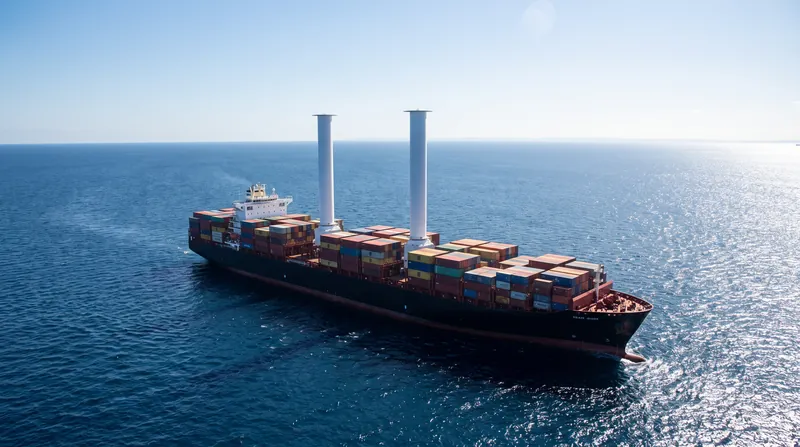
How Flettner Rotors Use the Magnus Effect to Cut Commercial Shipping Emissions
4 sources
Maritime Security
Projectile Strike on Tanker in Strait of Hormuz Injures 12 Seafarers Off Oman Coast
9 sources
Parametric Resonance
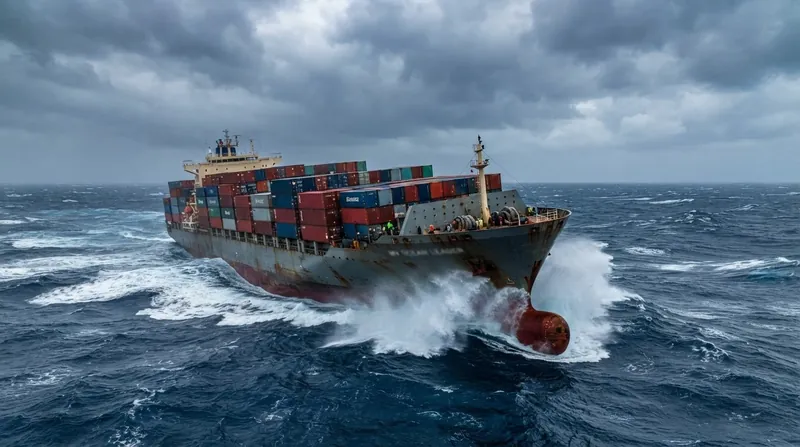
Waterplane Area Fluctuations at Twice the Natural Roll Frequency: Why Head Seas Trigger Violent Parametric Rolling in Container Ships
3 sources
Hydrodynamics
Under-Keel Water Acceleration Drops Hydrodynamic Pressure: Why Moving Ships Squat Toward the Seabed in Shallow Channels
6 sources
Comments
Every angle. Every day.
Get Transportation stories with full source coverage and perspective breakdowns, free every day.