
Trackless Trams: The 'Virtual Rail' Technology Trying to Bridge the Gap Between Buses and Trains
Autonomous Rapid Transit systems are rolling out in cities worldwide, promising the capacity and smooth ride of light rail at a fraction of the cost. But transit experts are debating whether the optically guided vehicles are a transit revolution or just a repackaged bus.
By Factlen Editorial Team
- Transit Innovators
- Advocates who view the trackless tram as a cost-effective catalyst for rapid urban regeneration.
- Pragmatic Skeptics
- Academics and planners who highlight hidden infrastructure costs, road wear, and the 'gadgetbahn' nature of the tech.
- Global Planners
- Observers viewing the technology objectively as a new tool in the urban transit arsenal, monitoring its global rollout.
What's not represented
- · Disability advocates on the accessibility of virtual docking at curbsides
- · Local taxpayers who may fund the hidden costs of road reinforcement
Why this matters
As cities choke on traffic and struggle to fund billion-dollar light rail projects, trackless trams offer a potential middle ground. If successful, they could allow mid-sized cities to rapidly deploy high-capacity, zero-emission transit networks without years of disruptive construction.
Key points
- Trackless trams (ART) use optical sensors and LiDAR to follow virtual lines painted on the road, eliminating the need for steel tracks.
- Proponents claim the systems cost $7–$15 million per kilometer to install, significantly less than traditional light rail.
- The 30-meter, bi-articulated vehicles run on batteries and can carry over 300 passengers.
- Critics warn that the heavy, precisely aligned wheels can cause severe road rutting, requiring expensive pavement reinforcement.
- Trials are currently underway in cities globally, including Perth, Dubai, and Abu Dhabi.
Urban planners across the globe face a universal and mounting dilemma: as metropolitan populations swell and daily traffic congestion worsens, the need for high-capacity public transit becomes increasingly urgent. For decades, Light Rail Transit (LRT) has been considered the gold standard for mid-tier urban transport, offering a smooth, fully electric ride that reliably spurs economic development and housing density along its corridors. However, the reality of implementing these systems is daunting. Laying physical steel tracks and erecting overhead catenary wires is notoriously expensive—often exceeding $50 million per kilometer in Western cities—and requires years of highly disruptive street excavation that can paralyze traffic and bankrupt local businesses before the first train ever arrives.
Enter the 'trackless tram,' formally known in the industry as Autonomous Rapid Transit (ART). Developed by the Chinese state-owned rail manufacturer CRRC, this emerging technology is explicitly designed to bridge the yawning gap between a standard city bus and a multi-million-dollar train network. It promises the high passenger capacity, premium ride quality, and fixed-route assurance of traditional light rail, but combines it with the navigational flexibility and dramatically lower infrastructure costs of a rubber-tired bus network. For cities desperate for transit upgrades but lacking billion-dollar budgets, it represents a tantalizing compromise.[8]
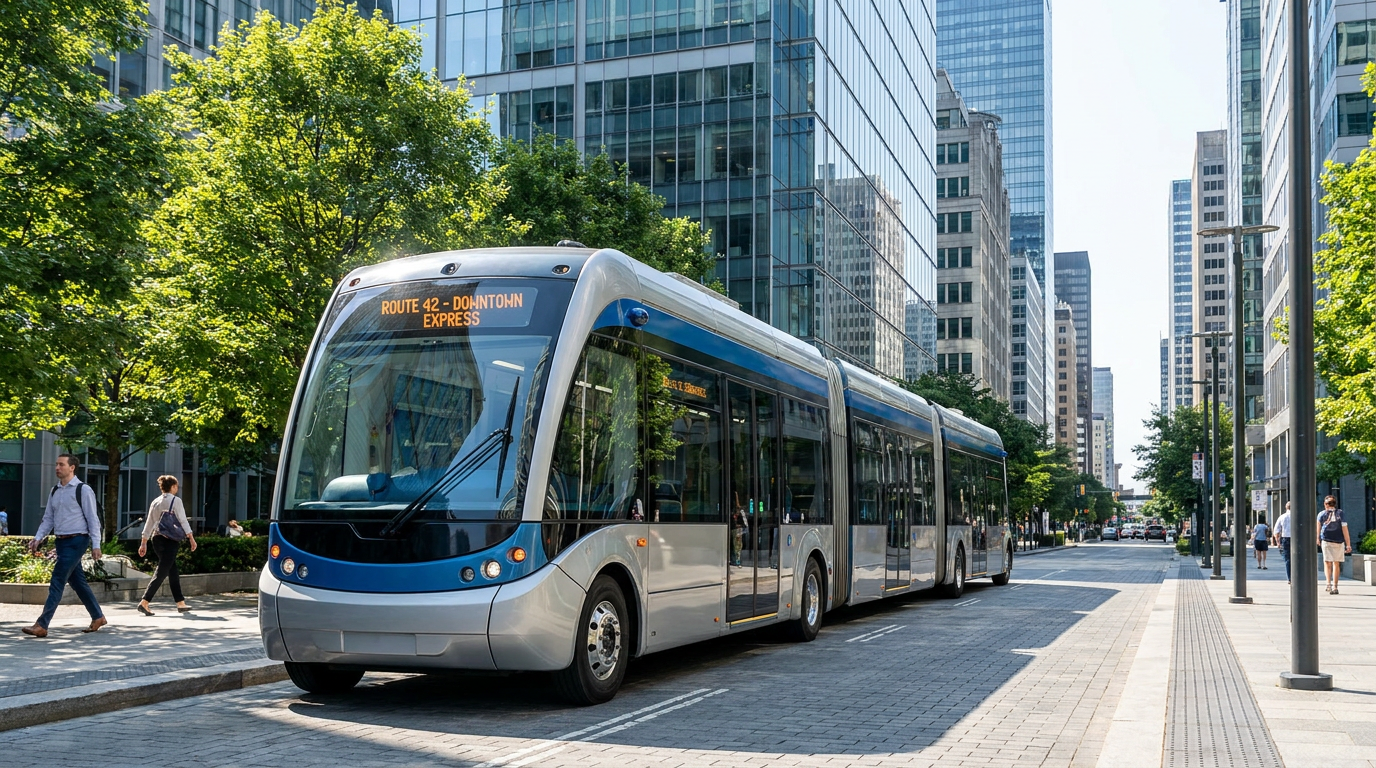
The core mechanism behind the trackless tram is a fascinating blend of automotive flexibility and rail engineering precision. Instead of relying on steel wheels locked onto physical steel rails, ART vehicles run on heavy-duty rubber tires. They navigate urban environments using 'virtual tracks'—which are essentially double-dashed white lines painted directly onto the asphalt. An advanced array of optical sensors, LiDAR (Light Detection and Ranging), and GPS continuously scan these painted lines and the surrounding environment, allowing the vehicle's onboard computers to steer autonomously along a mathematically precise path.[7][8]
Physically, the vehicles are imposing and designed to mimic the aesthetic and spatial feel of a modern train. A standard ART unit is bi-articulated, meaning it features three linked carriages connected by flexible gangways, stretching over 30 meters in length. This allows a single vehicle to carry upwards of 300 passengers, rivaling the capacity of many light rail systems. Furthermore, they feature a low-floor design for seamless, accessible boarding from raised platforms, and a twin-head system with a driver's cabin at both ends, meaning the tram can simply reverse direction at the end of a line without needing a wide turnaround loop.[7][8]

The primary claim driving intense global interest in trackless trams is their remarkably low price tag. Proponents and early feasibility studies estimate that deploying an ART system costs a mere fraction of traditional light rail. Estimates suggest the infrastructure and vehicle costs hover around $7 million to $15 million per kilometer. When compared to the staggering costs of digging up dense urban centers for steel tracks—which can easily spiral past $50 million to $100 million per kilometer depending on the city—the financial appeal for municipal governments is undeniable.[5][7]
Because there is absolutely no need to excavate streets, relocate complex underground utilities, or build massive power substations along the route, the required capital expenditure drops dramatically. Cities can theoretically deploy a trackless tram system as fast as their permitting, station construction, and road-painting processes allow. This rapid deployment capability has the potential to turn a decade-long, politically fraught megaproject into a swift rollout that can be completed within a single mayoral term, delivering immediate relief to congested corridors.[5]
Beyond the sheer cost savings, the technology specifically aims to solve the 'ride quality' problem that historically plagues standard buses. Traditional buses are notoriously jerky, swaying laterally in lanes and braking harshly in mixed traffic, which deters choice riders who much prefer the smooth, predictable glide of a train. Trackless trams aim to eliminate this discomfort by borrowing advanced stabilization and multi-axle hydraulic steering technology directly from the high-speed rail industry. By integrating these rail-grade suspension systems into a rubber-tired chassis, the vehicle isolates passengers from the bumps and vibrations typically associated with road travel, creating a premium commuter experience.[1]
This advanced multi-axle steering mechanism is a critical component of the system's design. It ensures that every single axle on the long vehicle precisely follows the exact path carved out by the front wheels. As a result, the massive 30-meter vehicle can snake through tight urban corners and narrow streets with a minimum turning radius of just 15 meters. This precise tracking minimizes the lateral sway that causes motion sickness in standard articulated buses, providing a smooth, train-like experience for standing passengers even when navigating complex city grids.[5][8]
Environmentally, ART systems are fully electric, aligning perfectly with global net-zero transit goals and the push to eliminate diesel emissions from city centers. They utilize advanced lithium-titanate batteries that are specifically designed for rapid, high-power charging. A quick 10-minute charge at a designated station can provide up to 25 kilometers of driving range. This allows the vehicle to top up its power reserves seamlessly while passengers board and disembark at major stops, entirely eliminating the need to string unsightly and expensive overhead catenary wires along the entire transit corridor.[7]

Environmentally, ART systems are fully electric, aligning perfectly with global net-zero transit goals and the push to eliminate diesel emissions from city centers.
This technology is no longer just a speculative concept confined to engineering white papers. CRRC officially unveiled the ART system in 2017, and it has been operational in real-world conditions in Chinese cities like Zhuzhou, Yibin, and Harbin since 2018. Having proven the concept domestically and refined the optical guidance software over millions of passenger kilometers, the manufacturer is now aggressively exporting the technology to international cities that are desperate for innovative, mid-tier transit solutions. These early deployments have served as a global showcase, proving that the vehicles can maintain high-frequency schedules and handle heavy daily commuter loads without the need for physical rails.[7][8]
In Australia, the City of Stirling in Perth recently concluded a high-profile, federally funded trial of a 30-meter trackless tram. The trial tested the vehicle along the busy Scarborough Beach Road corridor, assessing its maneuverability, battery performance in the Australian climate, and its potential to connect a major train station directly to the coast. Local officials and researchers from Curtin University view the technology as a potential game-changer that could spur urban regeneration and transit-oriented development without the crippling disruption of laying physical tracks.[1][6]
The Middle East is also aggressively exploring the technology as a solution to its own rapid urbanization challenges. Abu Dhabi already operates an ART route connecting Reem Mall to the Marina, providing a glimpse of the technology in a desert climate. Meanwhile, Dubai's transport authority is currently studying the feasibility of a broader trackless tram network. Planners in the Emirate hope that the sleek, modern aesthetic and premium ride quality will entice wealthier residents out of their private cars and onto public transport, helping to ease the city's growing road congestion.[3]
Despite the mounting enthusiasm from municipal governments and urban developers, many transit experts and academic researchers urge caution. Skeptics frequently label the trackless tram a 'gadgetbahn'—a derogatory industry term reserved for flashy, proprietary technologies that overpromise on innovation while ignoring the fundamental geometry and physics of urban transport. They warn that the sleek marketing often obscures the very real infrastructure challenges that come with deploying heavy, rubber-tired vehicles on standard city streets. These critics argue that city councils are being seduced by the futuristic aesthetic, potentially blinding them to the long-term maintenance costs that will inevitably arise.[5][8]
Critics are quick to point out that, when stripped of its futuristic marketing and rail-like body panels, a rubber-tired vehicle without physical tracks is, fundamentally, just a bus. Researchers at the University of Sydney note that optically guided buses are not a brand-new revolution; similar systems have existed since the early 2000s in European cities like Rouen, France, and Castellón, Spain. Those earlier iterations experienced limited long-term success, often struggling with sensor reliability in bad weather and failing to deliver the promised transformative impact on urban mobility.[5]

The most significant hidden cost of the trackless tram lies in the physical infrastructure it requires. While painting virtual tracks on the asphalt is undeniably cheap, the vehicles themselves are incredibly heavy. Because the optical guidance system forces the tram to follow a mathematically precise path, the heavy rubber tires roll over the exact same narrow strip of asphalt on every single trip, day after day, without the slight natural variations in lane position that a human driver provides. This lack of variance concentrates the immense weight of the bi-articulated vehicle onto a very small surface area of the roadway.[5][8]
This concentrated, unvarying weight can cause severe rutting and structural wear to standard city streets, literally carving depressions into the asphalt over time. To prevent the road from rapidly deteriorating under this constant pressure, cities may need to heavily reinforce the pavement with deep concrete foundations along the entire route. This is a highly disruptive and expensive construction process that quickly eats into the promised cost savings, making the final price tag look much closer to traditional light rail than originally advertised.[5]
There is also the lingering question of true autonomy. Despite the prominent use of the word 'Autonomous' in Autonomous Rapid Transit, current systems still require a human driver in the cabin for safety. The driver is necessary to monitor the vehicle's systems, handle unexpected emergencies, and navigate mixed traffic where unpredictable pedestrians and human-driven cars operate. Achieving true Level 4 or 5 autonomy in complex, chaotic urban environments remains a distant future goal rather than a present reality for these systems.[7][8]
Furthermore, to achieve the high speeds, reliability, and frequency of a true light rail system, trackless trams still require dedicated, physically separated right-of-way lanes. If an ART vehicle is forced to mix with regular car traffic, it will inevitably get stuck in the exact same congestion as a standard city bus, completely negating its rapid transit branding. Allocating these dedicated lanes requires taking space away from private vehicles—a political battle that is just as difficult whether the transit vehicle runs on steel rails or rubber tires.[3][8]

Finally, transit planners warn of the dangers of vendor lock-in. Because the optical guidance software, battery systems, and multi-axle steering technologies are highly proprietary to CRRC, cities that adopt the system may find themselves entirely dependent on a single supplier. Unlike standard buses or traditional trains, which can be sourced competitively from dozens of manufacturers globally, an ART city is locked into CRRC for specialized replacement parts, long-term maintenance contracts, and future vehicle purchases, which could drive up operational costs over the system's lifespan.[8]
Ultimately, the trackless tram represents a fascinating and highly debated evolution in mid-tier transit, blurring the traditional boundaries between Bus Rapid Transit (BRT) and Light Rail. It offers a compelling vision of the future: sleek, electric, high-capacity transit deployed at a fraction of the cost of a train. Whether it truly revolutionizes urban transport or simply becomes a niche technology will depend entirely on how cities balance its lower initial capital costs against the long-term realities of road maintenance, proprietary technology, and the political will to dedicate exclusive lanes.[4]
How we got here
2017
CRRC officially unveils the Autonomous Rapid Transit (ART) concept in China.
2018
The first commercial ART line begins passenger service in Zhuzhou, China.
Nov 2023
The City of Stirling in Perth, Australia, conducts a high-profile on-road trial of the trackless tram.
2024
Cities in the Middle East, including Dubai and Abu Dhabi, begin feasibility studies and limited operations of ART systems.
Viewpoints in depth
Urban Planners & Proponents
Advocates view the trackless tram as a cost-effective catalyst for urban regeneration.
This camp argues that mid-sized cities desperately need the capacity and ride quality of light rail, but simply cannot afford the billion-dollar price tags and years of disruptive construction. By utilizing virtual tracks and battery power, they believe ART systems can unlock the same economic development and transit-oriented density as traditional trains, but at a fraction of the cost and time.
Transit Skeptics & Academics
Critics argue the technology is a repackaged bus that ignores fundamental infrastructure realities.
This viewpoint, often shared by university researchers and traditional rail advocates, labels the trackless tram a 'gadgetbahn.' They emphasize that the precise optical guidance forces heavy rubber tires to roll over the exact same strip of asphalt, which will inevitably destroy standard roads. They argue that once the costs of reinforcing the pavement and dedicating exclusive right-of-way lanes are factored in, the financial advantages over standard Bus Rapid Transit (BRT) largely evaporate.
What we don't know
- The long-term maintenance costs of the reinforced roadways required to support the heavy vehicles.
- How the optical guidance systems will perform in cities with heavy snow, ice, or frequent road debris.
- Whether the proprietary nature of the technology will lead to expensive vendor lock-in for early-adopter cities.
Key terms
- Autonomous Rapid Transit (ART)
- A high-capacity passenger vehicle that runs on rubber tires but is guided by optical sensors along a virtual track.
- LiDAR
- A remote sensing method that uses light in the form of a pulsed laser to measure ranges and create precise 3D maps of the environment.
- Bi-articulated
- A vehicle design featuring two flexible joints (or gangways), allowing a long vehicle to bend around corners.
- Gadgetbahn
- A derogatory term used by transit planners for a speculative or overly complex transportation technology that solves a problem better addressed by conventional trains or buses.
- Bus Rapid Transit (BRT)
- A high-quality bus-based transit system that delivers fast, comfortable, and cost-effective services via dedicated lanes.
- Light Rail Transit (LRT)
- An urban form of public transport using steel-tracked vehicles, typically powered by overhead electrical wires.
Frequently asked
Does the trackless tram have a driver?
Yes. Despite the 'autonomous' branding, current systems require a human driver to monitor the vehicle, handle emergencies, and navigate mixed traffic.
How is the vehicle powered?
The trams are fully electric, utilizing onboard lithium-titanate batteries that can be rapidly recharged at passenger stations in about 10 minutes.
Can it drive on any standard road?
While it can physically drive on standard roads, its heavy weight often requires reinforced pavement, and it needs dedicated lanes to avoid getting stuck in regular car traffic.
Why not just build a normal tram?
Traditional trams require digging up the street to lay steel tracks and install overhead wires, which is highly disruptive and costs tens of millions of dollars per kilometer.
Sources
Source coverage
8 outlets
3 viewpoints surfaced








[1]SwitchedOnTransit Innovators
It's electric and smart - Australia's first trackless tram arrives
Read on SwitchedOn →[2]Rail ExpressTransit Innovators
CRRC trackless trams set for Perth trial
Read on Rail Express →[3]The NationalGlobal Planners
Can Dubai's trackless trams tackle growing congestion?
Read on The National →[4]Create DigitalPragmatic Skeptics
How viable are trackless tram systems?
Read on Create Digital →[5]The University of SydneyPragmatic Skeptics
Debunking the myths around optically-guided bus (Trackless trams)
Read on The University of Sydney →[6]City of StirlingTransit Innovators
Trackless Tram Trial Report - Perth
Read on City of Stirling →[7]Rail EngineerGlobal Planners
Trams without rails
Read on Rail Engineer →[8]WikipediaGlobal Planners
Autonomous rapid transit
Read on Wikipedia →

Every angle. Every day.
Get automotive stories with full source coverage and perspective breakdowns delivered to your inbox.