
The Science of Heart Rate Variability: How Autonomic Balance Dictates Athletic Recovery
Heart rate variability has become the gold standard for measuring athletic recovery. By tracking the microscopic fluctuations between heartbeats, athletes can decode their nervous system's readiness to perform.
By Factlen Editorial Team
- Sports Scientists
- Focus on the necessity of rolling averages and standardized measurement protocols.
- Wearable Tech Advocates
- Champion the accessibility and behavioral benefits of continuous monitoring.
- Skeptical Physiologists
- Warn against over-reliance on algorithms at the expense of subjective feeling.
What's not represented
- · Recreational athletes who find daily data tracking anxiety-inducing.
Why this matters
Understanding HRV allows anyone from elite athletes to recreational runners to objectively measure their body's systemic stress levels. This data prevents overtraining, reduces injury risk, and optimizes the exact days to push hard or prioritize rest.
Key points
- HRV measures the millisecond variance between heartbeats, reflecting autonomic nervous system balance.
- High HRV indicates parasympathetic dominance, meaning the body is recovered and adaptable.
- Low HRV indicates sympathetic dominance, signaling systemic stress or fatigue.
- RMSSD is the standard metric used by wearables to estimate recovery via ultra-short readings.
- Experts recommend using a 7-day rolling average rather than reacting to single daily scores.
For decades, athletes and coaches relied on a simple, subjective question to dictate training: "How do you feel today?" While perceived exertion remains valuable, the modern era of sports science has introduced a purely objective window into the body's readiness. We no longer have to guess if a muscle is recovered or if the central nervous system is fatigued. The answer lies in the microscopic spaces between our heartbeats, a metric known as Heart Rate Variability (HRV).[5]
Unlike resting heart rate, which simply counts the number of beats per minute, HRV measures the specific variance in time—down to the millisecond—between consecutive beats. If your heart beats 60 times in a minute, it does not beat exactly once every second. One interval might be 0.9 seconds, the next 1.1 seconds. This irregularity is not a sign of dysfunction; in fact, it is the ultimate signature of a healthy, adaptable cardiovascular system.[4]
To understand why this variability exists, we have to look at the engine controlling it: the Autonomic Nervous System (ANS). The ANS operates entirely behind the scenes, regulating involuntary functions like digestion, respiration, and heart rate. It is divided into two competing branches that act as the body's internal gas pedal and brake.[2][5]
The sympathetic nervous system is the gas pedal. It drives the "fight or flight" response, releasing adrenaline, elevating heart rate, and preparing the body for intense physical exertion or stress. The parasympathetic nervous system is the brake. Often called the "rest and digest" branch, it operates via the vagus nerve to slow the heart down, initiate cellular repair, and clear metabolic waste.[2][4]

HRV is the direct mathematical output of the tug-of-war between these two systems. When an athlete is highly stressed, fatigued, or under-recovered, the sympathetic system dominates. The heart is locked into a rigid, metronomic rhythm to deal with the perceived threat, resulting in low variability. Conversely, when the athlete is fully recovered, the parasympathetic system takes the wheel. The heart becomes highly responsive to micro-changes in breathing and environment, resulting in high variability.[2][4]
In the context of sports science, a high HRV indicates that the athlete's nervous system is relaxed but highly adaptable—primed to handle a heavy training load. A suppressed HRV serves as a biological warning light, signaling that the body is still fighting to restore homeostasis from a previous workout, poor sleep, or psychological stress.[4][5]
While there are many ways to calculate this variance, the gold standard for field monitoring and wearable technology is RMSSD (Root Mean Square of Successive Differences). This time-domain metric is particularly favored by sports scientists because it heavily reflects vagal tone—the direct influence of the parasympathetic nervous system—and can be accurately captured in ultra-short readings.[1][3]

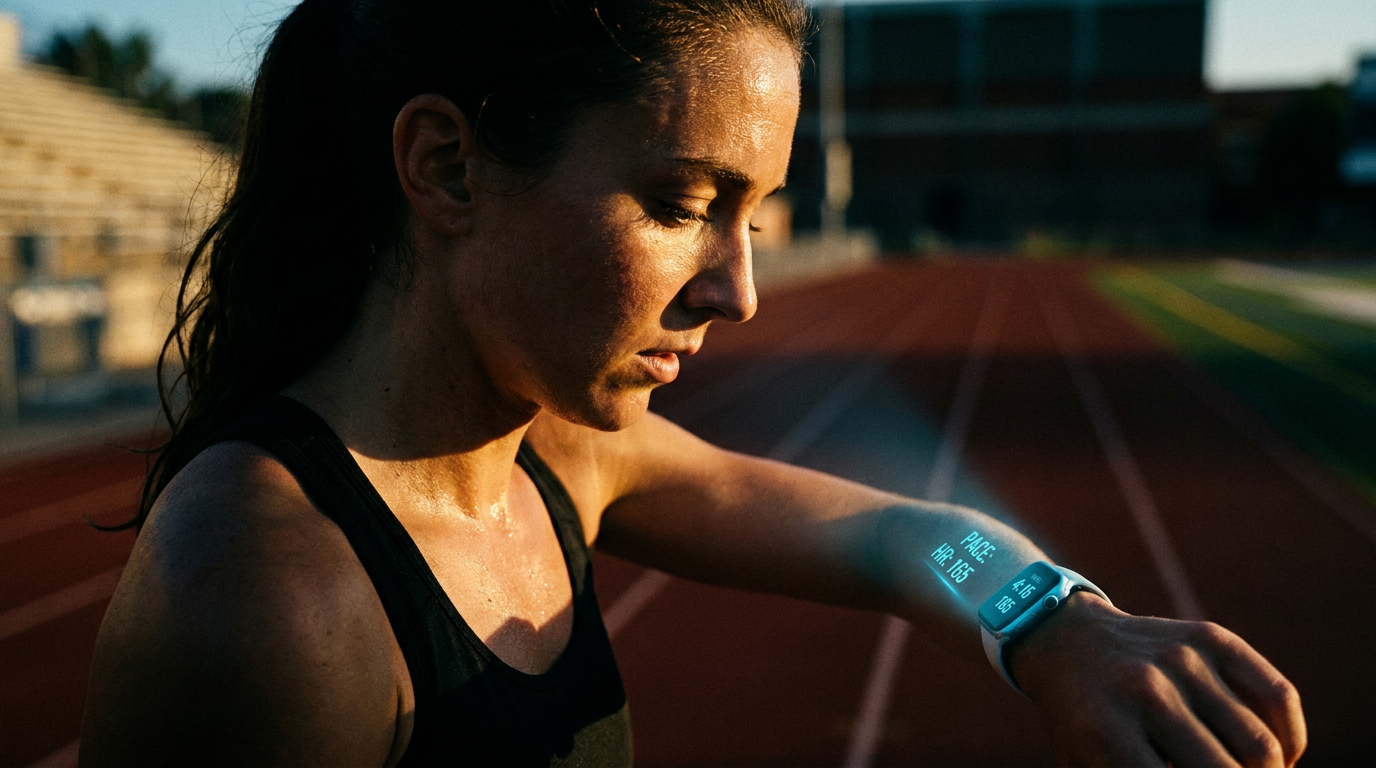
Historically, capturing HRV required a 5-minute electrocardiogram (ECG) in a controlled laboratory setting. Today, optical sensors in smartwatches and rings can estimate RMSSD using photoplethysmography (PPG). To minimize the noise of daily life, these devices typically measure HRV during deep sleep or require a standardized 1-minute reading immediately upon waking, before the athlete even sits up in bed.[1][3]
Historically, capturing HRV required a 5-minute electrocardiogram (ECG) in a controlled laboratory setting.
The practical application of this data has birthed a new paradigm: HRV-guided training. Instead of blindly following a pre-planned 12-week marathon schedule, athletes adjust their daily volume and intensity based on their morning HRV score. Studies have consistently shown that athletes utilizing HRV-guided protocols achieve greater performance gains and suffer fewer overuse injuries than those adhering to rigid, pre-set programs.[2][4]
The timeline of autonomic recovery is highly predictable. Following a maximal effort—such as a heavy weightlifting session or a high-intensity interval run—HRV plummets as the sympathetic nervous system takes over. Depending on the athlete's baseline fitness, it typically takes 24 to 72 hours for parasympathetic reactivation to fully restore HRV to baseline levels.[2][4]
However, sports scientists warn that HRV is not a magic bullet, and the data is highly susceptible to confounding variables. Frequency-domain measurements can be heavily skewed by an athlete's respiration rate. Furthermore, wrist-worn optical sensors are notoriously sensitive to movement artifacts and ambient temperature changes, which is why overnight averages are often preferred over daytime spot-checks.[1][3]
There is also a well-documented physiological paradox that coaches must watch for. While a dropping HRV usually indicates fatigue, severely overtrained endurance athletes will sometimes exhibit a sudden, paradoxical spike in HRV. This occurs when the nervous system becomes so exhausted that sympathetic drive completely crashes, leaving an artificial parasympathetic dominance that masks deep systemic fatigue.[1]
Because of these anomalies, experts emphasize that a single daily HRV score is virtually meaningless in isolation. The true power of the metric lies in the 7-day rolling average. By comparing today's score to a personalized weekly baseline, athletes can filter out the noise of a single bad night of sleep and identify genuine trends in their autonomic health.[1][5]

Crucially, the heart does not differentiate between physical and psychological stress. An athlete might have perfectly executed their physical taper, but if they are experiencing severe anxiety, dehydration, or fighting off a mild viral infection, their HRV will drop. This makes the metric a holistic gauge of total life stress, not just a reflection of time spent in the gym.[2][4]
Ultimately, the most effective recovery protocols do not rely on algorithms alone. The consensus among elite performance directors is to pair objective HRV data with subjective perceived recovery scores. When the wearable data and the athlete's physical sensation align, the path forward is clear. HRV hasn't replaced the coach's intuition; it has simply provided it with a high-definition biological compass.[1][5]
Viewpoints in depth
Sports Scientists
Focus on the necessity of rolling averages and standardized measurement protocols.
Academic researchers emphasize that while HRV is a powerful biomarker, it is highly sensitive to environmental noise. They argue that single daily readings are often skewed by hydration, sleep stages, or respiration rates. From a scientific perspective, HRV is only actionable when measured under strictly standardized conditions—such as immediately upon waking in the exact same posture—and evaluated as a 7-day rolling average to filter out acute anomalies.
Wearable Tech Advocates
Champion the accessibility and behavioral benefits of continuous monitoring.
Proponents of commercial fitness wearables argue that absolute clinical precision is less important than the behavioral changes the devices drive. By providing athletes with a daily, easily digestible 'readiness score,' wearables encourage better sleep hygiene, alcohol reduction, and smarter training decisions. They view the democratization of HRV data as a massive net positive for general population health and amateur athletic performance.
Skeptical Physiologists
Warn against over-reliance on algorithms at the expense of subjective feeling.
A subset of coaches and physiologists caution against the 'nocebo effect' of HRV tracking. They argue that athletes who wake up feeling physically fine might artificially suppress their performance if an algorithm tells them their HRV is low. This camp stresses that HRV should never override an athlete's subjective perceived exertion, pointing to the paradox where severely overtrained athletes sometimes display artificially high HRV scores due to complete sympathetic exhaustion.
What we don't know
- Whether wrist-based optical sensors can ever match the absolute precision of a chest-strap ECG during movement.
- The exact physiological mechanism behind the 'parasympathetic paradox' in severely overtrained athletes.
- How to perfectly isolate physical training stress from psychological life stress in HRV data.
Key terms
- Autonomic Nervous System (ANS)
- The part of the nervous system responsible for control of bodily functions not consciously directed, such as breathing, the heartbeat, and digestive processes.
- Sympathetic Nervous System
- The branch of the ANS that drives the 'fight or flight' response, elevating heart rate and preparing the body for stress.
- Parasympathetic Nervous System
- The branch of the ANS that drives the 'rest and digest' response, slowing the heart and facilitating cellular recovery.
- RMSSD
- Root Mean Square of Successive Differences; a time-domain measure of HRV that heavily reflects parasympathetic activity.
- Vagal Tone
- The activity of the vagus nerve, a key component of the parasympathetic nervous system that regulates resting heart rate.
Frequently asked
Is a higher HRV always better?
Generally, yes, as it indicates a recovered and adaptable nervous system. However, in rare cases of severe overtraining, athletes can experience a paradoxical spike in HRV due to complete sympathetic exhaustion.
Can I compare my HRV score to someone else's?
No. HRV is highly individualized and influenced by genetics, age, and gender. You should only compare your current HRV to your own historical baseline.
When is the best time to measure HRV?
To ensure consistency, HRV should be measured either continuously during deep sleep or via a short 1-minute reading immediately upon waking, before sitting up or looking at a phone.
Does mental stress affect my HRV?
Yes. The autonomic nervous system does not differentiate between physical training stress and psychological stress. Anxiety, poor sleep, and illness will all lower your HRV.
Sources
Source coverage
5 outlets
3 viewpoints surfaced





[1]MDPISports Scientists
Limitations and Applications of HRV Monitoring in Sports Science
Read on MDPI →[2]National Institutes of HealthSports Scientists
Heart Rate Variability in Athletes: A Systematic Review
Read on National Institutes of Health →[3]Frontiers in PhysiologySkeptical Physiologists
Monitoring Fatigue Status with HRV Measures in Elite Athletes
Read on Frontiers in Physiology →[4]Science for SportWearable Tech Advocates
Heart Rate Variability (HRV) and Recovery Status
Read on Science for Sport →[5]Factlen Editorial TeamWearable Tech Advocates
Synthesis by Factlen editorial team
Read on Factlen Editorial Team →
Every angle. Every day.
Get fitness stories with full source coverage and perspective breakdowns delivered to your inbox.