
The Science of Emulsification: How to Build Stable Sauces, Dressings, and Dips
Mastering the science of emulsification allows cooks to transform repelling ingredients like oil and water into stable, velvety sauces. By understanding amphiphilic molecules and shear force, anyone can build perfect vinaigrettes, mayonnaise, and pan sauces without fear of separation.
By Factlen Editorial Team
- Culinary Scientists
- Focus on the molecular interactions and thermodynamic principles that govern food.
- Professional Chefs
- Focus on technique, consistency, and the sensory impact of a perfectly bound sauce.
- Home Cooks
- Focus on practical applications, foolproof methods, and rescuing mistakes.
What's not represented
- · Commercial Food Manufacturers
Why this matters
A broken sauce can ruin an expensive meal, but understanding the chemistry behind emulsification gives you the power to troubleshoot, rescue, and elevate everyday cooking from greasy to gourmet.
Key points
- Emulsions are colloidal dispersions that force immiscible liquids, like oil and water, to mix into a stable, unified sauce.
- Emulsifiers like egg yolks (lecithin) and mustard (mucilage) contain amphiphilic molecules that bind water and fat together.
- Mechanical shear force, such as vigorous whisking or blending, is required to break the dispersed liquid into microscopic droplets.
- A broken emulsion can almost always be rescued by slowly whisking the separated mixture into a fresh base of water or emulsifier.
Every cook has experienced the quiet heartbreak of a broken sauce. You whisk olive oil and vinegar together for a salad, only to watch them stubbornly separate into a greasy puddle minutes later. Or you attempt a luxurious pan sauce, but the butter melts into an unappetizing slick that refuses to bind with the wine reduction. This culinary friction is a fundamental law of nature: oil and water are immiscible, meaning they naturally repel each other. Yet, the foundation of classical cooking—from velvety mayonnaise and airy hollandaise to the perfect, glossy coating on a bowl of cacio e pepe—relies entirely on forcing these sworn enemies to coexist. The magic that bridges this divide is known as emulsification.[1][2]
To understand how to build a stable sauce, you must first understand what you are trying to achieve. An emulsion is a colloidal dispersion of one liquid into another. In the kitchen, this almost always involves fat and water. There are two primary types: oil-in-water emulsions, where microscopic droplets of oil are suspended in a water-based liquid (like mayonnaise, milk, or vinaigrette), and water-in-oil emulsions, where water droplets are trapped within a fat matrix (like butter). Left to their own devices, the second law of thermodynamics dictates that these mixtures will eventually separate to minimize the surface area between the repelling molecules.[2][3]
The hero of this chemical standoff is the emulsifier. Emulsifiers are amphiphilic molecules, meaning they possess a split personality. One end of the molecule is hydrophilic (water-loving), while the other end is hydrophobic or lipophilic (fat-loving). When introduced into a mixture of oil and water, these molecules act as microscopic diplomats. They embed their fat-loving tails into the oil droplets and face their water-loving heads outward into the surrounding liquid. This forms a protective barrier around each droplet, drastically reducing the interfacial tension and preventing the droplets from coalescing back together.[2][5]

The most famous and powerful emulsifier in the culinary arsenal is the egg yolk. Egg yolks are packed with lecithin, a phospholipid that is exceptionally efficient at binding oil and water. This is why a single egg yolk can absorb and stabilize up to a cup of oil to create thick, creamy mayonnaise. Lecithin is so effective that it is widely extracted from soybeans and used commercially to stabilize everything from chocolate bars to store-bought salad dressings.[5]
But egg yolks are not the only option. For vinaigrettes, mustard is the undisputed champion. The hull of the mustard seed contains mucilage, a complex mixture of proteins and polysaccharides that forms a viscous gum when exposed to water. This mucilage acts as a powerful emulsifying agent. Adding just a teaspoon of Dijon mustard to a vinaigrette provides enough amphiphilic molecules to lock the oil and vinegar into a smooth, creamy suspension that will hold its structure for days rather than minutes.[4][5]
Other everyday ingredients possess surprising emulsifying properties. Garlic contains amphipathic compounds like diallyl sulfide, which is why traditional Mediterranean sauces like aioli and toum can achieve a creamy texture using little more than crushed garlic and olive oil. Honey, tomato paste, and even finely grated cheeses can provide physical stabilization to a sauce, thickening the water phase enough to make it difficult for oil droplets to move and merge.[2][5]
Other everyday ingredients possess surprising emulsifying properties.
Beyond chemical emulsifiers, there is a structural approach to binding sauces: starch. This is the secret behind the glossy, clinging sauces of Roman pasta dishes like carbonara and cacio e pepe. As pasta boils, it releases starch granules into the cooking water. When heated, these starches undergo gelatinization, swelling and forming a viscous network. If you add this starchy pasta water to a pan with fat—whether it is rendered guanciale fat, melted butter, or melted cheese—the starch network physically traps the fat droplets, creating a stable, creamy emulsion without the need for lecithin or mucilage.[3]

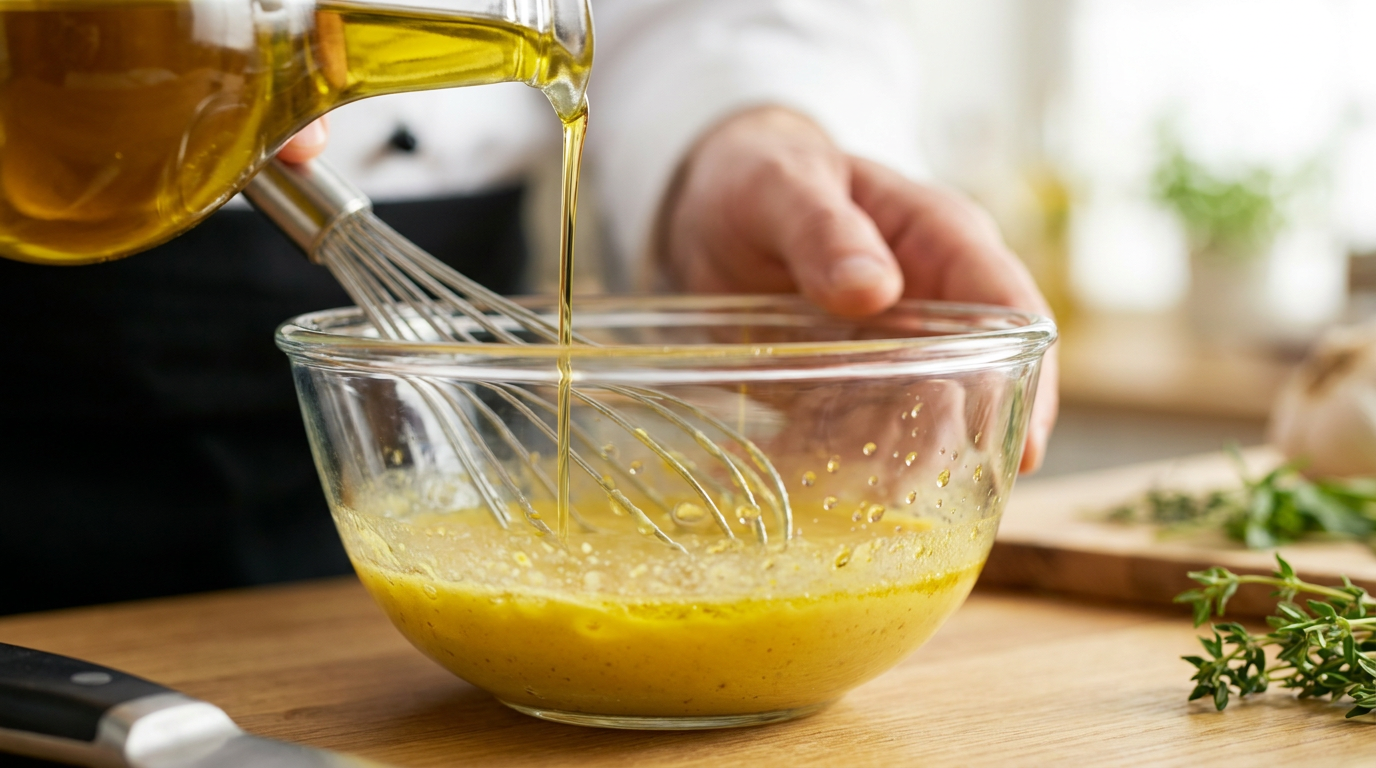
Having the right ingredients is only half the battle; the other half is mechanical. Emulsification requires shear force. You cannot simply stir oil and vinegar together and expect them to bind. You must aggressively whisk, blend, or process the mixture to physically shatter the dispersed phase (usually the oil) into millions of microscopic droplets. The smaller the droplets, the thicker and more stable the resulting sauce will be. This is why a vinaigrette made in a blender is often significantly creamier and paler than one mixed by hand.[1][2]
The golden rule of technique, universally taught in culinary schools, is the gradual addition of the dispersed phase. When making mayonnaise or a vinaigrette, the oil must be added in a slow, thin stream while whisking vigorously. If you dump all the oil in at once, the emulsifier becomes overwhelmed. The oil droplets will find each other before the emulsifier has a chance to coat them, resulting in a broken, greasy mess. Patience during the initial stages of mixing establishes a strong foundation that can absorb oil more rapidly later on.[1][2]
Temperature also plays a critical, and often destructive, role in emulsion stability. Heat increases molecular movement, which can cause droplets to collide and coalesce. More importantly, extreme heat denatures the proteins acting as emulsifiers. If you heat a hollandaise sauce past 150°F (65°C), the egg proteins will coagulate and scramble, instantly breaking the emulsion and weeping clarified butter. Conversely, cold temperatures can cause the fat droplets to solidify and crystallize, which is why olive oil vinaigrettes often congeal and separate when stored in the refrigerator.[2][3]
Recognizing a broken emulsion is a rite of passage for any cook. A stable sauce is opaque, glossy, and uniform. When it breaks, it loses its sheen, takes on a curdled or grainy appearance, and pools of clear fat begin to seep around the edges. This happens when the protective barriers around the droplets fail, allowing the dispersed liquid to merge back into a continuous, separate layer.[1]

Fortunately, science offers a reliable method for rescuing a broken sauce. Because the ingredients are already present, you simply need to re-establish the continuous phase. To fix a broken vinaigrette or mayonnaise, do not just whisk harder. Instead, start with a fresh bowl. Add a teaspoon of warm water, a fresh egg yolk, or a dab of mustard. Then, treating your broken sauce as if it were pure oil, slowly whisk it drop-by-drop into the new base. The new emulsifier will coat the fat droplets as they are reintroduced, restoring the sauce to its former glory.[1][2]
Mastering emulsification does more than improve the appearance of your food; it fundamentally alters the sensory experience of eating. A broken sauce delivers flavor in disjointed waves—a harsh hit of acidic vinegar followed by a slick coating of bland oil. A properly emulsified sauce, however, coats the palate evenly. It delivers water-soluble flavors (like acid and salt) and fat-soluble flavors (like herbs and aromatics) simultaneously, creating a balanced, harmonious profile in every bite.[2]
Ultimately, the kitchen is a laboratory, and every recipe is an experiment in applied physics and chemistry. By understanding the mechanics of amphiphilic molecules, the necessity of shear force, and the stabilizing power of starches, home cooks can shed the anxiety of complex recipes. Emulsification transforms cooking from a game of chance into a predictable, rewarding science, allowing anyone to build sauces with the confidence of a professional chef.[6]
Viewpoints in depth
Culinary Scientists
Focus on the molecular interactions and thermodynamic principles that govern food.
For food scientists, emulsification is a battle against the second law of thermodynamics. They view sauces not as recipes, but as colloidal dispersions that require precise manipulation of interfacial tension. By analyzing the amphiphilic properties of phospholipids like lecithin or the rheological behavior of mustard mucilage, scientists can predict exactly when and why a sauce will break, allowing for the development of hyper-stable commercial food products.
Professional Chefs
Focus on technique, consistency, and the sensory impact of a perfectly bound sauce.
In a high-pressure restaurant environment, chefs rely on the mechanics of emulsification—shear force and temperature control—to ensure consistency across hundreds of plates. A broken sauce is a failure of technique, usually caused by rushing the addition of oil or mismanaging heat. For professionals, an emulsion is essential for mouthfeel; it ensures that fat-soluble aromatics and water-soluble acids coat the diner's palate simultaneously, delivering a unified flavor profile.
Home Cooks
Focus on practical applications, foolproof methods, and rescuing mistakes.
For the everyday cook, emulsification is often viewed as a culinary magic trick that can easily go wrong. The focus is on reliable, forgiving techniques—like using a blender to generate massive shear force or relying on foolproof emulsifiers like Dijon mustard. The most valuable knowledge for this camp is the rescue protocol: understanding that a broken vinaigrette or mayonnaise isn't ruined, but can be seamlessly rebuilt by slowly whisking it into a fresh base of water or egg yolk.
What we don't know
- While the basic mechanisms of emulsification are well understood, food scientists are still researching how complex flavor compounds interact with different commercial emulsifiers at a molecular level.
- The exact threshold at which mechanical shear force begins to degrade certain delicate hydrocolloids in modernist cuisine remains an active area of culinary research.
Key terms
- Emulsion
- A stable mixture of two liquids that normally do not mix, such as oil and water, where one is suspended as tiny droplets within the other.
- Amphiphilic
- A molecule that has both a water-loving (hydrophilic) end and a fat-loving (hydrophobic) end, allowing it to bind repelling ingredients together.
- Lecithin
- A powerful natural emulsifier found abundantly in egg yolks and soybeans, essential for making mayonnaise and hollandaise.
- Mucilage
- A gummy substance found in the hulls of mustard seeds that acts as a stabilizer and emulsifier in vinaigrettes.
- Gelatinization
- The process where starch granules absorb water and swell when heated, creating a viscous network that can thicken sauces and trap fat.
- Shear Force
- The mechanical energy—applied by whisking, shaking, or blending—required to break a liquid into microscopic droplets so it can be emulsified.
Frequently asked
Why does my homemade vinaigrette separate in the fridge?
Cold temperatures cause the oil droplets to solidify and crystallize, which breaks the delicate emulsion. Letting the dressing sit at room temperature for 15 minutes and giving it a vigorous shake will usually restore it.
Can I fix a hollandaise sauce that has separated?
Yes, as long as the eggs haven't fully scrambled from too much heat. Start with a teaspoon of warm water or a fresh egg yolk in a new bowl, and slowly whisk the broken sauce into it drop-by-drop to rebuild the emulsion.
Why do recipes always say to save the pasta water?
As pasta boils, it releases starch into the water. This starchy water acts as a powerful physical emulsifier, helping to bind fats (like butter, cheese, or olive oil) into a creamy, cohesive sauce that clings to the noodles.
Is butter considered an emulsion?
Yes. While sauces like mayonnaise are 'oil-in-water' emulsions, butter is a 'water-in-oil' emulsion, where microscopic droplets of water and milk proteins are suspended within a continuous matrix of butterfat.
Sources
Source coverage
6 outlets
3 viewpoints surfaced





[1]Serious EatsProfessional Chefs
The Science of Emulsification
Read on Serious Eats →[2]Journal of Food Technology and PreservationCulinary Scientists
Cooking chemistry: How emulsions transform culinary creations
Read on Journal of Food Technology and Preservation →[3]ISTA Research ExplorerCulinary Scientists
Phase behavior of Cacio e Pepe sauce
Read on ISTA Research Explorer →[4]Food Research InternationalCulinary Scientists
Functional characteristics of mustard mucilage
Read on Food Research International →[5]Science and Food UCLACulinary Scientists
Culinary Chemistry: Emulsions
Read on Science and Food UCLA →[6]Factlen Editorial TeamHome Cooks
Synthesis by Factlen editorial team
Read on Factlen Editorial Team →

More in food drink
See all 34 stories →Baking Science
The Science of Tangzhong and Yudane: How Water Roux Transforms Bread
8 sources
Food Tech
The Science of Animal-Free Dairy: How Microbes Are Brewing Real Ice Cream and Cheese
8 sources
Food Tech
How Microbes Are Brewing Real Dairy Without Cows
7 sources
Longevity Science
The Science of Coffee and Longevity: How the Daily Brew Protects the Brain and Heart
7 sources

Every angle. Every day.
Get food drink stories with full source coverage and perspective breakdowns delivered to your inbox.