
The Rise of the Longevity Residence: How Wellness is Redefining Luxury Real Estate
High-end real estate is undergoing a structural shift as buyers prioritize homes engineered to extend their healthspan, driving a wellness real estate market projected to reach $1.8 trillion by 2030.
By Factlen Editorial Team
- Longevity & Wellness Advocates
- Argue that homes should actively extend healthspan and integrate clinical-grade preventive care into daily life.
- Sustainable Architecture Purists
- Emphasize that true wellness must include environmental health, focusing on net-zero emissions and low-carbon materials.
- Market Expansionists
- Focus on scaling these health-centric innovations beyond the ultra-wealthy to improve broader public health.
What's not represented
- · Middle-income homebuyers priced out of wellness features
- · Municipal building regulators
Why this matters
As the built environment increasingly dictates our physical and mental health, the innovations pioneered in these ultra-luxury homes are setting the new standard for how all future residences will be designed, built, and integrated with nature.
Key points
- The wellness real estate market is projected to reach $1.8 trillion by 2030.
- A new category of 'longevity residences' integrates clinical health tracking and biohacking into the home.
- Developers are focusing on the 'home biome,' installing hospital-grade air purification and circadian lighting.
- Wellness amenities are converging with sustainable, net-zero architectural principles.
The ultimate luxury status symbol has shifted. It is no longer the infinity pool, the sprawling wine cellar, or the private cinema. In 2026, the most coveted amenity in high-end real estate is time—specifically, the promise of a longer, healthier life. This profound shift in consumer priorities is transforming the architectural landscape, moving the focus from sheer square footage and opulent finishes to environments that actively optimize human biology. The modern luxury home is no longer just a place to live; it is a highly engineered sanctuary designed to restore the mind and extend the physical healthspan of its occupants.[2][4]
This shift has given rise to a booming sector known as wellness real estate, which has rapidly evolved from a niche market into a dominant global force. According to the Global Wellness Institute, the market has ballooned from $151 billion in 2017 to an estimated $876 billion in 2025, and is projected to reach a staggering $1.8 trillion by 2030. The growth rate is unprecedented. While overall global construction grew at roughly 5.5 percent annually over the past five years, wellness real estate surged at 19.5 percent, signaling a fundamental reordering of what high-net-worth buyers are willing to pay for.[1]
The financial implications of this trend are clear across the premium property market. Developers and real estate analysts report that buyers are routinely paying a 10 to 25 percent price premium for residences that actively promote their health and well-being. This premium reflects a growing understanding that health is heavily influenced by the built environment—the spaces where people spend the vast majority of their lives. Consequently, the industry is moving rapidly to meet this demand, embedding sophisticated health technologies directly into the foundation of new builds.[1][2]

At the pinnacle of this architectural revolution is a newly formalized category: the "longevity residence." Officially named by industry researchers in April 2026, these homes move far beyond the traditional "spa in the basement" template that defined luxury just a decade ago. A longevity residence is explicitly designed to support a longer, healthier life through the seamless integration of preventive medicine, biohacking tools, AI-enabled health tracking, and clinical programming.[1][2]
The operational model of these ultra-luxury developments is also evolving. Walk into the lobby of a flagship new build in Miami, Dubai, or Cancún today, and you are as likely to be greeted by a Director of Longevity as a traditional concierge. These dedicated professionals oversee the building's clinical layer, curating personalized health programs for residents that might include everything from nutritional counseling and biometric monitoring to coordinating on-site preventive medical care.[2]
Inside the residences themselves, the focus is heavily directed toward the "home biome"—the invisible environmental factors that quietly shape human health day in and day out. Developers are installing hospital-grade air and water purification systems that are calibrated far below standard city requirements, effectively filtering out microplastics, volatile organic compounds, and airborne pathogens. The goal is to create an indoor environment that is measurably purer than the natural world outside.[2][3]
The goal is to create an indoor environment that is measurably purer than the natural world outside.
Lighting has emerged as another critical component of the home biome. Circadian-aligned lighting systems are becoming standard in primary living spaces and bedrooms. These intelligent systems automatically adjust their color temperature and brightness throughout the day to mimic the natural progression of the sun, suppressing melatonin production during the day for focus and stimulating it at night to support restorative sleep-wake cycles.[2][4]

The physical amenities within these homes have also undergone a radical transformation. Contrast therapy suites, featuring commercial-grade cold plunge pools and infrared saunas, are increasingly replacing traditional home theaters or game rooms. Red light therapy panels are being embedded directly into primary closets and dressing rooms, allowing residents to seamlessly integrate cellular rejuvenation treatments into their daily morning routines without ever leaving their private quarters.[2][4]
Crucially, this wellness revolution is converging rapidly with the global sustainability movement. Industry experts note that a home designed to be genuinely healthy for its occupants is, almost by definition, lighter on the planet. The two agendas—human health and environmental resilience—are now widely understood as expressions of the exact same architectural philosophy.[4][5]
Luxury buyers in 2026 expect passive house principles and net-zero energy performance as a baseline, not a bonus. The use of low-embodied-carbon materials, such as sustainable timber, recycled aluminum, and hempcrete, pairs naturally with the desire to eliminate toxic chemicals from the indoor environment. High-performance insulation and triple-glazed windows not only reduce energy consumption but also provide essential acoustic zoning, shielding residents from the stress-inducing noise pollution of urban environments.[5]

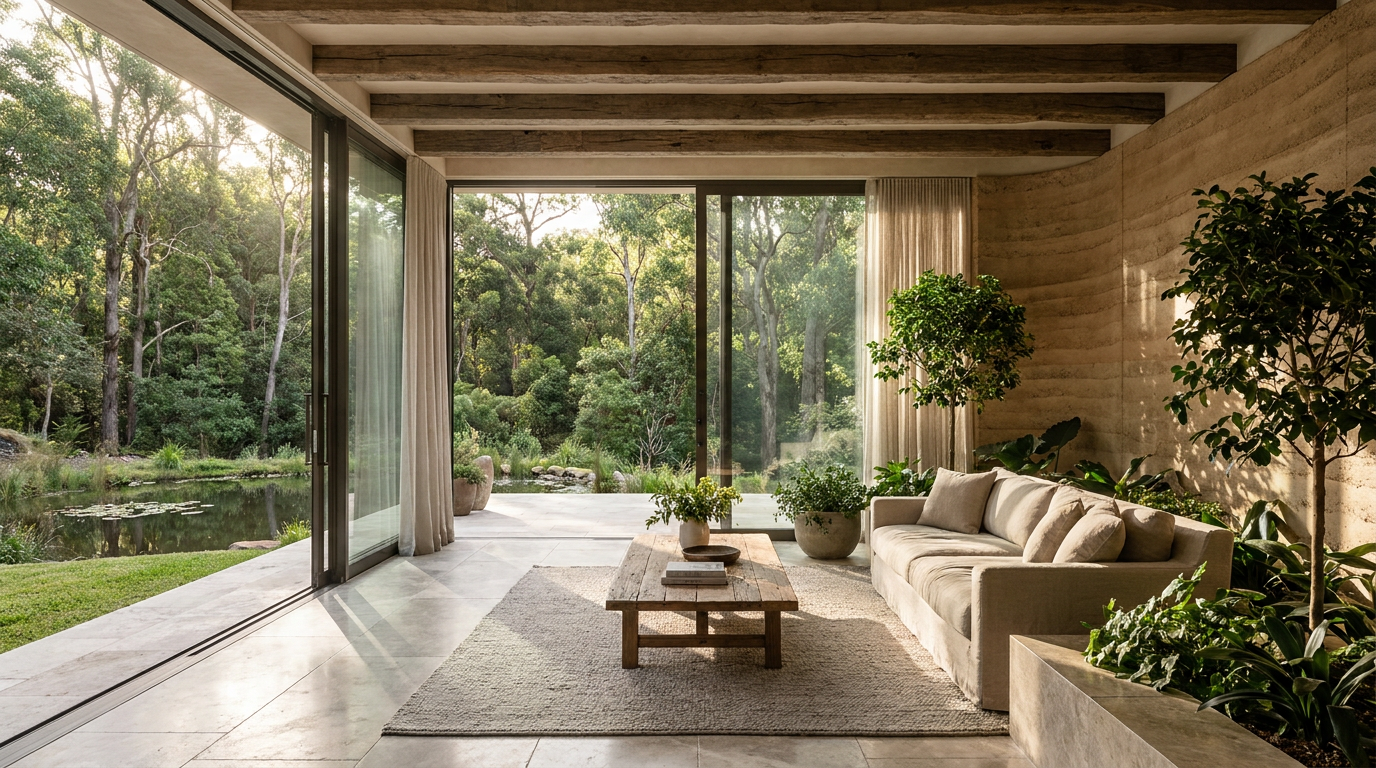
This convergence is heavily influenced by biophilic design, an architectural approach that strengthens the innate human connection to nature. Biophilia goes far beyond adding a few potted plants to a living room; it involves maximizing natural light, utilizing organic, tactile materials like rammed earth, and creating seamless indoor-outdoor transitions that blur the line between the built environment and the natural landscape.[4][5]
The psychological driver behind this structural shift is profound. For decades, the luxury resort stay was viewed as a temporary escape from a daily life that failed to support optimal health. Now, affluent buyers want to build the restorative environment they were escaping to, and live in it every single day. They are demanding homes that serve as multifunctional sanctuaries, offering emotional comfort and a profound sense of calm.[3][4]
This desire for emotional comfort is expanding the conversation into neuroaesthetics—the scientific study of how the built environment affects the brain. Architects are increasingly designing spaces that support cognitive well-being through intentional spatial sequencing, the use of fractal patterns found in nature, and the careful curation of sensory inputs. The most compelling luxury homes in 2026 are those that feel resolved, built with material honesty, and designed to actively lower cortisol levels.[3]

While currently concentrated in the ultra-luxury tier, the innovations pioneered in these longevity residences are beginning to influence broader building standards. The ultimate goal for many in the industry is to scale these health-centric technologies, proving their efficacy at the high end before adapting them for the mass market. As the understanding of the home biome deepens, the features that define today's exclusive longevity residences may soon become the baseline standard for all new residential construction.[3][6]
How we got here
2017
The global wellness real estate market is valued at $151 billion, primarily focused on basic amenities like community gyms.
2024
The market experiences explosive growth, reaching $548 billion as buyers increasingly prioritize health following the global pandemic.
2025
Wellness real estate hits $876 billion, vastly outpacing the growth of the broader global construction industry.
April 2026
The Global Wellness Institute formally names 'longevity residences' as a distinct new sub-category of real estate.
Viewpoints in depth
Longevity & Wellness Advocates
Argue that homes should actively extend healthspan and integrate clinical-grade preventive care into daily life.
This camp views the home not merely as a shelter, but as a primary healthcare tool. They advocate for the integration of biometric tracking, clinical infrastructure, and dedicated wellness staff within residential communities. For these advocates, the ultimate luxury is time, and real estate is the most effective vehicle for delivering continuous, passive health interventions that extend human longevity.
Sustainable Architecture Purists
Emphasize that true wellness must include environmental health, focusing on net-zero emissions and low-carbon materials.
This perspective argues that human health cannot be divorced from planetary health. They caution against "wellness washing"—where homes feature energy-intensive amenities like saunas and cold plunges without addressing the building's overall carbon footprint. Instead, they champion passive house principles, zero-waste construction, and the use of regenerative materials like hempcrete and rammed earth, insisting that a truly healthy home must be net-zero.
Market Expansionists
Focus on scaling these health-centric innovations beyond the ultra-wealthy to improve broader public health.
While acknowledging that the luxury sector funds the initial research and development of these technologies, this camp is focused on democratization. They argue that features like circadian lighting, hospital-grade air filtration, and acoustic zoning should be incorporated into standard building codes rather than reserved for the elite. Their goal is to transform the "home biome" from an exclusive amenity into a baseline standard for all new residential construction.
What we don't know
- How quickly the advanced clinical and biohacking technologies currently reserved for the ultra-wealthy will scale down to middle-market housing.
- The long-term empirical impact of living in a 'longevity residence' on actual human lifespan, as the category is too new for generational data.
- How municipal building codes will adapt to mandate the invisible 'home biome' standards, such as circadian lighting and advanced air purification.
Key terms
- Longevity Residence
- A newly defined category of real estate designed to actively support a longer, healthier life through preventive medicine, biohacking, and optimized environmental factors.
- Home Biome
- The invisible environmental factors within a residence that shape human health, including air quality, water purity, lighting, and acoustics.
- Biophilic Design
- An architectural approach that seeks to connect building occupants more closely to nature through the use of natural light, organic materials, and indoor greenery.
- Circadian Lighting
- Smart lighting systems that automatically adjust their color temperature and brightness throughout the day to mimic the sun, supporting natural sleep-wake cycles.
- Passive House Principles
- A rigorous standard for energy efficiency in a building, which reduces the ecological footprint and results in ultra-low energy homes that require little energy for space heating or cooling.
Frequently asked
What exactly is a longevity residence?
A longevity residence is a home designed specifically to extend the healthy lifespan of its occupants. It goes beyond standard gyms to include clinical-grade air and water purification, biohacking tools like infrared saunas, and sometimes even on-site medical or wellness staff.
Do wellness-focused homes cost more to buy?
Yes. Data shows that residences with integrated wellness and longevity features typically command a 10% to 25% price premium over comparable conventional luxury homes.
How does biophilic design improve health?
Biophilic design integrates natural elements—like sunlight, plants, and natural materials—into the built environment. Studies show this approach lowers stress, improves cognitive function, and enhances mood by satisfying the human psychological need to connect with nature.
Are these features only available in ultra-luxury homes?
Currently, the most advanced systems are concentrated in the luxury market. However, industry experts predict that as the technology scales, features like advanced air filtration and circadian lighting will increasingly become standard in mainstream residential construction.
Sources
Source coverage
6 outlets
3 viewpoints surfaced






[1]Global Wellness InstituteLongevity & Wellness Advocates
Wellness Real Estate Market Report 2026
Read on Global Wellness Institute →[2]Brightwill LuxuryLongevity & Wellness Advocates
Wellness-Led Luxury Residences in 2026: The Quiet Reordering of What HNW Buyers Pay For
Read on Brightwill Luxury →[3]BeautyMatterMarket Expansionists
Wellness Real Estate's Next Chapter Is About How We Feel
Read on BeautyMatter →[4]Engel & VölkersSustainable Architecture Purists
Luxury real estate trends 2026: How lifestyle and wellness are redefining premium property
Read on Engel & Völkers →[5]Found AssociatesSustainable Architecture Purists
What is shaping residential design in 2026?
Read on Found Associates →[6]Factlen Editorial TeamMarket Expansionists
Synthesis by Factlen editorial team
Read on Factlen Editorial Team →
Every angle. Every day.
Get real estate stories with full source coverage and perspective breakdowns delivered to your inbox.