
The Open Social Web Reaches Maturity: How the Fediverse and Bluesky are Breaking Down Walled Gardens
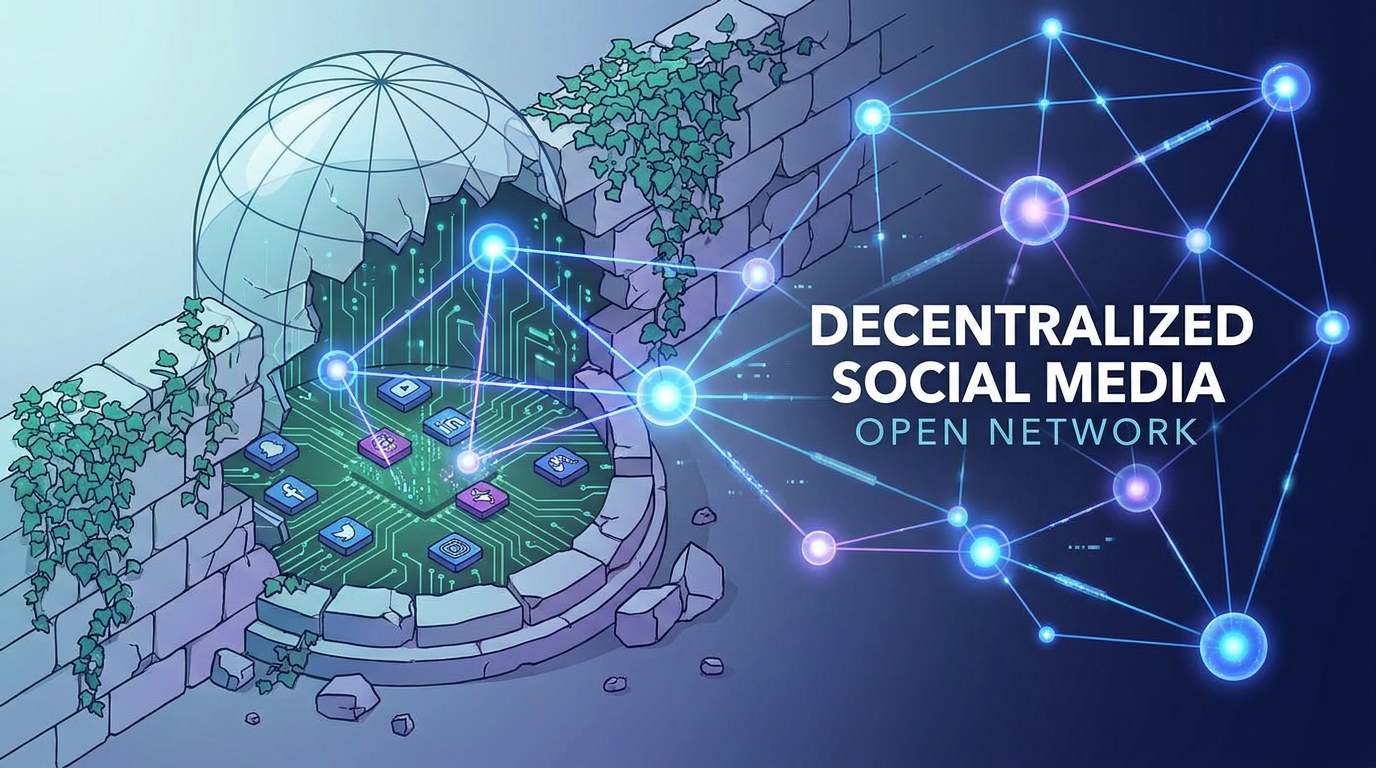
In 2026, decentralized social networks have achieved unprecedented interoperability, allowing users to communicate seamlessly across distinct platforms. This milestone marks a fundamental shift away from corporate-controlled walled gardens toward a user-owned digital ecosystem.
By Factlen Editorial Team

- Mainstream Pragmatists
- Developers and creators focused on usability, algorithmic choice, and bridging protocols to reach the widest possible audience.
- Grassroots Builders
- Advocates who view the open web as a social movement prioritizing community governance, mutual aid, and absolute data sovereignty.
- Digital Sovereignty Advocates
- Policymakers and regulators who see decentralized networks as a way to reduce reliance on foreign tech monopolies and build resilient public infrastructure.
What's not represented
- · Traditional Big Tech executives defending the walled-garden model
- · Advertisers navigating the ad-free nature of the core Fediverse
Why this matters
For the first time in the modern internet era, you no longer have to surrender your data to a single tech giant just to stay connected with your friends and favorite creators. The maturation of decentralized social media means you can finally own your digital identity and take your audience with you wherever you go.
Key points
- Decentralized social media platforms achieved major interoperability milestones in 2026.
- Third-party bridges now allow seamless communication between ActivityPub (Mastodon) and AT Protocol (Bluesky).
- Meta's Threads has partially integrated federated sharing, bringing 500 million users into the open web ecosystem.
- The shift empowers users with true data sovereignty and portable digital identities.
- Tensions remain between grassroots protocol purists and institutional pragmatists over corporate involvement.
For the better part of two decades, the social internet was defined by walled gardens. Platforms like Facebook, Twitter, and Instagram operated on a simple, highly profitable premise: to interact with a network's users, you had to join that specific network, agree to its rules, and surrender your data to its centralized servers. This model created massive, captive audiences and generated billions in advertising revenue, but it also left users vulnerable to sudden algorithmic shifts, arbitrary moderation, and platform decay. If a user wanted to leave, they had to abandon their entire social graph and start over from scratch.[1]
In 2026, that paradigm is fundamentally shifting. The "open social web"—a decentralized ecosystem of independent platforms that communicate seamlessly with one another—has transitioned from a niche technical experiment into a mainstream reality. Driven by a combination of user fatigue with traditional tech giants, regulatory pressure, and significant technological breakthroughs, decentralized social media is finally delivering on its core promise: interoperability.[1]
The concept of interoperability treats social media more like email or a radio broadcast. A user on Gmail can easily send a message to a user on Outlook; similarly, the open social web envisions a landscape where a person on one social platform can follow, reply to, and share content with someone on an entirely different platform. This eliminates the need for users to maintain a dozen different apps just to keep up with various friend groups and creators.[1][2]
At the heart of this movement are two primary protocols, each powering a different vision of the decentralized future. The first is ActivityPub, an open standard endorsed by the World Wide Web Consortium (W3C). ActivityPub is the engine behind the "Fediverse," a network of thousands of independent servers running software like Mastodon. Across the Fediverse, roughly 9,500 active instances connect millions of users who prioritize community autonomy, strict privacy, and freedom from corporate algorithms.[4][6]

The second major framework is the AT Protocol, developed by Bluesky. Originally incubated within Twitter before spinning off as an independent entity, Bluesky approaches decentralization with a focus on user experience and algorithmic choice. Rather than relying on community-run servers for identity, the AT Protocol allows users to maintain a portable digital identity that can move seamlessly between different hosting providers without losing followers or data. By 2026, Bluesky's user base is projected to cross 60 million, driven by its familiar, microblogging interface and rapid feature development.[1][4][5]
For years, these two protocols existed as parallel universes, unable to communicate natively. But the landscape changed dramatically with the maturation of third-party bridging tools. Services like BridgyFed now act as universal translators between ActivityPub and the AT Protocol. This means a Bluesky user can seamlessly follow a Mastodon account, and vice versa, effectively merging the two largest decentralized networks into a single, massive conversation space.[1][2]
The bridging experience is still evolving, occasionally requiring users to navigate clunky, auto-generated usernames to route messages across the protocol divide. However, the underlying technology has stabilized, allowing posts, likes, and replies to flow between networks in near real-time. This technical bridge represents a monumental achievement for open-source developers, proving that distinct architectural philosophies can coexist and interoperate without a centralized corporate mediator.[1][2]
The most significant—and controversial—catalyst for the open social web's growth has been the entry of Meta's Threads. Leveraging its massive Instagram user base, Threads quickly became the largest microblogging platform in the world, boasting upwards of 500 million monthly active users. Crucially, Meta committed to integrating ActivityPub into Threads, allowing its users to opt-in to federated sharing.[2][5]
The most significant—and controversial—catalyst for the open social web's growth has been the entry of Meta's Threads.
Threads' integration is partial and remains a work in progress, with full two-way federation rolling out slowly. Yet, its mere presence has fundamentally altered the decentralized landscape. For creators and brands, the ability to reach a mainstream audience on Threads while simultaneously broadcasting to the independent Fediverse offers an unprecedented level of reach and flexibility. It bridges the gap between the massive scale of corporate social media and the resilience of decentralized networks.[1][4][5]

However, Meta's embrace of ActivityPub has sparked intense debate within the grassroots communities that built the Fediverse. Many early adopters view the open web as a social movement designed explicitly to resist corporate capture and surveillance capitalism. These users fear that Meta will employ an "embrace, extend, and extinguish" strategy, using its massive resources to dominate the protocol and eventually dictate its future development. In response, numerous Mastodon instances have preemptively blocked Threads, choosing to maintain smaller, independent communities free from algorithmic influence.[1][2][8]
This tension highlights a broader cultural divide within the decentralized space. On one side are the "grassroots builders"—activists, privacy advocates, and protocol purists who prioritize mutual aid, community governance, and absolute data sovereignty. On the other side are the "institutional pragmatists"—developers and startup founders who believe that for decentralized social media to succeed, it must be legible to regulators, attractive to mainstream users, and capable of supporting sustainable business models.[8]
Beyond Mastodon and Bluesky, other protocols are pushing the boundaries of what data sovereignty means. Nostr (Notes and Other Stuff Transmitted by Relays) takes a radically different approach, decoupling identity entirely from servers. On Nostr, a user's identity is simply a cryptographic key pair. Posts are cryptographically signed and broadcast to various relays, meaning the user has absolute ownership of their data and social graph, completely immune to server-level censorship.[7]
While Nostr's architecture offers the purest form of digital autonomy, its steep learning curve and abstract mental model have kept it largely confined to niche communities, particularly among cryptocurrency advocates. Yet, its existence pushes the broader ecosystem to innovate, demonstrating that true permissionless networking is technically feasible, even if mainstream adoption remains challenging.[1][7]
The shift toward decentralized architecture also fundamentally changes how content moderation works. In the walled-garden era, a single trust and safety team in Silicon Valley dictated the rules for billions of global users. In the Fediverse, moderation is handled at the server level; individual communities set their own rules and can sever ties with servers that harbor toxic content. Bluesky takes a different approach, allowing users to subscribe to custom, third-party moderation lists and algorithms, effectively unbundling moderation from hosting.[4]

This decentralized approach to governance is increasingly catching the attention of global policymakers. Regulators, particularly in Canada and the European Union, are beginning to recognize that traditional platform regulations—designed to rein in massive tech monopolies—are ill-suited for volunteer-run, community-governed networks. There is a growing push to develop interoperability-based legal frameworks that protect users without overburdening the grassroots infrastructure of the open web.[3]
For governments, decentralized social media also aligns with broader goals of "digital sovereignty"—the desire to reduce reliance on foreign-owned tech conglomerates and foster local, resilient digital infrastructure. As the technology matures, it is highly likely that public institutions, universities, and even national governments will begin hosting their own instances, ensuring that critical public discourse is not subject to the whims of a single corporate CEO.[1][3]
Despite these massive strides, the open social web is not without its friction points. The onboarding process for new users can still be daunting, requiring them to choose a server or understand the difference between protocols before they can even make their first post. Cross-platform discovery—finding friends who might be scattered across Mastodon, Bluesky, and Threads—remains a clunky experience compared to the frictionless contact-syncing of centralized apps.[1][7]

Nevertheless, the milestones achieved in 2026 mark a point of no return. The infrastructure for a user-owned, interoperable social internet has been built, tested, and deployed at scale. The era of being locked into a single platform is ending, replaced by a dynamic ecosystem where users can finally choose their interface, own their audience, and participate in a global conversation on their own terms.[1]
How we got here
2016
Mastodon launches, popularizing the concept of the Fediverse and community-run servers.
2023
Bluesky launches as an invite-only beta, introducing the AT Protocol and the concept of portable identity.
2024
Meta's Threads begins testing ActivityPub integration, bringing mainstream attention to federation.
2025
Third-party bridges like BridgyFed launch, allowing early cross-protocol communication.
2026
Decentralized social media reaches a critical mass of interoperability, connecting millions across distinct protocols.
Viewpoints in depth
The Grassroots Builders' View
Prioritizing community autonomy and resisting corporate capture.
For the activists and protocol purists who built the early Fediverse, decentralization is fundamentally a social movement, not just a technological upgrade. This camp argues that true resilience comes from small, self-governed communities that operate outside the influence of venture capital and advertising models. They are deeply skeptical of Meta's entry into the space, fearing that corporate giants will use their massive scale to dictate protocol standards and eventually re-centralize the network. For these builders, the ability to block corporate instances is a vital feature of a healthy ecosystem.
The Mainstream Pragmatists' View
Focusing on usability, scale, and seamless interoperability.
Pragmatists argue that for the open social web to succeed, it must be accessible to the average user who doesn't care about the technical nuances of protocols. This viewpoint champions the development of seamless bridges between networks and the integration of platforms like Threads, arguing that bringing 500 million mainstream users into the federated orbit is a massive victory. They believe that giving users algorithmic choice and portable identities—as seen in Bluesky's architecture—is the most realistic path to breaking the monopoly of traditional walled gardens.
What we don't know
- How Meta's Threads will fully implement two-way federation and whether it will attempt to dominate the ActivityPub standard.
- Whether decentralized platforms can develop sustainable funding models that don't rely on traditional advertising or venture capital.
- How mainstream users will adapt to the complexities of server-level moderation and cross-platform discovery.
Key terms
- Fediverse
- A collection of interconnected, community-owned social platforms that can communicate with each other, primarily using the ActivityPub protocol.
- ActivityPub
- An open, decentralized social networking protocol endorsed by the W3C, used by Mastodon and partially by Threads.
- AT Protocol
- The underlying open-source framework developed by Bluesky that allows for account portability and algorithmic choice.
- Bridging
- Technical solutions that translate messages between different protocols, allowing users on distinct networks to interact seamlessly.
- Data Sovereignty
- The concept that users should have complete ownership and control over their digital identity and social graph, rather than surrendering it to a corporation.
Frequently asked
Can a Bluesky user follow a Mastodon user?
Yes. Through third-party bridging tools like BridgyFed, users on different protocols can now follow and interact with each other, effectively merging the networks.
Is Threads part of the Fediverse?
Threads has partially integrated the ActivityPub protocol, allowing users to opt-in to sharing their posts with the broader Fediverse, though full two-way federation is still rolling out.
Do I have to pay to use these networks?
Most decentralized networks are free to use. However, some individual servers (instances) may ask for voluntary donations to cover hosting costs, and premium features may emerge over time.
Who moderates decentralized social media?
Moderation is handled at the server or community level rather than by a central corporate authority. Users can choose servers with rules that align with their preferences, or subscribe to custom moderation algorithms.
Sources
Source coverage
8 outlets
3 viewpoints surfaced








[1]Factlen Editorial TeamGrassroots Builders
Synthesis by Factlen editorial team
Read on Factlen Editorial Team →[2]Electronic Frontier FoundationMainstream Pragmatists
A Bridge to Somewhere: How to Link Your Mastodon, Bluesky, or Other Federated Accounts
Read on Electronic Frontier Foundation →[3]Digital Policy HubDigital Sovereignty Advocates
Governing Decentralized Social Media in a Centralized Policy World
Read on Digital Policy Hub →[4]AdaptlyPostMainstream Pragmatists
Mastodon vs Bluesky: Comparing Decentralized Social Networks in 2026
Read on AdaptlyPost →[5]Tim Chambers BlogMainstream Pragmatists
My 2026 Open Social Web Predictions
Read on Tim Chambers Blog →[6]GetBlockDigital Sovereignty Advocates
Web3 Social Media Platforms 2026
Read on GetBlock →[7]DyneGrassroots Builders
The Sovereign Protocol: NOSTR and the Architecture of Autonomy
Read on Dyne →[8]Hamish CampbellGrassroots Builders
The tension that's pushed back into the fediverse the last few years
Read on Hamish Campbell →

More in technology
See all 5 stories →

Every angle. Every day.
Get technology stories with full source coverage and perspective breakdowns delivered to your inbox.