
The 'Library of Things' movement is turning neighborhoods into shared economies
Communities worldwide are expanding beyond books to lend power tools, camping gear, and appliances, saving residents money while reducing environmental waste.
By Factlen Editorial Team
- Circular Economy Advocates
- Focus on reducing material waste and carbon emissions by maximizing the lifespan of manufactured goods.
- Community Equity Organizers
- Focus on lowering financial barriers, providing access to essential tools, and building local wealth.
- Municipal & Library Planners
- Focus on modernizing public services and integrating physical item lending into existing infrastructure.
What's not represented
- · Traditional hardware retailers and tool manufacturers whose sales models rely on individual ownership.
Why this matters
By shifting from a model of individual ownership to community access, neighborhoods are lowering the cost of living, reducing carbon emissions, and rebuilding local social ties.
Key points
- Libraries of Things (LoTs) allow community members to borrow tools, appliances, and gear instead of buying them.
- There are currently over 2,000 formal sharing libraries operating globally.
- The model saves residents money, with average savings estimated at $60 per borrowed tool.
- Sharing drastically reduces environmental waste by maximizing the lifespan of manufactured goods.
- Many hubs also host repair workshops, teaching residents how to fix broken items.
- Public library systems are increasingly adopting the model to modernize their community services.
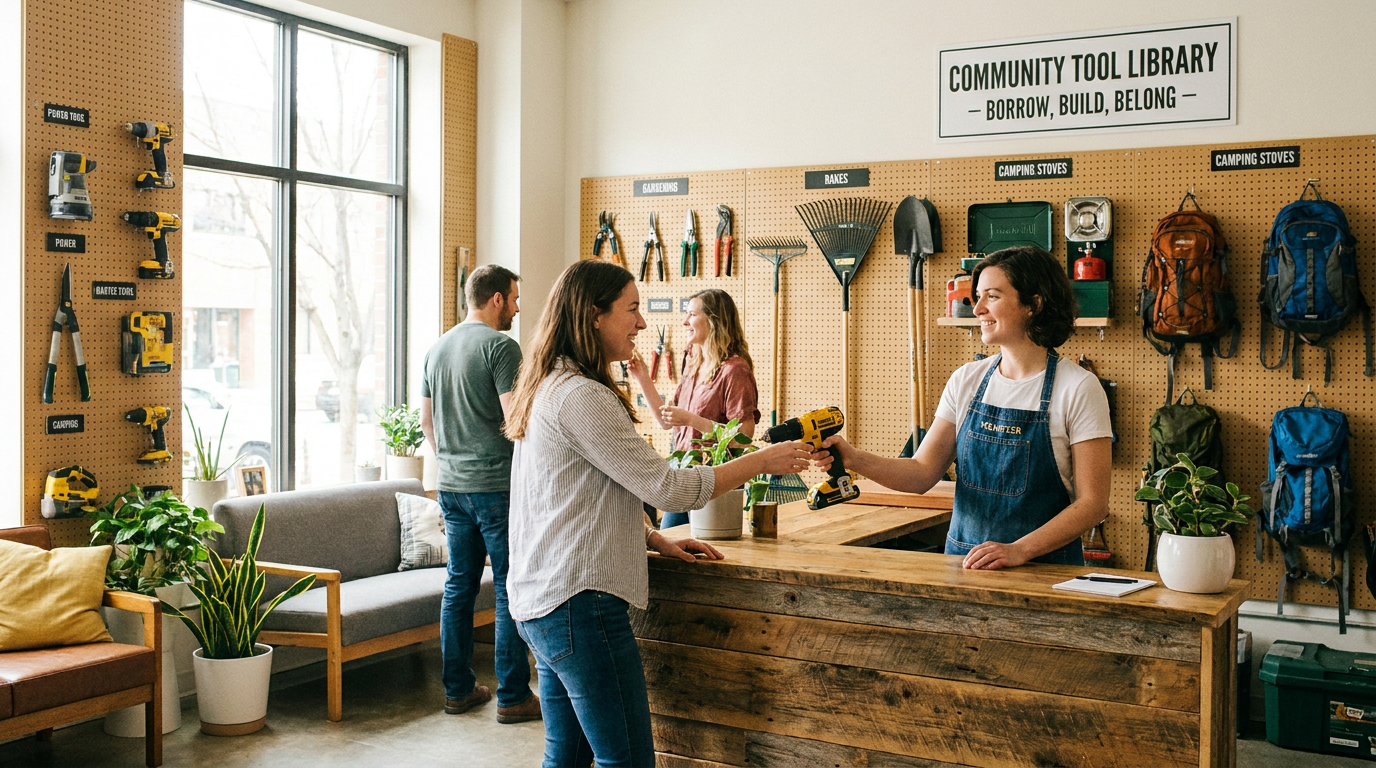
For decades, the standard household model has required families to purchase, store, and maintain a vast inventory of items they rarely use. From power drills and pressure washers to camping tents and carpet cleaners, garages and closets have become graveyards for single-use purchases. But a rapidly growing movement known as the "Library of Things" (LoT) is rewriting the rules of neighborhood consumption, replacing individual ownership with community access.[1][6]
The concept is straightforward: instead of buying an expensive item for a weekend project, residents can check it out from a local hub, use it, and return it. While the idea of tool lending libraries dates back to the late 1970s—with the Berkeley Public Library launching its tool collection in 1979—the modern LoT movement has surged in recent years. Today, there are an estimated 2,000 formal Libraries of Things operating worldwide, alongside countless informal neighborhood sharing networks.[1]
The mechanics of these libraries vary by community, but they generally follow a simple, accessible model. Members typically pay a small annual fee or a sliding-scale, pay-as-you-go rate to access the inventory. In the UK, for example, a network of sharing libraries allows residents to rent a power drill for roughly £6 a day, compared to the steep cost of purchasing one new. To make the process seamless, many modern LoTs have integrated digital booking software and self-serve smart lockers located in community centers, transit hubs, and existing public libraries.[2][5]

Beyond convenience, the economic impact of these sharing hubs is profound. For low- and middle-income households, the upfront cost of home repair tools, gardening equipment, or specialized appliances can be prohibitive. By removing these financial barriers, tool libraries help bridge neighborhood wealth gaps. Residents can maintain their homes, cultivate gardens, and even launch small businesses without taking on high-interest debt to purchase equipment. Studies estimate that users save an average of $60 every time they borrow a tool rather than buying it.[1][4]
Beyond convenience, the economic impact of these sharing hubs is profound.
The environmental stakes are equally significant. The Library of Things operates on the principles of the circular economy, which seeks to maximize the lifespan of manufactured goods and drastically reduce material waste. The statistics surrounding household consumption are stark; researchers frequently note that the average power drill is used for only about 15 minutes over its entire lifespan. By circulating a single drill among dozens of households, communities drastically cut down on the carbon emissions and raw material extraction required to manufacture new products.[1][3]
Advocates point out that maintaining and repairing shared items keeps them out of landfills for much longer than individually owned goods. Many LoTs also serve as hosts for "repair cafes" and skill-sharing workshops, where volunteers teach neighbors how to fix broken appliances, mend clothing, or safely operate power tools. This educational component transforms the library from a mere rental service into a hub for community resilience and self-sufficiency.[2][6]

Crucially, the movement is fostering a renewed sense of local connection in an era of increasing social isolation. When residents visit a sharing hub, they interact with volunteers, swap advice on DIY projects, and engage with neighbors they might never otherwise meet. Organizers report that these interactions build a foundation of mutual aid and trust, making neighborhoods more cohesive and better prepared to support one another during emergencies or economic downturns.[4][5]
As the concept proves its viability, municipal governments and traditional public library systems are increasingly adopting the model. Many city councils are now providing grants and physical space to help launch new sharing hubs, recognizing them as essential civic infrastructure. Public libraries, long the champions of shared knowledge, are expanding their catalogs to include "things"—ranging from thermal imaging cameras to check for home heat loss, to autism sensory kits and seeds for local gardens.[1][5][6]

The trajectory of the Library of Things suggests a fundamental shift in how communities define wealth and abundance. By pooling resources, neighborhoods are proving that access is often more valuable than ownership. As the sharing economy continues to mature, these local hubs are demonstrating that the most sustainable and economically resilient communities are those that build systems to share what they have.[3][6]
How we got here
1979
The Berkeley Public Library launches one of the first formal tool lending libraries in the United States.
2010s
The modern Library of Things movement gains traction in Europe and North America, driven by circular economy principles.
2020
The pandemic highlights the need for local community resilience, sparking a surge in mutual aid and neighborhood sharing networks.
2024–2026
Municipalities increasingly integrate sharing hubs into public infrastructure, utilizing smart lockers and digital booking apps.
Viewpoints in depth
Circular Economy Advocates
Focus on the environmental necessity of reducing material waste and carbon emissions.
This perspective argues that the current model of hyper-consumption—where every household owns identical, rarely used items—is ecologically unsustainable. By maximizing the utilization rate of a single manufactured product, communities can drastically cut down on the raw material extraction, manufacturing emissions, and landfill waste associated with consumer goods. They view the Library of Things as a critical stepping stone away from a linear 'take-make-dispose' economy.
Community Equity Organizers
Emphasize the role of sharing libraries in lowering financial barriers and building local wealth.
For equity advocates, the primary value of a tool library is economic justice. They highlight how the high upfront costs of tools and equipment disproportionately affect low-income neighborhoods, preventing residents from maintaining their homes or pursuing entrepreneurial ventures. By providing affordable access to these resources, sharing libraries help close the wealth gap, allowing marginalized communities to invest their savings into other essential needs.
Municipal Planners
View sharing hubs as an evolution of essential public infrastructure.
City planners and library administrators increasingly see the lending of physical items as a natural extension of traditional library services. They argue that integrating a Library of Things into existing civic spaces—such as public libraries or community centers—makes neighborhoods more resilient. This camp focuses on the logistics of scaling these programs, securing municipal grants, and using shared resources to support broader city goals like climate action and emergency preparedness.
What we don't know
- How quickly traditional public library systems will universally adopt and fund non-traditional item lending.
- Whether the sharing economy model can scale effectively in highly dispersed rural areas compared to dense urban centers.
Key terms
- Library of Things (LoT)
- A community-based service that allows people to borrow infrequently used physical items, such as tools and appliances, rather than purchasing them.
- Circular Economy
- An economic model focused on sharing, leasing, reusing, repairing, and recycling existing materials and products for as long as possible to reduce waste.
- Mutual Aid
- A voluntary, reciprocal exchange of resources and services among community members to provide mutual benefit and support.
- Repair Cafe
- A community gathering where volunteers help residents fix their broken household items, teaching repair skills and preventing waste.
Frequently asked
What kind of items can I borrow from a Library of Things?
Inventories vary, but common items include power tools, gardening equipment, carpet cleaners, camping gear, sewing machines, and board games.
How much does it cost to use a sharing library?
Most operate on a low-cost model, offering either a small annual membership fee or pay-as-you-go rentals. Many also offer free or concession rates for low-income residents.
Are these libraries run by the government or volunteers?
It is a mix. Many are independent non-profits run by community volunteers, while an increasing number are being integrated directly into municipal public library systems.
How do sharing libraries help the environment?
By allowing dozens of people to share a single item, they reduce the carbon emissions, raw material extraction, and packaging waste associated with manufacturing new products.
Sources
Source coverage
6 outlets
3 viewpoints surfaced





[1]ShareableCommunity Equity Organizers
Library of Things Toolkit
Read on Shareable →[2]Good HousekeepingCircular Economy Advocates
How a 'library of things' can save you money and help the planet
Read on Good Housekeeping →[3]Planet Smart CityCircular Economy Advocates
What is the Library of Things and how does it work?
Read on Planet Smart City →[4]Sierra Service ProjectCommunity Equity Organizers
How Tool Libraries Build Community Wealth
Read on Sierra Service Project →[5]MediumMunicipal & Library Planners
A Library of Things works like this
Read on Medium →[6]Factlen Editorial TeamMunicipal & Library Planners
Synthesis by Factlen editorial team
Read on Factlen Editorial Team →
Every angle. Every day.
Get community stories with full source coverage and perspective breakdowns delivered to your inbox.