
JWST Directly Reads the Surface Geology of a Rocky Exoplanet for the First Time
Astronomers using the James Webb Space Telescope have analyzed the thermal emission of the super-Earth LHS 3844 b, revealing a dark, airless world covered in basaltic rock.
By Factlen Editorial Team
- Exoplanetary Geologists
- Focuses on the planet's basaltic composition and what the lack of silicates reveals about its tectonic history.
- Atmospheric Modelers
- Emphasizes the confirmation of an airless world, which helps refine models of how red dwarf stars strip atmospheres from close-in planets.
- Observational Astronomers
- Highlights the technical triumph of JWST's MIRI instrument in isolating a planet's thermal emission across interstellar distances.
What's not represented
- · Astrobiologists studying the implications of airless worlds for the broader search for extraterrestrial life.
Why this matters
For decades, scientists could only guess at the surface compositions of planets outside our solar system. This breakthrough proves we now have the technology to conduct remote geology across dozens of light-years, opening a new era in understanding how rocky worlds form and evolve.
Key points
- JWST successfully analyzed the thermal emission of LHS 3844 b, marking the first direct geological profiling of a rocky exoplanet.
- The data confirms the planet is completely devoid of an atmosphere.
- The surface is composed of dark, iron-rich basalt rather than lighter, silica-rich rocks like granite.
- The absence of silicates strongly suggests the planet never experienced Earth-like plate tectonics.
- A lack of sulfur dioxide indicates the world is geologically inactive, with no ongoing volcanism.
For decades, the study of planets beyond our solar system has been an exercise in indirect observation, limited to measuring a world's mass, its radius, and occasionally the chemical makeup of its atmosphere. But astronomers using the James Webb Space Telescope (JWST) have now crossed a historic threshold. In a landmark study, researchers have successfully analyzed the thermal emission of a rocky exoplanet, directly reading its surface geology from dozens of light-years away. This achievement marks a profound shift in astronomy, moving the field from simply discovering exoplanets to conducting remote geological surveys of alien crusts.[3][6]
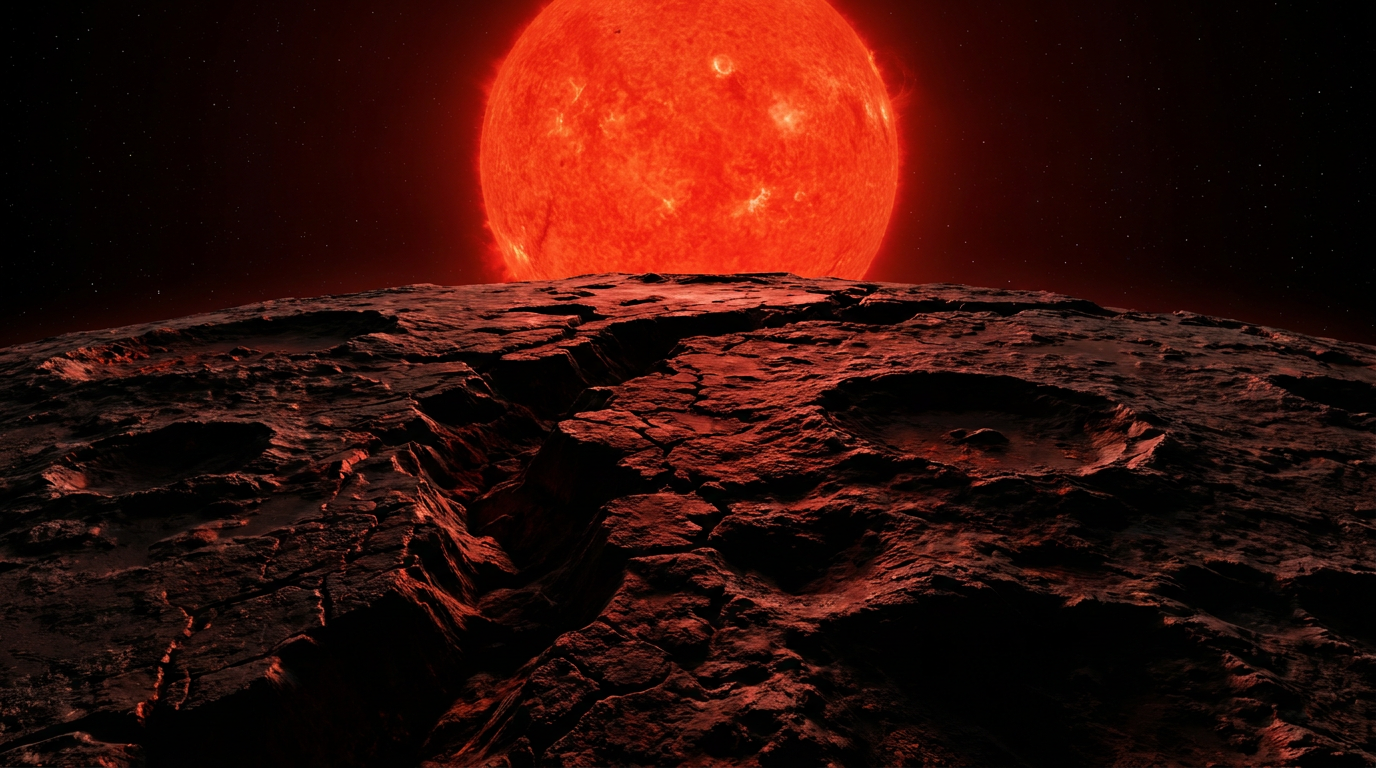
The subject of this unprecedented observation is LHS 3844 b, a rocky world located approximately 48.5 light-years from Earth in the southern constellation of Indus. Informally known as Kua'kua—a word meaning "butterfly" in the Indigenous Bribri language of Costa Rica—the planet was first identified in 2018 by NASA's Transiting Exoplanet Survey Satellite (TESS). Classified as a "super-Earth," Kua'kua is roughly 30 percent larger than our own planet and packs about twice its mass. However, despite its terrestrial classification, the environment on Kua'kua is entirely alien to anything found in our solar system.[4][6]
Kua'kua orbits a cool red dwarf star, known as Batsu, at an incredibly close distance, completing a full planetary year in just 11 hours. Because of this extreme proximity, the planet is tidally locked by the immense gravitational pull of its host star. Much like how the Moon always shows the same face to Earth, Kua'kua presents a single, unchanging hemisphere to its star. This perpetual dayside is baked by relentless stellar radiation, resulting in a constant surface temperature of approximately 1,000 Kelvin, or 1,340 degrees Fahrenheit—hot enough to melt aluminum.[5][7]
To peer across the interstellar void and determine what Kua'kua is made of, an international team of researchers led by Sebastian Zieba of the Center for Astrophysics | Harvard & Smithsonian, and Laura Kreidberg of the Max Planck Institute for Astronomy, turned to JWST's Mid-Infrared Instrument (MIRI). Because the planet is millions of times fainter than its host star, taking a direct photograph of its surface is currently impossible. Instead, the team relied on a highly precise technique known as secondary eclipse spectroscopy to isolate the planet's faint thermal glow.[1][2]

The mechanics of a secondary eclipse are a masterclass in observational astronomy. As Kua'kua orbits Batsu, there is a brief window where the planet slips directly behind the star from the perspective of Earth. By measuring the total infrared light of the system just before the eclipse, and then measuring the light of the star alone while the planet is hidden, astronomers can subtract the latter from the former. The remaining data represents the pure infrared emission radiating directly from the scorching dayside of the exoplanet.[4][6]
The mechanics of a secondary eclipse are a masterclass in observational astronomy.
The first major claim established by the JWST evidence pack is that Kua'kua is completely devoid of an atmosphere. If the planet possessed a gaseous envelope—even a thin one composed of carbon dioxide or nitrogen—the MIRI data would have revealed specific absorption signatures where those gases blocked certain wavelengths of infrared light. Furthermore, an atmosphere would circulate heat from the blistering dayside to the freezing nightside. Instead, the temperature profile perfectly matches a bare, airless rock absorbing and re-radiating stellar energy with zero atmospheric interference.[1][3]
With the atmosphere ruled out, the researchers could analyze the unobstructed emission spectrum of the surface itself, leading to their second major claim: Kua'kua is covered in dark, basaltic rock. Different minerals emit infrared light at distinct, identifiable wavelengths. The data returned by JWST showed a stark absence of silica-rich rocks, such as the granite that makes up much of Earth's continental crust. Instead, the spectral fingerprint closely aligns with basalt or mantle rock—heavy, dark volcanic materials rich in iron and magnesium.[1][5]

This basaltic composition provides the foundation for the team's third claim: Kua'kua lacks Earth-like plate tectonics. On our planet, the formation of a lighter, silicate-rich crust is the result of billions of years of tectonic activity. This prolonged geological refinement process relies heavily on surface oceans and subterranean water acting as a lubricant, allowing lighter minerals to separate from the heavier mantle rock and rise to the surface. The complete absence of these silicates on Kua'kua strongly implies that this tectonic recycling never occurred.[2][4]
The evidence for a geologically dead world is further bolstered by the lack of volcanic gases. On active bodies within our own solar system, such as Earth or Jupiter's highly volcanic moon Io, tectonic and magmatic activity constantly releases gases like sulfur dioxide into the environment. Even without a permanent atmosphere, a steady rate of volcanic eruptions on Kua'kua would have created a detectable, transient haze of sulfur dioxide. JWST's instruments searched for this specific chemical signature and found absolutely nothing, indicating a stagnant, inactive crust.[1][7]
While the broad composition of the planet is now known, transparent uncertainty remains regarding the exact physical texture of the surface. The current infrared data cannot definitively distinguish between a solid, unbroken slab of cooled magmatic rock and a landscape covered in a thick layer of pulverized, weathered gravel. Given the lack of an atmosphere to burn up incoming debris, researchers strongly suspect the surface is coated in a dark, space-weathered powder—known as regolith—similar to the heavily cratered terrains of our Moon or the planet Mercury.[5][6]

To resolve this uncertainty, future observation campaigns with JWST are already being planned. Astronomers intend to measure the planet's phase curve, tracking how its infrared brightness changes at different viewing angles as it orbits its star. Because rough, gravel-covered surfaces scatter light differently than smooth, solid rock, these phase curves will allow scientists to map the physical roughness of the alien terrain. This technique has been successfully used to characterize asteroids in our solar system, but applying it to an exoplanet represents another unprecedented leap.[2][4]
The successful geological profiling of LHS 3844 b serves as a powerful proof-of-concept for the future of exoplanet science. By demonstrating that JWST can accurately read the mineralogy of a world 48 light-years away, astronomers have unlocked a new methodology for exploring the cosmos. As researchers apply these techniques to other rocky exoplanets, they will gradually build a comprehensive catalog of alien geologies, helping us understand the diverse and complex ways that terrestrial worlds form, evolve, and eventually die across the Milky Way.[3][7]

How we got here
2018
The Transiting Exoplanet Survey Satellite (TESS) discovers LHS 3844 b by observing it cross in front of its host star.
2019
Initial observations with the Spitzer Space Telescope suggest the planet likely lacks a thick atmosphere.
May 2026
Astronomers publish JWST data in Nature Astronomy, providing the first detailed mid-infrared spectrum of the planet's surface geology.
Viewpoints in depth
Exoplanetary Geologists
Reading the tectonic history of an alien world.
For geologists, the most striking revelation is the absence of a silicate-rich crust. On Earth, granite and other silicates are the product of billions of years of plate tectonics, where water lubricates the crust and allows lighter minerals to rise to the surface. The fact that Kua'kua is covered in heavy, dark basalt—similar to Earth's mantle or the primordial lunar maria—suggests it never developed a recycling tectonic system. This implies a 'stagnant lid' geology, where the crust remains a single, unbroken shell, fundamentally altering our understanding of how rocky planets evolve without water.
Atmospheric Modelers
Understanding the harsh environment of red dwarf systems.
Atmospheric scientists view Kua'kua as a crucial data point in the ongoing debate about the habitability of red dwarf systems. Because red dwarfs are cooler, their habitable zones are much closer to the star, subjecting planets to intense stellar winds and frequent flares. The definitive proof that Kua'kua has been stripped completely bare of any atmosphere—lacking even a thin layer of carbon dioxide—supports models predicting that close-in planets around M-dwarf stars face severe atmospheric erosion, making them unlikely candidates for surface life.
Observational Astronomers
Pushing the limits of infrared spectroscopy.
From an observational standpoint, the success of this study is a testament to the unprecedented sensitivity of JWST's Mid-Infrared Instrument (MIRI). Isolating the thermal glow of a planet that is millions of times fainter than its host star, from 48 light-years away, requires measuring minute dips in infrared light during a secondary eclipse. Astronomers see this as a proof-of-concept that will unlock a new era of remote geology, allowing telescopes to map the surface compositions of dozens of other rocky exoplanets in the coming decade.
What we don't know
- Whether the basaltic surface is a solid, unbroken slab of cooled magma or a thick layer of pulverized, space-weathered gravel.
- The exact mechanism that stripped the planet of its primordial atmosphere, and whether it ever possessed one.
- How the extreme temperature differential between the permanent dayside and nightside affects the deep interior structure of the planet.
Key terms
- Secondary eclipse spectroscopy
- A technique where astronomers measure the light of a star system just before a planet passes behind the star, allowing them to isolate the light emitted by the planet itself.
- Tidal locking
- A gravitational phenomenon where a planet's rotation matches its orbit, causing the same side to permanently face its host star.
- Basalt
- A dark-colored, fine-grained volcanic rock rich in iron and magnesium, common on Earth's ocean floor and the lunar maria.
- Red dwarf
- A small, relatively cool star that is the most common type of star in the Milky Way galaxy.
- Super-Earth
- An exoplanet with a mass higher than Earth's, but substantially below those of the Solar System's ice giants, Uranus and Neptune.
Frequently asked
How far away is the exoplanet Kua'kua?
It is located 48.5 light-years from Earth in the southern constellation of Indus.
Could this rocky planet support alien life?
No. It completely lacks an atmosphere, and its dayside temperature reaches roughly 1,340 degrees Fahrenheit, making it entirely inhospitable to life as we know it.
Why is the planet informally named Kua'kua?
Kua'kua is the informal name approved by the International Astronomical Union, derived from the Indigenous Bribri language of Costa Rica, meaning "butterfly."
Sources
Source coverage
7 outlets
3 viewpoints surfaced







[1]Nature AstronomyExoplanetary Geologists
The dark and featureless surface of rocky exoplanet LHS 3844 b from JWST mid-infrared spectroscopy
Read on Nature Astronomy →[2]Max Planck Institute for AstronomyExoplanetary Geologists
A dark and airless rocky super-Earth
Read on Max Planck Institute for Astronomy →[3]Space.comObservational Astronomers
James Webb Space Telescope directly studies an exoplanet's surface for the 1st time
Read on Space.com →[4]Universe TodayObservational Astronomers
JWST Observations Allow Scientists to Get More Information About Distant Worlds
Read on Universe Today →[5]ScienceAlertAtmospheric Modelers
JWST Reveals A Star-Scorched Mercury-Like Planet That's Bigger Than Earth
Read on ScienceAlert →[6]University of ChicagoAtmospheric Modelers
Scientists get their best-ever look at distant planet's surface
Read on University of Chicago →[7]Penn State UniversityExoplanetary Geologists
Astronomers explore surface composition of a bare planet's hot crust 50 light-years from Earth
Read on Penn State University →
Every angle. Every day.
Get science stories with full source coverage and perspective breakdowns delivered to your inbox.