
The Rise of Local AI: How 2026 Became the Year Your Devices Stopped Needing the Cloud
Advances in neural processing hardware and highly optimized small language models have made it possible to run powerful AI directly on personal laptops and phones. This shift offers unprecedented privacy, zero subscription costs, and offline capabilities, fundamentally changing how users interact with artificial intelligence.
By Factlen Editorial Team
- Open-Source Developers
- Advocates for building AI tools that are free from corporate API lock-in.
- Privacy Advocates
- Focuses on the necessity of keeping sensitive data entirely on-device.
- Cloud Infrastructure Providers
- Maintains that centralized data centers remain essential for frontier AI capabilities.
What's not represented
- · Hardware Manufacturers
- · Cybersecurity Auditors
Why this matters
Running AI locally means your sensitive data never leaves your machine, eliminating privacy risks and recurring API bills while ensuring your tools work flawlessly even without an internet connection.
Key points
- Local AI allows users to run powerful language models directly on their own devices without an internet connection.
- The shift is powered by Neural Processing Units (NPUs) and highly optimized Small Language Models (SLMs).
- Tools like Ollama and LM Studio have democratized access, replacing complex coding setups with simple one-click installations.
- Running AI locally guarantees that sensitive data never leaves the machine, solving major enterprise privacy concerns.
- The industry is moving toward a hybrid model, where devices handle routine tasks locally and route complex reasoning to the cloud.
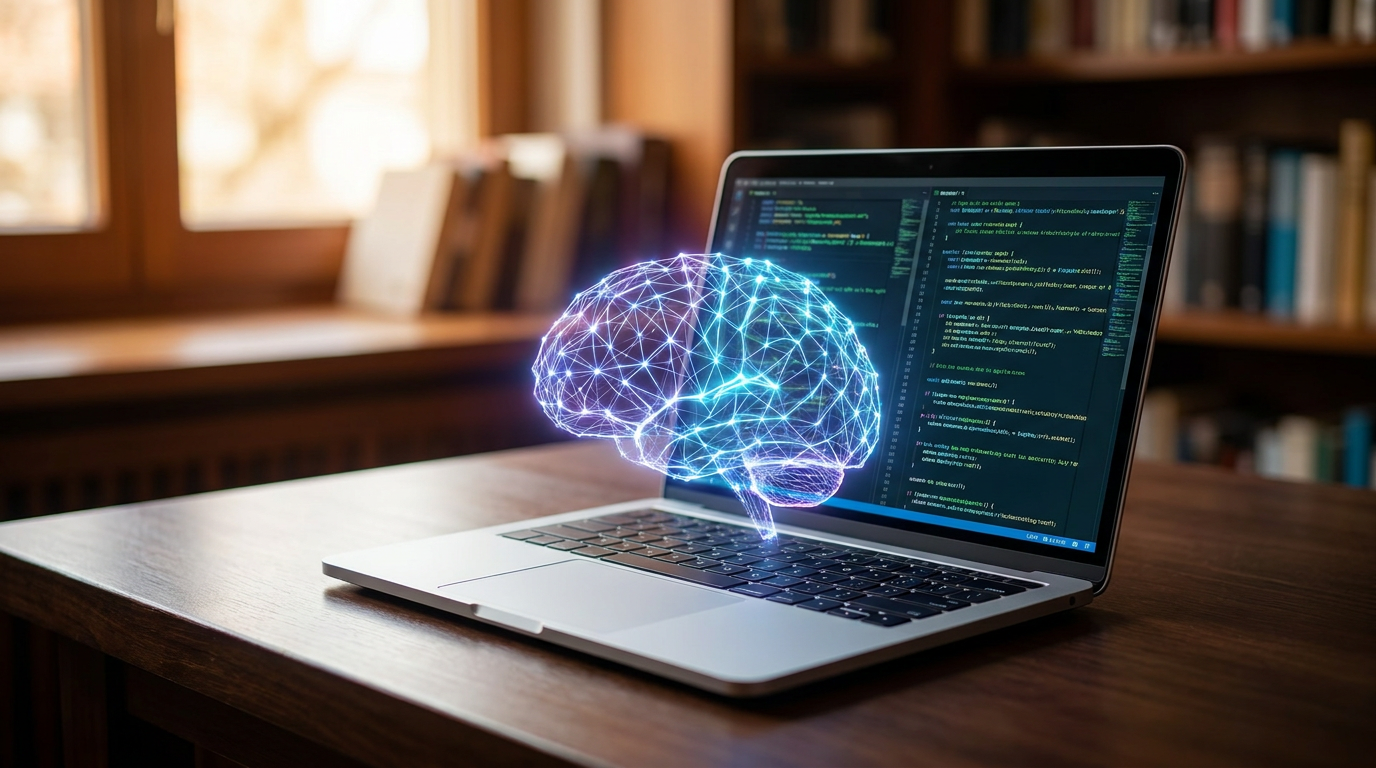
For the past three years, the story of artificial intelligence was written in megawatts and server farms. The default assumption for developers and users alike was that intelligence lived somewhere else, rendering personal devices as mere glass terminals that piped prompts to the cloud and waited for an answer. But in 2026, the paradigm has quietly flipped. The most significant AI revolution is no longer happening in desert data centers; it is running directly on the laptops, smartphones, and embedded devices sitting on our desks.[1][3]
This shift toward "local AI" or "on-device inference" solves the three fundamental flaws of the cloud-centric model: latency, cost, and privacy. Sending every query to a remote server means renting compute power by the millisecond, waiting for network round-trips, and handing over sensitive personal or corporate data to third parties. By bringing the neural network directly to the user's hardware, local AI ensures that data never leaves the machine, responses are generated in milliseconds, and the system works flawlessly even in airplane mode.[3][4]
The foundation of this transition is a massive hardware convergence. Dedicated silicon known as Neural Processing Units (NPUs) has become standard across consumer devices. Apple's M-series and A-series chips, alongside equivalents from Qualcomm and Intel, are no longer generic processors; they are purpose-built for sustained, low-power AI inference. Apple's M4 chip, for example, features a Neural Engine capable of 38 trillion operations per second (TOPS), utilizing a unified memory architecture that allows massive AI models to run without bottlenecking the CPU or draining the battery.[1][3]

Apple has leaned heavily into this architectural break. At WWDC 2026, the company expanded its Apple Foundation Models (AFM), introducing advanced on-device models like AFM 3 Core. To support this, Apple replaced its legacy Core ML framework with "Core AI," a modernized toolchain optimized specifically for unified memory and the Neural Engine. This allows developers to deploy full-scale large language models (LLMs) locally, embedding autonomous intelligence directly into iOS and macOS applications.[2][8]
But hardware is only half the equation. The software revolution of 2026 has been driven by the rapid maturation of Small Language Models (SLMs). Open-weight releases like Meta's Llama 4 Scout, Google's Gemma 4, and Alibaba's Qwen 3.5 have compressed frontier-level reasoning into remarkably efficient packages. A model like Gemma 4's 12-billion parameter variant can now run comfortably on a laptop with just 16 gigabytes of RAM, while still supporting native multimodal inputs like audio and images.[5][7]
The mechanism making this possible is a mathematical technique called quantization. In a data center, AI models typically run using 16-bit floating-point numbers, which require massive amounts of Video RAM (VRAM). Quantization shrinks these model weights down to 8-bit or even 4-bit integers. While this slightly reduces the mathematical precision of the model, the drop in actual reasoning quality is nearly imperceptible to the user. The result is a massive neural network that fits neatly onto consumer hardware.[1][5]

Alongside smaller models, the tooling to run them has been entirely democratized. What previously required complex Python environments and deep technical knowledge can now be achieved with a single click. Two applications—Ollama and LM Studio—have emerged as the dominant platforms for local inference, each serving a distinct type of user while utilizing the same underlying execution engines.[4][7]
Alongside smaller models, the tooling to run them has been entirely democratized.
For developers, Ollama has become the industry standard. Operating as a headless background daemon, Ollama allows users to download and run models using simple command-line instructions. More importantly, it exposes an OpenAI-compatible API on the local machine. This means developers can take existing applications built for cloud APIs, change the web address to "localhost," and instantly route all AI requests through their own hardware with zero code changes.[4][7]
For power users and enthusiasts, LM Studio offers a highly polished graphical interface. Instead of typing terminal commands, users can browse a built-in directory of thousands of community-tuned models, click download, and start chatting immediately. LM Studio provides visual sliders for parameter tuning—adjusting the model's creativity or context length—and allows users to drag and drop local PDFs and documents for the AI to analyze without ever connecting to the internet.[4][7]

As local AI adoption surges, the distinction between privacy and security has become a critical conversation. Local LLMs are inherently private; because the prompts are processed on the device, no corporate telemetry or third-party server ever sees the user's data. However, privacy does not automatically equal security. Users must still be vigilant about where they download their model weights, relying on verified hashes from trusted publishers to ensure malicious code isn't hidden within the files.[6]
The most profound impact of on-device AI is the rise of agentic workflows. We are moving past the era of passive chatbots that simply answer questions. Modern local models are being integrated deeply into operating systems to act as autonomous agents. Instead of a user manually opening three different apps to book a flight and update a calendar, an on-device agent can execute the entire sequence of intents in the background, reasoning through the steps locally without the latency of cloud communication.[1][8]
For software engineers, local AI has solved one of the biggest hurdles in enterprise development: code privacy. By running models like Qwen 3.5 27B locally through tools like Ollama, developers can use AI coding copilots that analyze their entire proprietary codebase without ever transmitting a single line of code to an external server. This provides the speed of AI-assisted programming while strictly adhering to corporate security compliance.[4][5]

Despite these massive leaps, the industry is not abandoning the cloud entirely. The smartest architecture in 2026 is a hybrid approach. Devices use their local NPUs to handle 80% of routine tasks—summarizing notifications, drafting emails, real-time translation, and basic coding. When a user requests a highly complex reasoning task that exceeds the local model's capabilities, the system seamlessly routes the query to a massive cloud model, such as Apple's Private Cloud Compute, ensuring the user gets the best of both worlds.[2][4]
This hybrid reality fundamentally changes the economics of artificial intelligence. By offloading the vast majority of daily inference to the user's own hardware, AI companies save hundreds of millions of dollars in server costs. Simultaneously, users and independent developers are freed from the friction of recurring API subscriptions, turning AI from a metered utility into an unlimited, always-available resource.[2][3]
Ultimately, the rise of local LLMs represents a democratization of compute. By severing the mandatory tether to centralized server farms, 2026 has proven that the future of artificial intelligence is distributed. As models continue to shrink and consumer silicon grows more powerful, the most capable AI systems will not just be tools we access—they will be tools we own, running silently and securely in our pockets.[1][3]
How we got here
2023–2024
The cloud AI boom normalizes generative AI, but raises widespread concerns over API costs, data privacy, and latency.
Late 2024
Apple announces Apple Intelligence, signaling a massive industry shift toward processing AI tasks directly on consumer devices.
2025
Open-weight Small Language Models (SLMs) begin matching the performance of earlier massive cloud models, proving local AI is viable.
Early 2026
Tools like Ollama and LM Studio gain mainstream adoption, making local deployment accessible to non-engineers via simple GUIs and APIs.
June 2026
The release of highly efficient models like Gemma 4 and Llama 4 Scout cement local AI as a zero-cost, privacy-first alternative to cloud subscriptions.
Viewpoints in depth
Open-Source Developers
Advocates for building AI tools that are free from corporate API lock-in.
For the open-source community, local AI is about sovereignty and control. Developers argue that relying on cloud APIs creates a fragile ecosystem where a single corporate policy change or server outage can break thousands of applications. By standardizing around tools like Ollama and open-weight models like Llama 4, developers can build autonomous agents and applications that are permanently functional, infinitely reproducible, and completely free from recurring usage taxes.
Privacy Advocates
Focuses on the necessity of keeping sensitive data entirely on-device.
Privacy advocates view the shift to local inference as a critical course correction for the tech industry. They emphasize that in sectors like healthcare, finance, and enterprise software, sending proprietary data to a third-party server is a massive compliance risk. While they champion local LLMs for guaranteeing that prompts never leave the machine, they also stress the importance of security—urging users to only download model weights from verified, trusted publishers to avoid malicious code.
Cloud Infrastructure Providers
Maintains that centralized data centers remain essential for frontier AI capabilities.
While acknowledging the utility of on-device models for routine tasks, cloud providers argue that the true cutting edge of artificial intelligence will always require massive centralized compute. They point out that while a 12-billion parameter model is impressive for a laptop, it cannot compete with the reasoning capabilities of a trillion-parameter cloud model. Their vision for 2026 is a hybrid ecosystem, where local NPUs act as a triage layer, but the heavy lifting remains securely in the cloud.
What we don't know
- Whether future regulations will require local AI models to implement the same safety guardrails mandated for cloud providers.
- How quickly battery technology will evolve to support continuous, heavy on-device AI inference without rapid degradation.
Key terms
- NPU (Neural Processing Unit)
- A specialized hardware chip designed specifically to accelerate artificial intelligence tasks efficiently without draining battery life.
- Small Language Model (SLM)
- A highly optimized AI model that offers strong reasoning capabilities while being small enough to run on consumer hardware.
- Quantization
- A mathematical technique that shrinks the file size and memory footprint of an AI model by reducing the precision of its numbers, allowing it to run on standard laptops.
- Unified Memory
- A hardware architecture where the CPU and GPU share the same pool of memory, drastically speeding up AI performance on devices like Apple's MacBooks.
- Open-weight Model
- An AI model where the underlying mathematical weights are made publicly available for anyone to download and run, though the training data may remain private.
Frequently asked
Do I need a supercomputer to run local AI in 2026?
No. Thanks to model quantization and efficient small language models, you can run highly capable AI on a standard laptop with 8GB to 16GB of RAM, or even on modern smartphones.
Is running local AI completely free?
Yes. Once you have the hardware, tools like Ollama and LM Studio, along with open-weight models like Llama 4 and Gemma 4, are completely free to download and use with no subscription fees.
Can local models completely replace cloud AI like ChatGPT?
Not entirely. Local models are excellent for 80% of daily tasks like drafting, summarizing, and coding. However, for highly complex reasoning or massive data synthesis, cloud models still hold an advantage.
Is my data truly private when using local AI?
Yes. When running models locally, your prompts and the generated responses never leave your device, ensuring 100% data privacy from third-party servers.
Sources
Source coverage
8 outlets
3 viewpoints surfaced








[1]Factlen Editorial TeamPrivacy Advocates
Synthesis by Factlen editorial team
Read on Factlen Editorial Team →[2]WikipediaCloud Infrastructure Providers
Apple Intelligence
Read on Wikipedia →[3]AI MagicxCloud Infrastructure Providers
On-Device AI in 2026: Running LLMs Locally on Your Phone, Laptop, and IoT Devices
Read on AI Magicx →[4]TechsyOpen-Source Developers
Run LLMs Locally 2026: The 5-Minute Setup for Any GPU
Read on Techsy →[5]OverchatOpen-Source Developers
The Best Local LLMs for 2026
Read on Overchat →[6]PromptQuorumPrivacy Advocates
Privacy vs Security for Local LLMs
Read on PromptQuorum →[7]BetterClawOpen-Source Developers
Ollama vs LM Studio: A Decision Guide
Read on BetterClaw →[8]dev.toCloud Infrastructure Providers
Apple's On-Device AI Strategy: A Technical Teardown
Read on dev.to →


Every angle. Every day.
Get ai stories with full source coverage and perspective breakdowns delivered to your inbox.