
The Multimillion-Dollar Science Behind the 2026 World Cup's Perfect Grass
Turf scientists have engineered a massive agricultural feat to keep natural grass alive inside domed NFL stadiums for the 2026 World Cup.
By Factlen Editorial Team
- Agronomists & Turf Scientists
- Focus on the biological and engineering challenge of sustaining a living crop in hostile indoor environments.
- Player Safety Advocates
- Focus on the injury-prevention benefits of natural grass and consistent traction across all 16 venues.
- Stadium Operators
- Focus on the logistical and financial burden of converting multi-use artificial turf venues into temporary natural grass ecosystems.
What's not represented
- · Local sod farmers
- · NFL groundskeepers
Why this matters
The health of the world's most valuable athletes—and the physics of the tournament itself—relies entirely on whether this unprecedented biological experiment survives 40 days of grueling play.
Key points
- FIFA requires all 2026 World Cup matches to be played on natural grass, including inside five domed stadiums.
- Turf scientists developed a system using cool-season grasses, LED grow lights, and industrial fans to keep the pitches alive indoors.
- The grass was grown for over a year on sod farms and shipped in massive 3,500-pound rolls.
- Synthetic plastic fibers are stitched into the natural grass to act as 'rebar,' preventing the surface from tearing.
- A specialized vacuum and ventilation system sits beneath the grass to manage moisture and airflow.
The 2026 FIFA World Cup is currently unfolding across 16 stadiums in the United States, Canada, and Mexico, featuring an expanded field of 48 teams playing 104 matches. But beneath the roaring crowds and the elite footwork lies one of the most complex agricultural engineering feats in sports history: the grass itself.[1][3]
FIFA strictly mandates that all World Cup matches be played on natural grass, a rule rooted in player safety and the predictable physics of the bouncing ball. However, the North American venue list presented an unprecedented biological challenge. Eight of the selected stadiums typically host NFL games on artificial turf, and five are fully enclosed domes where natural sunlight—the fundamental requirement for a living plant—cannot reach the stadium floor.[4][7]
To solve this, FIFA commissioned a multimillion-dollar research project led by turfgrass scientists Dr. John Sorochan of the University of Tennessee and Dr. John 'Trey' Rogers of Michigan State University. Their mandate was to create 16 identical, high-performance playing surfaces across wildly different climates, from the high altitude of Mexico City to the humid heat of Miami and the climate-controlled shadows of indoor arenas.[2][6]
The first major claim the scientific team had to prove was that domed stadiums could sustain elite natural grass for the grueling 40-day tournament. The evidence was gathered over years of testing inside a custom shade structure built at the University of Tennessee, which replicated the sunless conditions of a domed stadium.[1][4]

The biological mechanism they developed is counterintuitive. Instead of using warm-season grasses that would normally thrive in southern host cities like Houston and Atlanta, the scientists opted for a cool-season blend of Kentucky bluegrass and perennial ryegrass for the indoor venues. Because the domes are air-conditioned to a steady 72 degrees, the cool-season grass survives perfectly, avoiding the blistering outdoor heat that would otherwise incinerate it.[4][8]
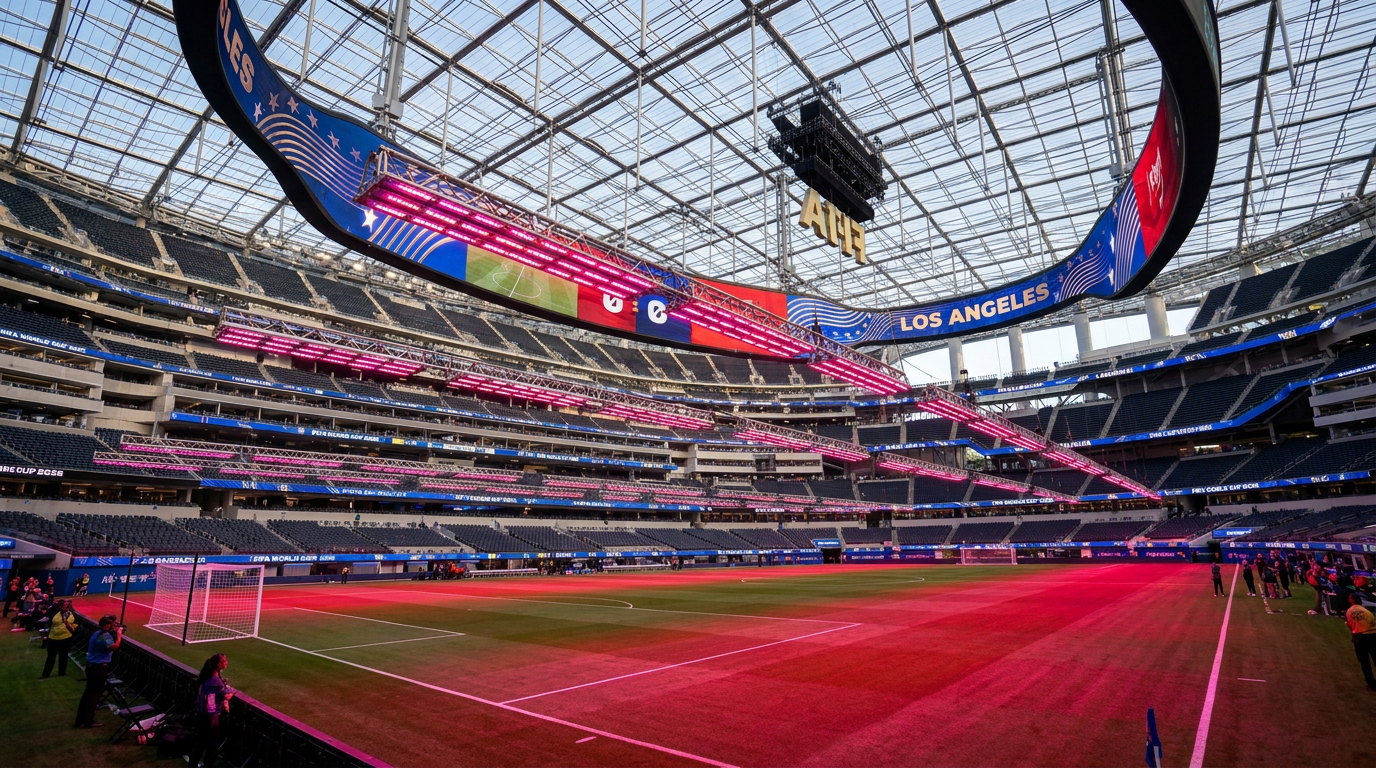
To replace the missing sun, stadium operators have deployed massive arrays of pink LED grow lights suspended directly over the pitches. Alongside the artificial sun, industrial fans run continuously, blowing air across the surface. This precise airflow is not for the players, but to prevent fungal diseases and root rot from taking hold in the stagnant indoor atmosphere.[5][8]
The second major claim was that a shallow, portable root system could perform identically to a traditional, deep-rooted soccer pitch. Because the grass had to be laid over existing artificial turf or concrete stadium floors, a standard 16-inch soil profile was impossible.[5][7]
The second major claim was that a shallow, portable root system could perform identically to a traditional, deep-rooted soccer pitch.
The evidence for this 'sod-on-plastic' approach lies in the massive scale of the sod farms. The grass for the tournament was grown for over a year at specialized farms across the continent. When it was time for installation, the grass was harvested in massive rolls measuring 40 feet long and 3.5 feet wide, with each roll weighing a staggering 3,500 pounds. The sheer weight helps the sod stay anchored to the floor without shifting.[5][8]

Beneath the grass, the engineering is just as complex. The heavy sod rolls are laid over a plastic honeycomb drainage structure and a waterproof liner to protect the stadium infrastructure. A specialized vacuum and ventilation system is installed underneath the pitch to actively pull moisture through the root zone and ensure continuous airflow, mimicking the drainage of a natural deep-soil field.[1][5]
The third crucial claim was that these temporary pitches would not tear apart under the extreme kinetic forces generated by the world's best athletes. A blowout on the pitch can cause catastrophic joint injuries, making surface stability a paramount concern for FIFA.[1][2]
The solution is a hybrid reinforcement system, which the researchers describe as 'rebar for turf.' Synthetic plastic fibers are stitched directly into the natural sod. This matrix of artificial fibers gives the natural grass roots something to wrap around, anchoring the plant and preventing the surface from shearing when a player plants their cleat to make a hard cut.[5][8]
To validate the safety of this hybrid surface, the scientists utilized a specialized 'Flex machine.' This device features a 3D-printed foot and ankle fitted with a standard soccer cleat. By dropping the mechanical foot onto the grass and simulating the twisting motions of a player, researchers could precisely measure the traction, give, and safety margins of the turf before a single human stepped on it.[1][8]

The logistics of executing this science experiment on a continental scale are staggering. In total, massive amounts of natural sod had to be harvested, loaded into refrigerated trucks, and shipped thousands of miles to the host cities. The installation windows were incredibly tight; in Houston, the stadium was hosting a rodeo just eight weeks before the tournament began, leaving zero margin for error in the turf's establishment.[5][8]
Despite the years of peer-reviewed agronomy and millions of dollars spent, transparent uncertainty remains regarding the later stages of the tournament. The World Cup is an intense gauntlet, and as the 104-match schedule progresses toward the semifinals, the pitches will endure compounding wear and tear.[2][8]
The primary unknown is how well the grass will recover when the rest periods between matches shrink to just a few days. While the synthetic fibers will hold the soil together, the living blades of grass can only withstand so much trampling before they struggle to photosynthesize and repair themselves, even under the glow of the LED lights.[2][5]

Ultimately, the turf scientists are striving for total invisibility. If the ball rolls perfectly, the players trust their footing, and the global audience remains completely oblivious to the 3,500-pound rolls of hybrid sod and the indoor breeze, the grand agricultural experiment will have been a flawless success.[1][8]
How we got here
1994
The Pontiac Silverdome becomes the first stadium to host a World Cup match indoors on temporary natural grass.
2018
FIFA approaches university turf scientists to begin researching pitch management for the expanded 2026 tournament.
2020
Researchers begin testing grass species in custom shade structures to simulate domed stadium environments.
Spring 2025
Sod farms across North America plant the specialized grass blends that will eventually be harvested for the stadiums.
June 2026
The World Cup kicks off across 16 custom-engineered natural grass pitches.
Viewpoints in depth
Agronomists & Turf Scientists
A monumental biological achievement.
For researchers, the 2026 World Cup is the ultimate test of modern turf science. By successfully growing and maintaining a living crop inside dark, climate-controlled domes for over a month, they are proving that evidence-based agronomy can overcome almost any environmental limitation. The data collected from this massive experiment is expected to revolutionize how local parks and golf courses manage their own grass in the future.
Player Safety Advocates
Consistency prevents catastrophic injuries.
Player unions and sports medicine professionals have long lobbied against artificial turf, citing the increased risk of non-contact ligament tears. For this camp, the multimillion-dollar investment in hybrid natural grass is a non-negotiable necessity. They argue that ensuring every pitch—whether in Mexico City or Boston—reacts identically under a player's cleat is the only way to protect the world's most valuable athletes during a grueling 104-match schedule.
Stadium Operators
A logistical and financial gauntlet.
For the management groups running multi-use venues like NFL stadiums, the FIFA mandate represents a massive logistical headache. Ripping up existing surfaces, coordinating the arrival of refrigerated sod trucks, and running industrial grow lights 24/7 requires immense capital and labor. While they acknowledge the necessity for the World Cup, operators are acutely aware of the ticking clock as they balance the tournament's demands with their regular event schedules.
What we don't know
- Whether the temporary pitches will hold up during the later stages of the tournament when rest periods between matches shrink.
- How the distinct microclimates inside each domed stadium might unexpectedly affect the grass's health over 40 days.
Key terms
- Hybrid turf
- Natural grass reinforced with synthetic plastic fibers stitched into the root zone to prevent the surface from tearing.
- Cool-season grass
- Grass species, like Kentucky bluegrass, that thrive in moderate temperatures and are being used inside climate-controlled domed stadiums.
- Sod-on-plastic
- An installation method where shallow-rooted grass is laid over a plastic honeycomb structure and waterproof liner to protect the stadium floor.
- Flex machine
- A scientific testing device featuring a 3D-printed foot and cleat used to measure the traction and safety of a playing surface.
Frequently asked
Why doesn't FIFA just use artificial turf?
Artificial turf alters the physics of the bouncing ball and increases the risk of joint injuries for players making hard cuts.
How does grass survive inside a dark dome?
Scientists use cool-season grass kept at 72 degrees, supplemented by massive arrays of pink LED grow lights and industrial ventilation fans.
What happens to the grass after the World Cup?
The temporary natural grass pitches will be removed, and the stadiums will revert to their standard artificial turf or multi-use surfaces.
Sources
Source coverage
8 outlets
3 viewpoints surfaced







[1]The New York TimesPlayer Safety Advocates
The Scientific Quest for Perfect World Cup Pitch
Read on The New York Times →The Secrets of a Soccer-Turf Master
Read on The New York Times →[3]The Wall Street JournalStadium Operators
FIFA Is Staking Its $3.8 Billion World Cup on Unprecedented Grass Experiment
Read on The Wall Street Journal →[4]Scientific AmericanAgronomists & Turf Scientists
Inside the 2026 World Cup's push to engineer the perfect pitch
Read on Scientific American →[5]Science News ExploresAgronomists & Turf Scientists
Perfect pitch? Scientists lay new grounds for World Cup
Read on Science News Explores →[6]USGAAgronomists & Turf Scientists
Creating the Perfect Pitch for the 2026 FIFA World Cup With Dr. John Sorochan
Read on USGA →[7]Fox SportsPlayer Safety Advocates
FIFA's indoor grass challenge for 2026 World Cup
Read on Fox Sports →[8]ForbesStadium Operators
The Science Behind The 2026 World Cup's Perfect Pitches
Read on Forbes →

Every angle. Every day.
Get science stories with full source coverage and perspective breakdowns delivered to your inbox.