
The Hidden Mechanics of the 'Index Inclusion Effect' Driving Billions to SpaceX
Following its record-breaking IPO, SpaceX is triggering a massive wave of forced buying from passive index funds, highlighting a structural market quirk that affects every retirement portfolio.
By Factlen Editorial Team
- Passive Index Investors
- Prioritize accurate tracking of the broader market and are mechanically forced to buy new index entrants regardless of current valuations.
- Active Arbitrageurs
- Seek to generate alpha by predicting index changes and front-running the mechanical buying of passive funds.
- Market Structure Academics
- Study the distorting effects of passive fund flows on price discovery and market efficiency.
What's not represented
- · Retail investors holding target-date funds who are unaware of index mechanics
- · Corporate treasurers who time share issuances to index inclusion dates
Why this matters
Trillions of dollars in everyday 401(k)s and pension funds are managed passively. Understanding how these funds are forced to buy stocks at specific times reveals the hidden plumbing that dictates the value of your retirement savings.
Key points
- SpaceX's massive IPO is triggering a secondary wave of capital driven entirely by passive index funds.
- Indices like the Russell 1000 use 'Fast Entry' rules to add mega-IPOs within days, forcing ETFs to buy the stock.
- Because SpaceX floated only ~4.2% of its shares, billions of dollars are chasing a highly restricted supply.
- This mechanical buying creates the 'index inclusion effect,' a predictable demand surge that active traders often try to front-run.
- The S&P 500 has rejected fast entry, meaning investors in S&P 500 index funds will not gain exposure to SpaceX until at least 2027.
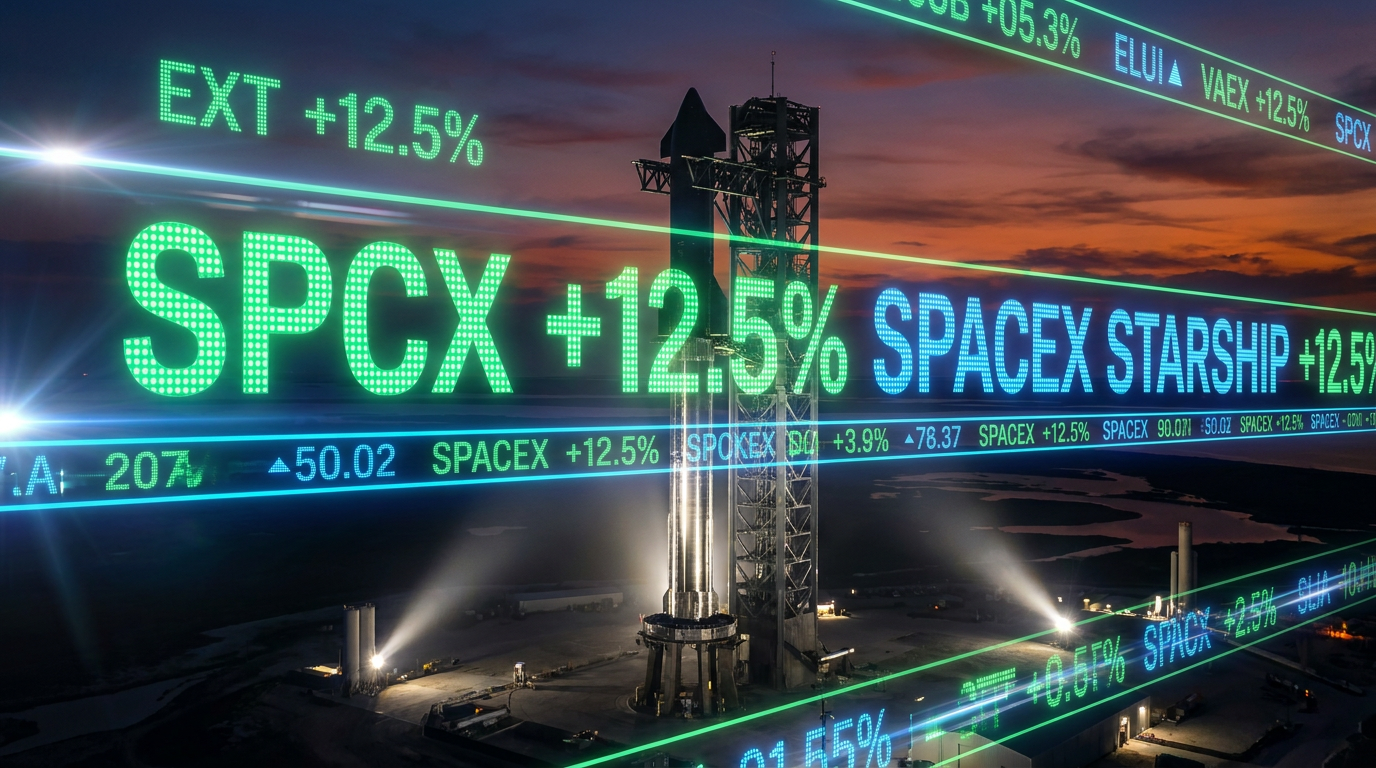
When SpaceX executed the largest initial public offering in financial history on June 12, 2026, the immediate retail frenzy dominated the headlines. But as the initial euphoria settles, a second, much larger wave of capital is quietly preparing to strike the aerospace giant's stock. This incoming tide is not driven by human stock-pickers analyzing rocket launch manifests or satellite broadband revenues. Instead, it is the result of cold, unfeeling mathematics: the mechanical forced buying of passive index funds.[1][6]
This phenomenon is known on Wall Street as the "index inclusion effect." Because trillions of dollars globally are benchmarked to major indices like the Russell 1000 and the Nasdaq-100, any change to the composition of those indices forces a corresponding change in the portfolios of thousands of mutual funds and exchange-traded funds (ETFs). When a new company is added to an index, passive fund managers have no choice but to buy it, regardless of its valuation or their personal opinion of the business.[5][6]
Historically, newly public companies had to wait months or even years to join the most prestigious indices. However, index providers have recently adapted their rules to accommodate "mega-IPOs" that are simply too large for the market to ignore. FTSE Russell, for example, utilizes a "Fast Entry" mechanism that allows massive new listings to bypass the standard quarterly reconstitution schedule. Under these rules, an eligible heavyweight can be added to the Russell 1000 just five trading days after its debut.[3]

For SpaceX, this fast-track eligibility means that in the coming days and weeks, index trackers will be forced to execute an estimated $22 billion to $27 billion in automatic purchases. To fund these massive acquisitions, index funds must simultaneously sell fractional amounts of their existing holdings—trimming positions in established tech giants like Apple, Microsoft, and Nvidia to make room for the newcomer. This creates a fascinating, albeit temporary, distortion in the broader market.[1][2][6]
The mechanics of this forced buying are further complicated by the concept of "public float." While SpaceX debuted with an implied market capitalization approaching $1.77 trillion, the company only made roughly 4.2% of its total shares available for public trading at the IPO. The vast majority of the equity remains locked up by founders, early employees, and private venture backers. Consequently, the billions of dollars in passive index capital are chasing a remarkably tiny pool of available shares.[2][6]
The vast majority of the equity remains locked up by founders, early employees, and private venture backers.
When inelastic demand meets severely restricted supply, the result is often a sharp upward spike in price. Academic research has long documented this dynamic. A landmark study published by the National Bureau of Economic Research (NBER) analyzed the price effects of companies moving between the Russell 1000 and the Russell 2000. The researchers found that the mechanical buying associated with index inclusion consistently drives share prices higher in the immediate term, proving that index inclusion fundamentally alters the demand curve for a stock.[4]

Naturally, where there is a predictable market mechanic, there are active traders attempting to exploit it. Hedge funds and opportunistic active managers frequently try to "front-run" the index inclusion effect. By purchasing shares immediately after an index provider announces an upcoming addition, these traders hope to ride the wave of forced passive buying, selling their shares to the index funds at a premium on the actual day of inclusion.[5][6]
However, the landscape is shifting. Recent data from Morningstar suggests that the traditional index inclusion effect has weakened over the past decade. As the market has grown more sophisticated, the arbitrage window has narrowed. Furthermore, corporate treasurers have wised up to the game. Some newly included companies now use the predictable surge in demand to issue new shares directly into the market, effectively absorbing the passive capital and dampening the expected price spike.[5]
Yet, market analysts argue that SpaceX may be the exception that proves the rule. The sheer scale of the company, combined with its exceptionally low float and the unprecedented speed of its index entry, creates a perfect storm that even the most efficient markets may struggle to price smoothly. The situation is further bifurcated by the stance of S&P Dow Jones Indices, which manages the benchmark S&P 500.[1][6]

Unlike Nasdaq and FTSE Russell, S&P has refused to grant SpaceX fast-track entry. The S&P 500 maintains strict requirements, including a 12-month seasoning period, a history of GAAP profitability, and a minimum 10% public float threshold. As a result, the trillions of dollars tracking the S&P 500 will sit on the sidelines until at least mid-2027. This creates a stark divergence in exposure for retail investors: those holding total-market or Nasdaq-heavy funds will own SpaceX immediately, while those in S&P 500 funds will not.[2][6]
This divergence highlights a crucial lesson for everyday investors. Passive investing is often marketed as a monolith—a simple, set-it-and-forget-it strategy. But the underlying rules governing these indices are complex, actively managed by committees, and highly consequential. The decision of when and how to include a generational company like SpaceX fundamentally alters the risk and return profile of the funds that track them.[6]

Ultimately, the unfolding SpaceX saga serves as a masterclass in modern market plumbing. It pulls back the curtain on the invisible forces that drive daily trading volumes, demonstrating how the rigid rules of passive indexing can create massive, mandatory capital flows. Whether the index inclusion effect results in a sustained premium for SpaceX or a fleeting spike, it underscores the reality that in today's market, the index providers often wield as much influence as the companies themselves.[1][6]
How we got here
June 4, 2026
S&P Dow Jones Indices announces it will maintain its 12-month seasoning requirement, delaying SpaceX's S&P 500 entry.
June 12, 2026
SpaceX executes the largest IPO in history, debuting on the Nasdaq with an implied valuation of $1.77 trillion.
Late June 2026
The 'Fast Entry' window opens, forcing funds tracking the Russell 1000 and Nasdaq-100 to mechanically purchase billions in SpaceX stock.
Viewpoints in depth
The Passive Mandate
Index providers and passive funds prioritize accurate market representation over valuation concerns.
For the architects of passive investing, the goal is not to pick winning stocks, but to accurately reflect the investable universe. When a company the size of SpaceX goes public, index providers like FTSE Russell argue that excluding it from benchmarks makes those indices fundamentally inaccurate representations of the U.S. economy. Consequently, passive fund managers view the forced buying not as a flaw, but as a strict fiduciary duty to minimize 'tracking error'—ensuring their fund's performance perfectly matches the benchmark, regardless of the short-term price distortions it might cause.
The Active Arbitrage
Hedge funds and active managers view index inclusion as a predictable inefficiency to be exploited.
Active market participants treat the rigid rules of passive indexing as a source of alpha. Because index providers publicly announce their methodology and the exact dates of reconstitution, hedge funds can calculate exactly how many shares passive funds will be forced to buy. By purchasing the stock in the days leading up to the inclusion date, these active traders aim to absorb the available float, effectively cornering the market. When the passive funds are finally mandated to buy, the active managers sell their holdings into the artificial demand surge, capturing a nearly risk-free premium.
The S&P 500 Guardrails
Some index committees prioritize stability and proven profitability over immediate market representation.
The S&P 500 stands apart from other major indices by utilizing a subjective committee rather than purely mechanical rules. By enforcing a strict 12-month seasoning period and requiring a history of GAAP profitability, the S&P committee acts as a gatekeeper, protecting its passive investors from the extreme volatility often associated with newly public companies. While this conservative approach means S&P 500 investors miss out on the initial upside of a mega-IPO, it also shields them from the artificial price spikes and subsequent corrections caused by the index inclusion effect itself.
What we don't know
- Whether the sheer size of the SpaceX IPO will overwhelm the historical patterns of the index inclusion effect.
- How much active hedge fund capital has already front-run the upcoming passive index purchases.
- If SpaceX will use the artificial demand window to issue secondary shares and raise additional capital.
Key terms
- Index Inclusion Effect
- A market phenomenon where a stock experiences a temporary price surge due to the mechanical, forced buying by passive funds when it is added to a major benchmark.
- Passive Fund
- An investment vehicle, like an ETF or mutual fund, that does not use human stock-pickers but instead automatically buys and holds the exact stocks listed in a specific market index.
- Public Float
- The portion of a company's total shares that are freely available to be traded by the general public, excluding locked-up shares held by insiders or early investors.
- Fast Entry Rule
- A special provision used by some index providers that allows exceptionally large newly public companies to bypass standard waiting periods and join an index within days of their IPO.
- Reconstitution
- The periodic process by which an index provider reviews and updates the list of companies included in its benchmark, adding new qualifiers and removing those that no longer meet the criteria.
Frequently asked
What is the index inclusion effect?
It is the tendency for a stock's price to rise temporarily when it is added to a major stock index, driven by the mandatory buying of passive mutual funds and ETFs that track that index.
Why do index funds have to buy the stock?
Passive funds are legally mandated to replicate the performance of their benchmark index. If the index adds a new company, the fund must buy it to avoid tracking error.
Why isn't SpaceX in the S&P 500 yet?
Unlike other indices that allow 'fast entry' for large IPOs, the S&P 500 requires a company to be public for at least 12 months and demonstrate a history of GAAP profitability before inclusion.
How does 'public float' affect this?
When a company has a low public float (few shares available to trade), the massive wave of forced buying from index funds hits a restricted supply, which can severely amplify price volatility.
Sources
Source coverage
6 outlets
3 viewpoints surfaced






[1]MarketWatchActive Arbitrageurs
The initial SpaceX frenzy is cooling off — but a new wave of cash is waiting to strike
Read on MarketWatch →[2]LongbridgeActive Arbitrageurs
SpaceX shares have cooled from their IPO highs but face new demand drivers
Read on Longbridge →[3]FTSE RussellPassive Index Investors
Russell US Equity Indexes: Fast Entry IPO Methodology
Read on FTSE Russell →[4]National Bureau of Economic ResearchMarket Structure Academics
Regression Discontinuity and the Price Effects of Stock Market Indexing
Read on National Bureau of Economic Research →[5]MorningstarPassive Index Investors
The Index Inclusion Effect: What Investors Need to Know
Read on Morningstar →[6]Factlen Editorial TeamMarket Structure Academics
Synthesis by Factlen editorial team
Read on Factlen Editorial Team →

More in finance
See all 7 stories →Crypto Regulation
Global Crypto Markets Enter Regulated Era as Europe's MiCA Framework Takes Full Effect
7 sources

Market Mechanics
The Hidden Mechanics of the SpaceX IPO: Why Index Funds Are Forced to Buy
7 sources
Market Mechanics
What Happens After a Blockbuster IPO? The Mechanics of SpaceX's Index Inclusion
6 sources
Passive Investing
How SpaceX's Record IPO is Forcing a Trillion-Dollar Divide in Index Funds
6 sources
Every angle. Every day.
Get finance stories with full source coverage and perspective breakdowns delivered to your inbox.