
The Science of Enhanced Geothermal Systems: How Engineered Hot Rocks Are Unlocking 24/7 Clean Power
By using advanced drilling to create artificial reservoirs deep underground, enhanced geothermal systems (EGS) are turning the Earth's crust into a limitless source of baseload clean energy.
By Factlen Editorial Team
- Grid Operators & Energy Markets
- Value EGS for its ability to provide 24/7 firm power to balance intermittent renewables and supply data centers.
- Subsurface Scientists
- Focus on the technical challenges of monitoring deep reservoirs, mapping fractures, and managing induced seismicity safely.
- Geothermal Developers
- Argue that oil and gas drilling technologies can be repurposed to unlock massive amounts of clean baseload power.
- Energy Transition Analysts
- View EGS as the critical missing puzzle piece required to build a fully decarbonized electrical grid.
What's not represented
- · Local communities near drilling sites
- · Fossil fuel workers transitioning to geothermal
Why this matters
Wind and solar power are intermittent, leaving grids vulnerable when the sun sets or the wind stops. Enhanced geothermal systems offer a scalable way to provide 24/7 carbon-free electricity, potentially solving the hardest challenge of the clean energy transition.
Key points
- Enhanced Geothermal Systems (EGS) use advanced drilling to create artificial underground reservoirs, unlocking geothermal power anywhere with hot rock.
- Unlike wind and solar, EGS provides 24/7 baseload clean energy, making it a critical tool for fully decarbonizing the electrical grid.
- Fervo Energy's Cape Station in Utah will become the world's first commercial-scale EGS facility when it begins delivering 100 MW of power in late 2026.
- A recent $421 million non-recourse debt financing package signals that Wall Street now views EGS as a bankable, utility-scale infrastructure asset.
- Princeton researchers estimate that as costs fall, EGS could eventually supply up to 20% of all electricity in the United States.
The global energy transition has a massive "firm power" problem. While wind and solar have become incredibly cheap, they are fundamentally intermittent. Battery storage can bridge the gap for a few hours after sunset, but it cannot sustain a grid through weeks of stagnant, cloudy weather. To fully decarbonize, the world needs clean electricity that runs 24 hours a day, seven days a week.[7]
The holy grail has always been geothermal energy. The Earth's core is hotter than the surface of the sun, and that heat radiates outward, offering a practically infinite source of baseload power. However, traditional geothermal plants are geographically constrained. They require a rare natural combination of underground heat, fluid, and highly permeable rock—conditions typically only found near volcanic fault lines or natural hot springs.[2]
Enter Enhanced Geothermal Systems (EGS). After decades of research, this technology is finally moving from theoretical pilot projects to utility-scale reality. By artificially engineering the subsurface conditions that traditional geothermal relies upon, EGS promises to unlock the Earth's heat almost anywhere on the planet.[2][7]
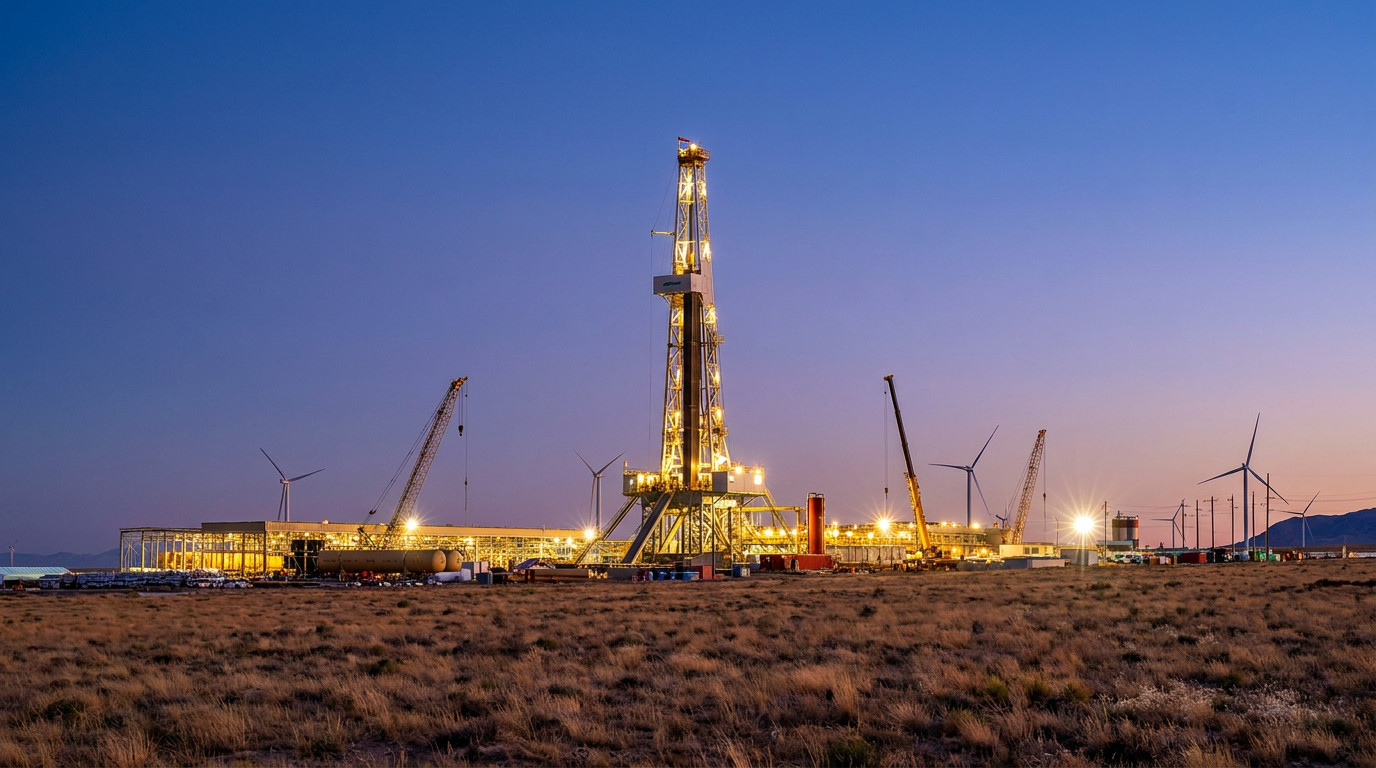
The vanguard of this shift is Cape Station, a massive development currently under construction in Beaver County, Utah. Spearheaded by Houston-based startup Fervo Energy, the project is slated to begin delivering its first 100 megawatts of continuous power to the grid in October 2026. It is on track to become the world's first commercial-scale enhanced geothermal facility.[4][5]

To understand the breakthrough, one must look at the mechanism. EGS works by creating a human-made reservoir in hot, dry, and impermeable rock deep underground. Engineers use advanced horizontal drilling techniques—ironically pioneered by the oil and gas industry for fracking—to bore thousands of feet into the Earth's crust.[2][5]
Once the well is drilled into the hot rock, cold fluid is injected under carefully controlled, high pressure. This process, known as hydro-shearing, forces pre-existing, sealed fractures in the rock to reopen and expand, creating a highly permeable artificial network.[2]
With the reservoir established, the system operates as a continuous closed loop. Cold water is pumped down an injection well and forced through the newly fractured rock. As the water travels through the subterranean web, it absorbs the intense ambient heat.[2]
The superheated fluid is then pushed up a separate production well to the surface. There, it is used to flash steam or heat a secondary working fluid, which spins a conventional turbine to generate electricity. Finally, the cooled water is injected back underground to repeat the cycle, resulting in zero greenhouse gas emissions.[2]

The superheated fluid is then pushed up a separate production well to the surface.
Operating in these extreme subsurface environments is notoriously difficult, but the science is rapidly catching up. In April 2026, researchers from the Lawrence Berkeley National Laboratory announced a major milestone at the Cape Station site: the longest continuous high-temperature seismic monitoring ever recorded in an engineered geothermal reservoir.[1]
For seven months, custom-built seismometers operated nearly 7,000 feet underground, enduring temperatures of 338°F. This data is critical. EGS relies on microseismic events to map how rock fractures form, and continuous monitoring ensures that operators can safely manage the reservoir and mitigate the risk of induced seismicity at the surface.[1]
The technological leaps are now translating into financial viability. Historically, first-of-a-kind energy projects have struggled to secure traditional project finance due to perceived risks. But in March 2026, Fervo Energy shattered that barrier by closing a $421 million non-recourse debt financing package for Cape Station.[4]

This oversubscribed financing round—led by major institutions like Barclays, J.P. Morgan, and RBC—marks a watershed moment. It signals that Wall Street now views enhanced geothermal not as a speculative science experiment, but as a bankable, utility-scale infrastructure asset.[4][7]
The scale of the EGS opportunity is staggering. Currently, the United States has about 2.7 gigawatts of installed geothermal capacity, representing a tiny fraction of the nation's total energy production.[6]
However, a recent analysis by Princeton University suggests that as EGS deployment scales and costs follow a predictable learning curve, the technology could unlock up to 150 gigawatts of reliable clean energy. The study concluded that enhanced geothermal could supply up to 20% of all U.S. electricity by 2050, emerging as the third most significant clean energy source behind wind and solar.[3][6]

The demand for this firm power is surging. The rapid proliferation of artificial intelligence data centers, combined with a resurgence in domestic manufacturing and vehicle electrification, has grid operators scrambling for reliable baseload generation. Tech giants are taking notice; Google recently backed Fervo's $462 million Series E funding round to secure 115 megawatts of geothermal power for its Nevada data centers.[4][5]
Looking ahead, the momentum is accelerating. Cape Station is fully contracted through power purchase agreements with utilities like Southern California Edison, and the site plans to scale to 500 megawatts of operating capacity by 2028.[4]
Meanwhile, the U.S. Department of Energy continues to pour resources into the sector, recently announcing $171.5 million in funding to support next-generation geothermal field tests and derisk exploration across diverse geologic conditions.[2]
By repurposing the drilling expertise of the fossil fuel era to harness the Earth's innate heat, enhanced geothermal systems offer a poetic solution to the climate crisis. If the 2026 milestones at Cape Station prove replicable, EGS may finally provide the missing puzzle piece required to build a fully decarbonized, highly resilient electrical grid.[7]
How we got here
2006
MIT publishes a landmark study predicting EGS could provide 100 GW of cost-competitive capacity in the US.
Nov 2023
Fervo Energy brings a 3.5-MW pilot facility online in Nevada, proving the commercial viability of horizontal geothermal drilling.
June 2025
Breakthrough Energy Catalyst leads a $206 million funding round to accelerate the Cape Station project.
March 2026
Fervo secures $421 million in non-recourse debt financing, proving the bankability of EGS.
April 2026
Berkeley Lab completes a record-breaking 7-month continuous seismic monitoring operation at 338°F.
Oct 2026
Cape Station Phase 1 is scheduled to begin delivering 100 MW of continuous power to the grid.
Viewpoints in depth
Geothermal Developers
Argue that the oil and gas industry's horizontal drilling and fiber-optic sensing technologies can be directly repurposed to solve the clean energy baseload problem.
For geothermal developers like Fervo Energy, the narrative is one of technological redemption. By taking the exact tools that fueled the shale boom—horizontal drilling, multi-stage completions, and distributed fiber-optic sensing—and applying them to hot rock, they argue the industry can rapidly scale clean energy without reinventing the wheel. They point to the successful $421 million non-recourse financing of Cape Station as proof that the commercial model is now fully derisked and ready for nationwide deployment.
Grid Operators & Utilities
View EGS as a critical stabilizing force for the grid, providing the 24/7 firm power needed to balance intermittent renewables.
Utilities and grid operators are increasingly anxious about the "duck curve" and the sheer volume of intermittent solar and wind power flooding the grid. They view enhanced geothermal as the ultimate grid stabilizer. Because EGS plants can run continuously, they provide the reliable baseload power necessary to keep the lights on during multi-day weather events when renewables fail. Furthermore, the explosion of power-hungry AI data centers has made this 24/7 clean power profile more valuable than ever.
Subsurface Scientists
Emphasize the technical hurdles of operating in extreme heat and pressure, focusing on the need for continuous seismic monitoring.
Researchers at institutions like the Lawrence Berkeley National Laboratory and the Department of Energy are focused on the immense technical challenges of the deep subsurface. While optimistic about EGS, they caution that operating equipment at 338°F and 7,000 feet underground pushes the limits of material science. Their primary focus is on managing induced seismicity—ensuring that the high-pressure fluid injection required to create artificial reservoirs does not trigger noticeable earthquakes at the surface, which requires meticulous, continuous monitoring.
What we don't know
- How quickly the cost of drilling deep EGS wells will fall as the technology scales nationwide.
- The long-term thermal drawdown rate—how fast the artificial underground reservoirs might cool after decades of continuous heat extraction.
- Whether regulatory frameworks and permitting processes will adapt quickly enough to support the rapid deployment of EGS outside of traditional western U.S. geothermal zones.
Key terms
- Enhanced Geothermal System (EGS)
- A human-made underground reservoir created by injecting fluid into hot, dry rock to generate geothermal electricity where natural hot springs do not exist.
- Hydro-shearing
- The process of injecting water at high pressure to reopen and expand pre-existing, sealed fractures in deep rock formations.
- Baseload power
- The minimum amount of electric power needed to be supplied to the electrical grid at any given time, requiring power plants that can run 24/7.
- Induced seismicity
- Minor, typically imperceptible earthquakes caused by human activity, such as injecting fluids deep underground to create geothermal reservoirs.
- Non-recourse financing
- A type of commercial loan where the lender is only entitled to repayment from the profits of the project itself, signaling high confidence in the project's success.
Frequently asked
Is EGS the same as oil and gas fracking?
While EGS uses similar horizontal drilling techniques, it relies on "hydro-shearing" rather than high-pressure tensile fracking. Hydro-shearing uses water to gently reopen existing natural fractures without the chemical proppants used in fossil fuel extraction.
Can enhanced geothermal plants be built anywhere?
In theory, yes, because the Earth's crust is hot everywhere if you drill deep enough. However, early commercial EGS projects are targeting areas in the western U.S. where hot rocks are closer to the surface, reducing drilling costs.
Does this process consume a lot of water?
No. EGS operates as a closed-loop system. Once the initial underground reservoir is filled, the water is continuously recycled—pumped up to spin the turbine, cooled, and injected back down—meaning ongoing water consumption is minimal.
Sources
Source coverage
7 outlets
4 viewpoints surfaced







[1]Lawrence Berkeley National LaboratorySubsurface Scientists
Scaling Enhanced Geothermal Systems with Continuous Monitoring
Read on Lawrence Berkeley National Laboratory →[2]U.S. Department of EnergySubsurface Scientists
Enhanced Geothermal Systems
Read on U.S. Department of Energy →[3]Princeton UniversitySubsurface Scientists
A once-overlooked technology could supply 20% of US electricity by 2050
Read on Princeton University →[4]Fervo EnergyGeothermal Developers
Fervo Energy Secures $421 Million in Non-Recourse Project Financing for Cape Station
Read on Fervo Energy →[5]Canary MediaGrid Operators & Energy Markets
Fervo nabs $462M to complete massive next-gen geothermal project
Read on Canary Media →[6]Switchgear MagazineGrid Operators & Energy Markets
Enhanced geothermal systems may unlock up to 150 GW of reliable clean energy
Read on Switchgear Magazine →[7]Factlen Editorial TeamEnergy Transition Analysts
Synthesis by Factlen editorial team
Read on Factlen Editorial Team →


Every angle. Every day.
Get guides stories with full source coverage and perspective breakdowns delivered to your inbox.